
There was a man who always wanted to start a business.
Not just any business — something of his own. Something meaningful. Something that could change his life.
He had ideas.
He had experience.
He had seen success before.
But every time he sat down to begin… something stopped him.
He would open his laptop.
Think for a while.
And then close it.
Days became weeks.
Weeks became months.
He started asking himself:
“Why am I like this?”
“Am I becoming lazy?”
“Have I lost my courage?”
The more he questioned himself, the heavier he felt.
One day, he paused.
Not to work.
Not to plan.
Just to observe his own life.
And then he saw it clearly.
His mind was not refusing business.
It was refusing pressure.
Because his life was already full of unfinished chapters.
There were legal matters dragging in the background.
There were health concerns at home.
There was his own body still recovering.
There were family tensions that drained his peace.
And on top of all this, there was uncertainty about income.
Each of these was not small.
Each of these was an open loop.
And his mind was trying to hold all of them together.
Starting a business is not just about ideas.
It needs:
– clarity
– energy
– the courage to take risks
But his system was not in that state.
It was in survival mode.
A silent mode that says:
“Don’t take more risk now.”
“First stabilize what is already shaking.”
That day, something changed.
He stopped calling himself lazy.
He stopped feeling guilty.
Instead, he understood something powerful:
Sometimes, not starting is also intelligence.
He didn’t quit his dream.
He simply postponed the timing.
He decided:
– close a few open loops
– regain stability
– rebuild energy
And then return stronger.
Because a business started in clarity grows.
A business started in chaos struggles.
If you are in a similar place, remember this:
You are not weak.
You are not incapable.
Your mind is protecting you.
And sometimes,
the strongest decision is to wait… until you are ready to move forward with full strength.
Category: Personal
When Salary Pride Attacks Asset Builders
Something interesting happened to me recently.
A family argument suddenly opened my eyes to a strange mindset gap that exists in many Indian families.
The argument was about money. But not really about money.
It was about how different generations understand income.
For many people of the older generation, success is simple to measure. A man wakes up every morning, goes to a job, gets a salary at the end of the month and runs his family. That model is clear, visible and respectable.
Salary equals pride.
Anything outside that formula confuses them.
Business income looks uncertain.
Investment income looks suspicious.
Rental income looks like “easy money”.
Recently I heard a statement thrown at me — that I am sitting and living from my wife’s income.
Ironically, the reality is very different.
My father-in-law’s pension, his rental income and my brother-in-law’s salary together are still only about 60% of what my assets generate every month.
Yet the arrogance with which the accusation was made was astonishing.
That moment made me realize something very interesting.
People respect visible effort, not necessarily actual income.
A man who goes to office every day, complains about workload and shows his salary slip is immediately seen as responsible.
But someone who spends years building assets, reinvesting income and creating rental streams looks like he is “doing nothing”.
The effort is invisible.
Asset builders usually spend years quietly reinvesting money. Loans are taken. EMIs are paid. Profits are pushed back into the next asset. The income grows slowly and silently.
From the outside, it looks like nothing is happening.
This is where the misunderstanding begins.
Older generations were trained to believe that job equals security. In their time, that was true. But the world has changed.
Today, long-term financial stability often comes from assets, not salaries.
A salary stops the day a job stops.
Assets continue working even when you sleep.
But mindsets built decades ago don’t update easily.
And sometimes when people don’t understand something, they attack it.
The funny part is this — I rarely react to my in-laws’ opinions. I have never interfered in their matters or spoken badly about them. I usually ignore things and move on.
But when someone questions your integrity or dignity, especially without understanding the reality, the silence naturally breaks.
Still, this entire episode taught me something valuable.
Sometimes the loudest opinions about success come from people who are measuring the world with a very outdated ruler.
And if someone still believes salary slips define a man while ignoring the assets he has built, then the real limitation is not financial — it is simply a stubborn old ego refusing to upgrade its software.
If Work Doesn’t Look Tiring, Is It Even Work?
There is a strange rule many of us grew up watching.
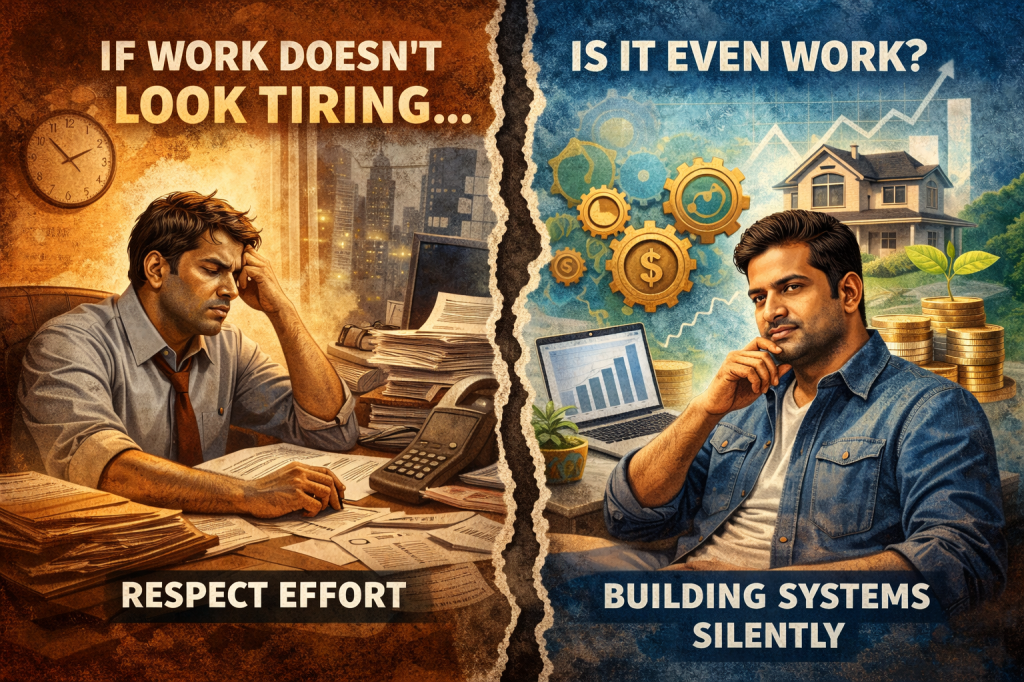
If work looks tiring, people respect it.
If work looks calm, people doubt it.
This is what I call the Effort Bias.
Older generations grew up in a world where hard work was always visible. A man would leave home early, go to office, sit at a desk all day, return tired in the evening and collect a salary at the end of the month.
That routine itself became proof of effort.
Government jobs, office work, shopkeeping, running a small business — all of these had one thing in common. They looked busy. They looked exhausting.
And because they looked exhausting, people respected them.
But the world of work has quietly changed.
Today a lot of wealth is created through thinking, planning and building systems.
Some people spend their time:
planning investments
structuring finances
negotiating deals
building rental assets
managing long-term investments
None of this looks dramatic from the outside.
There are no uniforms.
No punching attendance.
No visible rush every morning.
Sometimes it simply looks like someone is sitting quietly and thinking.
To someone who believes effort must look physically tiring, this can feel very confusing.
The conclusion they quickly jump to is simple:
“He is just sitting and doing nothing.”
But the irony is that some of the most powerful work happens exactly like this — quietly.
Instead of working every day for money, some people spend years building systems that make money work every day for them.
Assets are created.
Investments grow.
Income streams multiply.
And once those systems are built, they keep generating income even when the person is not physically working every day.
It may not look impressive to someone watching from the outside.
But sometimes the calmest looking work is the one doing the heaviest lifting behind the scenes.
The problem is not that the work is small.
The problem is that the effort is invisible.
The System Trap: Why Some Hardworking People Stay Poor
One common sentence we hear everywhere is this:
“If people work hard, they can become successful.”
It sounds good. It motivates people. But the reality is not always that simple.
I have seen many people in my life who work incredibly hard. Street vendors waking up at 4 AM. Small shop owners sitting in their stores for 14 hours a day. Daily wage workers sweating under the sun.
Yet many of them remain poor for decades.
So the question is — if effort alone creates wealth, why are these people still struggling?
Slowly I started realizing something uncomfortable.
Sometimes poverty is not created by people. It is created by systems.
Look at how many hurdles a small person faces.
A tiny shop owner has to deal with taxes, licenses, inspections, compliance, and endless paperwork. Rules change, interpretations change, and sometimes even officials interpret the same rule differently on different days.
If the rule book is confusing, power shifts to the person interpreting it.
And that is where harassment, delays and corruption quietly enter the system.
Large companies can hire lawyers, accountants and consultants. A small entrepreneur cannot.
Another interesting thing is how systems sometimes reward those who know how to manipulate them. Some people learn the shortcuts, exploit loopholes, or use connections.
Meanwhile, the honest person trying to follow every rule gets stuck in the slowest lane.
Even access to money is unequal. A rich person can get loans at lower interest rates, while the poor often borrow at much higher rates.
Education, legal systems, property rights, infrastructure — everything slowly stacks up either as a ladder or a barrier.
At some point I realized a powerful truth:
“People are poor not because they lack effort, but because systems limit opportunity.”
Hard work matters. But the environment around that hard work matters even more.
A good system can turn ordinary people into successful entrepreneurs.
A bad system can trap hardworking people in poverty for generations.
Sometimes the difference between prosperity and poverty is not talent, intelligence or effort.
It is simply the design of the system.
Salary Pride vs Asset Reality: When Old Mindsets Meet New Money
In every family there is one invisible scoreboard.

It is rarely spoken about, but everyone knows it exists.
For many in the older generation, success is measured by one simple formula:
Salary = Respect.
If a man wakes up every morning, goes to a job, comes back with a monthly paycheck, he is considered responsible, hardworking, and respectable.
Anything outside that formula confuses them.
Business cycles?
Investments?
Rental income?
Asset creation?
Those things simply don’t exist in their mental framework.
Recently I had one such moment in my own life.
Out of the blue, my father-in-law exploded in anger and declared that I was “sitting and eating from my wife’s income.”
The irony is almost poetic.
My brother-in-law earns around ₹70,000 a month. His wife doesn’t work, and the family runs on that income.
Meanwhile, I earn three to four times more than him, and even more than my wife, but the structure of my income is different.
Instead of chasing salary slips, I focus on building assets.
Rental income.
Investments.
Long-term wealth generation.
My wife’s salary goes into family expenses like children’s education and one house EMI. My rental income goes into building the next asset, the next EMI, the next investment.
It is a cycle of wealth creation.
But to someone who believes the only respectable money is a monthly salary, anything else looks suspicious.
This is where psychology becomes interesting.
The older generation grew up in a world where:
A job meant stability.
A pension meant dignity.
Business meant risk.
So when they see a different financial model, they don’t analyze it — they attack it.
And sometimes there is another layer beneath it: comparison.
If their own son earns a salary, they must defend that model at all costs. The easiest way to do that is by questioning the son-in-law who operates differently.
It is not logic.
It is ego protection.
But the world has changed.
Today wealth is not just built by salaries. It is built by assets, systems, and patience.
Some people understand this shift.
Some people don’t.
And some people grow old before their thinking does.
So when someone tries to lecture me about manhood, income, and responsibility while ignoring reality, I simply remind myself of one thing:
Age may add years to a person, but it does not automatically upgrade their thinking.
Can Vijay Become the MGR of the 21st Century? A Political Thought
In Tamil Nadu politics, comparisons are inevitable. Every new entrant is measured against someone from the past. For actor Vijay, the most common comparison is with the legendary MGR.
But when we look closely, the journeys are quite different.
MGR entered politics very early in his life. By his 30s he was already deeply involved in political movements. He first contested elections through an established party, the DMK founded by Annadurai. By the time he launched his own party in 1972, he had already served as an MLA and even as an MLC. Politics was not a sudden move for him; it was a long preparation.
Vijay’s political journey begins much later. He formally launched his party in 2024, around the age of fifty, and his first electoral test will likely be the 2026 Assembly election. Unlike MGR, he has not contested elections earlier through another party or through by-elections.
But the real difference between the two may not be timing. It may be political clarity.
MGR had a very clear political structure.
He had one ideological mentor — Annadurai.
And he projected one clear political rival — Karunanidhi.
This clarity helped his followers. They knew whom to follow and whom to oppose. In politics, clarity often creates strong movements.
Vijay’s political messaging appears broader. He draws inspiration from multiple leaders — Kamarajar, Ambedkar, Periyar, and others. While this reflects inclusiveness, it may also make the ideological identity less defined.
Similarly, his political opposition is spread across several fronts — the ruling party, national parties, and other regional forces. When too many opponents are named, supporters sometimes struggle to identify a single central political narrative.
MGR’s rise also came with a powerful electoral moment. In a tough four-cornered contest, his party secured about 30% vote share and translated that into around 120 seats. That result cemented his position in Tamil Nadu politics.
For Vijay, the real test will be the 2026 election.
If his party manages to capture even half of that historic momentum — say a significant vote share or a few dozen seats — it would mark the arrival of a serious new political force.
Until then, comparisons with MGR remain interesting political discussions.
Dubai or Singapore? A Simple Thought Every Entrepreneur Should Have
Sometimes when we talk about global business hubs, two names keep appearing again and again — Dubai and Singapore.
Both are small countries.
Both have no natural advantage like huge population or massive natural resources.
Yet both became global business magnets.
I often wonder why.
After observing entrepreneurs, investors and companies over the years, I realized something very simple.
Dubai and Singapore represent two different philosophies of business.
Dubai is built for making money efficiently.
Singapore is built for building companies that scale globally.
Dubai created an ecosystem where business can move fast.
Taxes are low, company setup is quick, and the city sits right in the middle of Europe, Asia and Africa.
If someone wants to trade goods, run consulting, manage wealth, or operate international commerce, Dubai becomes a very natural base.
Singapore, on the other hand, built a different reputation.
It became a global trust machine.
Investors trust the legal system.
Venture capital funds operate comfortably.
Technology startups find funding, mentorship and access to Southeast Asian markets.
If someone wants to build a technology company, raise venture capital or create a global startup, Singapore becomes the natural choice.
A simple way I see it is:
> Dubai helps you make money faster. Singapore helps you build companies stronger.
Many smart entrepreneurs actually use both.
For example, a SaaS founder might keep their startup headquarters in Singapore to attract investors, while using Dubai for tax-efficient global operations.
Similarly, an international trader may base operations in Dubai, but create a Singapore entity for global credibility with banks and partners.
In the end, it is not about which city is better.
It is about which ecosystem fits your business model.
Because in business, location is not just geography — it is strategy.
The Grand Chessboard: How the U.S. Played Multiple Moves in One Global Game
If we observe global politics like a chessboard rather than isolated events, the last four years begin to look very different.
Wars, regime shifts, proxy battles, sanctions, and economic pressure often appear chaotic. But sometimes, when you zoom out, the pattern starts to look like a carefully played long game.
This is my geopolitical observation.
The war between Russia and Ukraine initially looked like a regional conflict. But strategically, it forced Russia into a prolonged war of attrition. Even if Russia manages territorial gains, the real cost is economic isolation, military exhaustion, and long-term sanctions that weaken its global influence.
At the same time, another quiet shift happened in the Middle East.
For decades, Syria had been a critical geopolitical anchor backed by Russia and Iran. When the regional balance shifted and the regime weakened, it disrupted an entire network of alliances across the region.
That shift had ripple effects.
Groups aligned with Iran such as Hezbollah, Hamas, and Houthis began facing intensified pressure.
At the center of this regional realignment stands Israel, which suddenly found itself with greater operational freedom against hostile forces around its borders.
Meanwhile, another interesting development occurred thousands of miles away.
China had invested heavily in Venezuela, viewing it as a strategic foothold in the Western Hemisphere. But instability in Venezuela, combined with geopolitical pressure, has complicated those ambitions.
When you connect these dots, the broader picture becomes clearer.
One prolonged war weakens Russia.
Middle Eastern shifts isolate Iran.
Regional militant networks shrink.
China faces pressure in strategic investments.
And Israel emerges in a more secure position.
In one sequence of global events, multiple strategic rivals are forced onto the defensive.
This is why geopolitics often resembles chess more than warfare.
Sometimes winning the war is not about conquering territory.
It is about exhausting your rivals, reshaping alliances, and controlling the economic systems that power the world.
If energy markets remain aligned with the petrodollar system, global financial dominance stays where it has been for decades — with the United States.
In that sense, even if Russia wins battles on the ground in Ukraine, the larger geopolitical game may already be moving in a different direction.
And on the global chessboard, the most powerful move is often the one played several years before anyone notices.
The Invisible Tug of War: Why Some Mothers Can’t Let Their Daughters Go
Over the years, while talking to friends and colleagues about their family lives, I started noticing an interesting pattern in some marriages.
At first glance, the conflicts looked ordinary. It would start with small things — a mixie purchase, a fridge decision, a comment about finances, or a casual remark about respect.
But when these stories were compared across different families, a deeper pattern slowly emerged.
In some households, the mother struggles to accept that her daughter has moved into a new life after marriage. Marriage naturally shifts priorities. The daughter now builds a new household, makes decisions with her husband, and slowly forms an independent family unit.
For most parents, this transition is normal and even joyful.
But in a few cases, the mother experiences it as a loss of control.
That is when strange narratives start appearing.
A financial setback becomes “because you argued with your mother.”
A health issue becomes “because you hurt her feelings.”
A disagreement becomes “the reason your life is not going well.”
Slowly, guilt and fear start entering the daughter’s mind.
The conflict then stops being about the actual issue. It becomes an invisible tug of war between independence and emotional control.
What makes this dynamic powerful is not anger, but emotional conditioning. When children grow up hearing that hurting a parent brings bad karma or misfortune, even educated adults can feel uneasy when life problems appear.
But real life does not work like that.
Every family experiences ups and downs — money issues, health scares, misunderstandings. These are part of the normal rhythm of life, not the result of someone’s curse or anger.
The healthier families seem to understand one simple truth:
Marriage creates a new center of gravity.
Parents remain important, but they are no longer the command center of their children’s lives.
When this transition is accepted with grace, families grow stronger.
When it is resisted, invisible tug-of-wars begin.
And sometimes, the real victory in a family is not winning an argument, but quietly learning to let go.
The Invisible Good We Do
People rarely remember what you did for them.
But they clearly remember what you did not do.
You may help someone ten times.
But if you fail the eleventh time, suddenly the story becomes:
“You never help.”
It sounds unfair, but this happens everywhere — in families, friendships, workplaces, and even business.
Let’s understand why.
1. Human Memory Notices Absence More Than Presence
When something good happens repeatedly, the brain slowly treats it as normal.
For example:
A father drops his child at school every day for years.
One day he cannot go.
That one day becomes the memory.
Not the 1000 days he did it.
Because the brain records change, not routine.
2. Good Things Become “Expected”
When you consistently help someone, your help slowly moves from appreciation to expectation.
Example:
You lend money three times → appreciated.
Fourth time you refuse → suddenly you are “selfish”.
The earlier help disappears from the narrative.
It becomes baseline.
3. Negativity Has More Emotional Weight
Psychologists call this negativity bias.
One negative experience can emotionally outweigh many positive ones.
Think about restaurants:
10 good visits → normal.
1 bad experience → we remember it for years.
Human relationships behave the same way.
4. People Judge the Moment, Not the History
Most people evaluate based on the current moment, not the full history of actions.
So the thinking becomes:
“You didn’t help me when I needed you.”
Instead of:
“This person has helped me many times.”
The timeline shrinks to the latest event.
The Practical Lesson
The moment you stop expecting recognition, something interesting happens.
Your actions become free from emotional burden.
You help when you want.
You refuse when you must.
And you stop carrying the invisible disappointment of unnoticed goodness.
Because the truth is simple:
Goodness is often invisible.
But it still shapes who you are.
 AnandNataraj