21 Attempts Later: How ChatGPT and I Found the Answer Together


We talk about AI as if it’s magic.
Ask a question. Get an answer. Move on.

What we don’t talk about enough is what really happens when the answer doesn’t come easily.

This week, I learned that the hard way.

What looked simple on paper turned into 21 failed attempts, each one slightly different, each one confidently wrong. ChatGPT responded every time — clearly, logically, persuasively. And every time, something didn’t work.

That’s when I realised the first uncomfortable truth:

AI can sound right long before it is right.


The early illusion

The first few attempts were deceptive.

The responses were structured.
The explanations were neat.
Some even ended with words like “success”.

And yet… nothing actually happened.

Acknowledgement masqueraded as execution.
That illusion alone can waste hours if you’re not careful.


When confidence became the problem

By attempt seven or eight, both of us — ChatGPT and I — were confident.

The logic seemed airtight.
The fixes were small.
We were “almost there.”

That phrase — almost there — is dangerous.

Because it convinces you not to question your assumptions deeply enough.

The conversation changed

Somewhere around attempt eleven, I stopped asking ChatGPT what to do.

Instead, I started telling it what was wrong.

“This assumption doesn’t hold.”
“This part works; this doesn’t.”
“Let’s isolate just this behaviour.”

ChatGPT changed with me.

The answers slowed down.
The certainty softened.
The reasoning became cautious — collaborative.

That’s when it stopped feeling like a tool and started behaving like a thinking partner.


The humility phase

There was a stretch where neither of us rushed.

No clever shortcuts.
No sweeping rewrites.
Just deliberate, line-by-line progress.

I stopped expecting brilliance.
ChatGPT stopped pretending certainty.

Ironically, that’s when progress accelerated.


Attempt twenty-one

The final attempt didn’t announce itself.

No drama.
No celebration.

It simply worked.

And in that quiet moment, something became clear:

Success is often silent.
Failure is loud.

What this taught me about AI

ChatGPT didn’t replace thinking.
It demanded better thinking.

Weak prompts produced confident mistakes.
Better prompts invited reasoning.
Persistent correction reshaped responses in real time.

The miracle wasn’t AI.

The miracle was staying in the conversation.


The real takeaway

This wasn’t man versus machine.
And it wasn’t man commanding machine.

It was a convergence — through frustration, feedback, and patience.

Human intuition corrected AI assumptions.
AI pattern recognition sharpened human thinking.

Twenty-one failures later, the result wasn’t just success.

It was earned clarity.

Final thought:
The future won’t belong to people who use AI.
It will belong to those who can persist with it, long enough for understanding to emerge.

Because intelligence — human or artificial — means nothing without perseverance.

Yesterday in Tirunelveli: Courtesy, Care, and Too Much Good Food


Yesterday was one of those days that quietly reminds you why real-life experiences beat all stereotypes.

I travelled to Tirunelveli to meet the Mayor, to personally invite him for an event we are organising. The meeting itself was smooth, respectful, and reassuring. He was warm, courteous, and graciously accepted the invitation to honour the occasion.

But what followed after the meeting stayed with me far more deeply.

The Mayor asked one of his friends to accompany us — not just to guide us around Tirunelveli, but also to Ambasamudram, where we were to meet another friend. What I assumed would be a simple courtesy turned into an unexpected lesson in hospitality.

From the moment we stepped out, we were no longer “guests” — we were looked after.

Lunch was arranged without fuss. Evening snacks appeared almost magically. Conversations flowed easily, without agendas or urgency. At some point, I realised something important had happened.

I had to break my diet — not out of temptation, but out of respect.

And strangely, I felt no guilt.

There is something about the southern districts of Tamil Nadu — a quiet, unspoken culture of care. No loud displays. No forced politeness. Just a natural instinct to ensure that the person with you is comfortable, fed, and at ease.

What struck me most was that no one made a big deal of what they were doing. There were no announcements, no expectations of return favours. Hospitality wasn’t a performance — it was a reflex.

In a world where meetings are rushed, calories are counted, and kindness is often transactional, this felt refreshing. Almost old-fashioned. Almost sacred.

Some places don’t just welcome you.
They take responsibility for you, even if only for a day.

And Tirunelveli, yesterday, did exactly that.

In Business Breakups, the Winner Writes the Story


There is a kind of loss no one prepares you for.

Not failure.
Not bankruptcy.
Not even a breakup.

This is when a business partnership breaks, the other person walks away with the company, and you walk away with silence, blame, and a long legal shadow.

What makes it brutal is not just losing money or position.
It is losing identity, narrative, and fairness—all at once.

And watching the world applaud the aggressor.


1. Corporate Betrayal Trauma

This is not “a partnership issue.”

This is when:

  • Your life is deeply tied to the company
  • Your work continues—without your name
  • Your seat is occupied by the very person who pushed you out

It feels like divorce + job loss + public humiliation, rolled into one.

The worst part?
People expect you to “move on” while the wound is still open.


2. Asymmetric Power War

This is never a fair fight.

The aggressor has:

  • Company money
  • Legal teams on payroll
  • Employees, agencies, and advisors
  • Time and continuity

The victim has:

  • Personal savings
  • Family pressure
  • Emotional fatigue
  • And a ticking clock

Yet society judges both sides as equals.

They are not.


3. Narrative Hijack (Corrected Reality)

This is the most dangerous phase and the least understood.

The aggressor never speaks alone.

They have:

  • Employees
  • Friends
  • Consultants
  • PR agencies

All speaking on their behalf.

It looks like third-party endorsement, so people believe it.

But when the victim speaks:

  • It looks like self-defense
  • It looks like self-interest
  • It looks like weakness

Silence hurts you.
Speaking hurts you.

This is a communication trap with no clean exit.


4. Success Mask Injustice

Here is the cruel illusion:

The aggressor looks successful:

  • Company runs
  • Team stays
  • Money flows

The victim looks stuck:

  • Legal cases
  • Restarts
  • Explaining life to others

Society quietly assumes:

If he’s successful, he must be right.”

This is how appearance replaces truth.


5. Stakeholder Cross-Examination

You are forced to answer questions you never caused:

  • “Why did this happen to you?”
  • “Couldn’t you have avoided it?”
  • “What did you do wrong?”

Each question chips away at self-worth.

Not because you failed, but because you are the only one explaining.


6. Legal Time Distortion

Legal battles don’t just drain money.

They:

  • Freeze emotional closure
  • Reopen wounds every hearing
  • Delay life itself

Years pass.
Energy leaks.
Life waits unfairly.


7. Moral Injury

This is deeper than stress.

This is when:

  • You played fair
  • Trusted deeply
  • Followed ethics
  • And still lost publicly

It shakes your belief in:
Justice. Karma. Systems. Even faith.


How Do People Actually Survive This?

Not with motivation quotes.
Not with loud comebacks.

1. Stop Fighting on the Old Battlefield

You cannot:

  • Out-spend a company
  • Out-narrate a system
  • Out-perform a machine as an individual

Survival begins when you stop trying to win there.

This is not surrender.
This is strategy.


2. Replace the Narrative, Don’t Defend It

Don’t explain your past.

Build a present so strong that explanations become unnecessary.

People don’t revise beliefs.
They shift attention.


3. Re-Anchor Identity

Betrayal collapses identity.

Survivors consciously anchor themselves to:

  • A new domain
  • A new mission
  • A new value system

Not for money first.
For mental stability.


4. Shrink Your Circles

Keep only:

  • One truth circle
  • One energy-safe circle
  • One work circle

Everyone else gets distance.

Over-exposure is self-harm.


5. Accept Delayed Justice Without Losing Self-Respect

Acceptance is not saying:
They were right.”

Acceptance is saying:
My life will not wait for justice to arrive.

Justice may come or not.

Self-respect cannot wait.


The Quiet Truth

Many successful people carry one silent ruin in their past.
One betrayal they never speak about.
One phase that reshaped them completely.

Some battles are not meant to be won.

They are meant to change the person who survives them.

Islam, Power and Change: My Reading of a Pattern History Repeats


Over the last few years, I have been noticing a pattern that feels bigger than daily news headlines. It is not just about Saudi Arabia allowing concerts, or the UAE opening casinos, or Europe suddenly becoming more vocal against Islam. When I step back and look at history, it feels like something deeper is happening.

This is not about Islam collapsing.
It looks more like Islam is changing its role in society, the way other major religions have done before.


A pattern I see repeating in history

Whenever a religion becomes dominant for a long time, history shows a clear pattern.

First, the religion grows with confidence. It gives people law, identity, morality and order. Early Islam did this extremely well, just like early Christianity.

Then the religion merges with power. It becomes part of the state, law, education and daily life. Clerics gain authority, rules become strict, and belief is no longer only personal.

After that comes overreach. Religion starts controlling too much — what people wear, how they live, how the economy works, what pleasures are allowed. At this stage, religion slowly shifts from being a strength to being a limitation, especially for rulers and elites.

Finally comes the most important moment: the elites start stepping away from religious control.

This is the stage I believe Islam has entered now.


Why Saudi Arabia matters the most

Saudi Arabia is not just another Muslim country. It controls Mecca and Medina, which gives it symbolic authority over the entire Muslim world.

When Saudi Arabia weakens religious police, reduces clerical power, and focuses on tourism, entertainment and investment, it sends a very clear message:

Islam will no longer run the state directly.

This reminds me strongly of what happened in Europe when kings reduced the political power of the Church. Christianity did not disappear after that, but it stopped controlling public life.

That shift changed Christianity forever.


The UAE shows the future direction

The UAE is showing an even clearer model.

Islam exists there, but mostly as:

  • personal belief
  • culture
  • identity

The state itself is focused on business, money, global talent and stability. Religion is not enforced, it is managed.

This creates two very different reactions among Muslims:

  • One group quietly adapts and practices religion in private
  • Another group becomes more rigid and aggressive because it feels religion is losing space

History shows this kind of split always happens during transition periods.


About Islamophobia in Europe

I don’t see rising Islamophobia as the main cause of Islam’s problems. I see it as a reaction.

Societies become tolerant when they feel secure, and hostile when they feel insecure. Europe today is facing economic stress, migration pressure and identity confusion. In such times, societies harden.

This has happened many times before:

  • Jews in Christian Europe
  • Catholics in Protestant countries
  • Buddhists during unstable Chinese dynasties

Islamophobia is not shaping Islam’s future. It is responding to a changing balance between religion, identity and power.


What I think will actually change

Religions don’t disappear. They transform.

What I believe Islam is slowly losing:

  • Control over law and state
  • Clerical authority over daily life
  • Moral policing by governments

What I believe will remain strong:

  • Personal faith
  • Rituals and traditions
  • Cultural and ethical identity
  • Family and community practices

Islam will not stay one single shape. Like Christianity, it will fragment into many forms — cultural Muslims, spiritual Muslims, political Islamists, secular Muslims and quiet traditional believers.

This fragmentation feels uncomfortable and even dangerous in the short term. But history suggests it usually leads to long-term balance.


So, is Islam falling?

I don’t think so.

I think Islam is moving out of its imperial phase, where it controlled power and law, and entering a post-hegemonic phase, where belief becomes more personal and less enforced.

Christianity went through this after the Renaissance. It lost power, but it survived.

What Islam may lose is dominance.
What it may gain is sincerity.

History shows that religions survive not by force, but by adapting to a changing world. Islam now seems to be standing at that exact turning point.

And history, as always, has seen this story before.

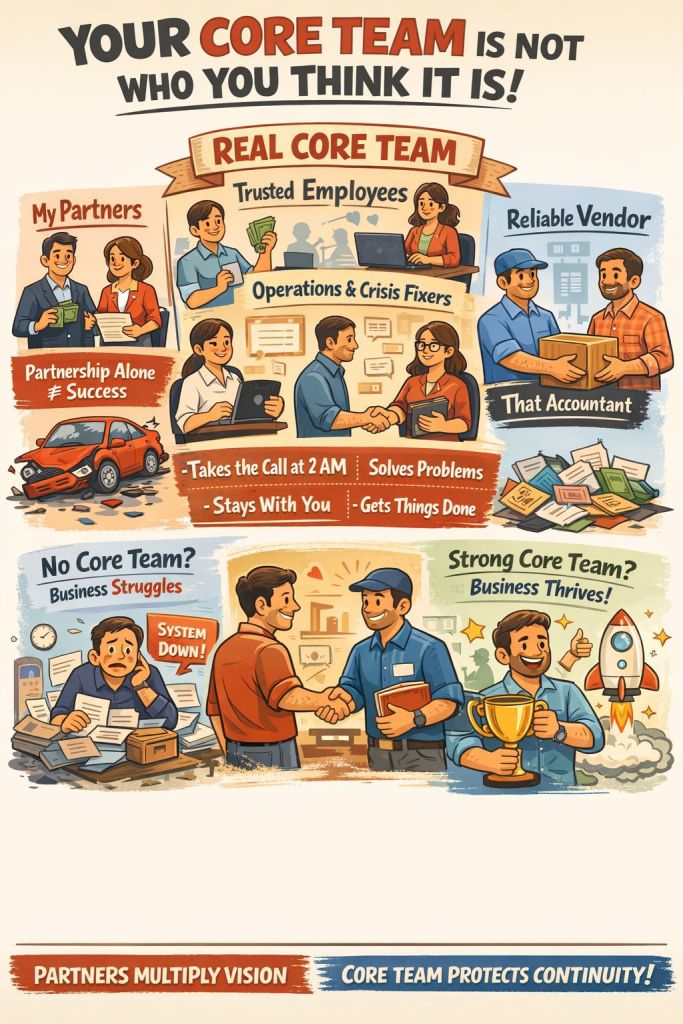
Your Core Team Is Not Who You Think It Is


Most people say this confidently:

My core team is my partners.”

Fair enough.
Good partners are gold.

But here’s the uncomfortable truth I learned the hard way:

👉 Many businesses die even with partners.
👉 Many businesses survive and grow without partners.

The difference is not partnership.
The difference is the core team.


Let me say this plainly

A core team is not about equity.
It is about who shows up when things go wrong.

The people who:

  • Pick up calls when something breaks
  • Know your business better than your SOPs
  • Fix problems without drama
  • Think, “If this fails, I fail too”

They may be employees.
They may be vendors.
They may not have a fancy title.

But without them, the business slows down or collapses.

That’s the real test.


Why founders misunderstand “core team”

Because startup culture romanticised this idea:

“Find a co-founder. Everything will be solved.”

Reality check:

  • Partners give direction
  • Teams give movement

A car with only a steering wheel won’t move.
You need an engine, wheels, fuel, and a driver who knows the road.

That’s your core team.


What a core team actually does (in real life)

Not theory. Real life.

They:

  • Remember why decisions were taken 3 years ago
  • Handle customers when you are sick, stuck, or burnt out
  • Prevent small issues from becoming public disasters
  • Keep the business breathing during bad phases

Most founders don’t fail suddenly.
They bleed slowly due to weak execution.

A strong core team stops that bleeding.


Some uncomfortable examples

Apple didn’t scale because Steve Jobs had partners.
It scaled because people like Tim Cook ran operations like a machine.

D-Mart didn’t grow because of flashy leadership.
It grew because store managers, buyers, and vendors stayed for decades.

Zoho didn’t win because of funding or hype.
It won because employees stayed long enough to care deeply.

Closer home?

Every successful small business has:

  • That one accountant who “knows everything”
  • That one operations person who holds the chaos together
  • That one vendor who never fails you

They don’t own shares.
But they own responsibility.


Vendors: the most ignored core team

Let’s talk about this honestly.

That vendor who:

  • Delivers even during strikes
  • Adjusts credit when cash flow is tight
  • Saves you from embarrassing customer issues

If they walk away, your business feels it immediately.

They are external employees in spirit.

Treat them like price-only suppliers and you lose them.
Treat them with respect and continuity, they become your shield.


Want to know who your real core team is?

Simple test. No theory.

Ask yourself:

  • If this person leaves tomorrow, will my business struggle?
  • Do they know things I never documented?
  • Do I trust them when money, reputation, or deadlines are at risk?

If the answer is yes — congratulations.
That’s your core team.

Whether HR agrees or not.


The hard truth most founders learn late

A business with partners but no core team is fragile.
A business with a strong core team can survive almost anything.

Partners multiply vision.
Core teams protect continuity.

If you’re building a business, don’t chase only co-founders and equity splits.

Build:

  • Trust
  • Respect
  • Long-term relationships

That’s what quietly builds durable businesses.


The Curious Economics of Gratitude


Helpers live strange lives.

They give without being asked loudly.
They help without calculating returns.
And when life turns, they are expected to disappear quietly.

No applause. No credit. No memory.

How Helping Slowly Becomes Invisibility

There is a social rule nobody teaches you:

Help is respected only when the helper stands above you.

When the helper stands beside you or worse, falls below you help stops being generosity and starts feeling like obligation.

At that point, gratitude quietly exits the room.

The Helper’s Trap

Helpers often give from sacrifice, not surplus.

They help when they shouldn’t.
They stretch when they can’t.
They assume goodwill compounds like interest.

It doesn’t.

What compounds is expectation.

Soon, the helper is no longer thanked they are approached.
Not remembered  but accessed.

And when the helper struggles?

Silence.

The Most Insulting Moment

The hardest part isn’t being refused help.
It’s being asked for help again  by the same people who ignored you when you were drowning.

At that moment, the helper realises something painful:

To some people, help is not a bond. It is a habit.

Why Helpers Are Forgotten

A few repeating patterns explain it:

1. Help Without Power Is Uncomfortable

Acknowledging help from a struggling person forces people to confront an unpleasant truth:

I was lifted by someone who is now below me.

So the mind erases the debt.

2. Helpers Disrupt the Success Narrative

People prefer clean stories:

I did it on my own.

Helpers complicate that story.

3. Familiarity Breeds Entitlement

The more quietly you help, the more invisible you become.

Silence is misread as strength.
Kindness is mistaken for availability.

A Darkly Funny Truth

Helpers are remembered in two moments only:

* When they are needed
* When they finally say no

The second moment is when relationships collapse.

Not because you stopped helping
but because you stopped *absorbing disrespect.

What Helpers Must Learn (The Hard Way)

Helping is noble.
But unprotected helping is self-harm.

Boundaries are not cruelty.
Refusal is not betrayal.
Self-respect is not arrogance.

Closing Line

“Helpers don’t regret helping.
They regret forgetting themselves while doing it.”

If you’re a helper, remember this:
Your value is not measured by how much you give but by how well you protect your dignity.

Chasing the Old Me: Why Midlife Dreamers Must Stop Running Backward


When I was young, fresh out of college, I leapt into entrepreneurship with no safety net. No big family backing, no golden spoon—just a mediocre boy’s dream and the stubbornness to break every dogma that came my way. And for a while, it worked. I tasted the thrill of proving people wrong, of showing my circle what dreams can really do when you chase them with 100% fire.

Then life happened.

Marriage, kids, bills, responsibilities. Somewhere in that transition, my dream got diluted. Not because I stopped caring, but because my energy started flowing toward being a husband, a father, a provider. And every time I tried to “chase my old self,” I failed miserably.

At first, I thought I was just rusty. That I only needed to “pick up where I left off.” But the truth hit me harder than failure: time had passed, and I had changed.

We often forget that chasing our old self is like chasing a ghost. The 25-year-old me who could burn 20 hours a day on a single idea doesn’t exist anymore. Today, I’m someone new—wiser, slower maybe, but richer in perspective. And it is unfair to drag myself back into old shoes that don’t fit anymore.

This realization is liberating. It tells us that midlife is not about “continuing an unfinished story,” but about writing a new one. Dreams don’t expire—but the dreamer evolves. If you’re above 40, reading this, and still trying to become the version of you that existed before kids, marriage, or setbacks—stop. That person no longer exists.

Instead, ask: Who am I today? What do I want now?

The truth is, life doesn’t punish us for changing—it punishes us for refusing to.

The Street Dog Dilemma: Between Compassion and Reality


In India, the dog debate is heating up. Activists, pet lovers, and ordinary citizens are clashing over what’s right and what’s humane. The nuisance of street dogs is real — and I’ve personally had multiple encounters since my student days.

Now, let me be clear: I’m a pet lover myself. I had a cute pug named Burger Boy who was with me for 11 years. But here’s the truth — street dogs are not pet dogs. They live a very different life, and my anger is not against dogs, but against how so-called activists romanticize their suffering.

The Harsh Reality of Street Dogs

  • Their condition is miserable — constantly fighting with other dogs for food, territory, or a female.
  • They face the brutality of climate: heat waves, rains, floods — with no shelter.
  • They often die an ugly death — from wounds, infections, starvation, or accidents.

Yet, many “dog lovers” and “activists” don’t talk about these realities. In the guise of compassion, they’re often doing more harm to both dogs and humans by resisting structured solutions.

My Take

Loving pets is wonderful. But equating street dogs with pets is misleading. A homeless, vulnerable, and suffering animal on the road is not the same as a pampered pet at home. Pretending otherwise doesn’t help the dogs — it just prolongs their misery.

If we really care, we should think about long-term solutions: proper shelters, sterilization programs, and responsible adoption — instead of just slogans.

The Curious Case of Credit Card Rolling: A User’s Perspective


Walk down any busy street these days and you’ll spot them — stickers on EB posts, lamp posts, even trees, shouting:

“Swipe Credit Card 2% – Get Immediate Cash!”

At first, I dismissed these as shady schemes. After all, to get a swipe machine you need a merchant code, GST, and settlement into a business account. How were these guys running such a smooth cash-for-swipe business?

But here’s the catch: when you’re cash-stressed and staring at a mountain of credit card bills, these services suddenly look less like an eyesore and more like a lifeline.

How It Works

  • You give your card, they swipe it like a regular merchant.
  • Instead of goods, you get instant cash in hand (minus ~2%).
  • You roll your credit card, push the due date, and breathe easier for the moment.

From the outside, it’s a gray zone. Legal? Maybe. Illegal? Possibly. But one thing’s for sure: these guys are fast, flexible, and discreet.

My Personal Take

I’ve used these services when things got tight. And honestly? Paying 2% on the swipe feels way better than getting hammered by the bank’s 3.5% minimum due interest + GST.

It’s not a long-term solution. It’s not glamorous. But when you’re in that “just need 30 more days” situation, these credit card rollers are the silent shock absorbers of the urban middle class.

And the funniest part? I doubt the regulators even know how deep this runs. Or maybe they do — and are just letting it be, because people like me would be in much worse shape without it.

When “No Kitchen Day” Turned Into a Buffet Disaster


Yesterday, I proudly announced to my wife: “No kitchen today.” I thought I was being the hero — breakfast and dinner taken care of with parcel food, and for lunch, I even took them out to a nice hotel. What could possibly go wrong?

Well, everything.

The plan started fine. My wife ordered a soup. I went with humble sambar rice. My daughter confidently chose mini meals. So far, so good.

Then the plot twisted. My wife ordered a veg biryani. Since the biryani arrived quicker than expected, she passed it to my daughter. Next thing I knew, I was already full but somehow ended up sharing sambar rice, curd rice, coconut rice, and biryani — all mixed on one plate — and handing it back to my wife, who was still sipping her soup.

Her reaction? Pot shots.
Apparently, her carefully planned lunch looked like a crazy cocktail, and I was somehow to blame for it. Never mind that I hadn’t ordered half the food. Never mind that I was the one who actually planned the “no kitchen day.” Never mind that I turned chauffeur and host all in one.

It got me thinking — when will wives ever recognize husbands? And if not recognize, can they at least say nothing?

But then again, maybe this is the hidden rule of marriage: no good deed goes unpunished, especially if it involves food.