
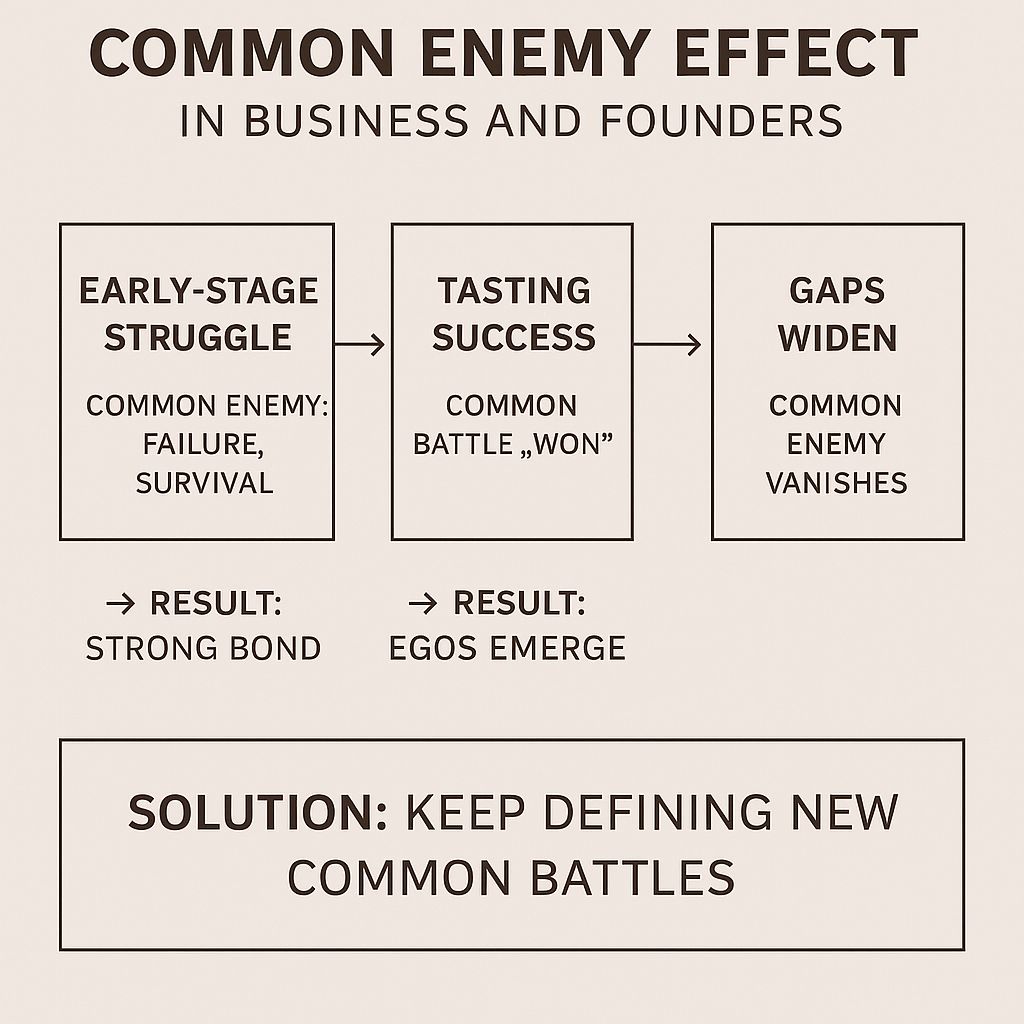
The common enemy effect is a powerful social phenomenon: people unite strongly when they share a common threat. We often see it in military units, sports teams, and political movements — and it’s equally true for founders and startup teams.
Phase 1: The early struggle
When founders start out, they face huge external threats:
- Market rejection
- Cash burn
- Pressure to prove themselves
- Family or societal doubt
Their common enemy is failure itself. This shared threat aligns them deeply. There’s no time for ego; decisions are fast and collective. Emotional support is strong. They feel like warriors in the same trench.
Phase 2: Early wins and success
Then comes funding, product traction, revenue, or media buzz. Suddenly, the “enemy” that held them together begins to fade.
Without that shared fight, founders start:
- Claiming credit individually
- Listening to “proxy teams” or external voices that inflate egos
- Pushing personal agendas
The urgent need to survive is gone, so the cracks appear.
Phase 3: Gaps widen
When the common threat disappears:
- Misaligned visions surface
- Egos grow
- Trust erodes
- Silent power struggles begin
The same founders who once pulled all-nighters together may now fight over direction, credit, or influence.
Lessons from research
✅ Ben Horowitz (The Hard Thing About Hard Things): In crises, teams unite; in safety, they splinter.
✅ Patrick Lencioni (The Five Dysfunctions of a Team): Without a shared mission, conflict thrives.
✅ Harvard Business Review: “Shared existential threats unify.” New shared missions are critical as you grow.
✅ Social Identity Theory (Tajfel & Turner): Strong group identity often needs an external “enemy” to stay focused.
What can founders do?
- Constantly define new “enemies” or big missions (new markets, innovations, tougher impact goals).
- Regularly revisit and realign personal and collective visions.
- Watch out for external influences that inflate individual egos.
- Build a culture where mission > individuals, always.
In short
What unites founders at first? A common enemy (failure, survival).
What causes splits later? The enemy fades, egos rise.
What’s the fix? Keep creating new shared battles to stay united.
 AnandNataraj