The Forest Theory of People: Why Different Personalities Keep the World Running


When we look at people, we often try to label them.

Good.
Bad.
Cunning.
Smart.
Spiritual.
Selfish.

But what if we are looking at it the wrong way?

What if people are not “good or bad”…
but part of a living ecosystem, just like a forest?


Think of Society Like a Forest

In a forest, you will find:

  • A deer that peacefully eats plants
  • A fox that survives with cleverness
  • A lion or tiger that hunts
  • An elephant that carries strength and stability

No one questions them.

No one says:

  • “Why is the tiger killing?”
  • “Why is the fox so cunning?”

Because every one of them has a role.


Now Look at People the Same Way

In our world:

  • Some people are like deer → calm, simple, and peaceful
  • Some are like foxes → smart, strategic, and opportunistic
  • Some are like elephants → responsible, stable, system builders
  • Some are like lions → powerful and authoritative
  • Some are like tigers → independent and bold
  • Some are like owls → wise and spiritual
  • Some are like monkeys → expressive and communicative

And yes…
Some are like snakes → silent, unpredictable, and sometimes dangerous


The Truth We Often Miss

We try to build a world where everyone is “good.”

But imagine this:

  • If everyone is soft → nothing moves
  • If everyone is aggressive → everything breaks
  • If everyone is spiritual → nothing gets built
  • If everyone is practical → no compassion exists

👉 Balance comes from difference, not sameness.


Conflict is Not Always Wrong

In a forest:

  • The deer fears the tiger
  • The fox tricks others
  • The lion dominates

Yet the forest survives.

Why?

Because each one creates movement, pressure, and balance

The same applies to people.

The people who challenge you, irritate you, or even hurt you…
are also part of the system that shapes growth.


A Personal Realization

At different stages of life, we become different animals:

  • When young → bold like a tiger
  • When building → strong like an elephant
  • When reflecting → wise like an owl

Life is not about being one thing.
It is about adapting within the ecosystem.


Last But Not The Least

The world doesn’t run because people are good.
It runs because people are different.

The real wisdom is not judging people…
but understanding:

  • Who they are
  • What role they play
  • How to deal with them

Because once you see life as a forest,
you stop expecting deer from a tiger…
and you start navigating the world better.

When Control Slips Away, Fear Steps In


I’ve always believed fear doesn’t come from ghosts in the dark or thunder in the skies. Fear creeps in when you realize life is no longer in your hands — when control quietly slips away.

I felt it most sharply during the two years my dad was hospitalized. Suddenly, the reins of my father’s life weren’t in my grip — they were in the hands of doctors and fate. Every beeping machine, every delayed report, every late-night call felt like a reminder that I had no say in what would happen next. That helplessness was fear in its purest form.

I felt it again during the late evenings when most of my friends were getting married. I feared loneliness — not because I didn’t want marriage, but because it was not in my control. No matter how much I tried, the timelines didn’t align with my wishes. The steering wheel of my life seemed hijacked by something larger.

Legal battles brought their own flavor of fear. I might have been the one fighting, but the reality was — attorneys, judges, and systems controlled the pace and outcome. I was just a passenger waiting at every bend.

And that’s the cruel trick of fear — it feeds on our urge to control. The more we cling to it, the tighter fear grips us.

What I’ve Learned

You can’t control everything. What you can do is:

  • Prepare yourself mentally to accept uncertainty instead of resisting it.
  • Focus on your response, not the situation — resilience is the only lever you always own.

Because at the end of the day, fortune favours the bold.

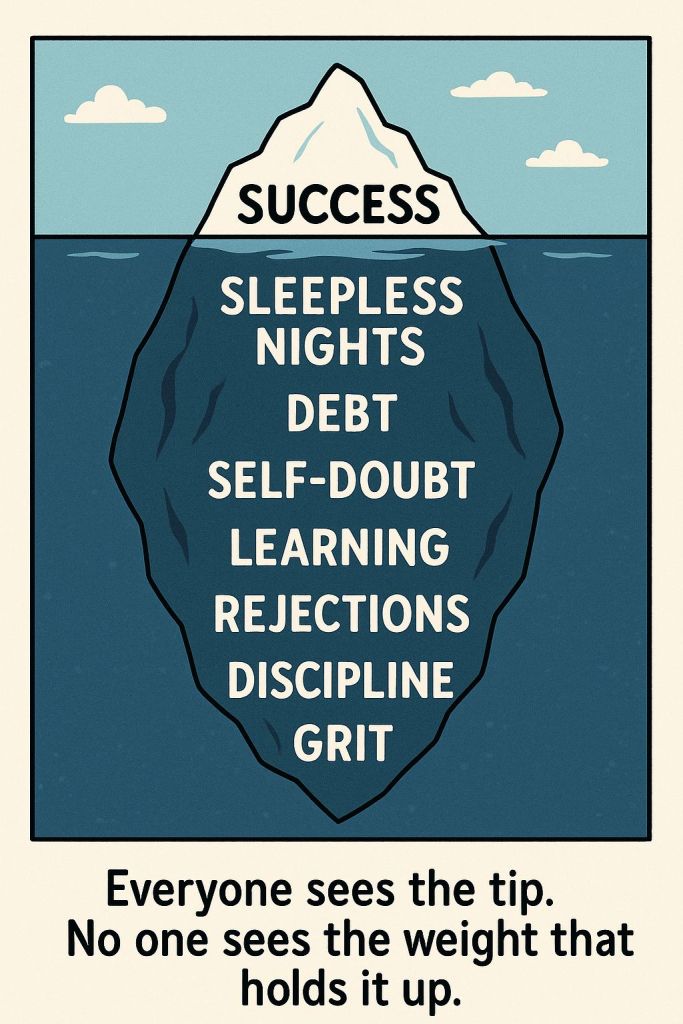
People Often Judge Outcomes, Not Journeys


Judged by outcomes. Built by journey.

I’ve seen this time and again — in business, in relationships, and especially in entrepreneurship:

People judge outcomes. Not journeys.

Success? You’re celebrated.
Failure? You’re forgotten.
Still trying? You’re questioned.

Why is it this way?

Because outcomes are visible, journeys are not.

Nobody sees the 3 a.m. self-doubt. The loan EMIs. The silent sacrifices.
They only see whether you “made it” — or didn’t.

Society has become obsessed with results.
We’ve built a culture where IPOs trend, but unpaid dues don’t.
Where LinkedIn posts shine, but emotional breakdowns stay hidden.

The cost of this mindset for entrepreneurs?

1.) Emotional burnout

You start believing you’re only as good as your last “win.”
The effort, grit, and growth mean nothing if the scoreboard shows zero.

2.) Judgment from close ones

The toughest hits often come not from strangers, but from family and friends:

“Still chasing your dream?”
“When will you settle down?”
“Why not take up something stable?”

Their concern is real, but their understanding is rare.

3.) Fear of failure

You start making safe bets. You drop ideas too soon.
You avoid risks just to avoid ridicule.

4.) Validation over vision

You chase vanity metrics. You post curated wins.
You start performing entrepreneurship instead of living it.

But here’s the truth no one talks about:

  • The journey builds you, whether or not the startup succeeds.
  • Failure isn’t the opposite of success — it’s a phase of it.
  • Your worth isn’t tied to revenue charts. It’s tied to resilience.

Let’s change the narrative:

Instead of asking:

“What’s your valuation?”
Let’s ask:
“What have you learned?”
“What’s keeping you going?”
“How can I help?”

Because some journeys deserve standing ovations — even without a trophy.