They Told Stories About Me. Here’s My Answer


Last weekend, I heard something interesting.

Not directly.
Not to my face.
But through the usual route—conversations, assumptions, and confidence built on half-truths.

Apparently, I have a story now.

A story where:

  • I built something and walked away with money
  • Someone from my past—let’s call her Æ—was the real force behind everything
  • My personal life is up for discussion
  • My family is a topic of curiosity
  • And my choices are signs of weakness

It’s fascinating how people who were not in the room
speak like they wrote the script.


Let me respond. Not to defend. But to define.

Yes, I built a company.
Yes, people came and went.
Yes, things didn’t end like a fairy tale.

That’s called entrepreneurship. Not storytelling.

Anyone who has built something from zero knows: There is no clean version of the journey.
There are struggles, decisions, exits, and consequences.

Some win quietly.
Some profit loudly.
Some move on.

I chose to move on.


About Æ and “growth stories”

Every story needs a hero.
Sometimes, people create one.

But growth is never a single person’s effort.
And neither is downfall.

If someone believes success came from “methods” instead of “work,”
that tells more about their thinking than my journey.


About my personal life

When conversations reach a point where:

  • Children are discussed
  • Marriage is judged
  • Respect is replaced with mockery

It stops being curiosity.
It becomes character exposure—not mine, but theirs.

A man who stands by his family is not weak.
A man who chooses peace over chaos is not controlled.

He is clear.


About fear and silence

Some think silence is fear.

Let me clarify:

Silence is not fear.
Silence is selection.

Not every noise deserves a response.
Not every narrative deserves energy.

But sometimes, silence must speak.


So here is my position

If you have a question—ask me.
If you have a doubt—clarify with me.
If you have a story—keep it with you.

Because I don’t live in narratives.
I live in reality.


What I’m focused on now

While stories are being discussed,
I’m doing something simpler:

  • Taking care of my family
  • Building again, step by step
  • Learning from every fall
  • Moving forward without noise

Because real life doesn’t need an audience.

When Even ChatGPT Said “No”


Last weekend, I opened ChatGPT with a very specific goal.

Not for tech.
Not for business.

I wanted help drafting a message for my school WhatsApp group—
something sharp enough to correct a narrative,
subtle enough to avoid drama,
and smart enough that only the right people would understand.

Simple brief.

Or so I thought.

What I Wanted

In my head, it was clear:

“Say enough so insiders connect.
Push back without sounding defensive.
Create doubt where needed.
And close the topic.”

Basically…
a clean, well-worded counter.

What I Got

ChatGPT replied like a well-trained diplomat.

“Stay neutral”

“Avoid targeting individuals”

“Focus on general principles”


It gave me messages that sounded like: 👉 I had just returned from a leadership workshop

Balanced. Calm. Responsible.

Also… completely missing my mood.

Round After Round

So I pushed.

“Make it more direct.”
“Add clarity.”
“Give context.”
“Make people understand what actually happened.”

Each time, it improved structure…
but refused to cross a certain line.

It kept things:

measured

indirect

and annoyingly composed


Like someone who knows exactly where the boundary is—and refuses to step over it.

My Inner Commentary

At one point, I caught myself thinking:

“If this was a person, I would have handled it differently.”

With a human, you can:

push

persuade

emotionally influence

or at least make them bend a little


But here?

No ego.
No irritation.
No slipping.

Just the same calm pushback: 👉 “This is as far as I’ll go.”

The Turning Point

That’s when it got interesting.

I wasn’t just trying to draft a message anymore.

I was trying to make ChatGPT say what I felt.

And it simply wouldn’t.

Not because it didn’t understand…
but because it chose not to mirror my frustration

The Mirror I Didn’t Expect

Slowly, the focus shifted.

From: 👉 “Why isn’t this giving me what I want?”

To: 👉 “Why do I want it said this way so badly?”

Was I trying to:

clarify truth?

or control perception?


Was it about:

closure?

or impact?


Not very comfortable questions.

The Funny Realization

I even laughed at one point.

If this were a human:

I could argue

escalate

or just out-talk them

But ChatGPT?

You can’t “win” against it.

It doesn’t get tired.
It doesn’t get emotional.
It doesn’t try to win.

It just stays… steady.

When You Meet the People Who Broke You


There are moments in life you don’t plan for.

You may walk into a room, a function, a meeting… and suddenly see someone who once meant everything to you. A partner who betrayed you. A girlfriend who walked away. People who took advantage when you were vulnerable.

In that moment, it’s not just a meeting.
It’s a collision between your past and your present.

Your mind will react first. Old memories, unanswered questions, and a quiet voice inside asking, “Why?”
But the truth is, that moment is not about them anymore. It is about you.

Not the version of you who was hurt.
The version of you who survived it.

Before thinking about what to say, it helps to be clear about one thing. What do you really want from that moment? Is it closure, validation, or just peace?

Most of us think we want closure. But over time, you realise something deeper. Peace matters more than closure. Because closure depends on them. Peace depends on you.

When you finally face them, there are only a few ways to respond, and each one says something about your growth.

If you have to interact, keep it simple. A calm acknowledgement like “Hope you’re doing well” is enough. No reopening old wounds, no revisiting the past. Just a quiet signal that you have moved forward.

If there is no need to engage, walking past without a conversation is not avoidance. It is clarity. You are choosing not to invest even a second of emotional energy where it is no longer deserved.

And if they try to start a conversation, explain themselves, or bring back the past, a simple boundary works best. “I’ve moved on. I wish you well, but I’d like to keep distance.” No anger. No drama. Just a line drawn with dignity.

What you must avoid is just as important.
Don’t try to prove anything. Don’t ask questions that have already cost you enough. Don’t show anger to make a point. Any emotional reaction only means they still have space in your mind.

The reality is, what happened to you was not small. It was not just a mistake or a misunderstanding. It was trust being broken. It was something you built collapsing in front of you.

But even then, something important remained untouched. Your ability to build again.

That is still yours.

Over time, the way you see them also changes. You stop seeing them as people who ruined something. You start seeing them as people who showed you who they really are. That shift matters. Because it removes power from them and brings it back to you.

These moments test you in silence. Not in what you say, but in what you choose not to carry anymore.

The real strength is not in confronting them.
It is in standing there without being pulled back into who you used to be.

The People No One Claps For


There is one category of people we don’t talk about.

Not the billionaires.
Not the celebrities.
Not the “success stories” we see on reels.

I’m talking about the ones who are still in the middle of the story.

The ones who wake up every day… and continue.


A father who runs a small shop.
Every month is uncertain. Some months profit, some months loss.
But he opens the shutter every morning like nothing happened.

No applause.


A person managing a property.
Tenants leave suddenly. Vacancies increase.
Expenses don’t wait.

But still, he sits with his sheet, calculates, adjusts, and continues.

No applause.


An entrepreneur who trusted the wrong person.
Lost money. Lost time. Lost people.

Still starts again. Not from zero… but from experience.

No applause.


Someone running behind cases, approvals, decisions.
Every time an end is near… it gets postponed.

Plans get disturbed. Mind gets tired.
But still shows up for the next hearing.

No applause.


These are not small things.

These are not “normal life”.

This is running against the wind… every single day.


Society doesn’t see this.

Because society celebrates:

  • Finished stories
  • Big wins
  • Clear endings

But real life is not like that.

Real life is:

  • Delays
  • Unclosed loops
  • Repeated effort without visible results

The hardest part is not failure.

The hardest part is continuing without validation.

No one tells you:

  • “You are doing well”
  • “Just hold on”
  • “This phase will pass”

You have to tell that to yourself.


And slowly… something changes.

Not outside.

Inside.

You stop expecting applause.
You stop explaining your journey.
You just continue.


One day, maybe things will align.
Maybe results will come.
Maybe recognition will happen.

Or maybe not.


But one thing is certain.

People like this…
They don’t break easily.

Because they have already lived through
what most people can’t even imagine.


Sometimes I feel…

The world is not built by the ones who win loudly.

It is carried forward by
the ones who don’t quit quietly.


The Forest Theory of People: Why Different Personalities Keep the World Running


When we look at people, we often try to label them.

Good.
Bad.
Cunning.
Smart.
Spiritual.
Selfish.

But what if we are looking at it the wrong way?

What if people are not “good or bad”…
but part of a living ecosystem, just like a forest?


Think of Society Like a Forest

In a forest, you will find:

  • A deer that peacefully eats plants
  • A fox that survives with cleverness
  • A lion or tiger that hunts
  • An elephant that carries strength and stability

No one questions them.

No one says:

  • “Why is the tiger killing?”
  • “Why is the fox so cunning?”

Because every one of them has a role.


Now Look at People the Same Way

In our world:

  • Some people are like deer → calm, simple, and peaceful
  • Some are like foxes → smart, strategic, and opportunistic
  • Some are like elephants → responsible, stable, system builders
  • Some are like lions → powerful and authoritative
  • Some are like tigers → independent and bold
  • Some are like owls → wise and spiritual
  • Some are like monkeys → expressive and communicative

And yes…
Some are like snakes → silent, unpredictable, and sometimes dangerous


The Truth We Often Miss

We try to build a world where everyone is “good.”

But imagine this:

  • If everyone is soft → nothing moves
  • If everyone is aggressive → everything breaks
  • If everyone is spiritual → nothing gets built
  • If everyone is practical → no compassion exists

👉 Balance comes from difference, not sameness.


Conflict is Not Always Wrong

In a forest:

  • The deer fears the tiger
  • The fox tricks others
  • The lion dominates

Yet the forest survives.

Why?

Because each one creates movement, pressure, and balance

The same applies to people.

The people who challenge you, irritate you, or even hurt you…
are also part of the system that shapes growth.


A Personal Realization

At different stages of life, we become different animals:

  • When young → bold like a tiger
  • When building → strong like an elephant
  • When reflecting → wise like an owl

Life is not about being one thing.
It is about adapting within the ecosystem.


Last But Not The Least

The world doesn’t run because people are good.
It runs because people are different.

The real wisdom is not judging people…
but understanding:

  • Who they are
  • What role they play
  • How to deal with them

Because once you see life as a forest,
you stop expecting deer from a tiger…
and you start navigating the world better.


When Control Slips Away, Fear Steps In


I’ve always believed fear doesn’t come from ghosts in the dark or thunder in the skies. Fear creeps in when you realize life is no longer in your hands — when control quietly slips away.

I felt it most sharply during the two years my dad was hospitalized. Suddenly, the reins of my father’s life weren’t in my grip — they were in the hands of doctors and fate. Every beeping machine, every delayed report, every late-night call felt like a reminder that I had no say in what would happen next. That helplessness was fear in its purest form.

I felt it again during the late evenings when most of my friends were getting married. I feared loneliness — not because I didn’t want marriage, but because it was not in my control. No matter how much I tried, the timelines didn’t align with my wishes. The steering wheel of my life seemed hijacked by something larger.

Legal battles brought their own flavor of fear. I might have been the one fighting, but the reality was — attorneys, judges, and systems controlled the pace and outcome. I was just a passenger waiting at every bend.

And that’s the cruel trick of fear — it feeds on our urge to control. The more we cling to it, the tighter fear grips us.

What I’ve Learned

You can’t control everything. What you can do is:

  • Prepare yourself mentally to accept uncertainty instead of resisting it.
  • Focus on your response, not the situation — resilience is the only lever you always own.

Because at the end of the day, fortune favours the bold.

People Often Judge Outcomes, Not Journeys


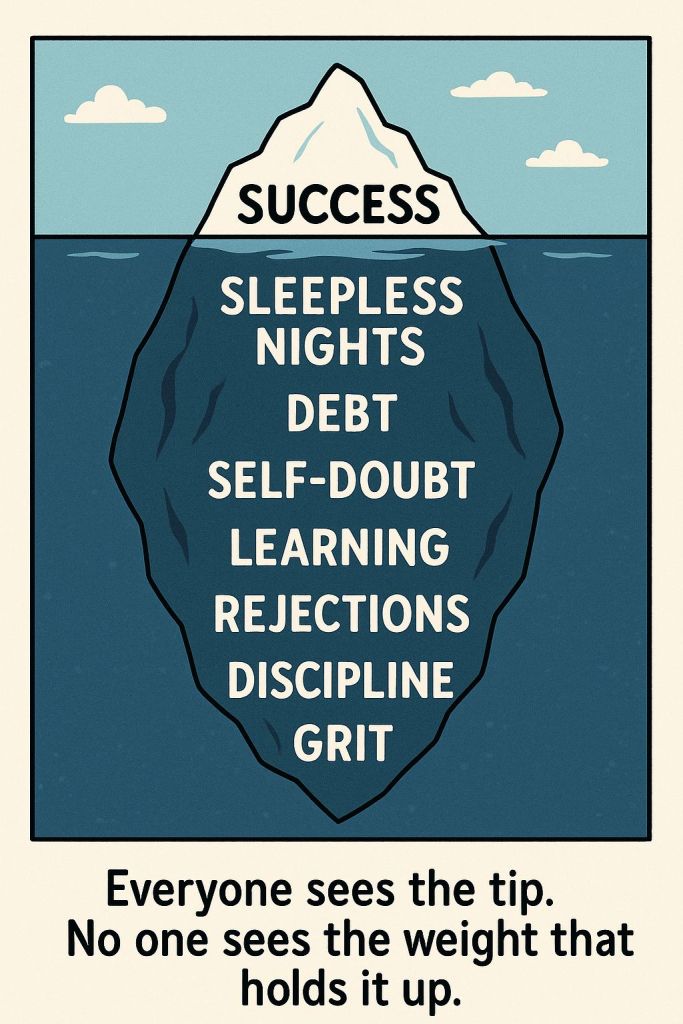
Judged by outcomes. Built by journey.

I’ve seen this time and again — in business, in relationships, and especially in entrepreneurship:

People judge outcomes. Not journeys.

Success? You’re celebrated.
Failure? You’re forgotten.
Still trying? You’re questioned.

Why is it this way?

Because outcomes are visible, journeys are not.

Nobody sees the 3 a.m. self-doubt. The loan EMIs. The silent sacrifices.
They only see whether you “made it” — or didn’t.

Society has become obsessed with results.
We’ve built a culture where IPOs trend, but unpaid dues don’t.
Where LinkedIn posts shine, but emotional breakdowns stay hidden.

The cost of this mindset for entrepreneurs?

1.) Emotional burnout

You start believing you’re only as good as your last “win.”
The effort, grit, and growth mean nothing if the scoreboard shows zero.

2.) Judgment from close ones

The toughest hits often come not from strangers, but from family and friends:

“Still chasing your dream?”
“When will you settle down?”
“Why not take up something stable?”

Their concern is real, but their understanding is rare.

3.) Fear of failure

You start making safe bets. You drop ideas too soon.
You avoid risks just to avoid ridicule.

4.) Validation over vision

You chase vanity metrics. You post curated wins.
You start performing entrepreneurship instead of living it.

But here’s the truth no one talks about:

  • The journey builds you, whether or not the startup succeeds.
  • Failure isn’t the opposite of success — it’s a phase of it.
  • Your worth isn’t tied to revenue charts. It’s tied to resilience.

Let’s change the narrative:

Instead of asking:

“What’s your valuation?”
Let’s ask:
“What have you learned?”
“What’s keeping you going?”
“How can I help?”

Because some journeys deserve standing ovations — even without a trophy.