The Summer That Stood Still


The Summer That Stood Still

Every year, summer vacations come and go. But once in a while, a summer arrives that feels different—a season you know you’ll remember long after it ends.

For me, this year’s summer vacation began on April 26th. What followed wasn’t just a holiday for the kids; it became nearly two months of uninterrupted family time, laughter, road trips, and moments that money simply cannot buy.

The adventure started with a four-day trip to Munnar, followed immediately by four days in Bengaluru. From there, we spent two weeks in Chennai, enjoying the simple pleasure of being together without deadlines, meetings, business calls, or schedules dictating our lives.

The journey didn’t stop there.

We moved between Madurai and Chennai, attending tuition programs, reconnecting with family, and most importantly, giving the children something increasingly rare in today’s world—time with their cousins. There were sleepovers, endless conversations, shared meals, games, inside jokes, and the kind of bonding that only happens when children spend weeks together instead of a few hurried hours during festivals.

One of the highlights was another trip to Munnar, this time with cousins joining the adventure. Watching the children create memories together was perhaps more enjoyable than the destination itself.

As the school reopening approached, reality slowly began knocking on the door. We attended the first day of school, squeezed in another quick Chennai visit, and then, for the final few days, stayed together once more before my sister’s family prepared to leave India.

Yesterday was the hardest part.

There were long hugs, emotional goodbyes, and that silent understanding that everyone was trying to be brave. The children held on a little longer than usual. We adults did too. By evening, we were on the road back to Madurai, reaching home close to midnight.

And just like that, the summer was over.

Looking back, I realize this wasn’t really about Munnar, Bengaluru, Chennai, or Madurai. It was about something much simpler—being present. Being available. Being together.

As parents, we know these summers are not permanent. Every year, our children grow a little older. Soon, academics, friendships, college plans, and their own lives will naturally take center stage.

Perhaps that’s what made this summer special.

It reminded me that childhood is not measured in years; it is measured in the number of summers we get to spend together before life gently pulls everyone in different directions.

For now, my heart is full of gratitude—for the journeys, the laughter, the cousins, the family, and the memories.

And if God is willing, may there be many more summers like this.

The destinations will fade from memory. The hugs, laughter, and time spent together never will.

A Day That Started Rough… and Ended with Popcorn & Smiles


Yesterday was one of those days that starts with resistance but quietly transforms into something meaningful.

We had reached Bangalore the previous night around midnight. Tired, exhausted… and then came the first spark—Aradhya didn’t like the bed. Too hard. Uncomfortable. Her reaction was instant—she messaged her mom asking if we could return to Madurai immediately. That set the tone.

I pushed her a bit to adjust. Not the best start, but sometimes parenting begins with friction.

Morning came with a follow-up call from my wife. I reassured her—and more importantly, I reassured my daughter. I told her, “Let me finish the work today. If you still don’t like it, we’ll go back.” That seemed to calm things down.

Breakfast was ordered on Swiggy, but the morning was slow. I got stuck watching Tamil Nadu election results on YouTube. The unexpected leads (especially Vijay trending) pulled me deeper into the screen than I planned. Time slipped.

By 11 AM, we finally started. Bank work took longer than expected—reached by 11:30, finished only by 2 PM. By then, my son had crossed the “hungry to angry” phase. That classic moment every parent knows.

We drove to Royal Meenakshi Mall, grabbed lunch, and picked up a few things he wanted. Energy levels improved immediately—food does magic.

By 3:30 PM, we reached the apartment. Wrapped up association work, handled the old tenant settlement, completed the new tenant handover. Work done—but the kids wanted time there. So we stayed. No rush.

By evening, we went back to the mall again. That’s when something interesting happened.

The kids discovered what a “second show” movie is.

When I explained it’s a late-night show—way past their usual sleep time—their eyes lit up. It wasn’t about the movie. It was about experiencing something new. Something “grown-up.”

They made a deal: “We won’t sleep. Please take us.”

I agreed.

All they wanted? Popcorn.

That excitement… that curiosity… that first-time feeling—it was worth everything.

After the movie, I casually asked my daughter if she enjoyed the day.

Her answer surprised me.

She said she wanted to stay for another 2–3 days.

Same place. Same bed she complained about.

This time, she asked, “Can we make it more comfortable?”

That’s when I told her something simple:
“This is our house. We don’t run away from discomfort. We improve it.”

We spoke about cushions, small changes, setting up our own comfort.

That moment mattered.

The day that began with resistance ended with ownership.

Kids finally slept at 3 AM.

Work got done. Memories got created.

And somewhere in between, a small lesson settled quietly—
not every discomfort needs escape… some just need adjustment.

From Restless Waiting to Divine Pause


One thing I’ve always hated is waiting. The second — dropping someone off and hanging around until they return.

As a teenager, my mom often insisted I drop my sister at her tuition classes. I’d grumble, resist, and still end up doing it. Sometimes even my cousin hopped on, and I became the unwilling chauffeur. I’d scoot back home, only to rush again to pick them up. When my grandmother scolded me for complaining, I’d shrug it off and continue hating the waiting.

Fast forward to today — I’m a father. And life, with its irony, has placed me in the same shoes. My daughter goes for her Hindi classes, and the new normal is this: drop her, wait for an hour and a half, pick her back.

I don’t enjoy it. I still hate waiting. But parenting isn’t about what I like — it’s about responsibility.

Yet, something surprising happened. Behind this uncomfortable routine, I discovered a new kind of experience. Since her classes are in downtown Madurai with no cafés or hangout spots nearby, I started spending that waiting time in a famous temple close by.

And there, waiting turned into something else.
The temple’s silence, the chants, the fragrance of incense, and the sight of strangers in prayer gave me peace I didn’t expect. The restless ticking of time became a pause — a divine pause.

Now, I don’t complain. I stand there, soaking in the positive energy, observing life in its simple rhythms, and walking away lighter than I came in.

Maybe waiting isn’t wasted time after all. Sometimes, it’s God’s way of slowing you down.

Shift in Attachment Patterns


If parenting had a rulebook, I think it would start with one golden line: don’t expect loyalty contracts from kids.

For the first five years, my son was my biggest fan. He backed me blindly — whether I was right, wrong, or just lazy. If I said the sky was green, he’d argue with the whole world to prove it. I secretly enjoyed this “mini-me” support system.

But suddenly, something changed. Slowly, my die-hard supporter began drifting… toward my wife. Now he backs her blindly, just the way he once did for me. At first, I thought it was a passing phase. But no — the boy has switched teams.

Of course, there’s a reason. My wife is the dominant one at home. She sets the rules, decides the flow, and basically runs the show. For a 5-year-old who is figuring out who’s really “in charge,” she looks like the clear captain. And in a child’s mind, siding with the captain is the smartest move.

At first, it stung. I felt like I’d been demoted from “head coach” to “assistant waterboy.” But then I realized — this is just how kids grow. They test attachments, they learn loyalty, they experiment with power. Today he’s Team Mom, tomorrow he might be back on Team Dad, and someday, hopefully, he’ll see us as one team.

Parenting is funny like that. We think we’re raising kids, but half the time, they’re teaching us lessons in patience, ego, and letting go.

So if you’re a parent going through the same — relax. Don’t compete. Build your unique bond. And remember: your kid isn’t rejecting you, he’s just exploring both sides of love.

Because in the end, it’s not about whose side he’s on. It’s about knowing he feels safe on both.

The Many Races of Childhood and Why I Choose to Slow Down


When I was a kid, life was simpler. We had one or two races to run—maybe a 100-meter dash at school, or the occasional race to grab a front-row seat on a bus ride. But today’s kids?

They’re sprinting in every direction.

  • A race in academics
  • A race in sports
  • A race in arts — music, dance, painting, coding… you name it.

Yesterday, I accompanied my daughter to her football zonals. I love watching her play, but what caught my attention wasn’t the game—it was the sidelines.

One parent was passionately talking about his daughter. She’s a topper in taekwondo, athletics, football, badminton. He wasn’t bragging but he was relentlessly calculating. He had recently moved her from her existing badminton club (where my daughter trains) to a “better” one, calling ours mediocre. You could see the pressure in his eyes and probably in his daughter’s shoulders too. He was pushing her to conquer all the milestones he missed in his own childhood.

Then there’s a friend of mine, a doting father. He’s got his daughter enrolled in every possible online class from Odo, Hindi, math, coding. He proudly told me she’s a Hindi pandit at 12. I casually mentioned, “Languages are beautiful, but if not practiced, they fade.” That offended him. He insists I’m being inefficient as a father because I don’t push my daughter like he does his.

Let me be clear—I’m not saying they’re wrong.

Their intentions come from love. They want to give their kids a better life, a stronger start, and more opportunities. But here’s my honest question:

Why make them run in every race?

Why can’t a child just choose one path—be it football, painting, dance, math—and go deep into it? Why must we chase breadth when they crave depth?

Childhood is not a battleground of unfinished parental dreams. It’s a playground for self-discovery.

We all want our children to succeed. But what if success isn’t standing on the winner’s podium in five fields at once? What if it’s simply being joyful, curious, and deeply good at one thing they actually  love?

In a world full of rat races, I choose to let my daughter jog, walk, pause, even skip… as long as she enjoys the journey.

A Generation Disconnected: Where Did We Lose the Thread?


We didn’t grow up visiting hotels. We grew up visiting hearts.

When I close my eyes and think of my childhood, it’s never about fancy vacations or five-star resorts. It’s the smell of my grandmother’s kitchen, the chaos of sleeping ten to a room on the floor, the shared laughter echoing through my uncle’s village home.

Holidays didn’t mean plane tickets or curated itineraries. Holidays meant piling into crowded buses and trains, hopping from one relative’s house to another. We didn’t book hotels but our homes were each other’s hotels. Our cousins weren’t just “relatives,” they were our first friends, our first rivals, our first lessons in sharing, forgiving, and standing up for each other.

We fought like cats and dogs over a piece of mango, formed secret gangs in the neighborhood, and defended each other in front of elders even if we had fought the previous night. Those silly fights and spontaneous adventures taught us patience, empathy, and resilience. They made us feel rooted, as if no matter how tough the world was outside, there was always a gang waiting with open arms.

But today, as I watch my children grow, I feel a quiet ache in my heart. The world has become smaller and faster, yet our circles have become narrower and colder.

Most of my cousins have moved abroad. We now meet on rare occasions and a rushed dinner, a hurried coffee. When they visit India, they stay in hotels or spend a day at our home before moving on. Our children look at each other like polite strangers, awkwardly sharing a few minutes before retreating to their screens. By the time they warm up, it’s already time to say goodbye.

When I was my daughter’s age, I had at least 15 cousins with whom I had created countless stories. Even today, no matter how far they are, I can pick up the phone and know there’s a friend on the other side who understands me without explanations.

But what about our kids? Who will they call when they’re lonely at midnight? Who will they turn to when they need that quiet moral support that only someone who grew up with you can offer?

We’ve unknowingly cut off a generation from the warmth of cousinhood, from the small fights that build big hearts, from the comfort of shared silences and shared mischief. We’ve traded community for comfort, depth for convenience.

I often wonder, if this new normal progress or a quiet tragedy? Are we giving them wings but forgetting to give them roots?

I don’t have all the answers. But I know this: relationships don’t grow in hotel lobbies or quick meet-ups. They grow in messy kitchens, in crowded living rooms, in late-night talks that spill into dawn.

It’s not too late. We can still invite cousins to stay over, plan longer family visits, encourage our kids to spend a summer vacation at a relative’s home without us hovering around. We can start telling them our stories — about how we played, how we fought, how we learned to love each other through it all.

We owe it to them. We owe it to the silent bonds that made us who we are today.

Let’s not leave them with just photos and polite greetings. Let’s gift them the messy, beautiful, irreplaceable magic of family.

When Parenting Engulfs You: My Silent Struggle Raising Two Young Kids Alone


Finding joy, even in the hardest days.

When people see a smiling parent with a child on each arm, they often think of joy, completeness, and warmth. But behind that photo, there can be stories of exhaustion, frustration, and a kind of loneliness that’s hard to describe.

From the very beginning, even before our second child was born, there were challenges. My in-laws strongly believed that having a second child was a bad idea, and they convinced my wife the same. Every time there’s an argument between us now, this topic comes back: that she didn’t fully analyze the challenges ahead. It makes me angry because, in my heart, I always believed I didn’t want to raise a single pampered child. I wanted my first child to have a sibling, a lifelong companion. This decision was never just about me — it was about building a family with deeper bonds, even if it meant going through harder days.

From the day my second child was born, life changed completely. We had no support system. No parents or in-laws stepping in to help, no extended family to call on, no trusted house help to share the load. It was just us, and every day felt like a survival mission.

People often say, “it takes a village to raise a child.” With my first child, I had that village. My in-laws supported us, and those memories felt like heaven — a beautiful, light-filled chapter of parenting. But with my second child, that village was gone. I became everything: the caretaker, the cook, the cleaner, the comforter, the entertainer, the teacher. From sleepless nights to endless school preparations, every moment demanded my full energy and presence.

In the process, my professional life took a huge hit. I went into procrastination because of constant mind fog. Work deadlines felt heavier, focus slipped away, and important opportunities quietly passed me by. My business struggled, and while outsiders only saw the missed targets and failures, they didn’t see the mental battles and emotional exhaustion that led me there.

At home, the constant focus on the kids created a silent gap with my spouse. Conversations turned into pure logistics: who would handle which meltdown. The small, loving moments that kept our bond alive quietly faded, replaced by stress and quiet resentment.

Yet despite all the anxiety, frustration, and helplessness, I cherished every moment with my second child. Even in the chaos, I found joy. I built precious memories, laughed through exhaustion, and watched my child grow closely every single day. It truly felt like a heaven inside a hell — beautiful moments glowing in the middle of struggle and darkness.

With support, those years could have been even better, perhaps closer to the lightness I experienced with my first child. But despite everything, I wouldn’t trade those moments for anything.

Parenting is beautiful, but when done alone and without support, it can swallow you whole. If you’re going through this, I want you to know: you’re not alone. You deserve understanding, you deserve support, and you deserve to cherish those beautiful moments without the heavy weight of judgment.

From Sleepovers to Missed Calls: Growing Up and Growing Apart


We didn’t grow apart. Life just grew between us.

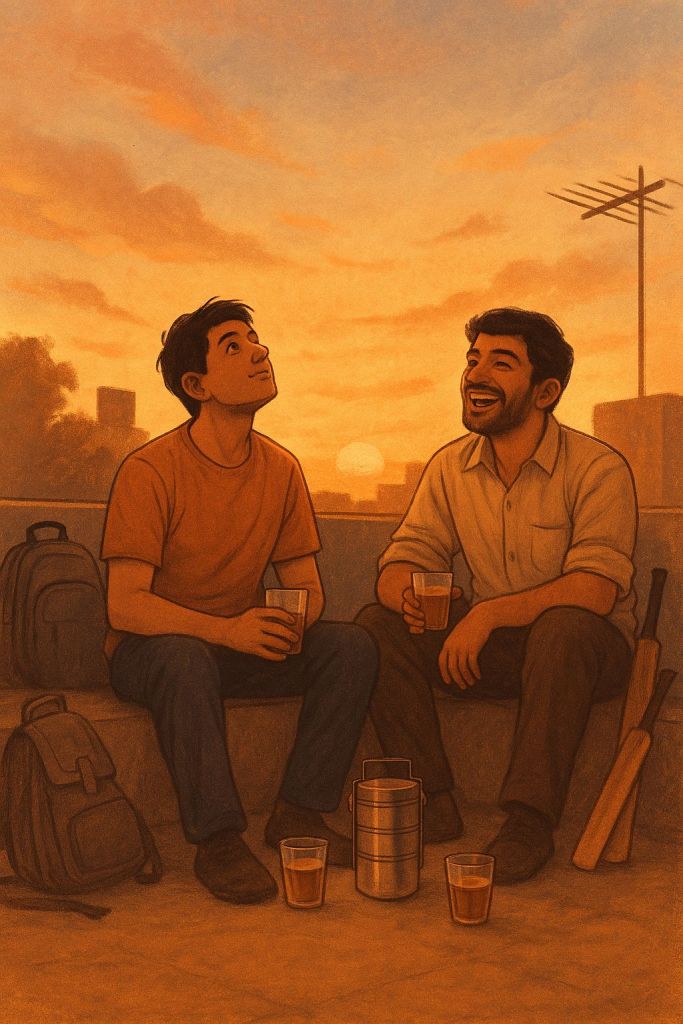
I come from an era when summer vacations meant stuffing myself with mangoes at cousins’ houses and fighting over who got to sleep next to the window.

Back then, we didn’t need fancy resorts or curated “experiences.” One friend’s terrace and a big steel tiffin box full of lemon rice did the job. We treated our friends’ parents like our own, and their mothers scolded us with such love and ownership, you’d think we came as part of the house package.

We finished our academics around 2000, all wide-eyed and curious about the future.

Some started with direct selling or handing out credit card applications in front of Saravana Stores — anything to avoid asking Appa for bus money.

By 2005, most of us had found jobs. From 2005 to 2012 (the year I got married), we were all busy “swiping right” in real life — running around for alliances, comparing horoscopes, and attending those awkward first meets where coffee tasted like tension.

Then came the kid marathon.
My second child was born in 2019. One of my best buddies, Vignesh, had his kid in 2020 — the final entry in our “Gen 1.0” batch.

Now, we’ve entered a new phase of life.
The same guys who once debated which cricket bat brand was best are now arguing about NEET coaching vs. coding classes.
We’ve moved from cycle races to chasing after school buses in the rain.

We want to hang out, but life says, “Sorry, today is fully booked with PTMs, grocery bills, and last-minute school project hunts.”

Last week, Vignesh came to India after ages. We managed just one hour together, squeezed between his kid’s nap schedule and my quick stop to buy vegetables.

I wanted to pour out my struggles, share my small wins, and dive deep into those “bro talks” that heal more than any medicine. But life had other plans and threw us back into separate lanes before we could even warm up.

We stay connected — thanks to Instagram stories and “Good morning” WhatsApp groups — but the emotional distance? That’s the new unspoken reality.

Looking back, it feels like life pressed the fast-forward button on us. We went from fighting over who would run up and twist the channel dial like we were defusing a bomb — to fighting over time slots in our own calendars.

Sometimes, I wish we could all pause. Sit on that same terrace again. No deadlines, no work calls, no worries about kids’ exams or cholesterol levels.

We grew up together, but somewhere along the way, life grew between us.