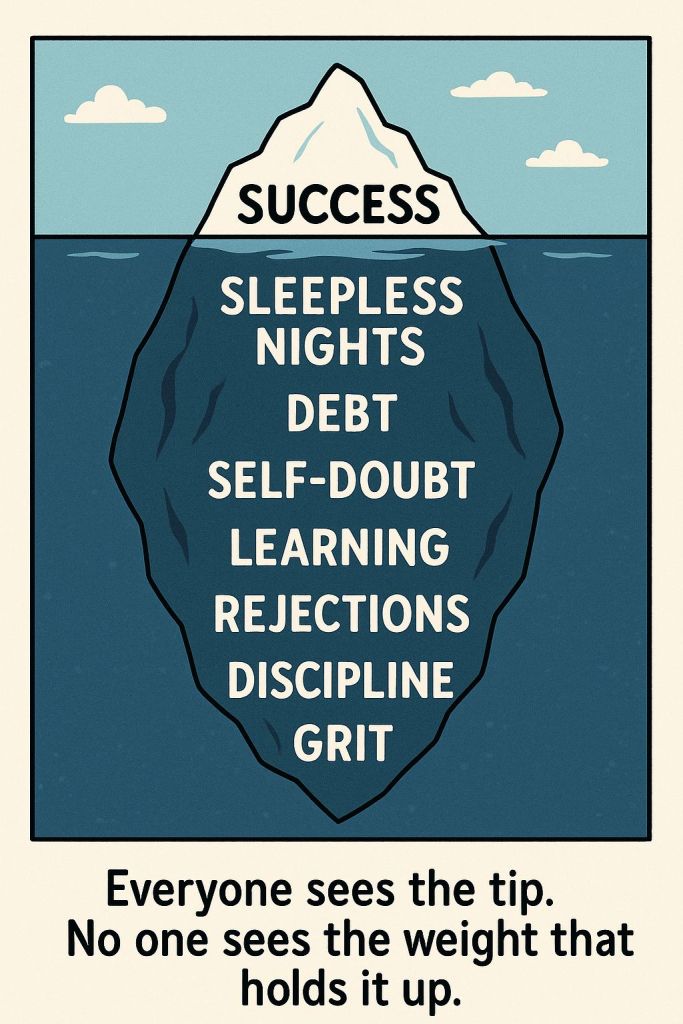
People Often Judge Outcomes, Not Journeys


Judged by outcomes. Built by journey.

I’ve seen this time and again — in business, in relationships, and especially in entrepreneurship:

People judge outcomes. Not journeys.

Success? You’re celebrated.
Failure? You’re forgotten.
Still trying? You’re questioned.

Why is it this way?

Because outcomes are visible, journeys are not.

Nobody sees the 3 a.m. self-doubt. The loan EMIs. The silent sacrifices.
They only see whether you “made it” — or didn’t.

Society has become obsessed with results.
We’ve built a culture where IPOs trend, but unpaid dues don’t.
Where LinkedIn posts shine, but emotional breakdowns stay hidden.

The cost of this mindset for entrepreneurs?

1.) Emotional burnout

You start believing you’re only as good as your last “win.”
The effort, grit, and growth mean nothing if the scoreboard shows zero.

2.) Judgment from close ones

The toughest hits often come not from strangers, but from family and friends:

“Still chasing your dream?”
“When will you settle down?”
“Why not take up something stable?”

Their concern is real, but their understanding is rare.

3.) Fear of failure

You start making safe bets. You drop ideas too soon.
You avoid risks just to avoid ridicule.

4.) Validation over vision

You chase vanity metrics. You post curated wins.
You start performing entrepreneurship instead of living it.

But here’s the truth no one talks about:

  • The journey builds you, whether or not the startup succeeds.
  • Failure isn’t the opposite of success — it’s a phase of it.
  • Your worth isn’t tied to revenue charts. It’s tied to resilience.

Let’s change the narrative:

Instead of asking:

“What’s your valuation?”
Let’s ask:
“What have you learned?”
“What’s keeping you going?”
“How can I help?”

Because some journeys deserve standing ovations — even without a trophy.

Love and Fear: The Battle Within a Coward’s Heart


As a coward, expressing love can be an extremely difficult task. Love requires vulnerability and courage, both of which can be very intimidating for someone who is naturally inclined towards fear and avoidance. It’s not that cowards are incapable of feeling love; it’s just that they struggle to express it in the way that they want to.

For me, expressing love has always been a daunting prospect. I have always been afraid of rejection and the potential for hurt that comes with putting oneself out there. As a result, I have often found myself holding back my feelings, afraid of what might happen if I were to reveal them. This has caused me a great deal of pain over the years, as I have watched opportunities for love slip away because I was too afraid to take the risk.

It’s not that I don’t feel love deeply. I do, and it’s a wonderful feeling. The problem is that my fear of rejection and my tendency to avoid confrontation make it difficult for me to express that love in a way that feels authentic and meaningful. Instead, I find myself resorting to small gestures and platitudes, hoping that they will be enough to convey what I am feeling.

Unquenchable Desires: Navigating the Joy and Pain of Love


Love is a powerful emotion that can make us feel both joy and pain. It can be difficult to express our feelings to someone, especially if we fear rejection. When unquenchable desires keep appearing, they can pierce our hearts and leave us feeling scared and vulnerable.

For me, expressing my love is like walking on a tightrope. It takes courage and a leap of faith to tell someone how I feel, but the fear of rejection can be paralyzing. I stir her name every day in my soul, but the trial she walks is like a shadow that I can never catch.

The hesitation in expressing my love is like a heavy weight on my chest. It’s as if I’m constantly holding my breath, waiting for the right moment to exhale. But the longer I wait, the harder it becomes. The dumbness and infatuation are like two halves that keep killing me every day.