
I grew up hearing the phrase “justice delayed is justice denied.” In my younger days, it sounded so powerful, so sharp — a perfect line to quote when you felt wronged or betrayed.
I believed justice meant someone should pay for hurting me, and they should pay now. I carried this belief with me, holding it close every time I felt cheated or double-crossed.
When I was betrayed, I felt an almost animal-like hunger for revenge. I would replay moments in my head, craft imaginary confrontations, and wish that karma would strike them down while I was still raw and bleeding.
But as time passed, something changed.
Life didn’t stop for my pain. The people who hurt me moved on, sometimes even seeming happier than before. I stayed stuck in a loop of anger, frustration, and helplessness, waiting for karma to arrive like a superhero and save me from my inner chaos.
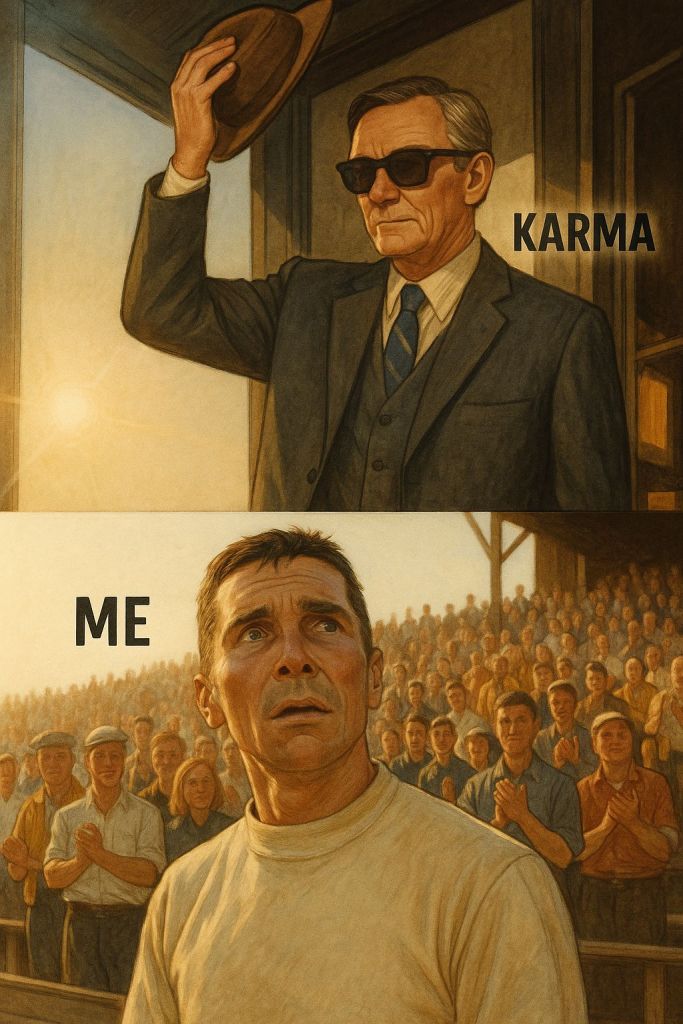
Years later, karma finally did visit them. Two of the people who had hurt me so deeply faced their consequences — harshly. But by then, something unexpected had happened to me: I had healed.
When I heard about their downfall, it felt like reading an old news headline. There was no thrill, no moment of triumph, no fireworks. Just a quiet nod inside me, as if my soul whispered, “See? Life balances itself.”
In that moment, I realized: karma is not my personal lawyer. It’s not designed to heal my wounds or bring me peace. It’s not even meant to satisfy my sense of timing.
Unlike our legal system, where “justice delayed is justice denied” because victims need relief here and now, karma operates on a different plane altogether. Karma doesn’t arrive on our schedule. It doesn’t rush to fix our pain. Instead, it patiently restores balance in its own mysterious, universal way.
By the time karma acts, the raw wound has already become a scar. And when it does, it often feels like a distant echo rather than the roaring justice I once imagined.
I used to think that if karma didn’t act fast enough, it was as good as denied. But today, I see it differently. Karma is not about me; it is about the larger flow of life, the unseen balance sheet of actions and consequences that spans beyond my small circle of feelings.
Looking back, I understand now that healing was never karma’s job. Healing was mine. Karma didn’t come to save me — I had to save myself, stitch up my own wounds, and learn to walk forward carrying my scars with pride.
Those scars? They’ve taught me more than any revenge ever could. They taught me resilience, boundaries, patience, and — above all — the power of moving on.
So today, when I think about those who wronged me and finally “paid” for it, I feel nothing more than a gentle nod to the universe: Thank you for doing your part. I had already done mine.
What I’ve learned
- Don’t wait for karma to heal you.
- Don’t put your peace on hold waiting for someone else to fall.
- Your healing is your responsibility; karma is just the universe keeping its own books.
In short
“Justice delayed is justice denied” is about human systems.
“Karma delayed” is not karma denied — because karma is not about providing you justice, but about cosmic balance.

