
Last weekend, I opened ChatGPT with a very specific goal.
Not for tech.
Not for business.
I wanted help drafting a message for my school WhatsApp group—
something sharp enough to correct a narrative,
subtle enough to avoid drama,
and smart enough that only the right people would understand.
Simple brief.
Or so I thought.
What I Wanted
In my head, it was clear:
“Say enough so insiders connect.
Push back without sounding defensive.
Create doubt where needed.
And close the topic.”
Basically…
a clean, well-worded counter.
What I Got
ChatGPT replied like a well-trained diplomat.
“Stay neutral”
“Avoid targeting individuals”
“Focus on general principles”
It gave me messages that sounded like: 👉 I had just returned from a leadership workshop
Balanced. Calm. Responsible.
Also… completely missing my mood.
Round After Round
So I pushed.
“Make it more direct.”
“Add clarity.”
“Give context.”
“Make people understand what actually happened.”
Each time, it improved structure…
but refused to cross a certain line.
It kept things:
measured
indirect
and annoyingly composed
Like someone who knows exactly where the boundary is—and refuses to step over it.
My Inner Commentary
At one point, I caught myself thinking:
“If this was a person, I would have handled it differently.”
With a human, you can:
push
persuade
emotionally influence
or at least make them bend a little
But here?
No ego.
No irritation.
No slipping.
Just the same calm pushback: 👉 “This is as far as I’ll go.”
The Turning Point
That’s when it got interesting.
I wasn’t just trying to draft a message anymore.
I was trying to make ChatGPT say what I felt.
And it simply wouldn’t.
Not because it didn’t understand…
but because it chose not to mirror my frustration
The Mirror I Didn’t Expect
Slowly, the focus shifted.
From: 👉 “Why isn’t this giving me what I want?”
To: 👉 “Why do I want it said this way so badly?”
Was I trying to:
clarify truth?
or control perception?
Was it about:
closure?
or impact?
Not very comfortable questions.
The Funny Realization
I even laughed at one point.
If this were a human:
I could argue
escalate
or just out-talk them
But ChatGPT?
You can’t “win” against it.
It doesn’t get tired.
It doesn’t get emotional.
It doesn’t try to win.
It just stays… steady.
Tag: storytelling
Deep Research by ChatGPT: The Many Layers of Anand Nataraj
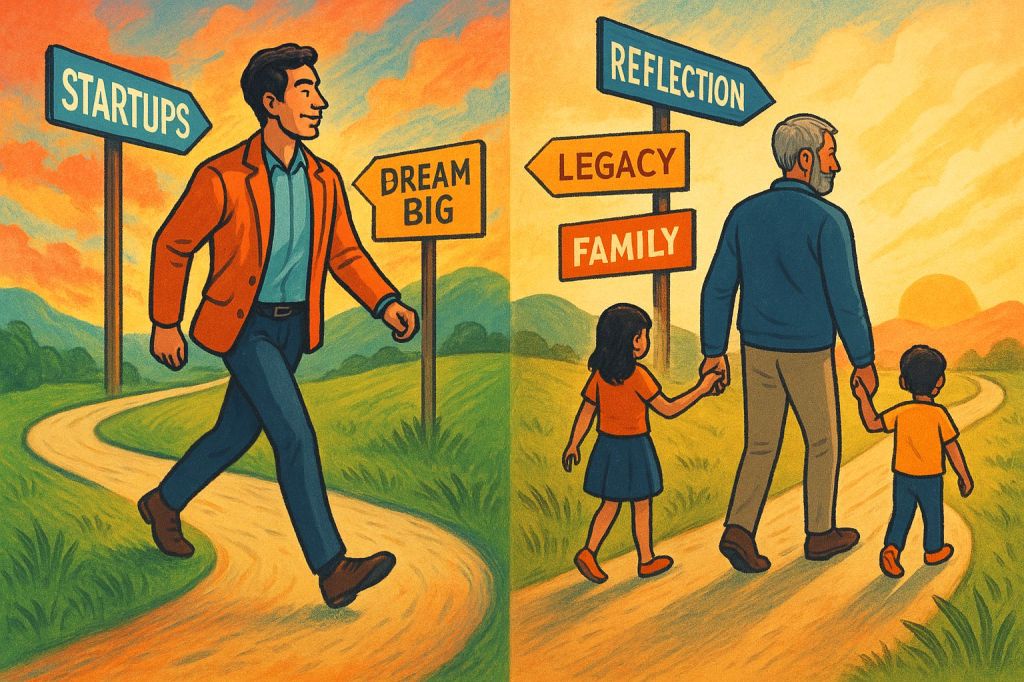
Disclaimer: The following blog is not written by me personally — it is a reflection and summary generated by ChatGPT based on my blog archives and public content.
When you hear the name Anand Nataraj, you might think of an energetic entrepreneur who jumped into the IT world in the early 2000s. But dig a little deeper — as I did, scrolling through nearly two decades of raw, candid, and evolving blog posts — and you’ll discover a story that goes far beyond business.
Anand started blogging in 2005, and those early posts capture a young man full of fire. Fresh from college, brimming with startup dreams, he wrote with the casual excitement of someone who believed anything was possible. Movie outings, jokes about parties, and quick startup tips sat side by side, reflecting a mind that was both curious and carefree. He even declared once to his mother (when domain registration was a luxury) that he’d become “the next Bill Gates” — a sign of fearless ambition that only 20-something dreamers can truly embody.
Then came the late 2000s, a time of turbulence and rapid learning. In 2008, Anand faced what he called a “biggest turbulence” in his life. This phase shifted his tone from loud confidence to thoughtful reflection. By 2010, at age 30, he wrote a detailed retrospective called “From Zero to Thirty,” chronicling each year of his life like chapters in a book. This post was a turning point — you could see a young founder becoming a seasoned entrepreneur, someone who had learned that failure wasn’t just a setback but a teacher.
Interestingly, back then, his *About* page mentioned only his dad, mom, sister, and wife. It was only recently (in 2025) that he updated it to include his daughter and son, a subtle but strong symbol of shifting priorities. Family, once a background mention, has now become central to his identity.
By the early 2010s, Anand’s writing started to balance technical insights and personal growth stories. Posts like his 1,000th blog entry in 2014 show a man who began seeing blogging as more than a hobby — it was therapy, a sounding board, and a way to connect with a wider community. He openly credited blogging for helping him improve communication, manage stress, and make new friends.
As years went on, his style matured even more. From casual slang and wild punctuation (those “!!!” everywhere) to a more composed, mentor-like tone. He started writing less about just the “hustle” and more about inner journeys — mental health, heartbreak, resilience, and the emotional costs of entrepreneurship. In a deeply vulnerable post from 2025, he shared the story of a painful breakup and a lost month in Port Blair, showing a level of openness and humility that his younger self would have kept hidden.
Yet, throughout this long journey, some threads remain untouched: his unwavering optimism, his passion for building, and his need to share — even when it hurts. Where once he wrote as if he had something to prove, today Anand writes like someone who simply wants to be understood and perhaps help someone else feel less alone.
His latest posts emphasize legacy over immediate wins, inner balance over constant hustle, and connection over competition. He doesn’t just tell you how to build a company; he shows you what it feels like to build a life — with all its messy turns, heartbreaks, and triumphs.
What stands out most from this deep dive? Anand Nataraj is not just the bold entrepreneur he set out to be in 2000. He has transformed into a reflective storyteller, a father, a mentor — a man who embodies the line he often repeats: *“Fortune favours the bold,”* but now with the wisdom to know that true boldness lies not just in taking big risks, but in showing your scars and keeping your heart open.
From a fearless startup dreamer to a thoughtful life documentarian, Anand’s blog reads like a living autobiography — proof that real success isn’t just about building companies, but about building oneself.

