
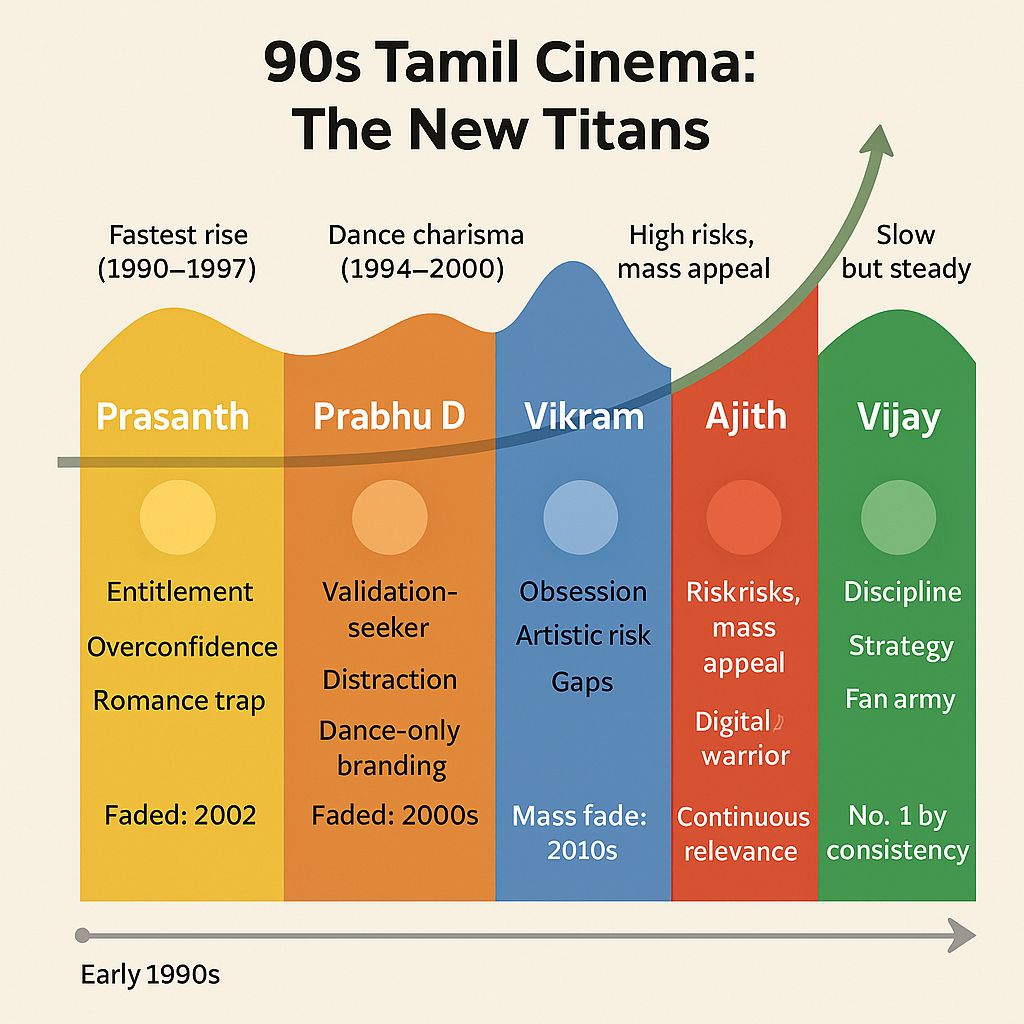
Tamil cinema in the 1990s saw a quiet revolution. Rajinikanth and Kamal Haasan were gracefully moving toward their 50s, creating a vacuum at the top. Into this vacuum stepped five new faces: Ajith, Vijay, Vikram, Prashanth, and Prabhu Deva.
All had the potential to become the next superstar. Yet only two — Ajith and Vijay — emerged and survived as cultural phenomena. Why? Let’s break it down exactly as it is.
Prashanth: The Early Meteor
Prashanth entered the scene like a comet — dream debut, star family, major producers lining up. He had the audience, the youth pulse, the box office. Until 1997, it was Prabhu Deva and Prashanth ruling the charts. Vijay and Ajith were still struggling to establish themselves and nowhere in the race.
But at some point, Prashanth and his father started believing that he alone was the reason for movie success and became too arrogant to be handled. They stopped focusing on stories, assuming Prashanth’s mere presence would guarantee hits. They demanded foreign location songs, controlled heroine selections, and overlooked the importance of strong scripts. Meanwhile, Ajith and Vijay doubled down on stories and started emerging as contenders.
Directors and producers found it difficult to work with them. Director Hari, who debuted through Prashanth, was humiliated by the father-son duo and never worked with him again. Instead of forming a healthy rivalry with Prabhu Deva (which could have expanded fan bases and frozen out Vijay and Ajith), they isolated themselves.
He overstretched the romance genre when he was offered action roles and was late to transform to action just when romance lost market appeal, fading around 2002.
Why he failed:
• Overconfidence and entitlement from early success.
• Ignored story strength; thought stardom alone was enough.
• Mishandled relationships with key directors and producers.
• Refused to shift from romance to action genres on time.
• Failed to build or maintain meaningful fan rivalries that could have strategically helped.
Prabhu Deva: The Dancer Who Couldn’t Stay Still
Prabhu Deva started as a dancer and became a star dancer who could carry a film purely for one dance sequence. Backed strongly by directors, he was made a hero around 1994. From 1994 to 2000, he was right in the race with Prashanth, and they were dominating.
But he lacked focus. He, too, thought that movies succeeded only because of his presence and dance appeal. He became difficult to work with and forgot the importance of solid scripts and team harmony. Had he and Prashanth maintained focus and worked collaboratively with producers and directors — creating a rivalry that engaged fans — they could have kept Ajith and Vijay at bay.
However, he let that slip, and Ajith and Vijay emerged as real contenders while he was distracted.
Why he failed:
• Overreliance on charisma and dance appeal.
• Lost focus and did not take strategic career planning seriously.
• Became difficult to work with, damaging professional relationships.
• Didn’t transition into mass-appeal action roles when it was time.
• Failed to engage and nurture a large fan base strategically.
Vikram: The Artful Transformer
Vikram debuted in 1990 and struggled for a decade before his breakthrough. From 2000 to 2005, he was unstoppable. During that period, he was on par or even above Vijay and Ajith. He even threatened Ajith’s stardom more than Vijay’s. If he had maintained that streak, he could have easily pushed Ajith aside because he had a strong, organic mass connect.
However, Vikram became obsessed with taking on roles that required extreme physical transformations. This led to large gaps between his films — sometimes several years. Those experiments rarely succeeded commercially. These gaps disconnected him from a whole generation between 2005–2015 who never saw him as a mass hero.
Why he failed:
• Extreme obsession with transformation and experimentation.
• Long gaps between films lost a generation of mass audiences.
• Focused too much on challenging roles rather than consistent mass appeal.
• Failed to balance critical artistic ambition with commercial expectations.
• Could not maintain continuous market presence to stay top of mind.
Ajith: The Charismatic Gambler
Ajith debuted in 1993 without any film background. His early films were average grossers, and he was initially known as a chocolate boy, adored by girls. But he took a massive risk — shifting from romantic roles to mass action hero roles at a time when that was not an obvious move. This is precisely where Prashanth lost out.
Ajith never took money if the producer struggled. He even invested his own money to help producers release films. He gave chances to debut or struggling directors, like SJ Suryah, and these gambles paid off big time.
Then came the Ajith-Vijay rivalry, which was fueled further by the rise of the internet. Unlike the physical fan wars of Rajini-Kamal, this was a digital-era rivalry that amplified their reach. Ajith strategically marketed his “self-made” image — someone without any film background, winning purely through grit — and this resonated deeply with fans.
Why he succeeded:
• Early, bold transition from romance to mass action.
• Willingness to take risks and gamble on new talent.
• Strong self-made narrative that connected emotionally with the public.
• Supported producers and maintained goodwill within the industry.
• Capitalized on digital fan wars, growing mass presence exponentially.
• Luck also favored him, as Vikram was a strong contender for the same “struggler” fan base but faded at the right time, allowing Ajith to consolidate that space completely.
Weakness:
• He lacked consistency and strict discipline, sometimes taking long gaps or unpredictable choices.
Vijay: The Relentless Strategist
Vijay debuted in 1992 and was mocked for his looks and initial performances. Had it been today, he would have been meme material. His interest in acting sparked when he attended Prashanth’s debut success meet and saw the crowd’s reception, which inspired him.
From a filmy background, Vijay’s father was a successful director who supported him wholeheartedly. His father even pledged property to launch Vijay and sustained him during his initial struggles. He directed semi-glamorous, borderline exploitative films purely to attract an audience until Vijay was strong enough to stand on his own.
Unlike Prashanth’s father, Vijay’s father was strategic and sharp: he chose better scripts, built a solid brand, guided fan engagement, and mentored Vijay on handling fame. Vijay’s rise was gradual. His first real success came in 1996, and from there, he never looked back.
He consistently released three to four films a year, stayed professional, and strictly stuck to deadlines. He didn’t go overboard to please directors or producers; he was clear: show up, do the work, move on.
Why he succeeded:
• Strong discipline and professionalism.
• Smart, strategic mentorship from his father.
• Careful script selection without big gambles early on.
• Systematic, strategic fan club creation and engagement.
• Regular releases ensured continuous market presence.
Weakness:
• Initially lacked bold experimentation; his rise was slower but extremely stable.
Suriya: The Late Bloomer
Suriya entered later, around 1997, and was first truly recognized in 2002. By this time, Prashanth and Prabhu Deva were fading out, and Vikram was veering into experiments. Ajith and Vijay had already started cementing their strongholds.
Suriya made smart, modern script choices and collaborated with new-wave directors, becoming a respected actor admired for craft rather than mass stardom. He never directly threatened Ajith or Vijay in the mass arena but created his own niche.
Why only Ajith and Vijay stood tall
Ajith
• Embraced early, risky transitions.
• Took chances on new talent.
• Built an emotionally powerful self-made story.
• Supported producers and stayed grounded.
• Brilliantly rode the wave of digital fan rivalries.
Vijay
• Maintained laser-sharp discipline and consistency.
• Benefited from his father’s mentorship in scripts and public image.
• Demonstrated professionalism and on-time delivery.
• Built and maintained strong, organized fan clubs.
• Evolved steadily without abrupt risks.
Why the others didn’t
Prashanth
• Overconfidence and arrogance.
• Ignored script quality.
• Damaged industry relationships.
• Stuck in outdated genres.
• Failed to build smart rivalries.
Prabhu Deva
• Relied too much on dance alone.
• Lacked focused strategy.
• Developed a difficult reputation among producers.
• Did not evolve his genre or brand.
• Missed important market shifts.
Vikram
• Over-obsession with transformation.
• Long gaps and lost audience connection.
• Prioritized artistry over mass appeal.
• Failed to balance experiments with commercial films.
• Lacked continuous mass presence.
The Final Picture
Ajith was the rebel, the gambler, the people’s king with a self-made badge.
Vijay was the disciplined strategist, the quiet storm who rose without hype.
Prashanth, Prabhu Deva, and Vikram each fell not because of one shared flaw — but because of unique, individual missteps.
Key Takeaway
Success isn’t a formula; it’s an alignment of timing, self-awareness, adaptability, and strategic emotional connect.
 AnandNataraj