The “Common Enemy Effect” in Founder Relationships


The common enemy effect is a powerful social phenomenon: people unite strongly when they share a common threat. We often see it in military units, sports teams, and political movements — and it’s equally true for founders and startup teams.


Phase 1: The early struggle

When founders start out, they face huge external threats:

  • Market rejection
  • Cash burn
  • Pressure to prove themselves
  • Family or societal doubt

Their common enemy is failure itself. This shared threat aligns them deeply. There’s no time for ego; decisions are fast and collective. Emotional support is strong. They feel like warriors in the same trench.


Phase 2: Early wins and success

Then comes funding, product traction, revenue, or media buzz. Suddenly, the “enemy” that held them together begins to fade.

Without that shared fight, founders start:

  • Claiming credit individually
  • Listening to “proxy teams” or external voices that inflate egos
  • Pushing personal agendas

The urgent need to survive is gone, so the cracks appear.


Phase 3: Gaps widen

When the common threat disappears:

  • Misaligned visions surface
  • Egos grow
  • Trust erodes
  • Silent power struggles begin

The same founders who once pulled all-nighters together may now fight over direction, credit, or influence.


Lessons from research

✅ Ben Horowitz (The Hard Thing About Hard Things): In crises, teams unite; in safety, they splinter.
✅ Patrick Lencioni (The Five Dysfunctions of a Team): Without a shared mission, conflict thrives.
✅ Harvard Business Review: “Shared existential threats unify.” New shared missions are critical as you grow.
✅ Social Identity Theory (Tajfel & Turner): Strong group identity often needs an external “enemy” to stay focused.


What can founders do?

  • Constantly define new “enemies” or big missions (new markets, innovations, tougher impact goals).
  • Regularly revisit and realign personal and collective visions.
  • Watch out for external influences that inflate individual egos.
  • Build a culture where mission > individuals, always.

In short

What unites founders at first? A common enemy (failure, survival).
What causes splits later? The enemy fades, egos rise.
What’s the fix? Keep creating new shared battles to stay united.

Core Team – The Unseen Faces Behind Every Big Win


Core team. Core strength.

If there’s one thing I keep repeating (even when no one asks), it’s that the success of any business revolves around the core team. People throw around words like “visionary” and “solo genius” as if someone sat in a corner and built an empire alone. But the reality? It’s always a team sport.

In my first venture, I had that magic combo. My partner and I were like two puzzle pieces that just clicked. My strength was his weakness, and his strength covered mine beautifully. It felt like playing doubles in tennis, always knowing someone had your back when you missed a shot.

And then, there were people like Aparnaa and Major Karthik — solid pillars. They weren’t just employees; they were the eyes and ears of the organization. They helped pick the right talents, made sure we kept them, and told us when something was wrong in the team. That loyalty, those late-night calls when there was a problem, those quick decisions we made together — these are things you can’t measure on paper.

When I started my second venture, I had a core team too. But this time, I missed that one piece: a true business partner. And those employees who would stand in the storm with me? I missed that too. You feel it most when the tide turns against you. You realize quickly that it’s not the office decor or the fancy logo that holds you up — it’s that circle of people who will pick up your call at 2 a.m.

It’s the same everywhere if you think about it. Rajinikanth had SP Muthuraman — they did over 25 films together. Many of Rajini’s blockbusters carry Muthuraman’s name behind the scenes. Vijayakanth had Ibrahim Rowther. After their break, Vijayakanth’s box office magic started to fade. And there’s Anand Jain — often called Mukesh Ambani’s “trusted brain,” a man who played the off-field game few saw but many felt.

Even in cricket, look at MS Dhoni. Everyone talks about the “Captain Cool” legend, but think about his gang — Raina, Jadeja, Ashwin — players who trusted him blindly and went to war for him on the field.

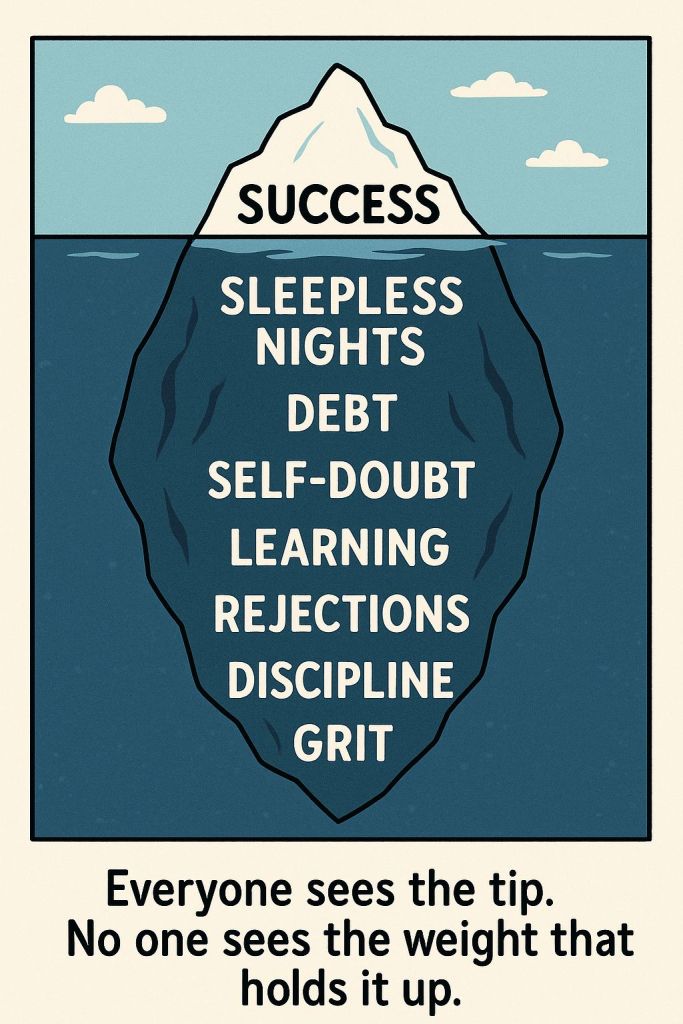
When you look back at your journey, it’s always the core team that shines through the fog. The ones who stayed when money ran out, when deals fell through, and when self-doubt felt louder than success. A strong core team isn’t about headcount or titles; it’s about those rare people who treat the business as their own, who see your vision when no one else does, and who carry you through storms without asking for credit. You can have the best idea, the best pitch, or a temporary viral success — but without a core team, it all fades like a one-time festival cracker. Many people have tasted quick wins but vanished because they didn’t have that foundation holding them up when the spotlight moved on.

Finding this team is an art. You don’t spot them in interviews; you see them in crisis rooms and on those quiet late nights when no one is watching. And once you find them, you hold on. You reward them, recognize them, and retain them at any cost — because no trophy or headline is worth more than a team that stands by you even when the world doesn’t.

As we say in Tamil, “தம்பி உடையான் படைக்கு அஞ்சான்” — the one who has brothers behind him never fears an army. It’s a beautiful way our ancestors explained the power of having a strong, loyal support system. Tamils knew long back that it isn’t the sword or the shield that makes you powerful — it’s the people standing behind you.

Some people build empires on sand; some build on people. And if you ask me, the ones who build on people are the only ones who last.

Why the Safe Route Looks Easy, But the Wild Route Feels Right


I’ve often sat at my desk late into the night, staring at the ceiling and asking myself the same question: Why do opportunities seem to pass me by? I risked it all. I worked long hours that blurred into days, pawned my wealth, missed family events, and took responsibility when no one else would even step up. Meanwhile, job goers clocked in their neat 10-hour shifts, played safe, saved their salaries, bought flats, and went home to sleep peacefully. Some even quit when things got tough, never bothering to look back. And today, they seem more “settled” than me. It almost feels unfair. But life isn’t a cricket match with a clear scoreboard. It’s more like a marathon with different routes — some smooth, some with hidden potholes.

The curse (and gift) of taking responsibility

When you take responsibility, you don’t just carry tasks; you carry dreams — yours and everyone else’s. You become the cushion when things go wrong, the cheerleader when hope runs out, and the punching bag when blame needs a home. You can’t play safe. You can’t say, “It’s not my problem.” You’re too busy turning fires into candles.

Why the hustler looks inconsistent

I used to think I was inconsistent. But looking back, I realize I wasn’t inconsistent — I was simply overloaded. When you’re fighting battles on ten fronts, you lose focus on the main goal. You build, break, restart, pivot. From the outside, it looks like a lack of discipline. From the inside, it’s a survival dance.

Why job goers win small but steady

Job goers? They stuck to one lane. They focused only on their paycheck, not the company’s future. They didn’t risk sleepless nights thinking about client payments or the next big move. They followed a simple formula: do the job, save, buy a house, take a vacation, repeat. And you know what? There’s nothing wrong with that.

But then, what about us?

We choose the path of impact, not just income. We choose unpredictability over comfort. We play the game knowing that some days, the scoreboard doesn’t even exist. We’re not inconsistent — we’re experimental. We’re not unlucky — we’re learning resilience the hard way. We’re not behind — we’re building stories that will echo beyond bank statements.

Job goers may retire with a pension; you’ll retire with a legacy. Choose your prize.

In the end, life isn’t about collecting steady paychecks or safe medals. It’s about staying in the arena, even when the crowd goes silent.

How to Become an Entrepreneur in 2025: Build Slow, Play Smart


I started my entrepreneurial journey back when internet cafes were still a thing, and valuation was a word only VCs in Silicon Valley threw around. In 2025, the startup game looks fancier, faster, and full of noise — but the fundamentals remain timeless.

Let’s break it down.

Motivation: Why do you really want to do this?

If your motivation is just to quit your boss, show off on LinkedIn, or post those “hustle harder” selfies — stop right here.

Entrepreneurship is about solving a problem you deeply care about, and having the stomach for months (or years) of invisible effort before the first clap.

Bootstrapping: Start with your own shoes

Bootstrapping isn’t just a funding method; it’s a mindset. You learn to be scrappy, resourceful, and ruthless about where every rupee or dollar goes.

Options to bootstrap in 2025:

  • Freelancing or consulting on the side.
  • Using small grants or local government innovation funds.
  • Partnering with customers to prepay (advance orders).
  • Running micro MVPs (minimal products) and using those profits to fuel growth.

Networking: Find ideas, co-founders & allies

Don’t just scroll startup hashtags.

  • Attend local meetups, online communities (like Indie Hackers, Founder Clubs), and industry events.
  • Discuss problems, not pitches — the right co-founder or investor loves problem-solvers, not wannabe unicorn hunters.
  • Build trust slowly, especially if your co-founder isn’t a sibling or lifelong friend.

Sales & branding: Story first, scale next

In 2025, every customer has a 5-second attention span. Your brand is your story.

  • Solve one problem well, not ten problems “sort of.”
  • Build organic brand trust before performance marketing splurges.
  • Don’t just sell products — sell why you exist.

Opportunities: 2025 is gold for niche plays

  • Hyper-local services (think “Swiggy for home-cooked elders’ meals”)
  • AI-powered micro SaaS tools
  • Regional content & commerce
  • Sustainability products (waste management, zero-waste packaging)
  • Health-tech and affordable wellness

Valuation rush vs. slow & steady

People today worship those “raised $50M in Series A” posts. But most don’t realize — those founders are married to investors now.

Conventional way (slow and steady):

  • Build solid foundation.
  • Focus on profits.
  • Cement market trust.

Unconventional way (valuation-focused):

  • Rapid user acquisition.
  • Burn money to dominate quickly.
  • Aim for big exit or IPO.

💬 Which is ideal?

If you’re building with trusted partners (like siblings or lifelong friends) → Conventional. You think long-term, family legacy, steady cash flows.

If you’re building with a convenience-based co-founder (someone you met for skills, not soul) → Unconventional might work. Faster exits, cashing out before personal values clash.

Dos & Don’ts

✅ Do:

  • Focus on one clear customer problem.
  • Keep costs lower than your ego.
  • Build systems before scaling.

❌ Don’t:

  • Build just for investor applause.
  • Ignore mental and physical health.
  • Copy trends blindly.

Benefits of being an entrepreneur

  • You own your time (even if it feels like your startup owns you at first).
  • You create impact beyond your payslip.
  • You choose your tribe — employees, partners, customers.
  • You grow faster as a person than in any corporate boardroom.

In 2025 or 2055, the game is still the same: solve real problems, stay true to your “why,” and play your own game — not someone else’s scoreboard.

Real Stories: Bootstrapping Journeys from Small Towns


When we think of startups, we often imagine glass offices in Bengaluru or pitch nights in Silicon Valley. But some of the most inspiring entrepreneurial journeys are quietly brewing in small towns, far from boardrooms and jargon-filled investor decks.

I’ve seen this firsthand founders building from cramped rooms above grocery stores, farms turned into offices, or small-town cafes with spotty Wi‑Fi and big dreams.

In small towns, bootstrapping isn’t a strategy but it’s the only way. There are no angel investors for coffee meetings or accelerators handing out capital. You depend on savings, supportive family, and a handful of believers.

The unfair advantage of small-town founders

Big-city entrepreneurs chase valuations and media hype. Small-town founders build sustainably — and by necessity. They stretch every rupee, barter for services, and play ten roles at once.

They teach themselves no-code tools. They learn social media marketing on YouTube at 2 a.m. They walk through local markets to gather feedback with humility and curiosity.

Stories that stay with me

I’m inspired by Nishita Vasanth and Priyashri Mani, co-founders of Hoopoe on a Hill, based in Kodaikanal. Since 2015, they’ve grown from sourcing wild honey from local Adivasi (Palaiyan) tribes in the Palani Hills to creating a full-fledged organic brand — including honey, beeswax wraps, and crayons — while empowering over 100 tribal families across 12 villages. Bootstrapped with ₹5 lakh–10 lakh, Hoopoe thrives on small-town efficiency, using India Post for logistics and employing local women in sustainable production. They prove you can build impactful, community-driven, profitable ventures — without chasing investor headlines.

Then there’s Ram Prasath, founder and CEO of Zaaroz, from Chidambaram. In 2018, he and his childhood friend Jayasimhan launched Zaaroz as a local food delivery app. But they didn’t stop at just meals — they expanded to deliver groceries, medicines, fruits, vegetables, meat, and even stationery across 36 tier-2 and tier-3 towns. Zaaroz has completed over 13 lakh deliveries with 400+ delivery executives. What started as a bootstrapped venture with just ₹30 lakh grew into a massive hyperlocal logistics network before they even considered raising funds. Only later did they secure ₹7 crore in funding — after they had already built a solid foundation.

The mindset difference

Small-town entrepreneurs don’t ask, “How soon can I exit?” Instead, they think, “How can I grow this so my community thrives?” They monitor daily cash flow, not social media vanity metrics. They chase satisfied customers, not valuations.

Why bootstrapping builds better character

Every setback hurts. Every win inspires. You learn resilience, patience, and the ultimate currency: resourcefulness. You build relationships because you know you’ll rely on them tomorrow.

A thought for aspiring founders

Don’t wait for perfect funding or polished pitches. Start where you are — with what you have. The market doesn’t care where you began; it cares what problem you solve and how well you solve it.

In small towns, they don’t raise funds first; they raise hopes, hustle, and heart.

In the end, bootstrapping isn’t just about building a business — it’s about building you.

Catching Up After 13 Years — With Kombucha & Cosmic Gossip


Today was one of those unexpectedly perfect days. I finally met Ajith after 13 long years. Honestly, I don’t even know how these years flew by — it felt like we were still on that Bangalore drive, debating random life topics and making a pit stop at midnight in McDonald’s Sulagiri.

Ajith took the initiative to set this up (big thanks, buddy!), and he also introduced me to TAKKT Southern Cafe & Kombucha. What a fun, happening place right in our own backyard! The kombucha? Absolutely fantastic — like a refreshing plot twist in a boring daily routine.

It felt nice to see that he has also given up a few things in life, just like I did. Maybe that’s why old friends feel special — they remind you of who you were and show parts of yourself you might have forgotten.

We covered everything today: work stories, personal struggles and joys from these 13 years, a little astrology (yes, Saturn in the 8th house still keeping life spicy), and plenty of those “just because” stories that have no start or end.

Thank you again, Ajith, for pulling me out and for the kombucha initiation. Let’s make sure we don’t wait another 13 years — next time, maybe a road trip, or even better, some divine temple trail to balance all this cosmic karma.

From Sleepovers to Missed Calls: Growing Up and Growing Apart


We didn’t grow apart. Life just grew between us.

I come from an era when summer vacations meant stuffing myself with mangoes at cousins’ houses and fighting over who got to sleep next to the window.

Back then, we didn’t need fancy resorts or curated “experiences.” One friend’s terrace and a big steel tiffin box full of lemon rice did the job. We treated our friends’ parents like our own, and their mothers scolded us with such love and ownership, you’d think we came as part of the house package.

We finished our academics around 2000, all wide-eyed and curious about the future.

Some started with direct selling or handing out credit card applications in front of Saravana Stores — anything to avoid asking Appa for bus money.

By 2005, most of us had found jobs. From 2005 to 2012 (the year I got married), we were all busy “swiping right” in real life — running around for alliances, comparing horoscopes, and attending those awkward first meets where coffee tasted like tension.

Then came the kid marathon.
My second child was born in 2019. One of my best buddies, Vignesh, had his kid in 2020 — the final entry in our “Gen 1.0” batch.

Now, we’ve entered a new phase of life.
The same guys who once debated which cricket bat brand was best are now arguing about NEET coaching vs. coding classes.
We’ve moved from cycle races to chasing after school buses in the rain.

We want to hang out, but life says, “Sorry, today is fully booked with PTMs, grocery bills, and last-minute school project hunts.”

Last week, Vignesh came to India after ages. We managed just one hour together, squeezed between his kid’s nap schedule and my quick stop to buy vegetables.

I wanted to pour out my struggles, share my small wins, and dive deep into those “bro talks” that heal more than any medicine. But life had other plans and threw us back into separate lanes before we could even warm up.

We stay connected — thanks to Instagram stories and “Good morning” WhatsApp groups — but the emotional distance? That’s the new unspoken reality.

Looking back, it feels like life pressed the fast-forward button on us. We went from fighting over who would run up and twist the channel dial like we were defusing a bomb — to fighting over time slots in our own calendars.

Sometimes, I wish we could all pause. Sit on that same terrace again. No deadlines, no work calls, no worries about kids’ exams or cholesterol levels.

We grew up together, but somewhere along the way, life grew between us.

Startups Then & Now: From Empty Streets to Crowded Highways


Two eras, one spirit: the unstoppable heart of an entrepreneur.

I started my entrepreneurial ride back in 2000.

Those days, we didn’t even call it a “startup.” We called it “business,” “consultancy,” or just “trying something on my own.”

There was no Shark Tank. No glossy LinkedIn posts with #hustle. No college workshops on “How to pitch to VCs.”

In 2000, entrepreneurship wasn’t a cool badge. It was something you did if you couldn’t find a job or if you were just stubborn enough to believe you could create something from nothing.

2000: Wild, open roads

  • No references for success. The word “startup” was so rare, only one in a lakh even dared to dream it.
  • Loyalty was real. Your first hire stayed not just for salary but for the dream, even if the office was a one-room setup with plastic chairs and Maaza bottles in the fridge.
  • Markets were raw. Everything was new and waiting. A simple website could make you look like a global player.
  • Corporates & tech were immature. Big companies were still figuring out email, and many had no clue how to use the internet beyond sending scanned copies of invoices.
  • Open source was magic. You could build a product for the price of a few nights of filter coffee.
  • Ecosystem? Nil. No accelerators, no pitch fests, no “startup India” subsidies. Just you, your idea, and sheer guts.
  • Limited resources, big possibilities. Everything felt like a blank canvas.

2025: Crowded highways

  • Startup became a fashion statement. Every Tom, Dick, and Harry wants to “launch something” — sometimes just to add “Founder” to their Instagram bio.
  • Expensive game. Startups today mean burn rates, seed funding rounds, CAC vs LTV debates — even before you have your first paying customer.
  • No loyalty. Employees switch for a ₹2,000 raise or a fancier “Head of Vibe” title.
  • Tech consolidation. The top 5 tech giants dictate tools, languages, and frameworks. Your “freedom to build” has a Terms & Conditions page.
  • Market consolidation. Big sharks have gobbled up fragmented small players. Niches get crushed before you even announce your beta.
  • Ecosystem overload. Events, podcasts, awards, startup conferences. Everyone is “networking,” but very few are really building.
  • Too many eyes, less patience. Today, if your product doesn’t go viral in 2 weeks, you’re labeled a flop.

Then vs Now: What’s the real deal?

In 2000, the road was empty and scary.
In 2025, the road is crowded and noisy.

Then, the challenge was survival in the unknown.
Now, the challenge is standing out in the overcrowded known.

Then, it was about creating a market.
Now, it’s about finding your slot in a saturated market.

Then, you worried about paying your first employee on time.
Now, you worry if your pitch deck slides have enough “impact words.”

But here’s the one thing that hasn’t changed:

The thrill of chasing a vision that only you can see.

Whether you’re hustling on a dusty internet café PC in 2000 or pitching on a Zoom call in 2025 — the soul of entrepreneurship remains the same:
A quiet voice inside that whispers, Let’s try anyway.

“Markets change. Tech evolves. But courage? That stays timeless.”

The Silent War After Failure


Sometimes the loudest battles are the ones no one sees.

I used to think failure was about numbers like losing money, shutting down a company, or missing targets. But real failure? It’s when you lose yourself.

After my own setback, I noticed something strange. It wasn’t just that I didn’t have work. It was that I couldn’t feel like working anymore. The spark that once lit me up like brainstorming at midnight, building teams, scaling products — it didn’t even create a flicker inside me.

I kept asking myself: Why can’t I just pick up something small and start? Why can’t I push through?

The truth hit me like a late-night punch: I had evolved. What excited me before simply didn’t feel meaningful anymore.

When you’ve built something big, your mind builds an invisible yardstick. You unconsciously measure every new idea against your past success. You remember the energy of a big team, the rush of growth charts, the adrenaline of new hires and expansions.

Now, when you try to start something small — a side gig, a consulting call, a tiny digital product — it feels like throwing pebbles after you’ve once launched rockets. You feel silly, almost embarrassed to call it “work.”

But it doesn’t stop there. Your entire identity gets woven into your career. Your “I am” statement was always followed by what you built or led. When that structure crumbles, it cracks you right at the core. You’re not just jobless; you feel nameless.

The worst part? You can’t even explain it to anyone. Friends and family might say, “Do something small! Just start anywhere!” They mean well. But they don’t realize you’re battling an invisible ghost inside — a ghost that constantly whispers, “You’re not enough anymore.”

I lived this. Every single hour felt heavy, every day felt like pushing through fog. I knew I should act, but the energy just wasn’t there.

I’m still figuring it out. I don’t have a grand conclusion yet. Maybe one day I will.

Sometimes the hardest comeback isn’t in the world outside — it’s in the quiet corner of your mind where your old self still lives.

Back to Basics: Trading Luxury for Life


If there’s one year I’d choose to fix in time — to bottle and revisit — it’s 2009.

Before that, life was an extravaganza. Between 2004 and 2008, I lived like there was no tomorrow. I got the first iPhone within a week of its US launch and mind you, it wasn’t even available in India. We jailbroke it, flaunted it. I wore branded sunglasses, high-end clothes, and indulged in a lifestyle that spelled luxury in bold letters.

Then came 2009.

I moved to Madurai, a city that felt more like a giant village than a bustling metropolis like Chennai. Suddenly, my world shrank. I swapped my shiny iPhone for a humble ₹1,000 Nokia. The car keys went into a drawer; I embraced crowded government buses and dusty auto rides. No more branded merchandise. No more air-conditioned comfort zones.

For the first time, I lived away from my parents. Rent? Just ₹3,000 on Bypass Road. Dining out? Almost every eatery was unbelievably cheap and the city had only two “posh” hotels: Pandian Hotel and Taj Pasumalai, meant for the affluent. I never set foot in them that year.

My weekends turned into quiet adventures: bus rides to Coimbatore, Kanyakumari, Thoothukudi, Munnar. With each journey, I peeled away another layer of comfort and rediscovered my resilience.

It was emotionally and financially tough. But here’s what matters most: I stuck to my resolution every single day, for the entire 365 days of 2009. I didn’t slip, didn’t compromise.

The year wasn’t great or something I long to relive. I don’t romanticize it. I simply cherish it for challenging myself with discomfort and for fulfilling that promise to myself completely.

Looking back today, I’m amazed that I really did it. I gave up all my comforts, chose a simple life, and stayed true to it for the whole year.

2009 wasn’t just another year. It was a fresh start, tough but real.