
I don’t know if I’ve ever shared this, but after my breakup, I hit the lowest point in my life. I was completely lost and drowning in my emotions. I started drinking heavily, trying to escape the pain. One night, after having too much on ECR, I blacked out. The next thing I remember was waking up in Port Blair, confused and disoriented.
I couldn’t figure out how I got there. Later, I realized that in my drunken state, I had booked flight tickets, reserved a hotel, made my way to the airport, boarded a plane, and flown for three hours—all of it a complete blank. I vaguely recall arriving in Port Blair, stumbling around aimlessly, before losing consciousness again and waking up in a hotel room.
I stayed there for a month, roaming the islands aimlessly. I drank more, met new people who unexpectedly became friends, and wandered without purpose. It was a chaotic and emotional time—full of grief, anger, and confusion. Yet, somewhere in that month, something changed. It wasn’t an instant solution, but slowly, I began to heal. I started to come to terms with what had happened and found the courage to move on, step by step.
Enemies Respect You; Traitors Measure You
Seeman Speech
Transcript in English
Today’s traitor was my friend yesterday. Tomorrow’s traitor is today’s friend.
An enemy is always at a distance. But a traitor is always near you.
An enemy will always respect your strengths. But a traitor will always calculate and exploit your weaknesses.
This doesn’t happen only to me — it will happen to you too. So, be cautious.
Kamarajar once said: ‘Show love to every living being, but be very careful with humans.’
We know what a snake will do. We know what a monkey will do. We know what a tiger will do.
But you can never predict what this human beast will do.
Core message
The speech warns us that true danger doesn’t always come from obvious enemies but it often comes from people close to us, the ones who appear as friends but act as traitors.
The speaker emphasizes caution in human relationships:
- Enemies are straightforward and respect your power.
- Traitors stay close, study your weaknesses, and use them against you.
- We understand animals, but humans are unpredictable and can be more dangerous than any wild creature.
It’s a call to be vigilant, not naive, and to love broadly but trust selectively.
A Day in the Life: Madurai to Chennai Hustle
The adventure kicked off at 9:30 PM, when Santhanam and I set out from Madurai, bound for Chennai. With Santhanam in the driver’s seat, we headed first to Kappalur toll to pick up a team of painters. They were on board to get his new place in Maraimalai Nagar freshened up, so we were on a mission.
After a quick stop at Vadipatti for dinner (Santhanam dined; I skipped as usual), I crashed in the passenger seat, only waking up near Ulundurpet, where Santhanam handed over the wheel. I took the final stretch, dropping the painters off at Advaith’s Nest around 4:30 AM. Then we headed to my place for a much-needed two-hour nap.
By 7:30 AM, the day was already off to a whirlwind start with back-to-back customer calls. Things got stormy as we hit our first snag—the housekeeper wasn’t picking up to hand over the keys to Santhanam’s new apartment. The painters were ready to go, but I had urgent client work to handle first. By 9 AM, things finally settled as the keys arrived, my client was happy, and work was back on track.
Next, Santhanam and I headed to Akshaya Metropolis to check out the apartment. The painters needed more supplies, so we made a quick run to the shop, restocking materials and gathering a list of electrical and bathroom fittings from the electrician on-site. Then it was off to the registrar’s office, where we handed over the required documents to the document writer.
Lunch was a welcome break at Santhanam’s favorite, Mohan’s Bhojanalaya—four chapatis with two sabjis. With energy renewed, we went straight to the Nagaratchi office to apply for a name transfer, then hit up ICICI Bank for a cash deposit.
Back at Akshaya Metropolis, we left some final instructions for the painters, and by 4 PM, we headed home. A nap was tempting, but fate had other plans—client calls streamed in, and I needed updates from our CTO. Before I knew it, the nap window had closed, and Santhanam also couldn’t catch a break.
By 6:20 PM, we decided a walk in the park would be the perfect reset. We walked until 7:30 PM, hitting my 10,000-step goal. Feeling accomplished, we treated ourselves to a refreshing sugarcane juice. Santhanam grabbed dinner, but I skipped, again keeping it light.
Once home, a shower did wonders for my energy, and by then, my stomach felt much better. Wrapping up the day, here I am, jotting down the day’s hustle by 10:30 PM. From a nighttime drive to a day packed with calls, errands, and teamwork, it’s been a non-stop ride—one I’m glad to share.
A Day in Kanniyakumari: Post-Diwali Family Adventures
After a bustling Diwali evening filled with lights and firecrackers, we all woke up later than planned, still exhausted from the celebrations. The morning was a mad rush with the usual house chores and packing, and no time to whip up breakfast at home. Eventually, we managed to set off at 10 AM. Just as I started the car, I noticed the fuel gauge hovering low, and to add to the mix, Advaith was already cranky. Yamuna suggested we fuel up right away, but I insisted on getting breakfast first to avoid an impending meltdown from Advaith.
We stopped at Harish Hotel, where Advaith’s hunger had reached new heights. Feeding him was a challenge, but Yamuna handled it skillfully, somehow keeping him settled. The rest of us—Yamuna, Aradhya, and I—had a quick breakfast, and by the time we refueled, it was 11:30 AM. With full bellies and a full tank, we were ready for our drive to Kanniyakumari.
The kids were soon immersed in mobile games and eventually drifted off to sleep, giving Yamuna and me a rare stretch of uninterrupted conversation. The two-hour drive passed by smoothly, and before we knew it, we arrived at Hotel Rajeshwari around 1:50 PM. The property was inviting, with spacious, clean rooms and ample parking. Only two kilometers from the southernmost tip of India, the kids were excited and instantly made themselves at home with the TV and some playful chaos.
Though none of us were especially hungry after breakfast, we decided not to skip lunch. The hotel restaurant was convenient, but the food didn’t quite live up to expectations. I soon discovered we couldn’t charge meals to our room, which was a minor annoyance. Lesson learned: perhaps next time we’d look for outside dining options.
In the afternoon, we headed to Sunset Beach, a spot we had all enjoyed last year. Strangely, the kids weren’t as thrilled this time and quickly voted to return to the hotel’s swimming pool instead. So, we did. The pool turned out to be a highlight of the day; the kids, Yamuna, and I spent a lively three hours there, splashing around and relaxing together.
After a quick change, we decided to explore Beach Street and revisit the food court we enjoyed last year. Disappointment awaited us, though, as most shops were closed, and even the play area now charged fees. We settled for some ice cream and watched the kids play for a while before setting off to hunt for a good vegetarian restaurant.
Our quest for dinner was almost comical. We tried Shantha Bhavan, but after being told it would take 30 minutes with no guarantee of availability, we moved on. Pure veg options were scarce, and seafood spots dominated the area. Finally, we found Hotel Chitra tucked inside Vivekananda Ashram. It had an old-world charm and college-hostel vibe, and to our delight, the simple dishes—dosa, chapati, and fresh juices—were delicious.


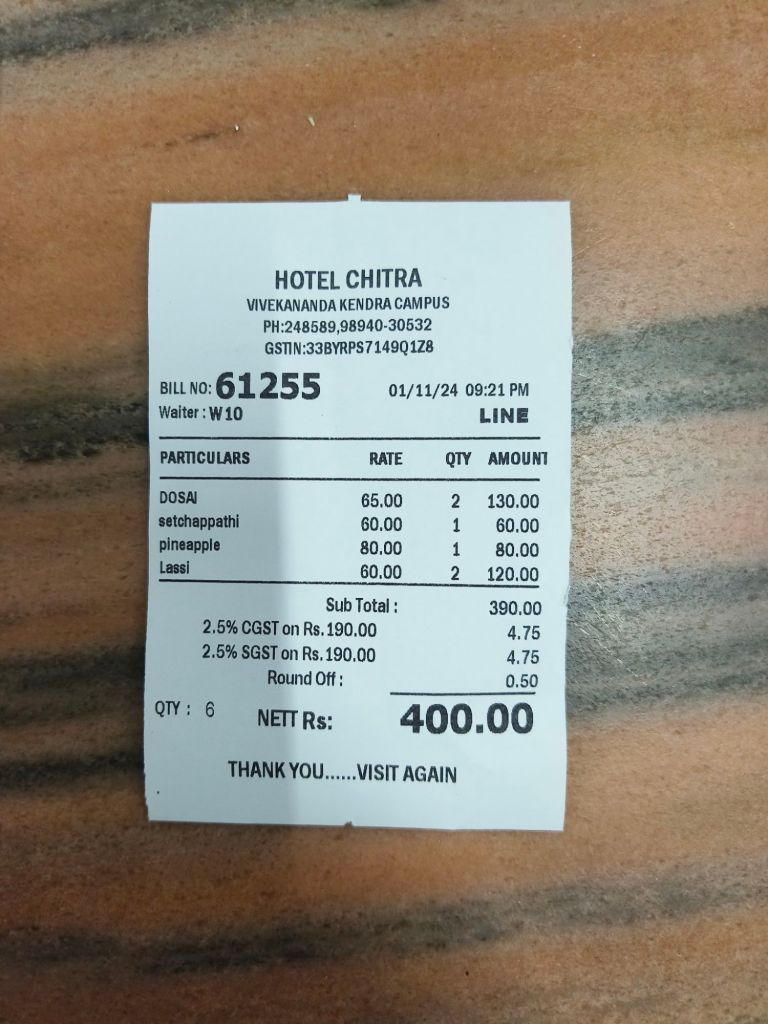
Back at the hotel, the kids settled in for the night, already planning tomorrow. They were adamant about another pool day, but I’d promised a visit to Poovar. Yamuna hinted at returning home early to rest before Monday. Whether the kids or Yamuna win that debate will be tomorrow’s story, but for now, it’s lights out.
A Day on the Road: From Madurai to Trichy, Pudukottai, and Beyond
Yesterday turned into a surprising road trip adventure across South India. It all started with my friend asking if I could join him on an official trip to Trichy and Pudukottai, where he was accompanying another friend. Since I already had a task to pick up some belongings from my aunt in Trichy, I figured, why not? We set out from Madurai at 10:30 AM, driving through the scenic routes of Madurai-Dindigul-Trichy.
By 12:40 PM, we made our first pit stop at Agathiyar Tea Shop in Karumandapam. Nothing sets the tone for a trip like some good tea and snacks. I treated myself to a sandwich and their famous stuffed bun — delicious and perfectly spiced. Energized, we then headed to my uncle’s house in Tillai Nagar. I arrived to a pleasant surprise: my cousin was there with her kids, and it was a heartwarming reunion with my family. It felt great to catch up, even if only for a short while.
Around 1:30 PM, my friend decided to meet up with his childhood friend, who happened to be nearby at the Airtel office in Tillai Nagar. We joined him and then wandered over to Chellammal Mess for a proper South Indian lunch buffet. Between 1:45 PM and 2:30 PM, we dined on a hearty spread of organic vegetables, spinach, and wholesome traditional dishes. A satisfying meal to fuel us for the long drive ahead.
After lunch, we made a quick stop at Padma Coffee to pick up some freshly ground filter coffee powder. This little side trip made us laugh as my friend started reminding us of our “official” purpose — though, in truth, it was shaping up to be more of a memorable day of spontaneous stops and laughs.
Just as we were ready to head back to Madurai, our friend mentioned he needed to buy crackers for his kids, sparking an impromptu detour to Sivakasi, famous for its firecracker shops. From Alangudi, we mapped out a route that led us through Pudukottai, Manamadurai, and Narikudi, which also happens to be my friend’s ancestral village. By this time, night had fully settled in, casting the route in darkness. The roads felt mysterious, winding through unfamiliar, dimly lit stretches with barely any signs of life. It added a sense of quiet adventure to our trip, navigating by headlights alone. We paused for a quick tea break in Tirumayam around 6:15 PM, briefly savoring a warm cup before pressing on through the shadowy roads toward Sivakasi.
After the long drive, we stopped for a late dinner at Karuppiah Nadar Mess in Ettuvattam around 9:45 PM. Once we’d refueled, we arrived at the cracker shop in Sivakasi by 10:30 PM, where we stocked up on fireworks, making sure each of us left with something for Diwali.
Finally, we drove back to Madurai, reaching home around midnight. Our friend was dropped off by 12:15 AM, and we arrived home, exhausted but happy, by 12:45 AM.
In total, it was a 500+ kilometer journey through cities, highways, and countryside. My friend drove the initial leg, but I took over after the tea stop and handled the rest of the trip. It was a day filled with laughter, unexpected stops, and family reunions — truly an unforgettable adventure on the road.

A Day in Madurai: Small Moments, Big Memories
Today was a relaxed, unexpected day. I woke up later than usual and missed the usual morning rush with the kids. Thankfully, my in-laws helped Yamuna get them off to school.
After breakfast, I had a haircut appointment at 10:30 AM. Yamuna gave me a few quick tasks to finish, and after a refreshing haircut and head massage, I was back home by 11:30.
Just as I arrived, I saw my friend and neighbor looking shaken up. His hands were swollen, and there was some blood on his face — he’d fallen off his scooter. I quickly drove him to the hospital in downtown Madurai, and after making sure he was in good hands, I headed back. On the way, I picked up a watermelon, thinking it might be fun for the kids later.
Back home by 1:30, I took a shower, then had lunch with Yamuna. She mentioned needing flowers, so my friend Santhanam and I went to the flower market. We returned with enough to last two weeks.
When the kids got home, Aradhya and Advaith wanted to make watermelon ice cream. We blended the watermelon, poured it into molds, and set it in the freezer. Then, Advaith and I took a nap until six.
Afterward, I went for a walk and completed my goal of 10,000 steps. In the evening, Santhanam and I went Diwali shopping at Ramraj, and he surprised me with three new shirts! We then picked up his brother-in-law from Madurai Railway Junction and returned home by 10 PM.
Reflecting on the day, it was filled with small joys and the warmth of family and friends. Sometimes, the best days are unplanned.
A Day Full of Family, Festivities, and Uninterrupted Sleep
I had a rare and truly satisfying sleep on the bus last night—one of those journeys where everything lined up perfectly. After writing yesterday’s blog, I boarded at Porur toll, dozed off, and miraculously woke up only when we reached Madurai. It was bliss. There’s something about the hum of a moving bus that felt like a lullaby this time, and it was honestly one of the best sleeps I’ve had on a bus in ages.
Reaching home felt just as comforting. I caught up with Advaith, who always has a way of energizing the day. Most of my day rolled by quietly, though, just resting. Except, of course, for a little afternoon sugarcane juice break—a simple pleasure that never fails to hit the spot.
By late afternoon, it was time to get ready for a special occasion: Aradhya’s birthday celebration. At around 4, Yamuna and I set out to pick up cake and snacks, with no idea it would turn into quite the event. But as soon as we returned, the magic happened. One by one, almost every kid in the community showed up, and before we knew it, Aradhya had her very own mini-party right at home. Watching her so happy, surrounded by friends, was a moment that really hit me. My little doll isn’t so little anymore—she’s growing up fast and building her own circle, which is beautiful to see.

Aradhya’s Birthday Cake
The day wrapped up with some fun for the kids: a little cracker-bursting session. It was noisy, joyful, and somehow the perfect ending to a family-filled day. It’s been a while since I felt this connected with everyone, and it was exactly what I needed.
From Meetings to Meaningful Moments: A Day of Connections and New Beginnings
Today was one of those days that just felt *right*. It started with a meeting at 10 AM with Prakash Anna, who was excited to introduce us to a group of budding young entrepreneurs in conversational AI. I picked up BT at the Ashok Nagar metro, and we headed to Dr.Smilez in Ashok Nagar, where our meeting took place. The energy in the room was fantastic; we clicked instantly with these entrepreneurs, sharing ideas and launching our latest product, Glance, specifically for Dr.Smilez. It felt like the start of something great.
Just as we wrapped up, Roshan called, needing his car back. So BT and I headed over to Urban Square for a quick chai discussion before dropping BT off in Asarkhana and delivering the car to Roshan. With that errand complete, I made my way to my cousin Bala’s place. En route, I ran into two of my uncles, and we ended up having a spontaneous, heartfelt conversation. The day was shaping up to be a mix of productivity and meaningful connections.
At Bala’s house, I enjoyed quality time with him and my periamma. However, I’d forgotten to pick up the CCS IT papers from Roshan’s car, so I asked him to drop them off at Saravana Stores, where I picked them up before walking home. I then booked a Swiggy Genie to get the documents over to Vani.
As evening set in, I connected with Balaji and BT over a few calls and took a walk in Porur Gardens. Later, I joined a Gmeet entrepreneurs meetup hosted by KBF. Finally, I packed up, walked to the Porur toll, and caught my bus to Madurai. Now here I am, jotting down this day’s adventures from the comfort of my bus seat, feeling deeply fulfilled.
A Day of Tasks, Adventures, and Surprises
The sun peeked through the curtains as I woke up early, energized to take on the day. It was one of those days where everything was lined up—calls, tasks, and a bit of adventure. I spent the morning catching up with people over calls—BT, Vilvam, Santhanam, Roshan, Balaji, and finally Aravind. Aravind was keen to join me on my rounds to Akshaya Metropolis and Advaith’s Nest, but as fate would have it, he showed up 45 minutes late. We finally left home at 12:45 PM, ready to tackle the long list of things to do.
First, we headed to Croma in Urapakkam. There, I purchased a fridge and a TV for one of my furnished apartments. By then, hunger had set in, so we took a detour to a juice shop, where I savored a sandwich and fresh juice.
Refueled, we moved to Paventher Road to pick up a kitchen rack, an exhaust fan, and a water heater. With the purchases loaded up, we visited Advaith’s Nest for a quick tour with Aravind, showing him the place I’ve been managing for some time.
Our next stop was Akshaya Metropolis, where I asked Raja to set up the rack, exhaust fan, and heater. However, things took an unexpected turn when the tenant incorrectly claimed that the old water heater wasn’t working—when, in fact, it was just fine. They also declined the exhaust fan, worried it might let mosquitoes in through the openings. Frustrated, I felt my time and money slipping through my fingers.
We then headed to the association office to set up the MyGate app. After getting it successfully installed and running, I was wowed by the features it offered—everything from visitor management to real-time updates made me feel more in control and secure.
As the day closed, we strolled through Mahindra City, taking in the evening calm. Despite returning home by 8:30 PM, I regretted not hitting my 10,000-step goal. But life, as always, had other plans.
A Clumsy Start, but a Fulfilling End: A Day of Hustle and Refreshing Moments
Today was one of those days that started with chaos but ended with fulfillment and satisfaction. My morning began at 9 AM as planned, getting ready to head to BT’s house. Just as I was about to leave, my mom wanted to visit the temple and asked me to lock the door, saying she would take the keys. Unfortunately, I mistakenly locked the latch, making it impossible to open the door without the spare key. The spare was with a family friend who had just left for their US visa biometrics appointment, leaving me no choice but to take my mom to my grandmother’s house at St. Thomas Mount for another key. It was a frustrating scooter ride, navigating through peak-hour traffic, taking 1.5 hours for the round trip.
Once that was sorted, I finally headed to BT’s house in Chitlapakkam, but my frustration only grew as I received repeated phone calls during the ride, unable to attend to them while wearing a helmet and driving. I arrived around noon and we quickly got to work, preparing the rent agreement and other documentation needed for opening a bank account. We then visited a nearby PAN service provider to register a PAN for the trust.
By 1:45 PM, we reached out to Balaji to check if he was free for a meeting. He agreed, and we decided to meet at Starbucks, Kathipara, by 2:30 PM. Balaji joined us at 3 PM. He wasn’t too pleased with my choice of Starbucks—rightfully so, as the coffee was more like milk than actual coffee. Even adding extra espresso couldn’t salvage it. Despite the disappointing coffee, I viewed it as a “lounge fee” for our business discussion in a comfortable space with air conditioning. We managed to have a productive meeting, so I couldn’t complain too much.
After dropping Balaji off at his in-laws’ house in Virugambakkam, I headed home and reached by 6:10 PM. Without missing a beat, I freshened up and went for my evening walk. By 6:25 PM, I was at Porur Gardens Park, walking until 7:40 PM, completing my goal of 10,000 steps and 40 heart points.
I wrapped up the day with a refreshing glass of sugarcane juice—a perfect end to a day that started with chaos but ended in fulfillment, fun, and a refreshing sense of accomplishment.
 AnandNataraj