The Day I Realised Not All Procrastination Is Bad


For the longest time, I had one label for myself —
“I’m procrastinating.”

And honestly, it felt heavy.

Because in my head, procrastination meant one thing:
👉 I’m being lazy.
👉 I’m avoiding work.
👉 I’m the problem.

But something didn’t add up.

There were days I didn’t work… not because I didn’t want to…
but because I simply couldn’t.

Still, I blamed it on procrastination.


Two Types. One Word. Big Confusion.

Only later I understood — there are actually two very different types hiding under the same word.

1. Passive Procrastination (The dangerous one)

This is the real problem.

  • You know what to do
  • You have time
  • But you still delay

You scroll, avoid, distract yourself…
and deep inside, there is a constant guilt running in the background.

👉 This leads to stress.
👉 This drains confidence.
👉 This is what I was doing… sometimes.


2. Active Procrastination (The misunderstood one)

This one surprised me.

  • You delay intentionally
  • You are aware
  • You are not guilty

You are either:

  • Waiting for the right energy
  • Letting things settle
  • Or choosing to act later with clarity

👉 This is not laziness.
👉 This is timing.


Where I Got It Wrong

My biggest mistake was this:

I treated everything as passive procrastination.

Even when I was:

  • Mentally drained
  • Emotionally tired
  • Stuck in long, uncontrollable delays

I still told myself:
👉 “You are just procrastinating.”

That confusion created more stress than the actual delay.

Because now I had:

  • No energy
    • Self-blame

The Turning Point

One day, I asked a simple question:

👉 “Am I avoiding… or am I exhausted?”

That changed everything.

I started observing:

  • If I feel guilt + distraction → Passive procrastination
  • If I feel calm but low energy → Active delay / recovery

Suddenly, things became clear.


How You Can Identify Yours

Try this simple check:

Ask yourself 3 questions:

  1. Do I feel guilty right now?
    → Yes = Passive
    → No = Likely Active
  2. Do I have energy but still avoiding?
    → Yes = Passive
  3. If I rest now, will I feel better or worse?
    → Better = You needed rest
    → Worse = You were avoiding

What Changed For Me

The moment I separated these two…

👉 I stopped calling myself lazy
👉 I stopped forcing work when drained
👉 I stopped feeling guilty for resting

And surprisingly…

👉 My productivity improved
👉 My mind became lighter


Final Thought

Not all delays are equal.

Some delays destroy you.
Some delays protect you.

The real skill is not “never procrastinate.”

👉 It is knowing
when you are avoiding… and when you are healing.

That clarity alone can change everything.
Patience and Time… The Only Two Players That Never Fail You


I came across a quote:

“The two most powerful warriors are patience and time.”

At first, it sounded like one more motivational line.

But when I sat with it… it felt uncomfortable.

Because it’s true.


The problem with us

We don’t like patience.

We want:

  • Fast results
  • Quick money
  • Immediate success

Even when we start something new…

Within days, we expect results.

If not, we feel:

  • It’s not working
  • Maybe this is not for me
  • Let me try something else

But life doesn’t work like that

Time has its own pace.

You can’t rush:

  • Business growth
  • Skill building
  • Relationships

You can only:

👉 Show up
👉 Stay consistent
👉 Wait


Why patience feels like weakness

Because nothing is visible.

When you are patient:

  • No one claps
  • No one notices
  • No instant reward

It feels like you are doing nothing.

But actually…

That’s where everything is building.


My realization

Looking back at my life…

Every good thing that stayed:

  • Took time
  • Needed patience

Every rushed decision:

  • Either failed
  • Or didn’t last

The hard truth

We think action creates results.

But in reality:

👉 Action + Patience + Time = Results

Remove patience and time…

Action becomes frustration.

Maybe success is not about doing more.

Maybe it is about:

👉 Doing the right thing…
👉 And giving it enough time to work

Because in the end…

Time always decides.

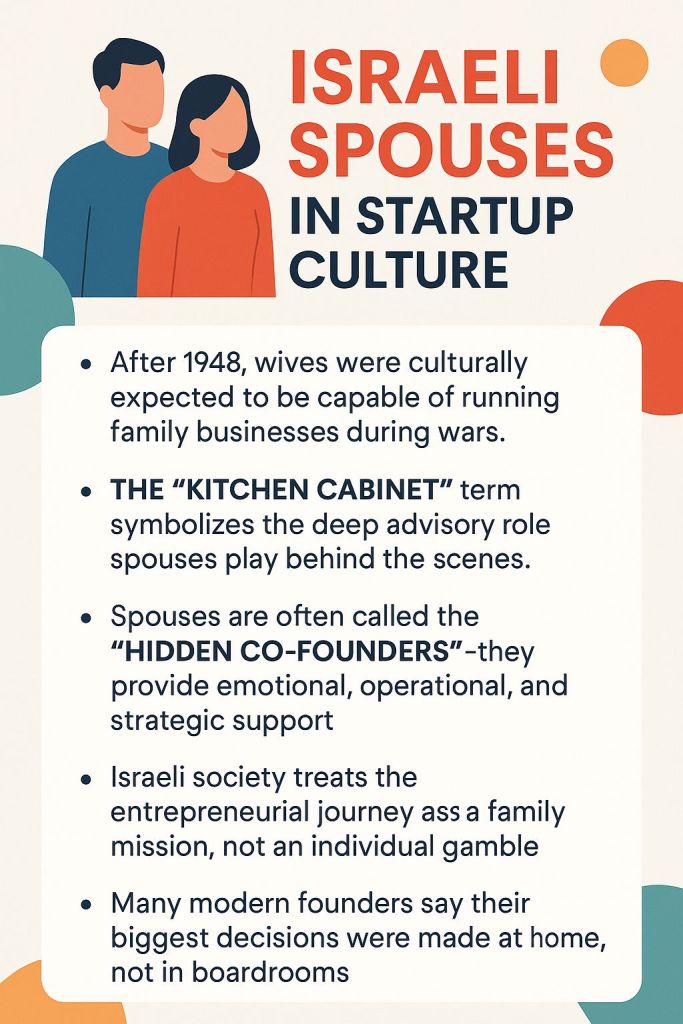
The Hidden Co-Founders: Israeli Spouses & The Kitchen Cabinet


While we often talk about venture capital, tech units, and risk-taking culture when describing Israel’s startup ecosystem, there’s a silent powerhouse that rarely gets enough credit: the spouses.

When Israel was founded in 1948, it was built in the middle of constant conflict and war. Men often had to volunteer or were called away for military service, leaving farms, family businesses, and shops vulnerable. While there wasn’t a strict law forcing women to officially take over businesses, there was a strong community expectation: the wife must know the business inside out to keep it alive if the husband was away — or never returned.

This wasn’t just about economics; it was survival. Business continuity was seen as a patriotic duty. Women weren’t simply supporters at home — they became equal partners in family businesses, laying the cultural foundation for today’s startup ecosystem where spouses often act as the “hidden co-founders.”

In modern Israeli startup culture, there’s a popular phrase called the “kitchen cabinet.” Originally used to describe Golda Meir’s informal advisory group that gathered in her kitchen, it now refers to the personal circle of trusted advisors founders rely on at home — often their spouses.

Many Israeli founders say their toughest strategic decisions didn’t happen in boardrooms but over late-night coffee with their spouse at the kitchen table. Spouses guide them through funding crises, pivots, layoffs, or those nerve-wracking “should we shut it down?” moments.

They hold the emotional line when things fail and cheer the loudest when things click. In a country where risk isn’t just accepted but celebrated, these spouses are not only emotional backbones but also often step into operational roles when needed — just like they did in the early days of the nation.

In Israel, a startup is never just “his” or “hers.” It’s a family mission, a collective leap, and a living example of shared resilience.

Real Stories: Bootstrapping Journeys from Small Towns


When we think of startups, we often imagine glass offices in Bengaluru or pitch nights in Silicon Valley. But some of the most inspiring entrepreneurial journeys are quietly brewing in small towns, far from boardrooms and jargon-filled investor decks.

I’ve seen this firsthand founders building from cramped rooms above grocery stores, farms turned into offices, or small-town cafes with spotty Wi‑Fi and big dreams.

In small towns, bootstrapping isn’t a strategy but it’s the only way. There are no angel investors for coffee meetings or accelerators handing out capital. You depend on savings, supportive family, and a handful of believers.

The unfair advantage of small-town founders

Big-city entrepreneurs chase valuations and media hype. Small-town founders build sustainably — and by necessity. They stretch every rupee, barter for services, and play ten roles at once.

They teach themselves no-code tools. They learn social media marketing on YouTube at 2 a.m. They walk through local markets to gather feedback with humility and curiosity.

Stories that stay with me

I’m inspired by Nishita Vasanth and Priyashri Mani, co-founders of Hoopoe on a Hill, based in Kodaikanal. Since 2015, they’ve grown from sourcing wild honey from local Adivasi (Palaiyan) tribes in the Palani Hills to creating a full-fledged organic brand — including honey, beeswax wraps, and crayons — while empowering over 100 tribal families across 12 villages. Bootstrapped with ₹5 lakh–10 lakh, Hoopoe thrives on small-town efficiency, using India Post for logistics and employing local women in sustainable production. They prove you can build impactful, community-driven, profitable ventures — without chasing investor headlines.

Then there’s Ram Prasath, founder and CEO of Zaaroz, from Chidambaram. In 2018, he and his childhood friend Jayasimhan launched Zaaroz as a local food delivery app. But they didn’t stop at just meals — they expanded to deliver groceries, medicines, fruits, vegetables, meat, and even stationery across 36 tier-2 and tier-3 towns. Zaaroz has completed over 13 lakh deliveries with 400+ delivery executives. What started as a bootstrapped venture with just ₹30 lakh grew into a massive hyperlocal logistics network before they even considered raising funds. Only later did they secure ₹7 crore in funding — after they had already built a solid foundation.

The mindset difference

Small-town entrepreneurs don’t ask, “How soon can I exit?” Instead, they think, “How can I grow this so my community thrives?” They monitor daily cash flow, not social media vanity metrics. They chase satisfied customers, not valuations.

Why bootstrapping builds better character

Every setback hurts. Every win inspires. You learn resilience, patience, and the ultimate currency: resourcefulness. You build relationships because you know you’ll rely on them tomorrow.

A thought for aspiring founders

Don’t wait for perfect funding or polished pitches. Start where you are — with what you have. The market doesn’t care where you began; it cares what problem you solve and how well you solve it.

In small towns, they don’t raise funds first; they raise hopes, hustle, and heart.

In the end, bootstrapping isn’t just about building a business — it’s about building you.

Startups Then & Now: From Empty Streets to Crowded Highways


Two eras, one spirit: the unstoppable heart of an entrepreneur.

I started my entrepreneurial ride back in 2000.

Those days, we didn’t even call it a “startup.” We called it “business,” “consultancy,” or just “trying something on my own.”

There was no Shark Tank. No glossy LinkedIn posts with #hustle. No college workshops on “How to pitch to VCs.”

In 2000, entrepreneurship wasn’t a cool badge. It was something you did if you couldn’t find a job or if you were just stubborn enough to believe you could create something from nothing.

2000: Wild, open roads

  • No references for success. The word “startup” was so rare, only one in a lakh even dared to dream it.
  • Loyalty was real. Your first hire stayed not just for salary but for the dream, even if the office was a one-room setup with plastic chairs and Maaza bottles in the fridge.
  • Markets were raw. Everything was new and waiting. A simple website could make you look like a global player.
  • Corporates & tech were immature. Big companies were still figuring out email, and many had no clue how to use the internet beyond sending scanned copies of invoices.
  • Open source was magic. You could build a product for the price of a few nights of filter coffee.
  • Ecosystem? Nil. No accelerators, no pitch fests, no “startup India” subsidies. Just you, your idea, and sheer guts.
  • Limited resources, big possibilities. Everything felt like a blank canvas.

2025: Crowded highways

  • Startup became a fashion statement. Every Tom, Dick, and Harry wants to “launch something” — sometimes just to add “Founder” to their Instagram bio.
  • Expensive game. Startups today mean burn rates, seed funding rounds, CAC vs LTV debates — even before you have your first paying customer.
  • No loyalty. Employees switch for a ₹2,000 raise or a fancier “Head of Vibe” title.
  • Tech consolidation. The top 5 tech giants dictate tools, languages, and frameworks. Your “freedom to build” has a Terms & Conditions page.
  • Market consolidation. Big sharks have gobbled up fragmented small players. Niches get crushed before you even announce your beta.
  • Ecosystem overload. Events, podcasts, awards, startup conferences. Everyone is “networking,” but very few are really building.
  • Too many eyes, less patience. Today, if your product doesn’t go viral in 2 weeks, you’re labeled a flop.

Then vs Now: What’s the real deal?

In 2000, the road was empty and scary.
In 2025, the road is crowded and noisy.

Then, the challenge was survival in the unknown.
Now, the challenge is standing out in the overcrowded known.

Then, it was about creating a market.
Now, it’s about finding your slot in a saturated market.

Then, you worried about paying your first employee on time.
Now, you worry if your pitch deck slides have enough “impact words.”

But here’s the one thing that hasn’t changed:

The thrill of chasing a vision that only you can see.

Whether you’re hustling on a dusty internet café PC in 2000 or pitching on a Zoom call in 2025 — the soul of entrepreneurship remains the same:
A quiet voice inside that whispers, Let’s try anyway.

“Markets change. Tech evolves. But courage? That stays timeless.”

Enemies Respect You; Traitors Measure You


Seeman Speech

Transcript in English

Today’s traitor was my friend yesterday. Tomorrow’s traitor is today’s friend.

An enemy is always at a distance. But a traitor is always near you.

An enemy will always respect your strengths. But a traitor will always calculate and exploit your weaknesses.

This doesn’t happen only to me — it will happen to you too. So, be cautious.

Kamarajar once said: ‘Show love to every living being, but be very careful with humans.’

We know what a snake will do. We know what a monkey will do. We know what a tiger will do.

But you can never predict what this human beast will do.

Core message

The speech warns us that true danger doesn’t always come from obvious enemies but it often comes from people close to us, the ones who appear as friends but act as traitors.

The speaker emphasizes caution in human relationships:

  • Enemies are straightforward and respect your power.
  • Traitors stay close, study your weaknesses, and use them against you.
  • We understand animals, but humans are unpredictable and can be more dangerous than any wild creature.

It’s a call to be vigilant, not naive, and to love broadly but trust selectively.

From Seed to Success: How Planting a Tree Mirrors the Journey of Entrepreneurship


Entrepreneurship is often considered as a path to financial success, but it is also a responsibility that passes down through generations. The metaphor of planting a tree and watching it grow is a perfect analogy to explain the process of entrepreneurship.

Just like planting a sapling, entrepreneurship requires hard work and perseverance to see it flourish. The first generation of entrepreneurs is responsible for planting the seed, laying the foundation of the business and establishing the brand. They often work long hours, take risks, and make sacrifices to ensure that the business survives the initial years.

The second generation of entrepreneurs, just like the son who nurtured the sapling, are responsible for maintaining the business and ensuring its sustainability. They take what their parents have built and add their own expertise and innovation to keep the business relevant and thriving.

Finally, the third generation of entrepreneurs, like the grandson who enjoys the fruits of the tree, reap the benefits of the hard work of their predecessors. They have the advantage of the trust, systems and processes, and the team and expertise that their parents and grandparents have built.

Furthermore, there is no pride in merely planting a sapling, as it is the duty of any person to contribute to the growth and betterment of society. Similarly, the first generation of entrepreneurs should not take pride in merely starting a business, but rather in creating a legacy that benefits their family and the society as a whole.

In conclusion, the metaphor of planting a tree to explain the process of entrepreneurship is a powerful one. It illustrates the importance of hard work, perseverance, and innovation in creating a successful business. However, it also highlights the responsibility of the first generation to lay a strong foundation, and the obligation of all individuals to contribute to the growth and betterment of society

Perceive Without Quitting: Understanding Failure as a Step Before Success


Success is often seen as the ultimate goal, the pinnacle of our achievements. We strive for it, work towards it, and celebrate it when we reach it. But what about failure? We tend to see it as the opposite of success, something to avoid at all costs. But what if I told you that failure is actually a step before success? That it can be a valuable learning experience that propels you forward towards your goals? In this blog post, we’ll explore the idea that failure is not something to fear, but something to embrace and learn from.

Firstly, let’s define failure. Failure is simply not achieving the desired outcome. It’s important to note that failure is not a reflection of your worth as a person. We all fail at some point in our lives, and it’s how we respond to failure that makes all the difference. The fear of failure can be paralyzing, but if we shift our mindset and see failure as an opportunity to learn and grow, we can use it to our advantage.

One of the greatest benefits of failure is that it teaches us resilience. When we fail, we experience disappointment, frustration, and even embarrassment. But if we can pick ourselves up, dust ourselves off, and keep going, we become more resilient. Resilience is the ability to bounce back from setbacks and keep moving forward. It’s an essential quality for success in any area of life, and failure can help us develop it.

Another benefit of failure is that it can lead to creativity and innovation. When we’re faced with a challenge and our first attempt fails, we’re forced to think outside the box and come up with new ideas. This process of trial and error can lead to breakthroughs and new discoveries. Many of the world’s greatest inventors and innovators experienced failure before achieving success.

Lastly, failure can teach us important lessons. When we fail, we have the opportunity to reflect on what went wrong and how we can do better next time. This process of self-reflection and learning is crucial for personal growth and development. It allows us to identify our strengths and weaknesses and work on improving ourselves.

In conclusion, failure is not something to fear or avoid, but something to embrace and learn from. It can teach us resilience, lead to creativity and innovation, and help us learn important lessons. Remember that failure is a step before success, and don’t give up on your goals just because you experience setbacks. Persevere, learn from your failures, and keep moving forward. With this mindset, you’ll be well on your way to achieving success

10 Essential Commandments for Entrepreneurial Success


  1. Believe in Yourself: Self-belief is the foundation of entrepreneurship. You need to believe in yourself, your vision, and your ability to make it a reality.
  2. Embrace Failure: Failure is a natural part of the entrepreneurial journey. Embrace it, learn from it, and use it to improve.
  3. Be Passionate: To be a successful entrepreneur, you need to be passionate about what you are doing. Passion is what drives you when things get tough.
  4. Take Risks: Entrepreneurship is all about taking risks. Don’t be afraid to take calculated risks to achieve your goals.
  5. Focus on Your Customers: Your customers are the lifeblood of your business. Focus on delivering value to them, and everything else will fall into place.
  6. Build a Great Team: You cannot do everything on your own. Build a great team that shares your vision and is committed to achieving your goals.
  7. Keep Learning: Entrepreneurship is a continuous learning process. Keep learning and improving yourself and your business.
  8. Be Innovative: Innovation is the key to success in entrepreneurship. Be creative and find new ways to solve problems.
  9. Stay Focused: Focus on your goals and don’t get distracted by shiny objects. Stay true to your vision and keep moving forward.
  10. Have Fun: Entrepreneurship can be challenging, but it should also be fun. Enjoy the journey, celebrate your successes, and don’t forget to have fun along the way.

The Power of Persistence: How Embracing Failure Can Lead to Success


If you want to be rich, never give up. These words may sound cliché, but they hold a lot of truth. Many people start on the path to wealth with a lot of enthusiasm, only to give up when the going gets tough. However, if you have persistence, you will come out ahead of most people. More importantly, you will learn.

It is important to understand that failure is not a sign of weakness or incompetence. It is simply an indication that you have not learned enough. When you do something and fail, it is not the end of the world. You can use that experience to learn and grow, and do it differently the next time around.

The most successful people in the world have failed countless times before achieving their goals. It is through failure that they have learned valuable lessons that have helped them succeed. So, if you want to be rich, don’t be afraid to fail. Failure is your friend.

Persistence is key when it comes to achieving success. You need to have the courage to keep going even when things seem impossible. This requires a lot of mental and emotional strength. But, if you are determined and persistent, you will eventually achieve your goals.

It is important to note that success does not come overnight. It takes time and effort to achieve success. So, be patient and keep working hard. It may take years, but if you keep at it, you will eventually achieve your goals.

In conclusion, if you want to be rich, never give up. Be persistent, learn from your failures, and keep working hard. Remember, failure is not a sign of weakness, but an opportunity to learn and grow. With persistence and hard work, you will eventually achieve your goals and become successful