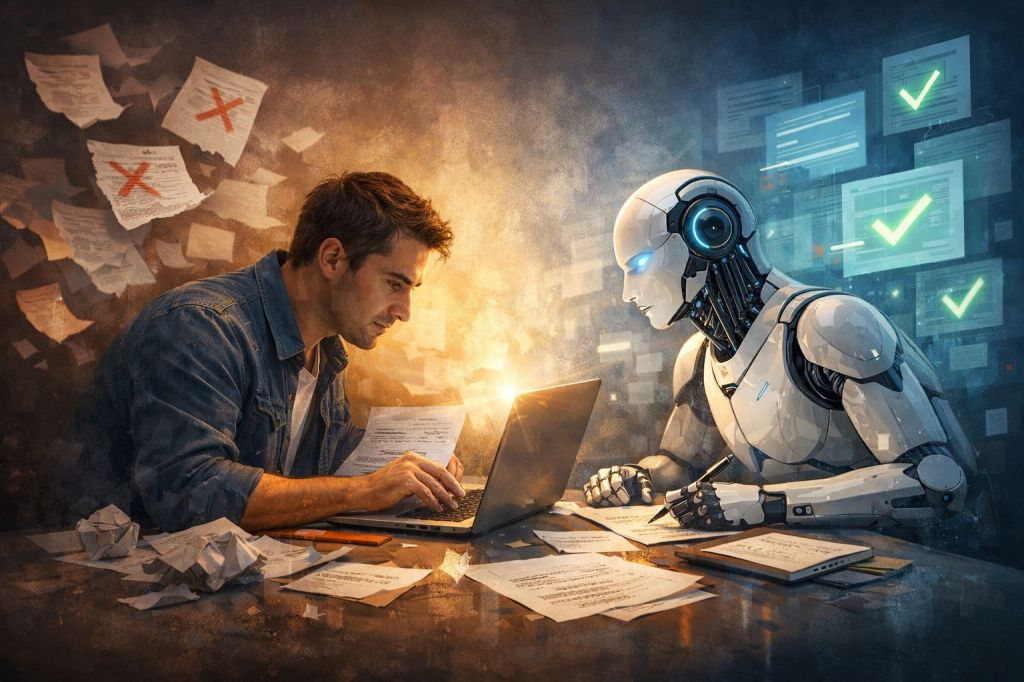
I have been in technology and business for 26 years.
I started when creating a website itself was a skill. Then tools simplified it. PHP changed development. Frameworks reduced development time. Open source changed how we built products. Then came cloud, SaaS and APIs.
Every few years, somebody moved my cheese.
But AI feels different.
AI didn’t just steal my cheese. It seems capable of stealing the next cheese before I even decide where to keep it.
I have been using AI from its early days and watched it move from generic answers to usable content, code, reasoning and now agents that can actually perform tasks.
And I can clearly see gaps in today’s agents.
They struggle with some workflows. They need supervision. Enterprise integrations are messy. Exceptions confuse them.
The entrepreneur in me immediately thinks: “There is a business here.”
Then another voice asks:
“Will this problem still exist six months from now?”
That is something I have never experienced at this intensity in my 26 years of business.
Everyone Is Asking the Same Question
Talk to employees: Will my job survive?
Talk to entrepreneurs: What should I build?
Talk to software companies: What happens when AI can build this itself?
There are plenty of answers—learn AI, reskill, build agents, become AI-first.
But frankly, much of it still feels like writing in the air.
Nobody really knows where the capability line will be two years from now.
That made me realise I may have been asking the wrong question.
Instead of:
“What can I build that AI cannot replace?”
Maybe I should ask:
“What becomes more valuable as AI becomes more capable?”
Don’t Build Around AI’s Weakness
If I build a business around something AI cannot do today, my business depends on AI remaining bad at it.
That is a dangerous moat.
But if I own the customer problem—the workflow, integrations, domain knowledge, exceptions, relationships and operating process—AI becoming better can actually make my business better.
My cost of solving the problem comes down.
That completely changes the equation.
Don’t make AI’s limitation your moat. Make AI’s improvement your leverage.
Maybe I Was Trying to Plant the Wrong Thing
For years, I wanted to build something that lasts.
Something I could plant today and still see standing twenty years later.
AI made me wonder whether that is possible anymore.
Then my own journey gave me an answer.
HTML changed. Development tools changed. PHP changed. Frameworks changed. Infrastructure changed. Cloud changed things again. Now AI is changing almost everything.
But businesses still have customers.
Buildings still need managing. Companies still need moving data between systems. Money still needs collecting. People still need problems solved.
And suddenly it became obvious:
The problem was the tree. Technology was only its leaves.
Leaves are supposed to change.
What Do I Plant Now?
I don’t know where AI will be five years from now.
I don’t think anybody really does.
But I don’t need to find something AI will never change.
I need to find a problem worth owning even if the way we solve it changes five times.
A temporary AI gap might last six months.
Use it.
It brings customers. Customers bring workflows. Workflows bring knowledge. Knowledge creates systems, relationships, distribution and trust.
Those may survive the next model release.
Maybe creating a legacy in the AI era isn’t about building something that never changes.
Maybe it is about building something that knows how to change without losing the problem it exists to solve.
After 26 years of technology repeatedly moving my cheese, perhaps that is the lesson:
AI will keep moving my cheese. My job is not to guard the cheese. It is to own the dairy.