
Most people say this confidently:
“My core team is my partners.”
Fair enough.
Good partners are gold.
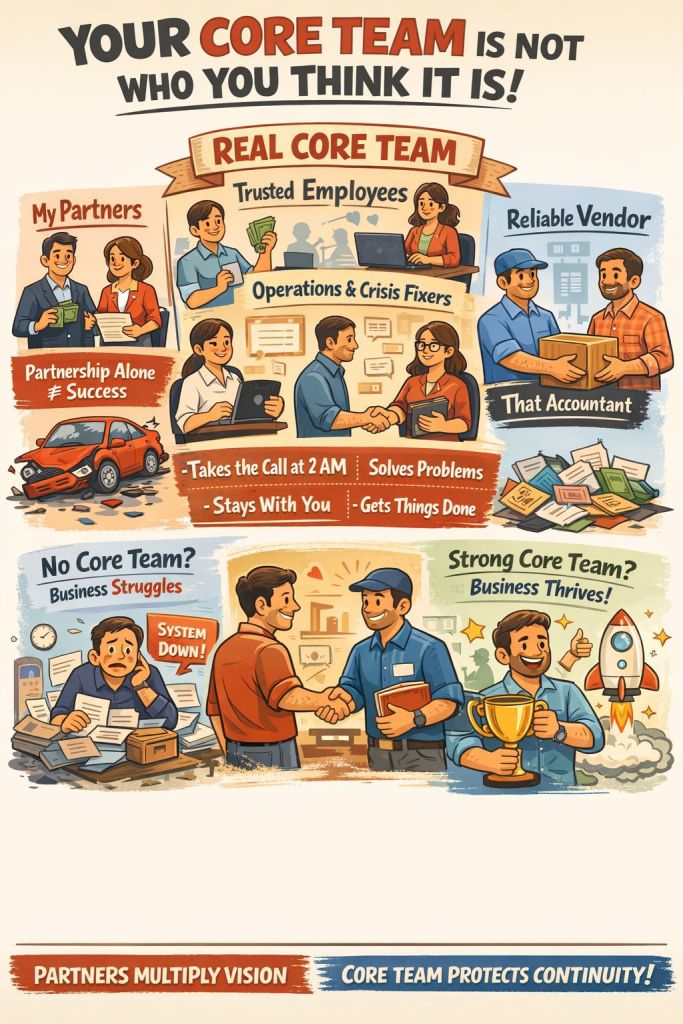
But here’s the uncomfortable truth I learned the hard way:
👉 Many businesses die even with partners.
👉 Many businesses survive and grow without partners.
The difference is not partnership.
The difference is the core team.
Let me say this plainly
A core team is not about equity.
It is about who shows up when things go wrong.
The people who:
- Pick up calls when something breaks
- Know your business better than your SOPs
- Fix problems without drama
- Think, “If this fails, I fail too”
They may be employees.
They may be vendors.
They may not have a fancy title.
But without them, the business slows down or collapses.
That’s the real test.
Why founders misunderstand “core team”
Because startup culture romanticised this idea:
“Find a co-founder. Everything will be solved.”
Reality check:
- Partners give direction
- Teams give movement
A car with only a steering wheel won’t move.
You need an engine, wheels, fuel, and a driver who knows the road.
That’s your core team.
What a core team actually does (in real life)
Not theory. Real life.
They:
- Remember why decisions were taken 3 years ago
- Handle customers when you are sick, stuck, or burnt out
- Prevent small issues from becoming public disasters
- Keep the business breathing during bad phases
Most founders don’t fail suddenly.
They bleed slowly due to weak execution.
A strong core team stops that bleeding.
Some uncomfortable examples
Apple didn’t scale because Steve Jobs had partners.
It scaled because people like Tim Cook ran operations like a machine.
D-Mart didn’t grow because of flashy leadership.
It grew because store managers, buyers, and vendors stayed for decades.
Zoho didn’t win because of funding or hype.
It won because employees stayed long enough to care deeply.
Closer home?
Every successful small business has:
- That one accountant who “knows everything”
- That one operations person who holds the chaos together
- That one vendor who never fails you
They don’t own shares.
But they own responsibility.
Vendors: the most ignored core team
Let’s talk about this honestly.
That vendor who:
- Delivers even during strikes
- Adjusts credit when cash flow is tight
- Saves you from embarrassing customer issues
If they walk away, your business feels it immediately.
They are external employees in spirit.
Treat them like price-only suppliers and you lose them.
Treat them with respect and continuity, they become your shield.
Want to know who your real core team is?
Simple test. No theory.
Ask yourself:
- If this person leaves tomorrow, will my business struggle?
- Do they know things I never documented?
- Do I trust them when money, reputation, or deadlines are at risk?
If the answer is yes — congratulations.
That’s your core team.
Whether HR agrees or not.
The hard truth most founders learn late
A business with partners but no core team is fragile.
A business with a strong core team can survive almost anything.
Partners multiply vision.
Core teams protect continuity.
If you’re building a business, don’t chase only co-founders and equity splits.
Build:
- Trust
- Respect
- Long-term relationships
That’s what quietly builds durable businesses.
 AnandNataraj