
The Year I Stopped Chasing and Started Compounding
For most of my life, I was chasing something.
Chasing revenue.
Chasing validation.
Chasing the next big idea.
Chasing people who didn’t even know they were being chased.
And I thought that was ambition.
If you are reading this from New York, Texas, California or even from a small Midwest town, you know this culture. Hustle. Scale. Optimize. 10X. Exit. Repeat.
We celebrate velocity.
But nobody talks about durability.
The American Dream vs The Compounding Dream
The American Dream is powerful. Build something from scratch. Work hard. Make it big.
But somewhere along the way, “make it big” quietly replaced “make it sustainable.”
I learned this the hard way.
There was a time in my life when everything collapsed at once. Business, relationships, reputation. It felt like falling from the sky without a parachute. And what shocked me was not the fall.
It was the realization that I had built speed, not strength.
Speed impresses.
Strength survives.
The Quiet Power of Compounding
Compounding is boring.
It does not trend on Twitter.
It does not go viral on Instagram.
It does not get you invited to podcasts.
But it changes everything.
Compounding is:
Writing one thoughtful post every week
Investing small amounts consistently
Showing up for your family even when you are tired
Learning one concept deeply instead of ten concepts superficially
In finance, compounding turns 100 dollars into millions over decades.
In character, compounding turns small discipline into unshakeable confidence.
In relationships, compounding turns simple trust into lifelong loyalty.
Why This Matters in 2026
We live in a time of:
AI shortcuts
Overnight creators
Instant monetization
Algorithm driven fame
But the world is also quietly rewarding consistency again.
Businesses that survive are not the loudest. They are the most resilient.
Creators who last are not the most viral. They are the most authentic.
Leaders who endure are not the flashiest. They are the most grounded.
Compounding does not care about geography.
It works the same in Silicon Valley and in a small town in India.
That is the beauty of it.
My Shift
The year I stopped chasing:
I stopped saying yes to everything
I stopped trying to prove my worth
I stopped running behind fast money
Instead:
I built systems
I reduced unnecessary risk
I invested in health
I rebuilt trust
I chose fewer, deeper relationships
Nothing dramatic happened overnight.
But something powerful happened slowly.
Stability.
The day you stop chasing and start compounding is the day your life begins to feel less fragile and more intentional.
Tag: discipline
People Often Judge Outcomes, Not Journeys
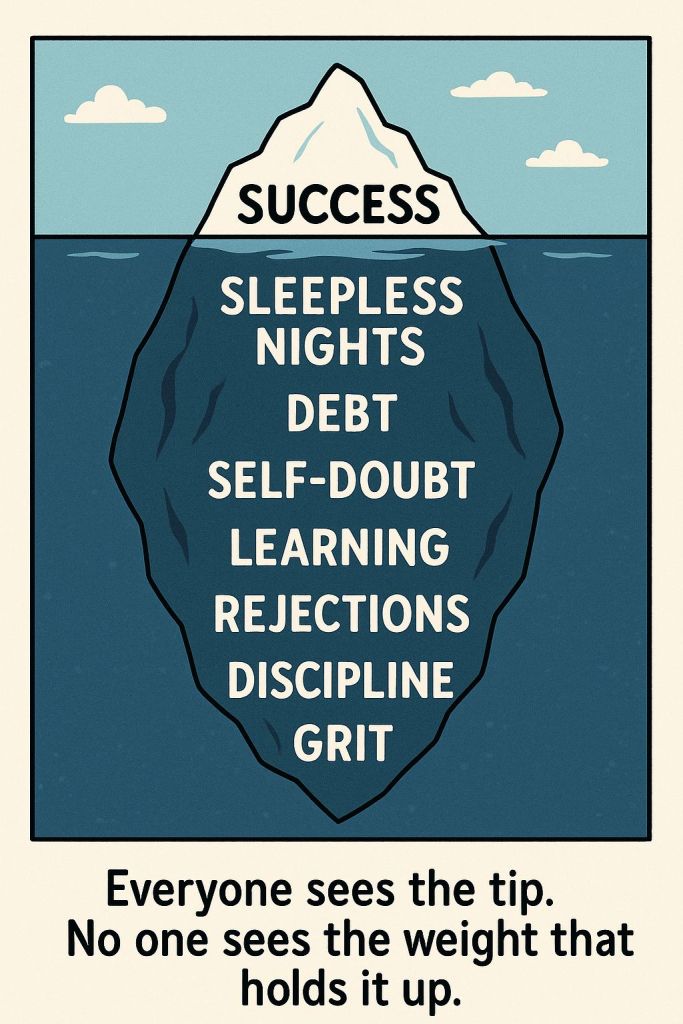
I’ve seen this time and again — in business, in relationships, and especially in entrepreneurship:
People judge outcomes. Not journeys.
Success? You’re celebrated.
Failure? You’re forgotten.
Still trying? You’re questioned.
Why is it this way?
Because outcomes are visible, journeys are not.
Nobody sees the 3 a.m. self-doubt. The loan EMIs. The silent sacrifices.
They only see whether you “made it” — or didn’t.
Society has become obsessed with results.
We’ve built a culture where IPOs trend, but unpaid dues don’t.
Where LinkedIn posts shine, but emotional breakdowns stay hidden.
The cost of this mindset for entrepreneurs?
1.) Emotional burnout
You start believing you’re only as good as your last “win.”
The effort, grit, and growth mean nothing if the scoreboard shows zero.
2.) Judgment from close ones
The toughest hits often come not from strangers, but from family and friends:
“Still chasing your dream?”
“When will you settle down?”
“Why not take up something stable?”
Their concern is real, but their understanding is rare.
3.) Fear of failure
You start making safe bets. You drop ideas too soon.
You avoid risks just to avoid ridicule.
4.) Validation over vision
You chase vanity metrics. You post curated wins.
You start performing entrepreneurship instead of living it.
But here’s the truth no one talks about:
- The journey builds you, whether or not the startup succeeds.
- Failure isn’t the opposite of success — it’s a phase of it.
- Your worth isn’t tied to revenue charts. It’s tied to resilience.
Let’s change the narrative:
Instead of asking:
“What’s your valuation?”
Let’s ask:
“What have you learned?”
“What’s keeping you going?”
“How can I help?”
Because some journeys deserve standing ovations — even without a trophy.
 AnandNataraj