Friends, Politics and Social Media: Can We Disagree and Still Coexist?


There was a time in India when people with completely different political opinions still remained close friends.
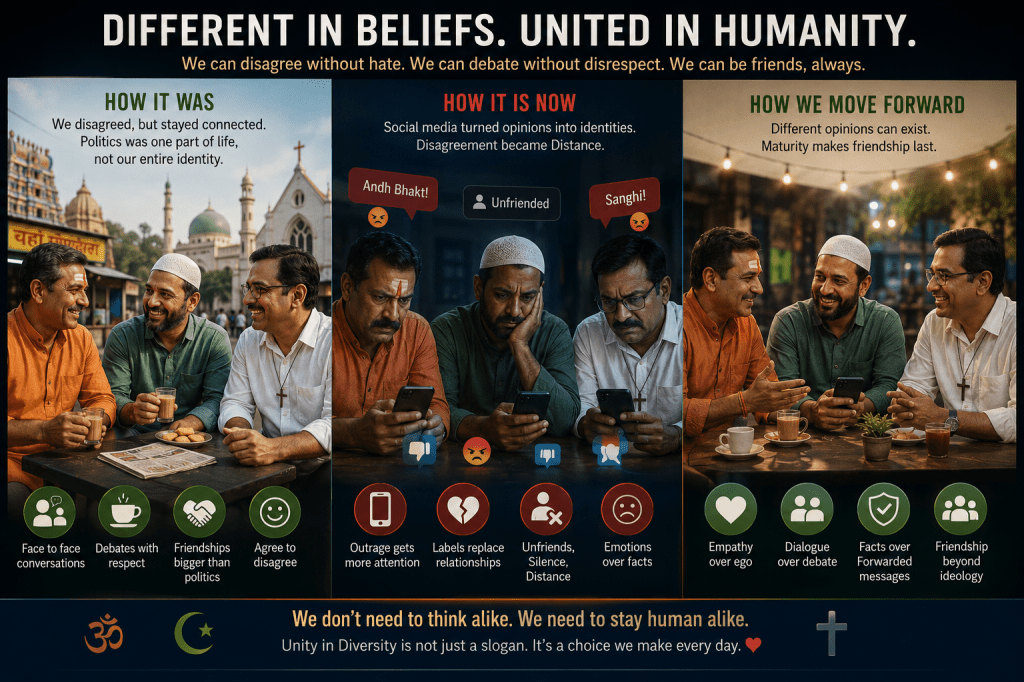
One person voted Congress.
Another supported BJP.
Someone else supported DMK.
One was deeply religious.
Another was secular.

Yet:

  • they attended weddings together,
  • worked together,
  • helped each other in business,
  • had tea shop debates,
  • argued loudly,
  • and still remained connected.

Politics was just one part of life, not the entire identity of a person.

But social media slowly changed this culture.

Today, a political opinion is no longer seen as “just an opinion.” It has become an emotional identity marker. The moment someone openly supports a political party or reacts to a religious issue, people start placing them into categories and labels.

This is where the real pain begins.

In my case, I have many close Muslim and Christian friends — friends from work, business, ex-employees and social circles. I never questioned their religious practices or political preferences. I never had a problem if they supported Congress or DMK.

But when I openly supported BJP or reacted when I felt Hindu beliefs were mocked or insulted, suddenly the reactions changed.

Some called me and expressed disappointment.
Some unfriended me silently.
Some stopped engaging completely.
Some branded me a “Sanghi.”

That word itself is often used today as if it is meant to socially isolate someone.

The irony is: supporting a political party in a democracy should be normal.

is not a banned organization or an underground movement. It is a democratically elected political party, just like or .

Then why has society become emotionally uncomfortable with political differences?

That is the bigger question.

I realized this issue is no longer just about BJP, Congress, religion or ideology. The deeper issue is that society is slowly losing the ability to coexist despite disagreement.

Earlier we had emotional maturity to separate:

  • friendship from politics,
  • people from opinions,
  • relationships from ideology.

Today social media mixes everything together.

Algorithms reward outrage.
Politics becomes identity.
Identity becomes emotion.
Emotion becomes division.

Even normal people slowly become emotionally reactive online.

A person who would happily sit and have coffee with you in real life may still get disturbed by your political post online.

That is the strange contradiction of the social media era.

The dangerous part is not disagreement. Disagreement is healthy in a democracy.

The dangerous part is emotional isolation.

When people stop expressing openly:

  • resentment builds silently,
  • echo chambers grow,
  • society becomes polarized,
  • and friendships become conditional.

Maybe a healthier society is not one where everyone agrees.

Maybe a healthier society is one where:

  • people openly express opinions,
  • disagree strongly,
  • debate emotionally,
  • cool down,
  • and still remain human with one another afterward.

India survived for centuries because of coexistence despite differences in:

  • religion,
  • language,
  • caste,
  • food,
  • region,
  • and politics.

“Unity in diversity” is not about similarity.
It is about emotional maturity despite differences.

Social media has tested that maturity.

Now society must evolve again.

Because if friendships cannot survive political disagreement, then politics has become bigger than humanity itself.

The Season of Social Shrinking


There was a time when my phone was always busy.

Morning calls.
Random evening check-ins.
Late night “dei macha, free ah?” conversations.

If I missed three calls, someone would message: “Are you alive?”

I was that guy.

I could sit with a class topper and discuss marks, then walk to the last bench and laugh about nothing. I was friends with introverts, extroverts, loud guys, silent guys, toppers, backbenchers — I never saw categories. I saw people.

My circle wasn’t small. It was massive.

And I made sure it stayed that way. I would call. I would follow up. I would organize. I would remember birthdays. I would maintain.

Connection was not accidental in my life. It was intentional.

Then somewhere around 2021, something changed.

Not dramatically. Not with a fight. Not with a single event.

It just… thinned.

Some friendships faded because of geography.
Some because of ego clashes.
Some because marriage and children took priority.
Some because life simply moved in different directions.

But here’s the part that surprised me.

The phone slowed down.

And I didn’t try to fix it.


At first, I noticed it like background noise disappearing.

Earlier my phone would ring even if I stepped into the bathroom. Now I can leave it in another room and nothing happens.

And when it rings?

I don’t feel excited.
I don’t feel irritated.
I just don’t feel like talking beyond five minutes.

That shocked me.

Because for most of my life, I enjoyed conversations. I enjoyed being needed. I enjoyed being in the middle of networks.

Somewhere along the way, that desire reduced.

Not because I hate people.

But because I no longer have the same appetite for noise.


The uncomfortable truth is this:

My identity was partially built on being “well connected.”

I was the bridge between groups.
The guy who knew everyone.
The one whose phone never slept.

When that stopped, I had to face a strange question:

If my phone doesn’t ring, who am I?

That question is not dramatic.
It’s quiet.
But it’s heavy.


I’ve also noticed something else.

I don’t have patience for surface-level conversations anymore.

“Enna da news?”
“Same old, machi.”
“Ok ok, catch up soon.”

That loop feels exhausting now.

If I talk, I want depth.
If I meet, I want meaning.
If we connect, I want alignment.

Otherwise silence feels better.

I recently read a line by Jim Rohn:

“You are the average of the five people you spend the most time with.”

Maybe midlife is when you consciously choose those five.

Not because others are bad.
But because your time becomes precious.


There’s another layer to this.

In the last few years, I’ve seen enough — professionally and personally — to understand that trust is fragile. You invest in people, and sometimes the return is confusion, distance, or disappointment.

You don’t become bitter.

You become selective.

That’s different.


Now when my phone doesn’t ring, I experience mixed feelings.

Sometimes there is relief.
Sometimes a small pinch.
Sometimes peace.

But I also notice this:

I think more.
I reflect more.
I plan more.
I observe more.

My external world reduced.
My internal world expanded.

Maybe this is not loneliness.

Maybe this is compression before redesign.

Maybe life is moving me from being socially available to being internally anchored.

I didn’t lose friends overnight.

I lost the need to be everywhere.

And I’m still figuring out whether that is decline…

Or growth in disguise.