
There was a time in India when people with completely different political opinions still remained close friends.
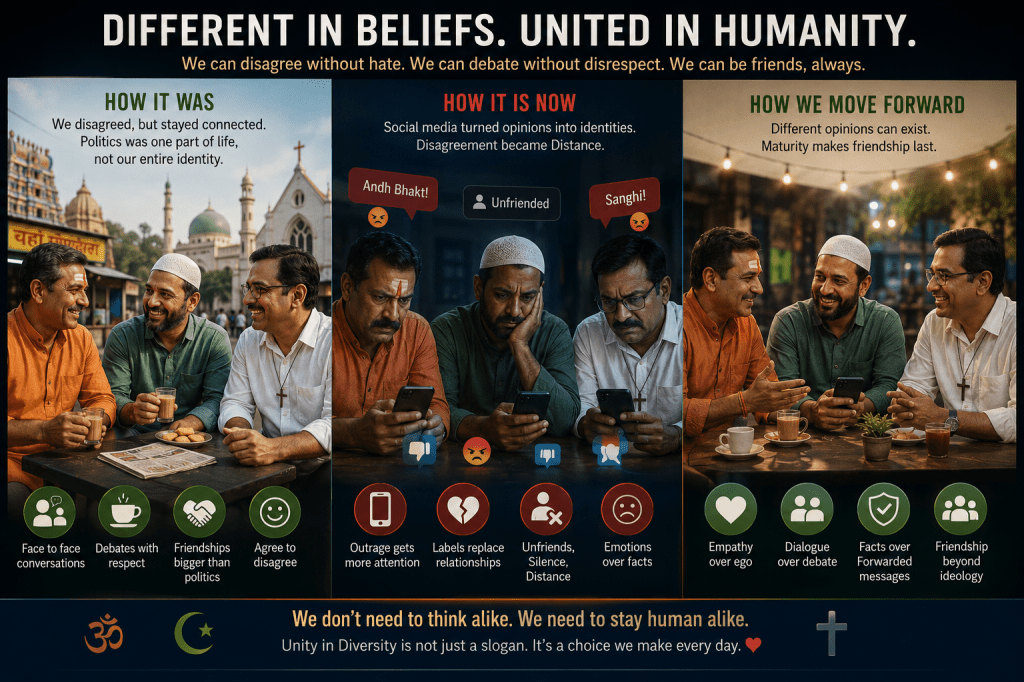
One person voted Congress.
Another supported BJP.
Someone else supported DMK.
One was deeply religious.
Another was secular.
Yet:
- they attended weddings together,
- worked together,
- helped each other in business,
- had tea shop debates,
- argued loudly,
- and still remained connected.
Politics was just one part of life, not the entire identity of a person.
But social media slowly changed this culture.
Today, a political opinion is no longer seen as “just an opinion.” It has become an emotional identity marker. The moment someone openly supports a political party or reacts to a religious issue, people start placing them into categories and labels.
This is where the real pain begins.
In my case, I have many close Muslim and Christian friends — friends from work, business, ex-employees and social circles. I never questioned their religious practices or political preferences. I never had a problem if they supported Congress or DMK.
But when I openly supported BJP or reacted when I felt Hindu beliefs were mocked or insulted, suddenly the reactions changed.
Some called me and expressed disappointment.
Some unfriended me silently.
Some stopped engaging completely.
Some branded me a “Sanghi.”
That word itself is often used today as if it is meant to socially isolate someone.
The irony is: supporting a political party in a democracy should be normal.
is not a banned organization or an underground movement. It is a democratically elected political party, just like or .
Then why has society become emotionally uncomfortable with political differences?
That is the bigger question.
I realized this issue is no longer just about BJP, Congress, religion or ideology. The deeper issue is that society is slowly losing the ability to coexist despite disagreement.
Earlier we had emotional maturity to separate:
- friendship from politics,
- people from opinions,
- relationships from ideology.
Today social media mixes everything together.
Algorithms reward outrage.
Politics becomes identity.
Identity becomes emotion.
Emotion becomes division.
Even normal people slowly become emotionally reactive online.
A person who would happily sit and have coffee with you in real life may still get disturbed by your political post online.
That is the strange contradiction of the social media era.
The dangerous part is not disagreement. Disagreement is healthy in a democracy.
The dangerous part is emotional isolation.
When people stop expressing openly:
- resentment builds silently,
- echo chambers grow,
- society becomes polarized,
- and friendships become conditional.
Maybe a healthier society is not one where everyone agrees.
Maybe a healthier society is one where:
- people openly express opinions,
- disagree strongly,
- debate emotionally,
- cool down,
- and still remain human with one another afterward.
India survived for centuries because of coexistence despite differences in:
- religion,
- language,
- caste,
- food,
- region,
- and politics.
“Unity in diversity” is not about similarity.
It is about emotional maturity despite differences.
Social media has tested that maturity.
Now society must evolve again.
Because if friendships cannot survive political disagreement, then politics has become bigger than humanity itself.

