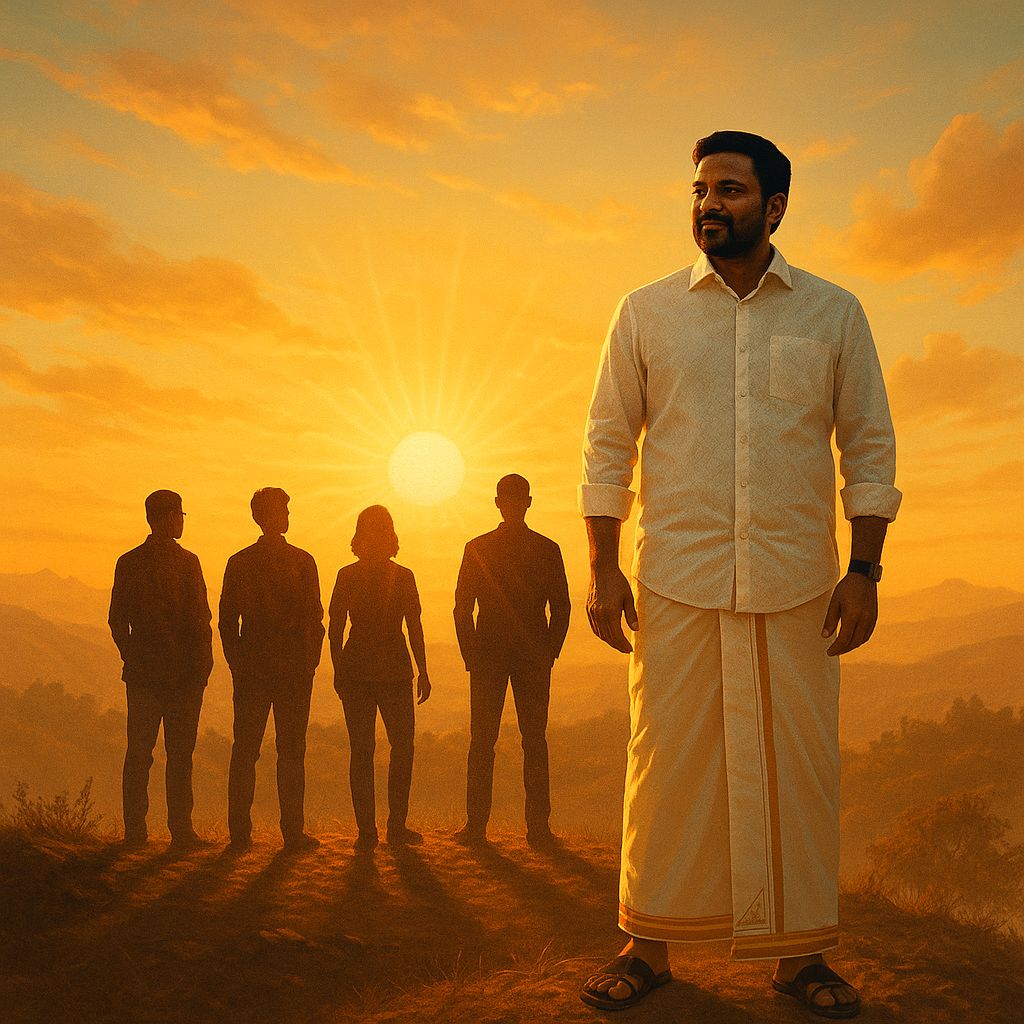
Core Team – The Unseen Faces Behind Every Big Win


Core team. Core strength.

If there’s one thing I keep repeating (even when no one asks), it’s that the success of any business revolves around the core team. People throw around words like “visionary” and “solo genius” as if someone sat in a corner and built an empire alone. But the reality? It’s always a team sport.

In my first venture, I had that magic combo. My partner and I were like two puzzle pieces that just clicked. My strength was his weakness, and his strength covered mine beautifully. It felt like playing doubles in tennis, always knowing someone had your back when you missed a shot.

And then, there were people like Aparnaa and Major Karthik — solid pillars. They weren’t just employees; they were the eyes and ears of the organization. They helped pick the right talents, made sure we kept them, and told us when something was wrong in the team. That loyalty, those late-night calls when there was a problem, those quick decisions we made together — these are things you can’t measure on paper.

When I started my second venture, I had a core team too. But this time, I missed that one piece: a true business partner. And those employees who would stand in the storm with me? I missed that too. You feel it most when the tide turns against you. You realize quickly that it’s not the office decor or the fancy logo that holds you up — it’s that circle of people who will pick up your call at 2 a.m.

It’s the same everywhere if you think about it. Rajinikanth had SP Muthuraman — they did over 25 films together. Many of Rajini’s blockbusters carry Muthuraman’s name behind the scenes. Vijayakanth had Ibrahim Rowther. After their break, Vijayakanth’s box office magic started to fade. And there’s Anand Jain — often called Mukesh Ambani’s “trusted brain,” a man who played the off-field game few saw but many felt.

Even in cricket, look at MS Dhoni. Everyone talks about the “Captain Cool” legend, but think about his gang — Raina, Jadeja, Ashwin — players who trusted him blindly and went to war for him on the field.

When you look back at your journey, it’s always the core team that shines through the fog. The ones who stayed when money ran out, when deals fell through, and when self-doubt felt louder than success. A strong core team isn’t about headcount or titles; it’s about those rare people who treat the business as their own, who see your vision when no one else does, and who carry you through storms without asking for credit. You can have the best idea, the best pitch, or a temporary viral success — but without a core team, it all fades like a one-time festival cracker. Many people have tasted quick wins but vanished because they didn’t have that foundation holding them up when the spotlight moved on.

Finding this team is an art. You don’t spot them in interviews; you see them in crisis rooms and on those quiet late nights when no one is watching. And once you find them, you hold on. You reward them, recognize them, and retain them at any cost — because no trophy or headline is worth more than a team that stands by you even when the world doesn’t.

As we say in Tamil, “தம்பி உடையான் படைக்கு அஞ்சான்” — the one who has brothers behind him never fears an army. It’s a beautiful way our ancestors explained the power of having a strong, loyal support system. Tamils knew long back that it isn’t the sword or the shield that makes you powerful — it’s the people standing behind you.

Some people build empires on sand; some build on people. And if you ask me, the ones who build on people are the only ones who last.

Why the Safe Route Looks Easy, But the Wild Route Feels Right


I’ve often sat at my desk late into the night, staring at the ceiling and asking myself the same question: Why do opportunities seem to pass me by? I risked it all. I worked long hours that blurred into days, pawned my wealth, missed family events, and took responsibility when no one else would even step up. Meanwhile, job goers clocked in their neat 10-hour shifts, played safe, saved their salaries, bought flats, and went home to sleep peacefully. Some even quit when things got tough, never bothering to look back. And today, they seem more “settled” than me. It almost feels unfair. But life isn’t a cricket match with a clear scoreboard. It’s more like a marathon with different routes — some smooth, some with hidden potholes.

The curse (and gift) of taking responsibility

When you take responsibility, you don’t just carry tasks; you carry dreams — yours and everyone else’s. You become the cushion when things go wrong, the cheerleader when hope runs out, and the punching bag when blame needs a home. You can’t play safe. You can’t say, “It’s not my problem.” You’re too busy turning fires into candles.

Why the hustler looks inconsistent

I used to think I was inconsistent. But looking back, I realize I wasn’t inconsistent — I was simply overloaded. When you’re fighting battles on ten fronts, you lose focus on the main goal. You build, break, restart, pivot. From the outside, it looks like a lack of discipline. From the inside, it’s a survival dance.

Why job goers win small but steady

Job goers? They stuck to one lane. They focused only on their paycheck, not the company’s future. They didn’t risk sleepless nights thinking about client payments or the next big move. They followed a simple formula: do the job, save, buy a house, take a vacation, repeat. And you know what? There’s nothing wrong with that.

But then, what about us?

We choose the path of impact, not just income. We choose unpredictability over comfort. We play the game knowing that some days, the scoreboard doesn’t even exist. We’re not inconsistent — we’re experimental. We’re not unlucky — we’re learning resilience the hard way. We’re not behind — we’re building stories that will echo beyond bank statements.

Job goers may retire with a pension; you’ll retire with a legacy. Choose your prize.

In the end, life isn’t about collecting steady paychecks or safe medals. It’s about staying in the arena, even when the crowd goes silent.

How to Become an Entrepreneur in 2025: Build Slow, Play Smart


I started my entrepreneurial journey back when internet cafes were still a thing, and valuation was a word only VCs in Silicon Valley threw around. In 2025, the startup game looks fancier, faster, and full of noise — but the fundamentals remain timeless.

Let’s break it down.

Motivation: Why do you really want to do this?

If your motivation is just to quit your boss, show off on LinkedIn, or post those “hustle harder” selfies — stop right here.

Entrepreneurship is about solving a problem you deeply care about, and having the stomach for months (or years) of invisible effort before the first clap.

Bootstrapping: Start with your own shoes

Bootstrapping isn’t just a funding method; it’s a mindset. You learn to be scrappy, resourceful, and ruthless about where every rupee or dollar goes.

Options to bootstrap in 2025:

  • Freelancing or consulting on the side.
  • Using small grants or local government innovation funds.
  • Partnering with customers to prepay (advance orders).
  • Running micro MVPs (minimal products) and using those profits to fuel growth.

Networking: Find ideas, co-founders & allies

Don’t just scroll startup hashtags.

  • Attend local meetups, online communities (like Indie Hackers, Founder Clubs), and industry events.
  • Discuss problems, not pitches — the right co-founder or investor loves problem-solvers, not wannabe unicorn hunters.
  • Build trust slowly, especially if your co-founder isn’t a sibling or lifelong friend.

Sales & branding: Story first, scale next

In 2025, every customer has a 5-second attention span. Your brand is your story.

  • Solve one problem well, not ten problems “sort of.”
  • Build organic brand trust before performance marketing splurges.
  • Don’t just sell products — sell why you exist.

Opportunities: 2025 is gold for niche plays

  • Hyper-local services (think “Swiggy for home-cooked elders’ meals”)
  • AI-powered micro SaaS tools
  • Regional content & commerce
  • Sustainability products (waste management, zero-waste packaging)
  • Health-tech and affordable wellness

Valuation rush vs. slow & steady

People today worship those “raised $50M in Series A” posts. But most don’t realize — those founders are married to investors now.

Conventional way (slow and steady):

  • Build solid foundation.
  • Focus on profits.
  • Cement market trust.

Unconventional way (valuation-focused):

  • Rapid user acquisition.
  • Burn money to dominate quickly.
  • Aim for big exit or IPO.

💬 Which is ideal?

If you’re building with trusted partners (like siblings or lifelong friends) → Conventional. You think long-term, family legacy, steady cash flows.

If you’re building with a convenience-based co-founder (someone you met for skills, not soul) → Unconventional might work. Faster exits, cashing out before personal values clash.

Dos & Don’ts

✅ Do:

  • Focus on one clear customer problem.
  • Keep costs lower than your ego.
  • Build systems before scaling.

❌ Don’t:

  • Build just for investor applause.
  • Ignore mental and physical health.
  • Copy trends blindly.

Benefits of being an entrepreneur

  • You own your time (even if it feels like your startup owns you at first).
  • You create impact beyond your payslip.
  • You choose your tribe — employees, partners, customers.
  • You grow faster as a person than in any corporate boardroom.

In 2025 or 2055, the game is still the same: solve real problems, stay true to your “why,” and play your own game — not someone else’s scoreboard.