
The Year I Stopped Chasing and Started Compounding
For most of my life, I was chasing something.
Chasing revenue.
Chasing validation.
Chasing the next big idea.
Chasing people who didn’t even know they were being chased.
And I thought that was ambition.
If you are reading this from New York, Texas, California or even from a small Midwest town, you know this culture. Hustle. Scale. Optimize. 10X. Exit. Repeat.
We celebrate velocity.
But nobody talks about durability.
The American Dream vs The Compounding Dream
The American Dream is powerful. Build something from scratch. Work hard. Make it big.
But somewhere along the way, “make it big” quietly replaced “make it sustainable.”
I learned this the hard way.
There was a time in my life when everything collapsed at once. Business, relationships, reputation. It felt like falling from the sky without a parachute. And what shocked me was not the fall.
It was the realization that I had built speed, not strength.
Speed impresses.
Strength survives.
The Quiet Power of Compounding
Compounding is boring.
It does not trend on Twitter.
It does not go viral on Instagram.
It does not get you invited to podcasts.
But it changes everything.
Compounding is:
Writing one thoughtful post every week
Investing small amounts consistently
Showing up for your family even when you are tired
Learning one concept deeply instead of ten concepts superficially
In finance, compounding turns 100 dollars into millions over decades.
In character, compounding turns small discipline into unshakeable confidence.
In relationships, compounding turns simple trust into lifelong loyalty.
Why This Matters in 2026
We live in a time of:
AI shortcuts
Overnight creators
Instant monetization
Algorithm driven fame
But the world is also quietly rewarding consistency again.
Businesses that survive are not the loudest. They are the most resilient.
Creators who last are not the most viral. They are the most authentic.
Leaders who endure are not the flashiest. They are the most grounded.
Compounding does not care about geography.
It works the same in Silicon Valley and in a small town in India.
That is the beauty of it.
My Shift
The year I stopped chasing:
I stopped saying yes to everything
I stopped trying to prove my worth
I stopped running behind fast money
Instead:
I built systems
I reduced unnecessary risk
I invested in health
I rebuilt trust
I chose fewer, deeper relationships
Nothing dramatic happened overnight.
But something powerful happened slowly.
Stability.
The day you stop chasing and start compounding is the day your life begins to feel less fragile and more intentional.
Tag: Long Term Thinking
Three Ways to Become ‘Successful’ — Sweat, Setback, or Shaadi?
There are three kinds of “successful” people in this world.
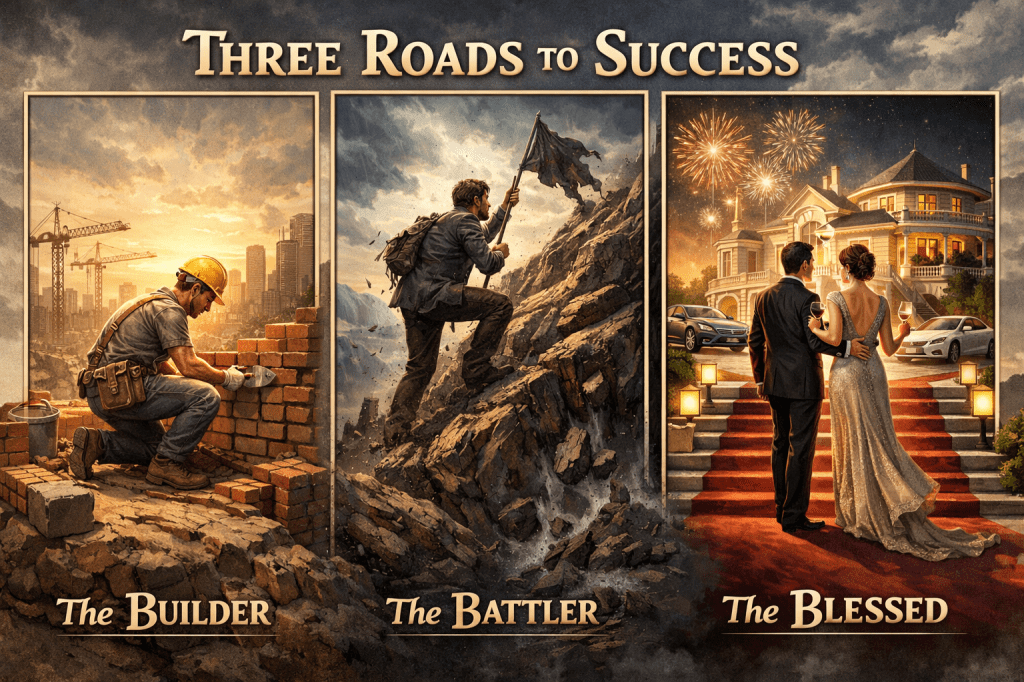
The first kind works hard. Relentlessly. They wake up before sunrise, sleep after midnight, build, rebuild, and keep building. They believe in compounding effort. They trust process.
And they grow.
Not explosively. Not dramatically.
Just steadily.
“They don’t trend. They endure.”
Their life is less fireworks, more sunrise. Not flashy — but dependable. They are the kind who build brick by brick. Slow growth, strong roots.
The second kind works just as hard.
Maybe harder.
They sacrifice sleep, relationships, comfort. They dream big. They bet everything. And sometimes… they lose.
Market shifts. Partners betray. Timing misfires.
And the fall is brutal.
“Hard work guarantees growth of character, not always growth of bank balance.”
These are not failures. They are warriors with scars. They carry depth. They understand gravity. They are the ones who know what it means to fall from the sky and still stand up again.
Empathy belongs here. Respect belongs here.
Because trying and failing builds a different muscle — resilience.
And then… there is the third kind.
The lucky ones.
They marry into wealth.
They inherit position.
They hold property in someone else’s name.
They wake up rich on a Tuesday.
No sweat. No scars. Just destiny saying, “Beta, VIP entry.”
“Some people climb mountains. Some start at the top.”
To be fair, luck is also a skill — mainly in choosing the right wedding venue.
But here’s the humour hidden in truth:
Luck can open doors. It cannot build capability.
And life eventually tests everyone.
In the long run, success is not about how fast you rose.
It is about whether you can stand when the wind changes.
The slow builder? Stable.
The fallen warrior? Stronger than before.
The lucky one? Depends.
Because borrowed power shakes.
Built power roots.
And if you ask me —
I’ll bet on the one who knows how to rebuild.
Narrative vs Karma: What Kind of Entrepreneur Do You Want to Be?
Western business runs on narrative.
Indian thinking runs on karma.

One controls perception.
The other trusts consequence.
As entrepreneurs, we stand in the middle of this crossroads every single day.
Let me start with a man who mastered narrative correction.
The Man Called “Merchant of Death”
Alfred Nobel invented dynamite.
Technically brilliant.
Commercially successful.
Morally… complicated.
In 1888, a French newspaper mistakenly published his obituary (they confused him with his brother). The headline reportedly called him:
“The Merchant of Death is Dead.”
The article criticized him for profiting from explosives used in war.
Imagine reading your own obituary… and discovering the world thinks you are a villain.
That moment changed everything.
Nobel rewrote his legacy.
He set aside most of his fortune to establish what we now know as the — honoring achievements in peace, science, literature, and humanity.
Same man.
Same past.
New narrative.
History remembers him not for dynamite, but for the Nobel Prize.
That is narrative power.
Narrative-Centric Entrepreneurship
Narrative entrepreneurs ask:
- How am I perceived?
- What story is being told about my brand?
- How do I position myself?
- Can I shape reputation before others shape it for me?
They understand something brutal:
“If you don’t write your story, someone else will.”
In the West, this is strategy.
Brand positioning.
PR management.
Thought leadership.
Legacy planning.
It’s not necessarily immoral.
It’s smart.
But here’s the catch.
Narrative can polish image.
It cannot erase consequence.
Karma-Centric Entrepreneurship
In Indian thought, karma says:
“You don’t manage image. You manage action.”
Results follow intention + action.
You don’t rush to fix headlines.
You focus on dharma.
For example:
- Tata Group supporting employees during crises.
- Businesses that extend support beyond legal obligation.
- Founders who choose long-term trust over short-term profit.
No press release needed.
Just silent strength.
Karma-centric entrepreneurs think:
- Would I do this if no one was watching?
- Is this decision aligned with my values?
- What consequence will this create 10 years from now?
They believe reputation is a byproduct of conduct.
The Real Question
Should you be ruthless?
Or moral?
Wrong framing.
The real question is:
Can you be sharp in strategy and strong in values?
Alfred Nobel didn’t deny his past.
He redirected his wealth toward something greater.
That is hybrid entrepreneurship.
The Hybrid Model (My Take)
- Build value ruthlessly.
- Compete intelligently.
- Protect your narrative.
- Never betray your core values.
Because here’s the truth:
Narrative builds brand.
Karma builds foundation.
Narrative gets applause.
Karma gets peace.
Narrative controls headlines.
Karma controls legacy.
And legacy always wins.
Final Thought
You can manipulate perception for 5 years.
You cannot escape consequence for 50.
Choose wisely.
 AnandNataraj