Entrepreneur Dogma: The Silent Killer of Originality


“I started to build my dream. Somewhere along the way, I started building someone else’s playbook.”

In the wild world of startups, we love hero stories. The founder who hustled 24/7, the genius who failed fast and rose again, the team that raised millions overnight.

We turn these stories into gospel. We worship them as dogma — rigid, holy commandments that every founder must obey.

But here’s the dangerous truth:
Dogma is a shortcut to comfort, not success.

The deadliest dogmas every entrepreneur is sold.

1️⃣ Hustle 24/7 or die trying

Work until you collapse. Sleep when you’re dead. Family? Health? Who cares.

Sounds heroic, right?
In reality, this is how burnout is sold as a badge of honor. Sustainable success comes from sharp focus and energy — not self-destruction.

2️⃣ Fail fast, fail often

Yes, learning from failure is crucial. But romanticizing failure without learning is like celebrating a car crash because it “taught you something.”

Failure is a teacher — not a strategy.

3️⃣ Raise money at all costs

Somewhere along the line, we decided VC money was a trophy. The more you raise, the more you “win.”

But money is a tool, not a victory parade.
Your business might thrive better bootstrapped, profitable, and free.

4️⃣ The customer is always right

No. Some customers are wrong, loud, and costly. Your job is to choose your customer — not please everyone.

5️⃣ Growth above everything

We chase hockey-stick graphs, forgetting that vanity metrics are just that — vanity.
Revenue without margins, customers without loyalty, growth without soul — these lead to slow deaths disguised as momentum.

Why do we fall for dogma?

Because it’s easy.
It feels safer to follow a known path than to carve your own.
It feels cooler to repeat Silicon Valley slogans than to think deeply about your own reality.

Dogma gives you a script — but the greatest founders write their own.
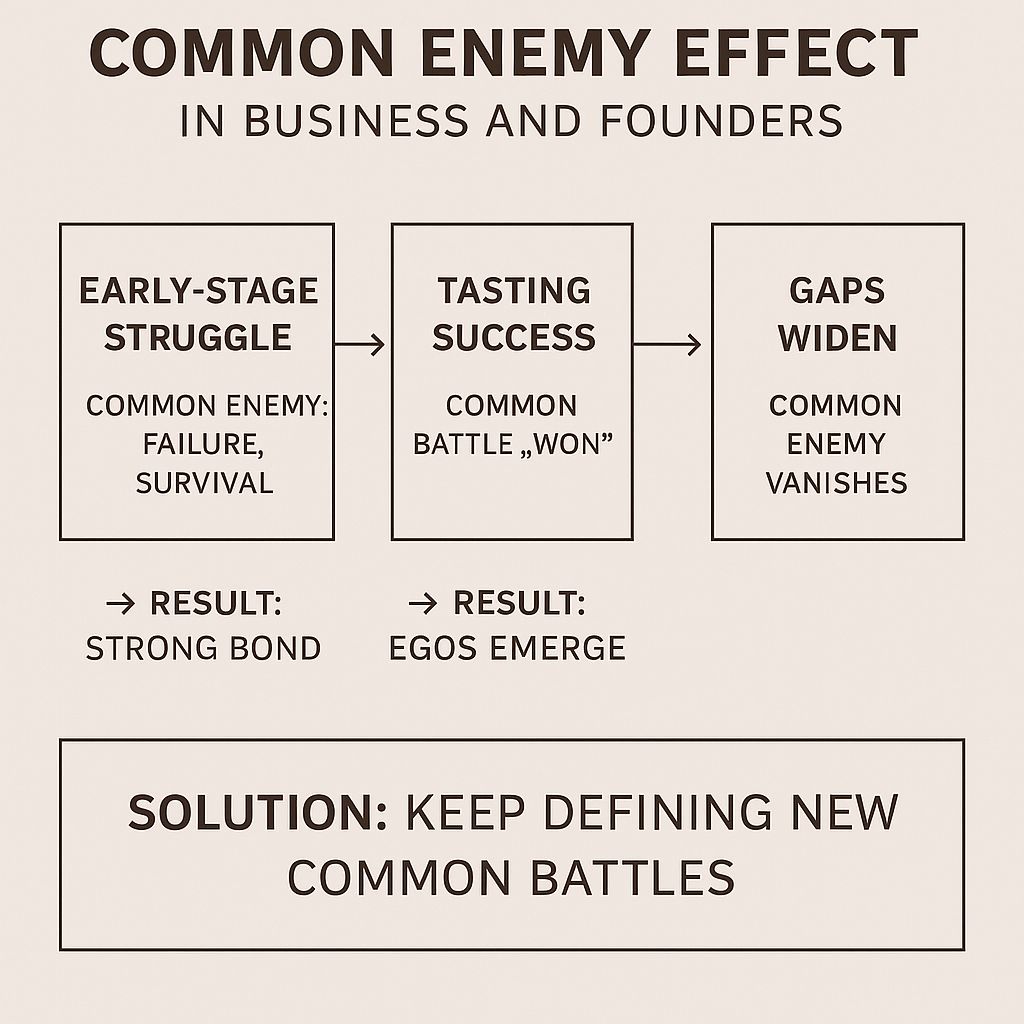
The “Common Enemy Effect” in Founder Relationships


The common enemy effect is a powerful social phenomenon: people unite strongly when they share a common threat. We often see it in military units, sports teams, and political movements — and it’s equally true for founders and startup teams.


Phase 1: The early struggle

When founders start out, they face huge external threats:

  • Market rejection
  • Cash burn
  • Pressure to prove themselves
  • Family or societal doubt

Their common enemy is failure itself. This shared threat aligns them deeply. There’s no time for ego; decisions are fast and collective. Emotional support is strong. They feel like warriors in the same trench.


Phase 2: Early wins and success

Then comes funding, product traction, revenue, or media buzz. Suddenly, the “enemy” that held them together begins to fade.

Without that shared fight, founders start:

  • Claiming credit individually
  • Listening to “proxy teams” or external voices that inflate egos
  • Pushing personal agendas

The urgent need to survive is gone, so the cracks appear.


Phase 3: Gaps widen

When the common threat disappears:

  • Misaligned visions surface
  • Egos grow
  • Trust erodes
  • Silent power struggles begin

The same founders who once pulled all-nighters together may now fight over direction, credit, or influence.


Lessons from research

✅ Ben Horowitz (The Hard Thing About Hard Things): In crises, teams unite; in safety, they splinter.
✅ Patrick Lencioni (The Five Dysfunctions of a Team): Without a shared mission, conflict thrives.
✅ Harvard Business Review: “Shared existential threats unify.” New shared missions are critical as you grow.
✅ Social Identity Theory (Tajfel & Turner): Strong group identity often needs an external “enemy” to stay focused.


What can founders do?

  • Constantly define new “enemies” or big missions (new markets, innovations, tougher impact goals).
  • Regularly revisit and realign personal and collective visions.
  • Watch out for external influences that inflate individual egos.
  • Build a culture where mission > individuals, always.

In short

What unites founders at first? A common enemy (failure, survival).
What causes splits later? The enemy fades, egos rise.
What’s the fix? Keep creating new shared battles to stay united.