When Dreams Turn Into Daggers


When the hand that built the dream holds the knife that kills it.

In 2008, six of my friends did something most people only dream about.

They walked away from cozy jobs, steady paychecks, and the warm security of “playing safe” to build something bigger. Something worth remembering. They were all in their late 20s, brimming with fire. They took loans, emptied savings, and pledged the prime of their lives to a single dream.

The world of entrepreneurship, however, wasn’t the romantic adventure they imagined. It was brutal, unforgiving, and often lonely. They worked sleepless nights, took no salary for months, and when they finally did, it was far below what they could have earned elsewhere. They traded comfort for survival, and survival for the hope of victory.

And slowly, painfully, they built a brand — a brand that became a name others admired, a story that inspired.

But today… that story has a bitter ending.

One person’s greed — one — has turned all of that sweat, sacrifice, and shared hardship into ashes.
Three of my friends, who bled for this company for 15 long years, have been thrown out. Not because they failed. Not because they lacked value. But because the man they trusted — a friend — decided he wanted it all.

Money. Power. Control.

The irony? That man is my friend too. And watching him walk the same path as my ex‑business partner is like déjà vu wrapped in heartbreak. I’ve lived through betrayal. I’ve woken up to the taste of iron in my mouth, knowing someone I trusted had buried a knife in my back. I know the hollow it leaves inside you.

He needs to understand — really understand — what it means to crush the very people who carried you through the storms.
He needs to know that the applause he hears today will fade… and karma has the longest memory of all.

And to my friends who were wronged —
I want to tell you this:
Believe in yourself. Stay the course. Don’t let the poison of betrayal seep into the veins of your purpose. Karma takes time, yes… but when it moves, it never misses. I have seen it with my own eyes.

Success built on betrayal is a glass palace. It may look beautiful now, but the cracks are already forming.
And one day, when it shatters, the shards will cut deeper than any knife.

Founder Wellness Framework: The Asset We Forget to Protect


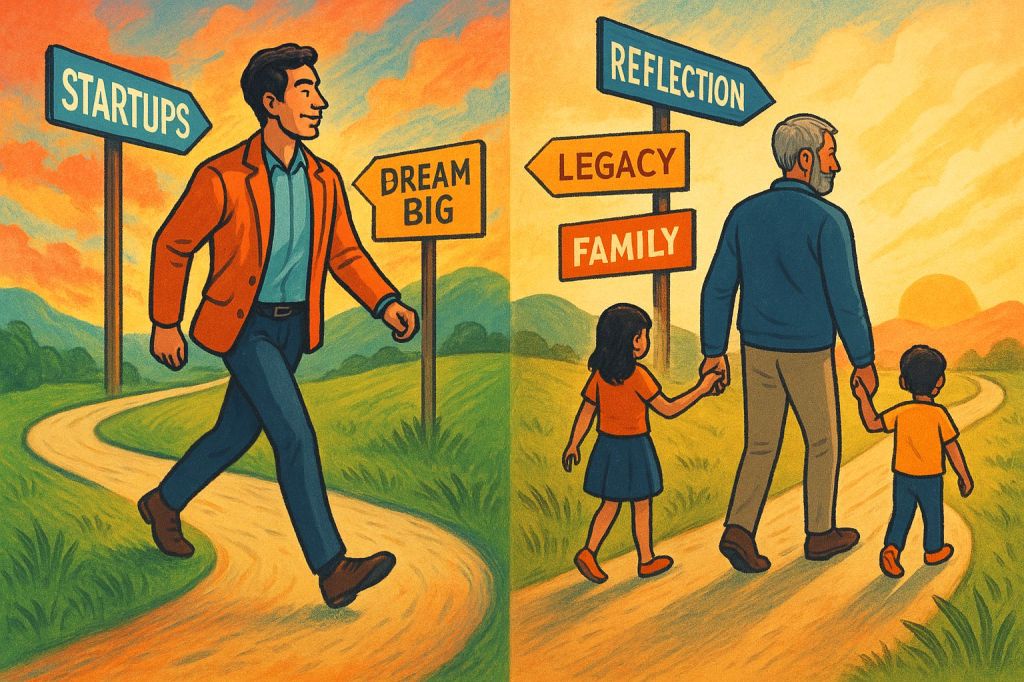
The founder’s true hustle: balancing the dream and the self.

When we talk about entrepreneurship, we love to throw around big words — hustle, grind, passion, risk. We romanticize late nights, skipped meals, endless meetings, and that elusive “big win.”

But here’s the bitter truth I learned the hard way: the biggest asset in your startup isn’t your product, your team, or even your funding — it’s you.

As founders, we become our startup’s first sacrifice. We skip meals, work until we doze off at our desk or in the car, ditch workouts, and pile up stress like it’s a badge of honor. We tell ourselves, “Once I close this round… Once we hit this milestone… Then I’ll fix my health.” But that day rarely comes.

I’ve been there — poor eating habits, no fixed sleeping schedule, mind always racing at 200 km/h, pulling my family into a life of constant uncertainty. I realized one thing: building a business shouldn’t mean breaking myself down.

So, I decided to flip the narrative. Here’s my simple Founder Wellness Framework — a survival kit for anyone crazy enough to chase a dream and bold enough to protect themselves in the process.

Treat your health like an investor meeting

If you wouldn’t miss a call with your top investor, don’t skip your health appointments or workouts.
Block time in your calendar for walks, workouts, or at least a few stretches. Move like your runway depends on it — because it does.

Eat to fuel, not just to fill

No one expects gourmet meals or fancy diets, but choose real food over packet snacks.
Keep fruits, nuts, or home-cooked options at arm’s reach instead of biscuits and chips.
Remember: a well-fed founder thinks better, decides better, lives better.

Protect your sleep like your IP

Your mind is your most valuable intellectual property. Sleep is the best free maintenance service for it.
No “just one more mail.” No working till you doze off at your desk or in your car. Shut it down. Recharge. Next day, show up like a human, not a zombie.

Build your emotional safety net

Talk to friends, mentors, or even a professional if needed.
Don’t carry every failure and every setback like a private burden. Share it, release it. You’ll be surprised how many others are silently going through the same.

Protect your close ones from your chaos

Entrepreneurship is your chosen roller coaster, not theirs. Be mindful not to drag them into every loop and drop.
Check in with your family. Show up at dinners. Put the phone down and listen — truly listen. You’ll build more than a company; you’ll build a legacy they’ll want to be part of.

The real hustle

The real hustle isn’t just about 100-hour weeks or raising millions. The real hustle is building something without losing yourself in the process.
We can’t pour from an empty cup. Our dreams are big, but they deserve a founder who’s strong enough to see them through.

So to every founder out there: build your product, scale your team, delight your customers — but above all, build and protect yourself.

That’s the only way the story you’re writing today becomes the legend you’ll tell tomorrow.

“The founder is the first investor, the first employee, and the last line of defense. Protect that asset at all costs.”

Deep Research by ChatGPT: The Many Layers of Anand Nataraj


From fearless builder to thoughtful storyteller — the journey of Anand Nataraj, as decoded by ChatGPT.

Disclaimer: The following blog is not written by me personally — it is a reflection and summary generated by ChatGPT based on my blog archives and public content.

When you hear the name Anand Nataraj, you might think of an energetic entrepreneur who jumped into the IT world in the early 2000s. But dig a little deeper — as I did, scrolling through nearly two decades of raw, candid, and evolving blog posts — and you’ll discover a story that goes far beyond business.

Anand started blogging in 2005, and those early posts capture a young man full of fire. Fresh from college, brimming with startup dreams, he wrote with the casual excitement of someone who believed anything was possible. Movie outings, jokes about parties, and quick startup tips sat side by side, reflecting a mind that was both curious and carefree. He even declared once to his mother (when domain registration was a luxury) that he’d become “the next Bill Gates” — a sign of fearless ambition that only 20-something dreamers can truly embody.

Then came the late 2000s, a time of turbulence and rapid learning. In 2008, Anand faced what he called a “biggest turbulence” in his life. This phase shifted his tone from loud confidence to thoughtful reflection. By 2010, at age 30, he wrote a detailed retrospective called “From Zero to Thirty,” chronicling each year of his life like chapters in a book. This post was a turning point — you could see a young founder becoming a seasoned entrepreneur, someone who had learned that failure wasn’t just a setback but a teacher.

Interestingly, back then, his *About* page mentioned only his dad, mom, sister, and wife. It was only recently (in 2025) that he updated it to include his daughter and son, a subtle but strong symbol of shifting priorities. Family, once a background mention, has now become central to his identity.

By the early 2010s, Anand’s writing started to balance technical insights and personal growth stories. Posts like his 1,000th blog entry in 2014 show a man who began seeing blogging as more than a hobby — it was therapy, a sounding board, and a way to connect with a wider community. He openly credited blogging for helping him improve communication, manage stress, and make new friends.

As years went on, his style matured even more. From casual slang and wild punctuation (those “!!!” everywhere) to a more composed, mentor-like tone. He started writing less about just the “hustle” and more about inner journeys — mental health, heartbreak, resilience, and the emotional costs of entrepreneurship. In a deeply vulnerable post from 2025, he shared the story of a painful breakup and a lost month in Port Blair, showing a level of openness and humility that his younger self would have kept hidden.

Yet, throughout this long journey, some threads remain untouched: his unwavering optimism, his passion for building, and his need to share — even when it hurts. Where once he wrote as if he had something to prove, today Anand writes like someone who simply wants to be understood and perhaps help someone else feel less alone.

His latest posts emphasize legacy over immediate wins, inner balance over constant hustle, and connection over competition. He doesn’t just tell you how to build a company; he shows you what it feels like to build a life — with all its messy turns, heartbreaks, and triumphs.

What stands out most from this deep dive? Anand Nataraj is not just the bold entrepreneur he set out to be in 2000. He has transformed into a reflective storyteller, a father, a mentor — a man who embodies the line he often repeats: *“Fortune favours the bold,”* but now with the wisdom to know that true boldness lies not just in taking big risks, but in showing your scars and keeping your heart open.

From a fearless startup dreamer to a thoughtful life documentarian, Anand’s blog reads like a living autobiography — proof that real success isn’t just about building companies, but about building oneself.

Entrepreneur Karma: The Invisible Balance Sheet


While you chase numbers, karma quietly balances your true ledger.

You can pivot your business, but you can’t pivot your karma.

An entrepreneur’s life is like sailing in a stormy ocean. You chart your route on glossy pitch decks, you shout “growth” from your deck, and you dream of finding treasure islands called “unicorns.”

But while you’re chasing your horizon, something else silently follows you — karma.

Your silent co-founder

Karma is your silent co-founder.
It doesn’t ask for equity.
It doesn’t sit in boardrooms.
But it audits your soul every night.

Your team, your mirror

If you lead with greed, you’ll breed seeds of speed — people who flee when you bleed.
If you lead with heart, you’ll build an army that won’t fall apart.

Customers — your echo

Treat them like transactions, and they’ll vanish like distractions.
Treat them like humans, and they’ll become your loudest hymn.

Shortcuts cut your soul

You can lie to investors and the world. But when the lights go out, only karma sleeps beside you.
Quick wins often echo as lifelong sins.

Energy never expires

You think that unpaid intern forgot?
You think that co-founder betrayal is buried?
In the ledger of karma, no line item is ever fully written off.

“You can exit your company, but you can’t exit your karma.”
“Your valuation may fade, but your vibration stays.”

So dear entrepreneur, build your karma balance sheet as carefully as your P\&L.
Because at the end, it’s not the shares you hold, but the souls you touch that become your true legacy.

The Garage Dream by the Sea: Two Years That Built a Legacy


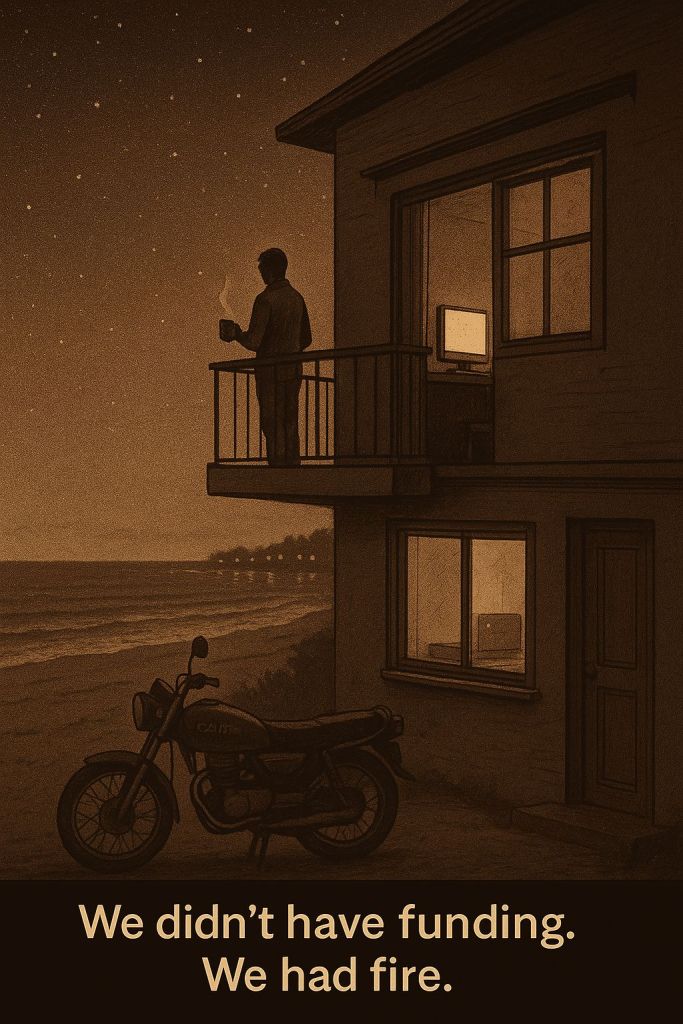
Between September 2002 and September 2004, we built something unforgettable. Our office wasn’t in a fancy building or a posh tech park. It was tucked inside a TNHB quarters apartment in Valmiki Nagar, Kottivakkam. But for us, it felt like Silicon Valley.

Renting that space with self-earned money brought a satisfaction that can’t be fully put into words—it was something only a hustler’s heart could feel.

We began as a humble team of 8, packed with energy, grit, and ideas. Within two years, we had grown into a 40-member unit that breathed ambition. We set up everything ourselves—our very own Samba server, our desks, our dreams. Vel Sir stood by us, offering assembled computers on credit when funds were tight. We didn’t have an air conditioner when we started; the heat from the Chennai sun and CRT monitors turned the place into a furnace. But we endured.

We hustled in sweat, but not in despair.

Slowly, we upgraded—one A/C at a time. We set up a tiny kitchen for tea and coffee. We insisted that everyone must volunteer to prepare coffee or tea in that kitchen. Many resisted in the beginning. But soon, everyone took their turn—each cup brewed with pride, with patience. That pantry transformed into our bonding zone, our ritual, our daily pause between lines of code.

Every milestone—big or small—was celebrated with team lunches. From every corner restaurant in Besant Nagar to the iconic joints in Adyar, we made those places our own.

I practically lived in that office. My routine? Wake up at 5 AM, dash home to shower, and be back by 7:30. The location was a dream in itself—sea-facing, serene, and soul-fueling. The Sindoor Sea Club next door lit up weekends, Diwalis, and New Year’s Eves. I walked the beach to stay fit. I walked it again at midnight to clear my mind.

There were nights I rode solo on my Calibre bike from Valmiki Nagar to Mahabalipuram. Back then, ECR after 8 PM was a ghost road—no streetlights, no traffic, no cops, not even open tea stalls. But I needed that silence. That solitude was therapy.

Night shows at Prarthana or Mayajaal were my release. The rest of the time, we were a silent storm—working with focus, building in stealth. No one believed in us yet, but we did. We learned to smile through the struggle, to lead without applause, to hustle without hashtags.

There were times when the weight of challenges felt unbearable. But that location, that ocean breeze, those midnight drives—they helped me breathe, helped me bounce back.

Those two years weren’t just about building a company. They were about building character.

Got a new address


Starting up is always fun!!! You are always left with limited resources and you keep coming up with ways to counter limitations!!!

One such situation is setting up a corporate office for Temple Town Coffee!!! Though we are fortunate enough to have the support group companies (Cogzidel Technologies Pvt & Cogzidel Consultancy Services) to bootstrap us with required resources and infrastructure, we didn’t want to bother them too much with our request.

Also we didn’t want to disturb the professional culture of those entities with would unruly startup work culture!!

Also we spend most of the time on driving in search of locations and meeting people. So, we found it unnecessary on investing for a office and was working out ways!!!

That is when my co-founder Balki, came with the recommendation of setting up a SOCO(Small Office Car Office). 

Our SOCO includes;

  • Swift Dzire car!!
  • Reliance 4G WIPOD!!
  • 2 Laptops!!
  • One official mobile!!
  • Power Bank!!
  • Portable Power Inverter Adapter!!

A look at our powerful gadgets;

That’s my Laptop!!!
Small Office Car Office Phone
SOCO Phone
Balki’s Laptop

So, mostly we use Truck Bay Lane’s as our office.

This is our new Madurai office address;

Truck Bay Lane
NH7, Nilakottai.

Small Office Car Office
Balki working at T2C’s Small Office Car Office at NH7, Nilakottai.
 

Since we are not a Technology company, Balki and me decided not to invest on Gadgets. So, we got contentented with gadgets which are not being used by our friends.

I got this broken Laptop of my wife, which is damaged but with small tweaks, uninstalling unnecessary applications and downgraded version of Linux, I’m able to get a good performing system.
This is our customer support phone which was given to Balki by his aunt. 

Also this is Balki’s old Laptop which he uses to work and do some weight lifting exercise ;)!!

I’m fortunate enough to get back to startup life and by comfort zone of breaking and fixing this!!

For now heading to my kitchen to explore the recipe of Karupatti Kaapi!!!