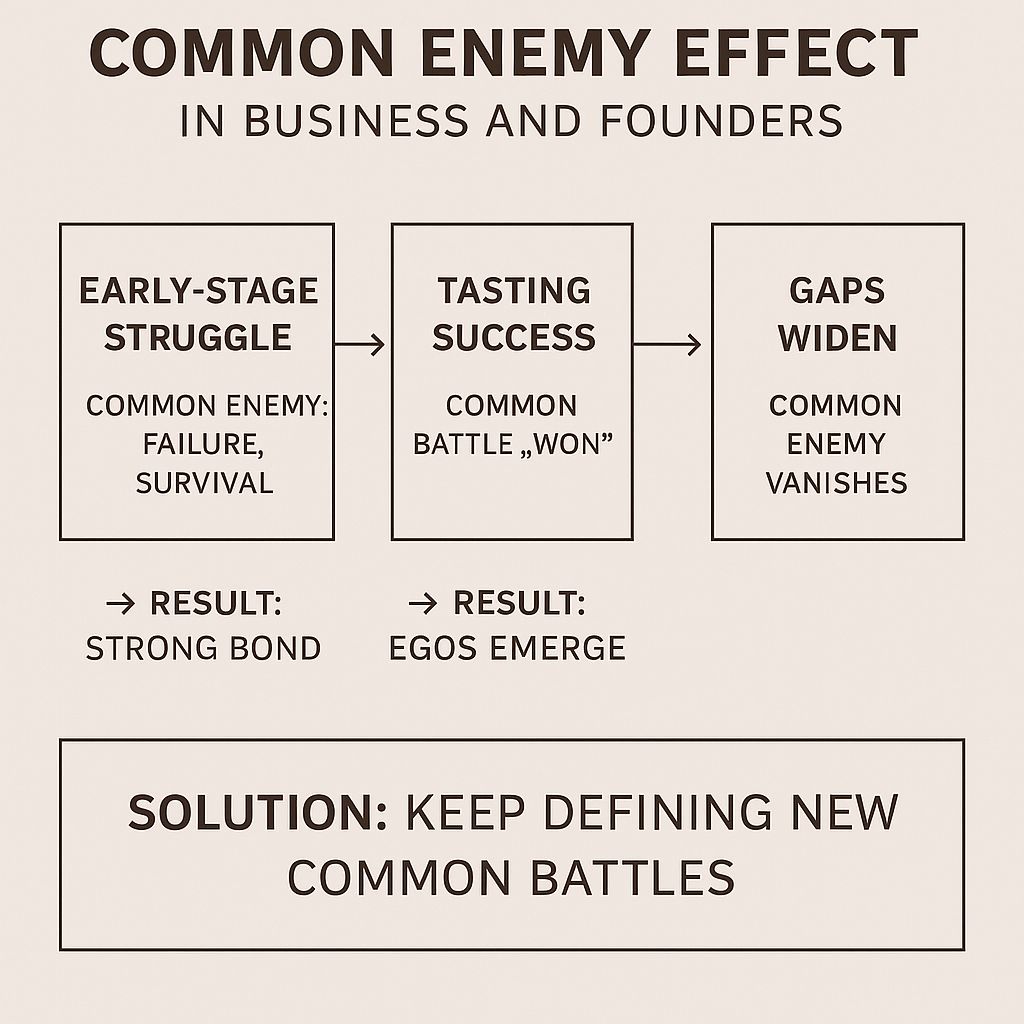
The “Common Enemy Effect” in Founder Relationships


The common enemy effect is a powerful social phenomenon: people unite strongly when they share a common threat. We often see it in military units, sports teams, and political movements — and it’s equally true for founders and startup teams.


Phase 1: The early struggle

When founders start out, they face huge external threats:

  • Market rejection
  • Cash burn
  • Pressure to prove themselves
  • Family or societal doubt

Their common enemy is failure itself. This shared threat aligns them deeply. There’s no time for ego; decisions are fast and collective. Emotional support is strong. They feel like warriors in the same trench.


Phase 2: Early wins and success

Then comes funding, product traction, revenue, or media buzz. Suddenly, the “enemy” that held them together begins to fade.

Without that shared fight, founders start:

  • Claiming credit individually
  • Listening to “proxy teams” or external voices that inflate egos
  • Pushing personal agendas

The urgent need to survive is gone, so the cracks appear.


Phase 3: Gaps widen

When the common threat disappears:

  • Misaligned visions surface
  • Egos grow
  • Trust erodes
  • Silent power struggles begin

The same founders who once pulled all-nighters together may now fight over direction, credit, or influence.


Lessons from research

✅ Ben Horowitz (The Hard Thing About Hard Things): In crises, teams unite; in safety, they splinter.
✅ Patrick Lencioni (The Five Dysfunctions of a Team): Without a shared mission, conflict thrives.
✅ Harvard Business Review: “Shared existential threats unify.” New shared missions are critical as you grow.
✅ Social Identity Theory (Tajfel & Turner): Strong group identity often needs an external “enemy” to stay focused.


What can founders do?

  • Constantly define new “enemies” or big missions (new markets, innovations, tougher impact goals).
  • Regularly revisit and realign personal and collective visions.
  • Watch out for external influences that inflate individual egos.
  • Build a culture where mission > individuals, always.

In short

What unites founders at first? A common enemy (failure, survival).
What causes splits later? The enemy fades, egos rise.
What’s the fix? Keep creating new shared battles to stay united.
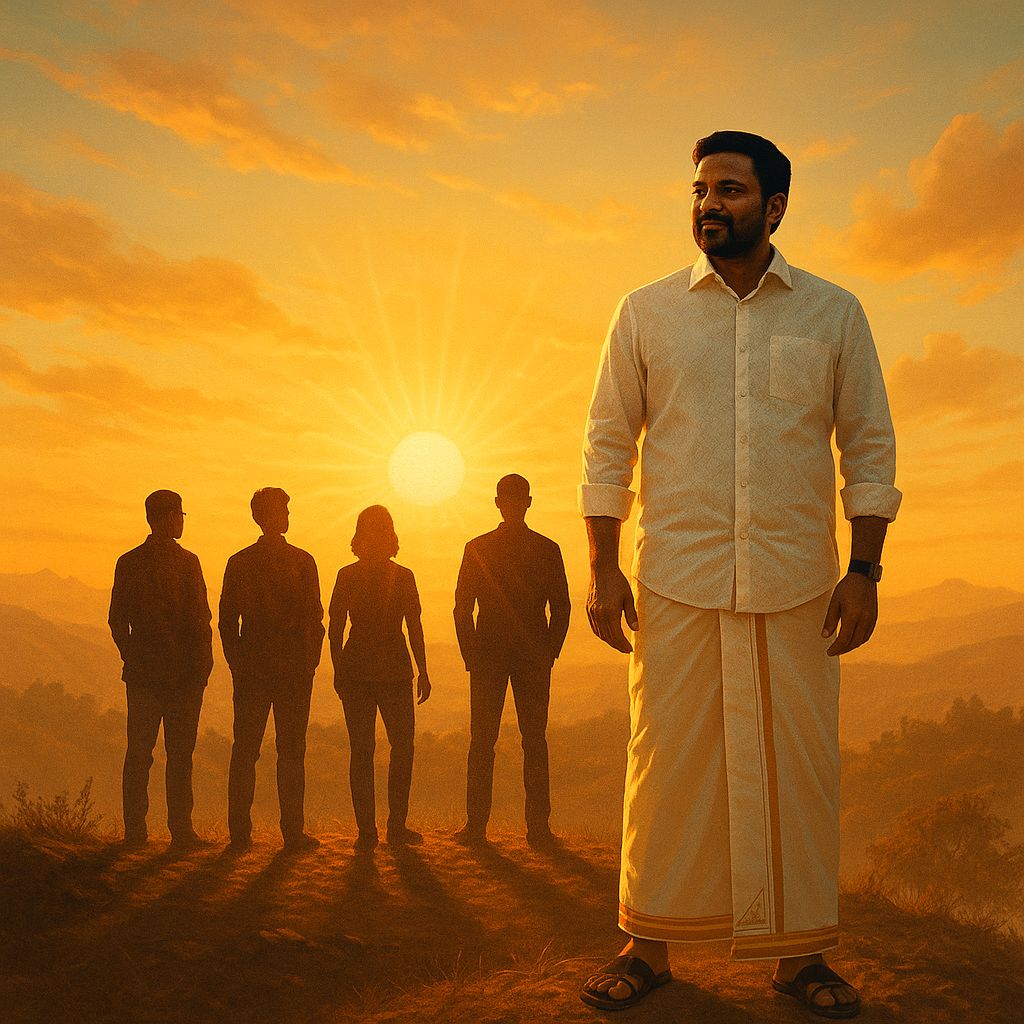
Core Team – The Unseen Faces Behind Every Big Win


Core team. Core strength.

If there’s one thing I keep repeating (even when no one asks), it’s that the success of any business revolves around the core team. People throw around words like “visionary” and “solo genius” as if someone sat in a corner and built an empire alone. But the reality? It’s always a team sport.

In my first venture, I had that magic combo. My partner and I were like two puzzle pieces that just clicked. My strength was his weakness, and his strength covered mine beautifully. It felt like playing doubles in tennis, always knowing someone had your back when you missed a shot.

And then, there were people like Aparnaa and Major Karthik — solid pillars. They weren’t just employees; they were the eyes and ears of the organization. They helped pick the right talents, made sure we kept them, and told us when something was wrong in the team. That loyalty, those late-night calls when there was a problem, those quick decisions we made together — these are things you can’t measure on paper.

When I started my second venture, I had a core team too. But this time, I missed that one piece: a true business partner. And those employees who would stand in the storm with me? I missed that too. You feel it most when the tide turns against you. You realize quickly that it’s not the office decor or the fancy logo that holds you up — it’s that circle of people who will pick up your call at 2 a.m.

It’s the same everywhere if you think about it. Rajinikanth had SP Muthuraman — they did over 25 films together. Many of Rajini’s blockbusters carry Muthuraman’s name behind the scenes. Vijayakanth had Ibrahim Rowther. After their break, Vijayakanth’s box office magic started to fade. And there’s Anand Jain — often called Mukesh Ambani’s “trusted brain,” a man who played the off-field game few saw but many felt.

Even in cricket, look at MS Dhoni. Everyone talks about the “Captain Cool” legend, but think about his gang — Raina, Jadeja, Ashwin — players who trusted him blindly and went to war for him on the field.

When you look back at your journey, it’s always the core team that shines through the fog. The ones who stayed when money ran out, when deals fell through, and when self-doubt felt louder than success. A strong core team isn’t about headcount or titles; it’s about those rare people who treat the business as their own, who see your vision when no one else does, and who carry you through storms without asking for credit. You can have the best idea, the best pitch, or a temporary viral success — but without a core team, it all fades like a one-time festival cracker. Many people have tasted quick wins but vanished because they didn’t have that foundation holding them up when the spotlight moved on.

Finding this team is an art. You don’t spot them in interviews; you see them in crisis rooms and on those quiet late nights when no one is watching. And once you find them, you hold on. You reward them, recognize them, and retain them at any cost — because no trophy or headline is worth more than a team that stands by you even when the world doesn’t.

As we say in Tamil, “தம்பி உடையான் படைக்கு அஞ்சான்” — the one who has brothers behind him never fears an army. It’s a beautiful way our ancestors explained the power of having a strong, loyal support system. Tamils knew long back that it isn’t the sword or the shield that makes you powerful — it’s the people standing behind you.

Some people build empires on sand; some build on people. And if you ask me, the ones who build on people are the only ones who last.