
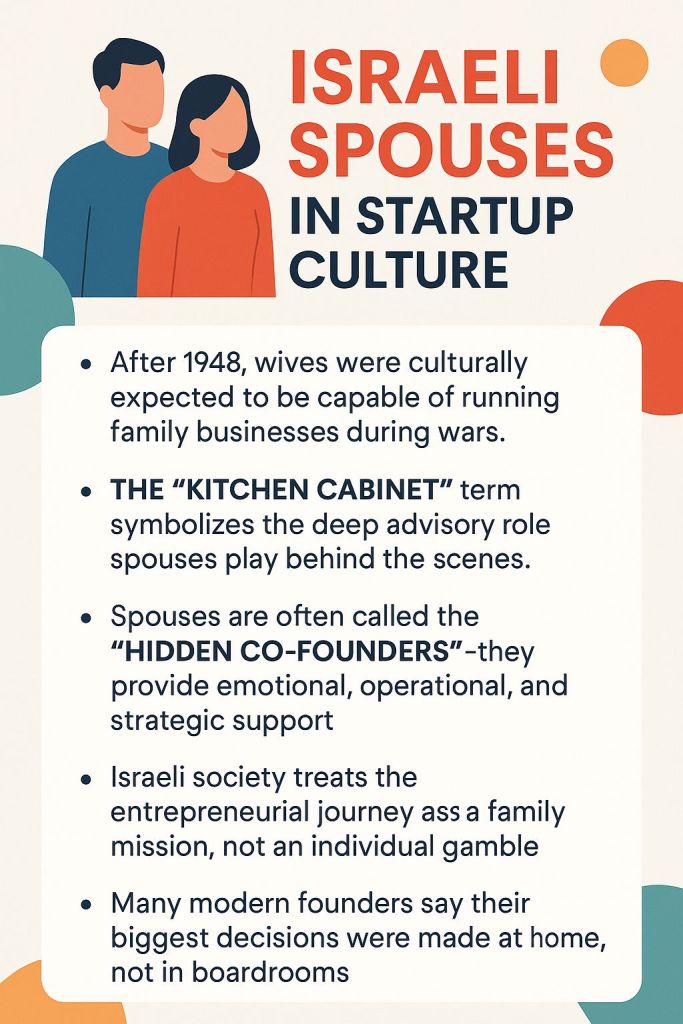
While we often talk about venture capital, tech units, and risk-taking culture when describing Israel’s startup ecosystem, there’s a silent powerhouse that rarely gets enough credit: the spouses.
When Israel was founded in 1948, it was built in the middle of constant conflict and war. Men often had to volunteer or were called away for military service, leaving farms, family businesses, and shops vulnerable. While there wasn’t a strict law forcing women to officially take over businesses, there was a strong community expectation: the wife must know the business inside out to keep it alive if the husband was away — or never returned.
This wasn’t just about economics; it was survival. Business continuity was seen as a patriotic duty. Women weren’t simply supporters at home — they became equal partners in family businesses, laying the cultural foundation for today’s startup ecosystem where spouses often act as the “hidden co-founders.”
In modern Israeli startup culture, there’s a popular phrase called the “kitchen cabinet.” Originally used to describe Golda Meir’s informal advisory group that gathered in her kitchen, it now refers to the personal circle of trusted advisors founders rely on at home — often their spouses.
Many Israeli founders say their toughest strategic decisions didn’t happen in boardrooms but over late-night coffee with their spouse at the kitchen table. Spouses guide them through funding crises, pivots, layoffs, or those nerve-wracking “should we shut it down?” moments.
They hold the emotional line when things fail and cheer the loudest when things click. In a country where risk isn’t just accepted but celebrated, these spouses are not only emotional backbones but also often step into operational roles when needed — just like they did in the early days of the nation.
In Israel, a startup is never just “his” or “hers.” It’s a family mission, a collective leap, and a living example of shared resilience.
 AnandNataraj