Entrepreneur, Blogger, Traveller, Pet Lover, Networker, Social Drinker, Party Animal, Movie Addict, Startup Enthusiast, Organic Gardner, Avid Reader....
In Israel, failure isn’t feared — it’s your startup badge of courage.
When we think of failure in India, it usually comes with a long line of unsolicited advice from relatives, worried glances from parents, and that unspoken label — “loser.” But if you zoom out to Israel, famously known as the Startup Nation, you’ll see something very different.
I’ve been diving into articles, founder interviews, and global startup reports — and one thing is crystal clear: failure isn’t just accepted in Israel, it’s almost celebrated.
In Israel, if your startup fails, people don’t write you off. They ask, “So, what’s next?” Investors don’t shy away from you; they lean in closer. It’s as if failure is your badge of honor, proof that you had the guts to play in the arena instead of watching from the sidelines.
Why? Because in Israel, they believe that if you haven’t failed, you probably haven’t aimed big enough. You didn’t push hard enough. You didn’t swing for the fences.
A huge part of this mindset comes from their military culture. Israeli youth go through mandatory army service, where experimentation, rapid problem-solving, and facing unexpected challenges are everyday routines. Mistakes aren’t punished — they’re analyzed and turned into future strategies.
Add to that a society built on survival and constant innovation. When you’re turning deserts into green farms and defending your borders every day, you learn fast that trial and error isn’t optional — it’s how you stay alive.
What really blew my mind is that many Israeli VCs actually prefer founders who have tasted failure. They believe these founders have “paid their tuition fees” and know what not to do. Imagine pitching to an investor in India after a failed venture — chances are you’ll get a lecture on “safe government jobs” instead of funding.
Israel’s startup ecosystem treats failure like a pivot, not a funeral. It’s a milestone, not a tombstone. And that’s exactly why they keep producing unicorns and game-changing technologies, even with a population smaller than some Indian cities.
As founders and dreamers, maybe it’s time we bring this “fail forward” attitude home. Because the real failure isn’t falling — it’s refusing to get back up.
Israel doesn’t bury failed startups; it recycles them into stronger founders.
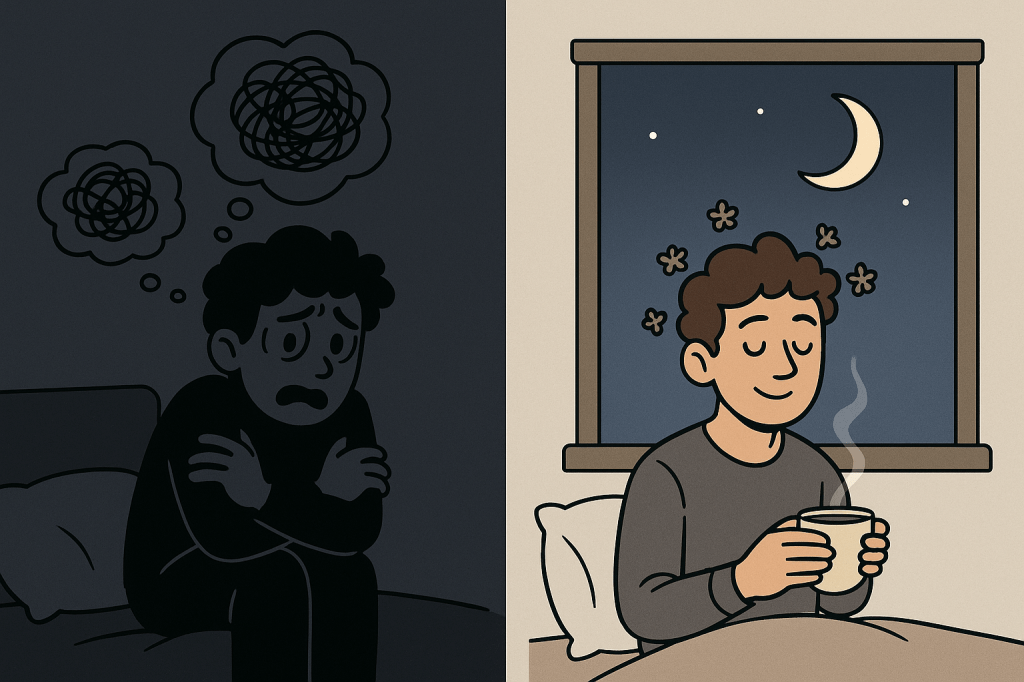
I met my scariest thoughts in silence. Later, I met my truest self there too.
Between 2010 and 2012, most of my close friends got married and slowly started moving to the US. I was still in India, watching my social circle shrink. Slowly, I started feeling a deep loneliness. It wasn’t just the absence of people; it was a heavy, unsettling silence that echoed inside me.
That loneliness didn’t feel like a quiet evening to rest. Instead, it created a voice inside me — a kind of invisible scare. I had sleepless nights and scary nights, but what exactly was I scared of? I couldn’t define it clearly.
Through my own reflection and reading, I understood that these were what psychologists sometimes call phantom threats. When our social support system breaks down, our brain starts scanning for danger, even if there isn’t any real external threat. It’s a leftover survival instinct from when being alone meant being vulnerable to wild animals or enemies. In modern life, this translates to vague fears, restlessness, or a feeling of being unsafe — even in the comfort of our own room.
Then, I got married. Suddenly, I had a partner, someone to share every small joy and every small fear with. That scary loneliness vanished. I didn’t feel that void anymore.
Fast forward to 2019–2025. Life had moved into another gear: kids, family commitments, work deadlines, responsibilities piling up. Ironically, there was no physical loneliness at all — I was constantly surrounded by people.
But deep inside, a new kind of loneliness crept in. This wasn’t the fear of being alone in an empty room; it was the exhaustion of never truly being alone with myself.
Every day felt like a marathon — waking up to attend to kids, squeezing in work calls, family discussions, endless errands. Even at night, when the world finally went quiet, my mind didn’t. It kept replaying unfinished tasks, small conflicts, worries about the kids, tomorrow’s to-do list.
I would close my eyes but feel half-awake, as if there was a hidden guard inside me who refused to let me fully rest. My dreams were crowded — sometimes about work, sometimes about family, sometimes random worries stitched together in confusing ways.
When I woke up, instead of feeling refreshed, I felt as if I had already lived an entire day in my mind. My body was stiff, my head heavy. It was like my brain never turned off, always on “alert mode,” scanning for the next responsibility.
There was no space for me. No silent cup of coffee alone. No lazy morning staring at the ceiling. No blank mental canvas. Just an endless wave of obligations crashing over me, one after another.
This was a loneliness that no one talks about — the loneliness inside a crowded life. You are surrounded by people, yet your inner self is starved for attention.
In June 2025, I moved to Chennai to focus on work, and for the first time in years, I got a lot of alone time. I was worried that the old fears would return, that those phantom threats would sneak back into my nights. But to my surprise, this loneliness felt completely different.
This time, it wasn’t scary. It was warm, healing. It felt like a solitude that I had long needed.
Now, instead of voices and scares, the silence felt like music. The quiet nights felt like gentle hugs from my own mind. I started enjoying small things again — watching the rain, making my own tea, sitting in silence without having to answer anyone.
I realized that this wasn’t loneliness; it was solitude — a conscious, chosen space to meet myself. It was no longer about being left out but about reconnecting inward.
Looking back, I realize loneliness and solitude are two sides of the same coin. One scares you when you don’t feel safe with yourself; the other heals you when you finally do.
As I write this today, I don’t feel the void I once did. Instead, I feel gratitude — for the noisy years, for the silent nights, and for the rare chance to meet my own mind in peace.
Five started the race. Two rewrote the finish line.
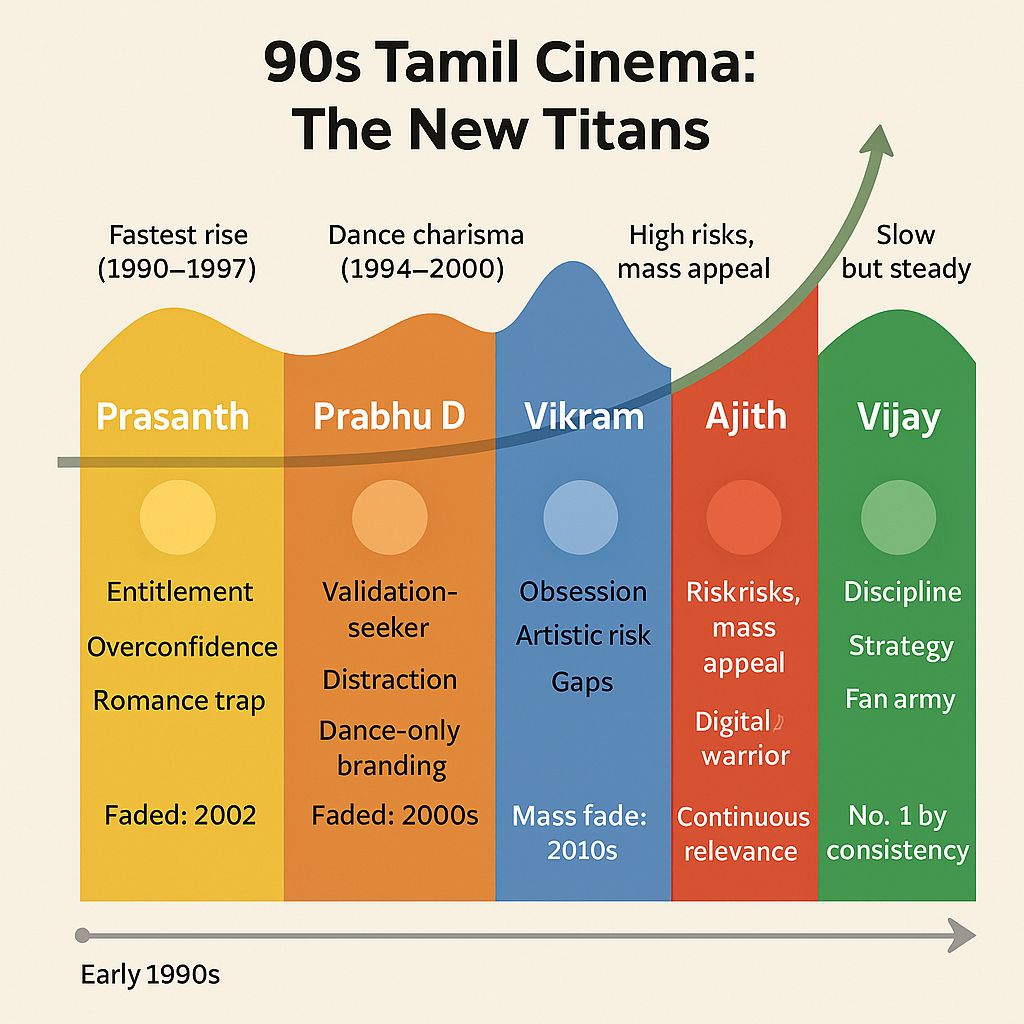
Tamil cinema in the 1990s saw a quiet revolution. Rajinikanth and Kamal Haasan were gracefully moving toward their 50s, creating a vacuum at the top. Into this vacuum stepped five new faces: Ajith, Vijay, Vikram, Prashanth, and Prabhu Deva.
All had the potential to become the next superstar. Yet only two — Ajith and Vijay — emerged and survived as cultural phenomena. Why? Let’s break it down exactly as it is.
Prashanth: The Early Meteor
Prashanth entered the scene like a comet — dream debut, star family, major producers lining up. He had the audience, the youth pulse, the box office. Until 1997, it was Prabhu Deva and Prashanth ruling the charts. Vijay and Ajith were still struggling to establish themselves and nowhere in the race.
But at some point, Prashanth and his father started believing that he alone was the reason for movie success and became too arrogant to be handled. They stopped focusing on stories, assuming Prashanth’s mere presence would guarantee hits. They demanded foreign location songs, controlled heroine selections, and overlooked the importance of strong scripts. Meanwhile, Ajith and Vijay doubled down on stories and started emerging as contenders.
Directors and producers found it difficult to work with them. Director Hari, who debuted through Prashanth, was humiliated by the father-son duo and never worked with him again. Instead of forming a healthy rivalry with Prabhu Deva (which could have expanded fan bases and frozen out Vijay and Ajith), they isolated themselves.
He overstretched the romance genre when he was offered action roles and was late to transform to action just when romance lost market appeal, fading around 2002.
Why he failed:
• Overconfidence and entitlement from early success. • Ignored story strength; thought stardom alone was enough. • Mishandled relationships with key directors and producers. • Refused to shift from romance to action genres on time. • Failed to build or maintain meaningful fan rivalries that could have strategically helped.
Prabhu Deva: The Dancer Who Couldn’t Stay Still
Prabhu Deva started as a dancer and became a star dancer who could carry a film purely for one dance sequence. Backed strongly by directors, he was made a hero around 1994. From 1994 to 2000, he was right in the race with Prashanth, and they were dominating.
But he lacked focus. He, too, thought that movies succeeded only because of his presence and dance appeal. He became difficult to work with and forgot the importance of solid scripts and team harmony. Had he and Prashanth maintained focus and worked collaboratively with producers and directors — creating a rivalry that engaged fans — they could have kept Ajith and Vijay at bay.
However, he let that slip, and Ajith and Vijay emerged as real contenders while he was distracted.
Why he failed:
• Overreliance on charisma and dance appeal. • Lost focus and did not take strategic career planning seriously. • Became difficult to work with, damaging professional relationships. • Didn’t transition into mass-appeal action roles when it was time. • Failed to engage and nurture a large fan base strategically.
Vikram: The Artful Transformer
Vikram debuted in 1990 and struggled for a decade before his breakthrough. From 2000 to 2005, he was unstoppable. During that period, he was on par or even above Vijay and Ajith. He even threatened Ajith’s stardom more than Vijay’s. If he had maintained that streak, he could have easily pushed Ajith aside because he had a strong, organic mass connect.
However, Vikram became obsessed with taking on roles that required extreme physical transformations. This led to large gaps between his films — sometimes several years. Those experiments rarely succeeded commercially. These gaps disconnected him from a whole generation between 2005–2015 who never saw him as a mass hero.
Why he failed:
• Extreme obsession with transformation and experimentation. • Long gaps between films lost a generation of mass audiences. • Focused too much on challenging roles rather than consistent mass appeal. • Failed to balance critical artistic ambition with commercial expectations. • Could not maintain continuous market presence to stay top of mind.
Ajith: The Charismatic Gambler
Ajith debuted in 1993 without any film background. His early films were average grossers, and he was initially known as a chocolate boy, adored by girls. But he took a massive risk — shifting from romantic roles to mass action hero roles at a time when that was not an obvious move. This is precisely where Prashanth lost out.
Ajith never took money if the producer struggled. He even invested his own money to help producers release films. He gave chances to debut or struggling directors, like SJ Suryah, and these gambles paid off big time.
Then came the Ajith-Vijay rivalry, which was fueled further by the rise of the internet. Unlike the physical fan wars of Rajini-Kamal, this was a digital-era rivalry that amplified their reach. Ajith strategically marketed his “self-made” image — someone without any film background, winning purely through grit — and this resonated deeply with fans.
Why he succeeded:
• Early, bold transition from romance to mass action. • Willingness to take risks and gamble on new talent. • Strong self-made narrative that connected emotionally with the public. • Supported producers and maintained goodwill within the industry. • Capitalized on digital fan wars, growing mass presence exponentially. • Luck also favored him, as Vikram was a strong contender for the same “struggler” fan base but faded at the right time, allowing Ajith to consolidate that space completely.
Weakness:
• He lacked consistency and strict discipline, sometimes taking long gaps or unpredictable choices.
Vijay: The Relentless Strategist
Vijay debuted in 1992 and was mocked for his looks and initial performances. Had it been today, he would have been meme material. His interest in acting sparked when he attended Prashanth’s debut success meet and saw the crowd’s reception, which inspired him.
From a filmy background, Vijay’s father was a successful director who supported him wholeheartedly. His father even pledged property to launch Vijay and sustained him during his initial struggles. He directed semi-glamorous, borderline exploitative films purely to attract an audience until Vijay was strong enough to stand on his own.
Unlike Prashanth’s father, Vijay’s father was strategic and sharp: he chose better scripts, built a solid brand, guided fan engagement, and mentored Vijay on handling fame. Vijay’s rise was gradual. His first real success came in 1996, and from there, he never looked back.
He consistently released three to four films a year, stayed professional, and strictly stuck to deadlines. He didn’t go overboard to please directors or producers; he was clear: show up, do the work, move on.
Why he succeeded:
• Strong discipline and professionalism. • Smart, strategic mentorship from his father. • Careful script selection without big gambles early on. • Systematic, strategic fan club creation and engagement. • Regular releases ensured continuous market presence.
Weakness:
• Initially lacked bold experimentation; his rise was slower but extremely stable.
Suriya: The Late Bloomer
Suriya entered later, around 1997, and was first truly recognized in 2002. By this time, Prashanth and Prabhu Deva were fading out, and Vikram was veering into experiments. Ajith and Vijay had already started cementing their strongholds.
Suriya made smart, modern script choices and collaborated with new-wave directors, becoming a respected actor admired for craft rather than mass stardom. He never directly threatened Ajith or Vijay in the mass arena but created his own niche.
Why only Ajith and Vijay stood tall
Ajith
• Embraced early, risky transitions. • Took chances on new talent. • Built an emotionally powerful self-made story. • Supported producers and stayed grounded. • Brilliantly rode the wave of digital fan rivalries.
Vijay
• Maintained laser-sharp discipline and consistency. • Benefited from his father’s mentorship in scripts and public image. • Demonstrated professionalism and on-time delivery. • Built and maintained strong, organized fan clubs. • Evolved steadily without abrupt risks.
Why the others didn’t
Prashanth
• Overconfidence and arrogance. • Ignored script quality. • Damaged industry relationships. • Stuck in outdated genres. • Failed to build smart rivalries.
Prabhu Deva
• Relied too much on dance alone. • Lacked focused strategy. • Developed a difficult reputation among producers. • Did not evolve his genre or brand. • Missed important market shifts.
Vikram
• Over-obsession with transformation. • Long gaps and lost audience connection. • Prioritized artistry over mass appeal. • Failed to balance experiments with commercial films. • Lacked continuous mass presence.
The Final Picture
Ajith was the rebel, the gambler, the people’s king with a self-made badge.
Vijay was the disciplined strategist, the quiet storm who rose without hype.
Prashanth, Prabhu Deva, and Vikram each fell not because of one shared flaw — but because of unique, individual missteps.
Key Takeaway
Success isn’t a formula; it’s an alignment of timing, self-awareness, adaptability, and strategic emotional connect.
In Indian arranged marriages, your first meeting with your future wife often happens in a temple, surrounded by her relatives and yours, all watching closely. When I first met my wife like this, I didn’t make any big promises. I just told her honestly that entrepreneurship was my passion and that I would need her extra support to succeed.
She agreed. We got married. And for the first six years, it felt like life had blessed us. The business was thriving, money was flowing, and the house was filled with laughter. In those days, support was easy because success made everything look shiny.
But the real test of any relationship isn’t when you’re flying high — it’s when you crash.
When business challenges started piling up, everything changed. Debts, setbacks, betrayals — my dream began to crumble, and with it, so did the sense of security in our home.
Yet, she stood by me. She didn’t pack her bags or run away. In fact, after an eight-year career gap spent raising our kids, she took up a job to support the family. That move alone deserves more respect than any applause I’ve ever received in my entrepreneurial journey.
But support has layers. While she stood strong on the outside, inside there were storms. She wanted me to take up a job, to drop the dream, to “be practical” for the sake of the family. There were fights, emotional distance, and moments when we felt like strangers living under the same roof.
From her side, it made sense. She saw stability as love, and she believed protecting the kids from uncertainty was her duty. From her view, why should anyone hold on to a passion so stubbornly when it meant risking everything?
From my side, quitting wasn’t an option. Entrepreneurship wasn’t a hobby — it was who I am. If I gave up on it, I wouldn’t just lose a business; I would lose myself. I believed true happiness can exist even in simplicity or poverty, as long as you’re true to your soul’s calling.
I often asked myself: *Who is cruel here? Who is right?*
The truth is, neither of us was wrong. We were just two people trying to survive in our own ways. She fought for emotional and financial security; I fought for identity and purpose.
Marriage is often painted as a journey of compromise. But sometimes, it’s a silent negotiation between two very different worlds: passion and practicality.
She may never fully understand why I chose to stay on this rocky path. And I may never fully understand her fear of instability. But in those differences, there’s a story of two people who didn’t give up on each other — even when they didn’t fully agree.
When people see a smiling parent with a child on each arm, they often think of joy, completeness, and warmth. But behind that photo, there can be stories of exhaustion, frustration, and a kind of loneliness that’s hard to describe.
From the very beginning, even before our second child was born, there were challenges. My in-laws strongly believed that having a second child was a bad idea, and they convinced my wife the same. Every time there’s an argument between us now, this topic comes back: that she didn’t fully analyze the challenges ahead. It makes me angry because, in my heart, I always believed I didn’t want to raise a single pampered child. I wanted my first child to have a sibling, a lifelong companion. This decision was never just about me — it was about building a family with deeper bonds, even if it meant going through harder days.
From the day my second child was born, life changed completely. We had no support system. No parents or in-laws stepping in to help, no extended family to call on, no trusted house help to share the load. It was just us, and every day felt like a survival mission.
People often say, “it takes a village to raise achild.” With my first child, I had that village. My in-laws supported us, and those memories felt like heaven — a beautiful, light-filled chapter of parenting. But with my second child, that village was gone. I became everything: the caretaker, the cook, the cleaner, the comforter, the entertainer, the teacher. From sleepless nights to endless school preparations, every moment demanded my full energy and presence.
In the process, my professional life took a huge hit. I went into procrastination because of constant mind fog. Work deadlines felt heavier, focus slipped away, and important opportunities quietly passed me by. My business struggled, and while outsiders only saw the missed targets and failures, they didn’t see the mental battles and emotional exhaustion that led me there.
At home, the constant focus on the kids created a silent gap with my spouse. Conversations turned into pure logistics: who would handle which meltdown. The small, loving moments that kept our bond alive quietly faded, replaced by stress and quiet resentment.
Yet despite all the anxiety, frustration, and helplessness, I cherished every moment with my second child. Even in the chaos, I found joy. I built precious memories, laughed through exhaustion, and watched my child grow closely every single day. It truly felt like a heaven inside a hell — beautiful moments glowing in the middle of struggle and darkness.
With support, those years could have been even better, perhaps closer to the lightness I experienced with my first child. But despite everything, I wouldn’t trade those moments for anything.
Parenting is beautiful, but when done alone and without support, it can swallow you whole. If you’re going through this, I want you to know: you’re not alone. You deserve understanding, you deserve support, and you deserve to cherish those beautiful moments without the heavy weight of judgment.
Between 2012 and 2014, my entire world was confined to a hospital room. My father was in and out of coma during that time, and I practically lived in the hospital. Life outside those walls felt distant and almost unreal. Festivals came and went, and though friends called and offered support, I just couldn’t engage with them. I didn’t have the emotional space or words to share what I was really feeling.
I wasn’t just taking care of my father; I was battling intense anxiety, frustration, and helplessness every single day. I questioned everything from the doctors’ advice, the treatment decisions, my own ability to handle the situation. I felt like I was stuck in a loop, hoping for a sign of improvement, fearing the worst with every passing hour.
This is a state known as caregiver burnout, where your mind and body are pushed to the edge by constant stress and emotional weight. You run on autopilot, trying to stay strong for your loved one, while inside you feel like you’re drowning.
It took me a long time to process those years and find a sense of normalcy again. To learn that it was okay to step away for a moment, to accept help, and to acknowledge my own emotions without guilt.
If you’re in a similar situation, please remember: your feelings are valid. You’re not alone in your anxiety and helplessness. Take moments for yourself, reach out for support, and know that it’s okay to take care of yourself too.
I was that kid who never copied in exams. Even when I knew I’d fail and get caned by teachers, scolded by parents, and laughed at by friends, I stood my ground. I believed honesty would eventually get me somewhere.
But life outside those dusty classroom benches? Oh, it plays by a very different rulebook.
Out here, no one cares how many nights you stayed up studying or how honestly you wrote every word. They don’t applaud your discipline or your quiet sacrifices. They only ask one thing: Did you pass? The world doesn’t celebrate effort — it only worships results. The process is forgotten; only the scoreboard shines.
I saw people who copied, cheated, and manipulated — and they didn’t just pass; they got medals, got applause, and even got the spotlight. And me? I was left clapping for them from the sidelines, still holding on to my moral certificate like it was a VIP pass to success.
Truth is, history remembers the winners, not how the game was played. We remember who won the trophy, not who played fair. In business too, people are judged by how big their bank balance is, not by the sleepless nights or the fair deals they kept refusing.
Somewhere along the way, I realized: society doesn’t run on sincerity certificates. It runs on headlines. And as long as you don’t get caught, no one questions your methods. It’s a harsh truth, but it’s the truth nonetheless.
But in today’s world, everything is fair in love, war, and the race for success. Marksheets don’t show how many nights you cried, balance sheets don’t list your sacrifices, and award speeches never thank the honest failures. Merits are judged only by results — the headlines, the trophies, the follower counts. It’s a jungle out there, and no one asks if you hunted fair — they only admire the kill.
In a world obsessed with results, playing it straight is not just rare — it’s almost rebellious.
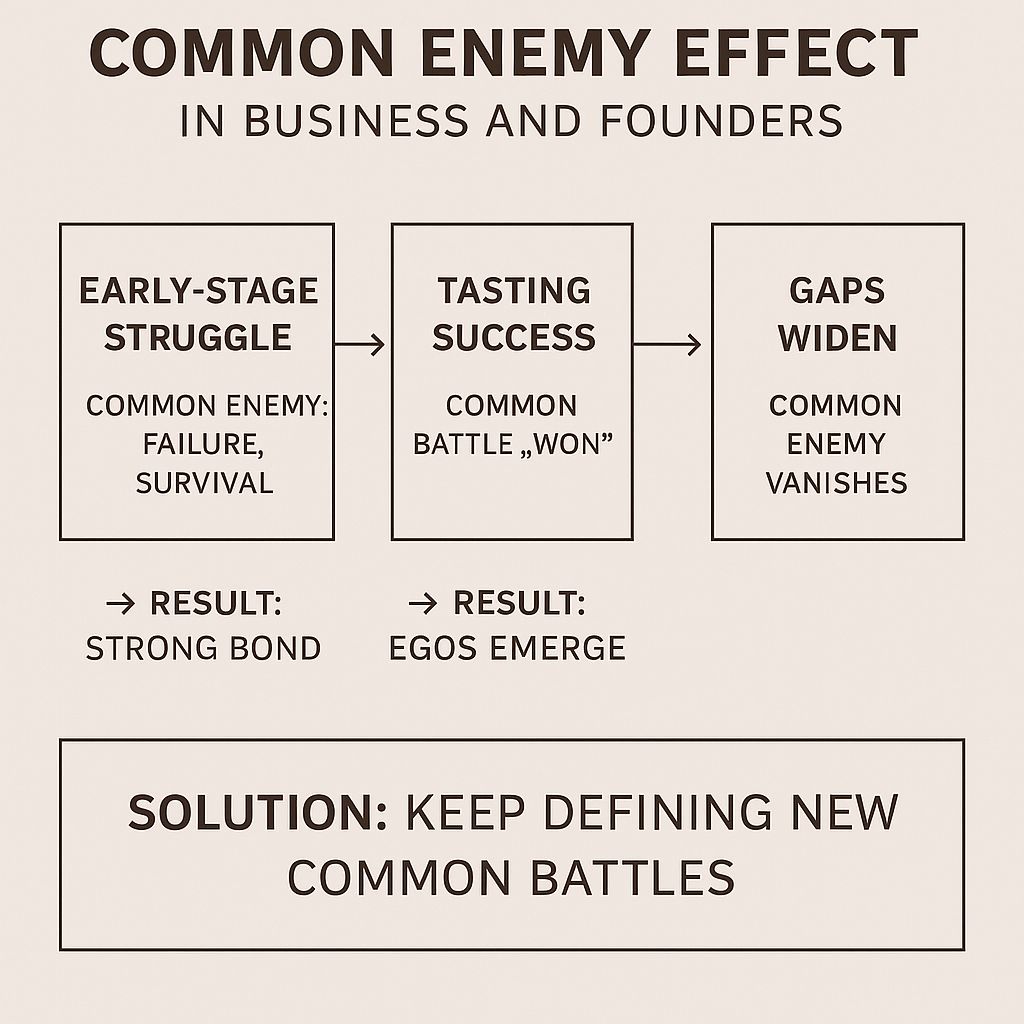
The common enemy effect is a powerful social phenomenon: people unite strongly when they share a common threat. We often see it in military units, sports teams, and political movements — and it’s equally true for founders and startup teams.
Phase 1: The early struggle
When founders start out, they face huge external threats:
Market rejection
Cash burn
Pressure to prove themselves
Family or societal doubt
Their common enemy is failure itself. This shared threat aligns them deeply. There’s no time for ego; decisions are fast and collective. Emotional support is strong. They feel like warriors in the same trench.
Phase 2: Early wins and success
Then comes funding, product traction, revenue, or media buzz. Suddenly, the “enemy” that held them together begins to fade.
Without that shared fight, founders start:
Claiming credit individually
Listening to “proxy teams” or external voices that inflate egos
Pushing personal agendas
The urgent need to survive is gone, so the cracks appear.
Phase 3: Gaps widen
When the common threat disappears:
Misaligned visions surface
Egos grow
Trust erodes
Silent power struggles begin
The same founders who once pulled all-nighters together may now fight over direction, credit, or influence.
Lessons from research
✅ Ben Horowitz (The Hard Thing About Hard Things): In crises, teams unite; in safety, they splinter. ✅ Patrick Lencioni (The Five Dysfunctions of a Team): Without a shared mission, conflict thrives. ✅ Harvard Business Review: “Shared existential threats unify.” New shared missions are critical as you grow. ✅ Social Identity Theory (Tajfel & Turner): Strong group identity often needs an external “enemy” to stay focused.
What can founders do?
Constantly define new “enemies” or big missions (new markets, innovations, tougher impact goals).
Regularly revisit and realign personal and collective visions.
Watch out for external influences that inflate individual egos.
Build a culture where mission > individuals, always.
In short
What unites founders at first? A common enemy (failure, survival). What causes splits later? The enemy fades, egos rise. What’s the fix? Keep creating new shared battles to stay united.
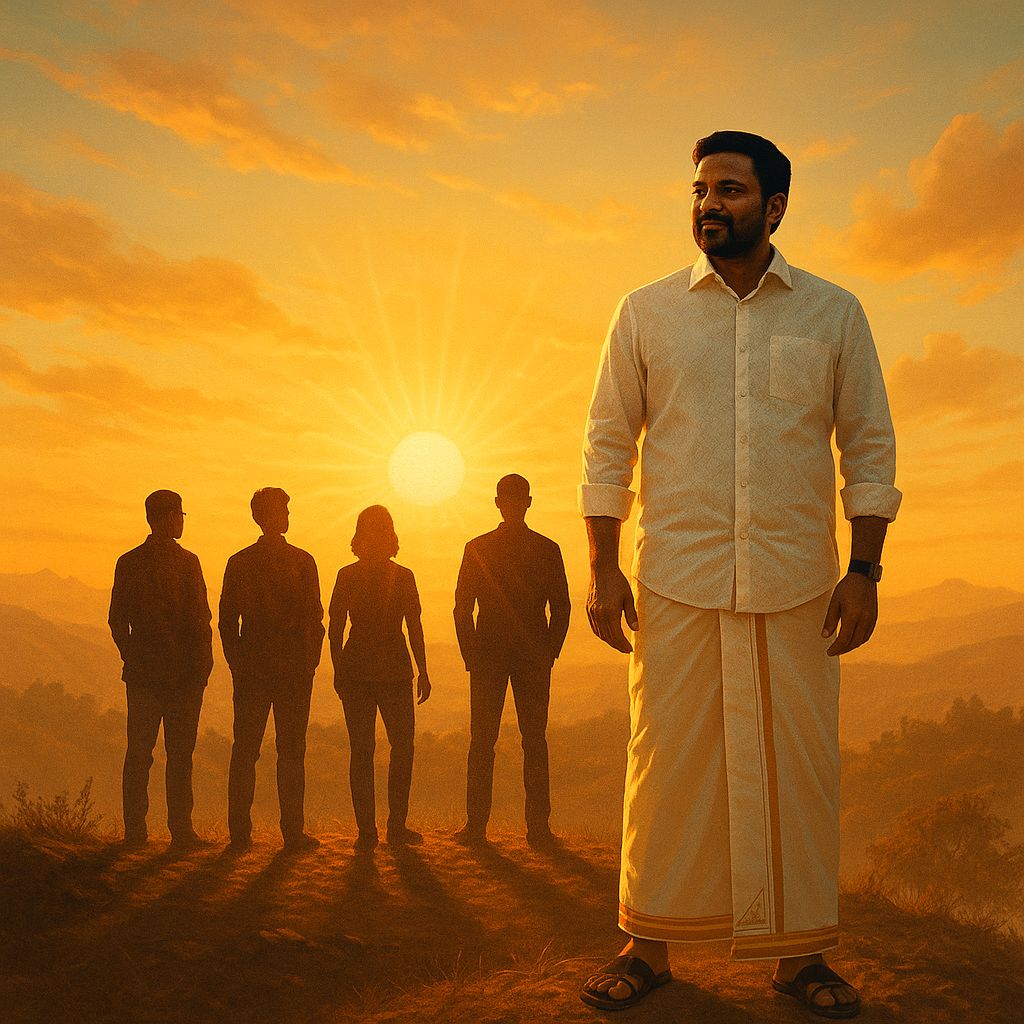
If there’s one thing I keep repeating (even when no one asks), it’s that the success of any business revolves around the core team. People throw around words like “visionary” and “solo genius” as if someone sat in a corner and built an empire alone. But the reality? It’s always a team sport.
In my first venture, I had that magic combo. My partner and I were like two puzzle pieces that just clicked. My strength was his weakness, and his strength covered mine beautifully. It felt like playing doubles in tennis, always knowing someone had your back when you missed a shot.
And then, there were people like Aparnaa and Major Karthik — solid pillars. They weren’t just employees; they were the eyes and ears of the organization. They helped pick the right talents, made sure we kept them, and told us when something was wrong in the team. That loyalty, those late-night calls when there was a problem, those quick decisions we made together — these are things you can’t measure on paper.
When I started my second venture, I had a core team too. But this time, I missed that one piece: a true business partner. And those employees who would stand in the storm with me? I missed that too. You feel it most when the tide turns against you. You realize quickly that it’s not the office decor or the fancy logo that holds you up — it’s that circle of people who will pick up your call at 2 a.m.
It’s the same everywhere if you think about it. Rajinikanth had SP Muthuraman — they did over 25 films together. Many of Rajini’s blockbusters carry Muthuraman’s name behind the scenes. Vijayakanth had Ibrahim Rowther. After their break, Vijayakanth’s box office magic started to fade. And there’s Anand Jain — often called Mukesh Ambani’s “trusted brain,” a man who played the off-field game few saw but many felt.
Even in cricket, look at MS Dhoni. Everyone talks about the “Captain Cool” legend, but think about his gang — Raina, Jadeja, Ashwin — players who trusted him blindly and went to war for him on the field.
When you look back at your journey, it’s always the core team that shines through the fog. The ones who stayed when money ran out, when deals fell through, and when self-doubt felt louder than success. A strong core team isn’t about headcount or titles; it’s about those rare people who treat the business as their own, who see your vision when no one else does, and who carry you through storms without asking for credit. You can have the best idea, the best pitch, or a temporary viral success — but without a core team, it all fades like a one-time festival cracker. Many people have tasted quick wins but vanished because they didn’t have that foundation holding them up when the spotlight moved on.
Finding this team is an art. You don’t spot them in interviews; you see them in crisis rooms and on those quiet late nights when no one is watching. And once you find them, you hold on. You reward them, recognize them, and retain them at any cost — because no trophy or headline is worth more than a team that stands by you even when the world doesn’t.
As we say in Tamil, “தம்பி உடையான் படைக்கு அஞ்சான்” — the one who has brothers behind him never fears an army. It’s a beautiful way our ancestors explained the power of having a strong, loyal support system. Tamils knew long back that it isn’t the sword or the shield that makes you powerful — it’s the people standing behind you.
Some people build empires on sand; some build on people. And if you ask me, the ones who build on people are the only ones who last.
I’ve often sat at my desk late into the night, staring at the ceiling and asking myself the same question: Why do opportunities seem to pass me by? I risked it all. I worked long hours that blurred into days, pawned my wealth, missed family events, and took responsibility when no one else would even step up. Meanwhile, job goers clocked in their neat 10-hour shifts, played safe, saved their salaries, bought flats, and went home to sleep peacefully. Some even quit when things got tough, never bothering to look back. And today, they seem more “settled” than me. It almost feels unfair. But life isn’t a cricket match with a clear scoreboard. It’s more like a marathon with different routes — some smooth, some with hidden potholes.
The curse (and gift) of taking responsibility
When you take responsibility, you don’t just carry tasks; you carry dreams — yours and everyone else’s. You become the cushion when things go wrong, the cheerleader when hope runs out, and the punching bag when blame needs a home. You can’t play safe. You can’t say, “It’s not my problem.” You’re too busy turning fires into candles.
Why the hustler looks inconsistent
I used to think I was inconsistent. But looking back, I realize I wasn’t inconsistent — I was simply overloaded. When you’re fighting battles on ten fronts, you lose focus on the main goal. You build, break, restart, pivot. From the outside, it looks like a lack of discipline. From the inside, it’s a survival dance.
Why job goers win small but steady
Job goers? They stuck to one lane. They focused only on their paycheck, not the company’s future. They didn’t risk sleepless nights thinking about client payments or the next big move. They followed a simple formula: do the job, save, buy a house, take a vacation, repeat. And you know what? There’s nothing wrong with that.
But then, what about us?
We choose the path of impact, not just income. We choose unpredictability over comfort. We play the game knowing that some days, the scoreboard doesn’t even exist. We’re not inconsistent — we’re experimental. We’re not unlucky — we’re learning resilience the hard way. We’re not behind — we’re building stories that will echo beyond bank statements.
Job goers may retire with a pension; you’ll retire with a legacy. Choose your prize.
In the end, life isn’t about collecting steady paychecks or safe medals. It’s about staying in the arena, even when the crowd goes silent.