21 Attempts Later: How ChatGPT and I Found the Answer Together


We talk about AI as if it’s magic.
Ask a question. Get an answer. Move on.

What we don’t talk about enough is what really happens when the answer doesn’t come easily.

This week, I learned that the hard way.

What looked simple on paper turned into 21 failed attempts, each one slightly different, each one confidently wrong. ChatGPT responded every time — clearly, logically, persuasively. And every time, something didn’t work.

That’s when I realised the first uncomfortable truth:

AI can sound right long before it is right.


The early illusion

The first few attempts were deceptive.

The responses were structured.
The explanations were neat.
Some even ended with words like “success”.

And yet… nothing actually happened.

Acknowledgement masqueraded as execution.
That illusion alone can waste hours if you’re not careful.


When confidence became the problem

By attempt seven or eight, both of us — ChatGPT and I — were confident.

The logic seemed airtight.
The fixes were small.
We were “almost there.”

That phrase — almost there — is dangerous.

Because it convinces you not to question your assumptions deeply enough.

The conversation changed

Somewhere around attempt eleven, I stopped asking ChatGPT what to do.

Instead, I started telling it what was wrong.

“This assumption doesn’t hold.”
“This part works; this doesn’t.”
“Let’s isolate just this behaviour.”

ChatGPT changed with me.

The answers slowed down.
The certainty softened.
The reasoning became cautious — collaborative.

That’s when it stopped feeling like a tool and started behaving like a thinking partner.


The humility phase

There was a stretch where neither of us rushed.

No clever shortcuts.
No sweeping rewrites.
Just deliberate, line-by-line progress.

I stopped expecting brilliance.
ChatGPT stopped pretending certainty.

Ironically, that’s when progress accelerated.


Attempt twenty-one

The final attempt didn’t announce itself.

No drama.
No celebration.

It simply worked.

And in that quiet moment, something became clear:

Success is often silent.
Failure is loud.

What this taught me about AI

ChatGPT didn’t replace thinking.
It demanded better thinking.

Weak prompts produced confident mistakes.
Better prompts invited reasoning.
Persistent correction reshaped responses in real time.

The miracle wasn’t AI.

The miracle was staying in the conversation.


The real takeaway

This wasn’t man versus machine.
And it wasn’t man commanding machine.

It was a convergence — through frustration, feedback, and patience.

Human intuition corrected AI assumptions.
AI pattern recognition sharpened human thinking.

Twenty-one failures later, the result wasn’t just success.

It was earned clarity.

Final thought:
The future won’t belong to people who use AI.
It will belong to those who can persist with it, long enough for understanding to emerge.

Because intelligence — human or artificial — means nothing without perseverance.

In Business Breakups, the Winner Writes the Story


There is a kind of loss no one prepares you for.

Not failure.
Not bankruptcy.
Not even a breakup.

This is when a business partnership breaks, the other person walks away with the company, and you walk away with silence, blame, and a long legal shadow.

What makes it brutal is not just losing money or position.
It is losing identity, narrative, and fairness—all at once.

And watching the world applaud the aggressor.


1. Corporate Betrayal Trauma

This is not “a partnership issue.”

This is when:

  • Your life is deeply tied to the company
  • Your work continues—without your name
  • Your seat is occupied by the very person who pushed you out

It feels like divorce + job loss + public humiliation, rolled into one.

The worst part?
People expect you to “move on” while the wound is still open.


2. Asymmetric Power War

This is never a fair fight.

The aggressor has:

  • Company money
  • Legal teams on payroll
  • Employees, agencies, and advisors
  • Time and continuity

The victim has:

  • Personal savings
  • Family pressure
  • Emotional fatigue
  • And a ticking clock

Yet society judges both sides as equals.

They are not.


3. Narrative Hijack (Corrected Reality)

This is the most dangerous phase and the least understood.

The aggressor never speaks alone.

They have:

  • Employees
  • Friends
  • Consultants
  • PR agencies

All speaking on their behalf.

It looks like third-party endorsement, so people believe it.

But when the victim speaks:

  • It looks like self-defense
  • It looks like self-interest
  • It looks like weakness

Silence hurts you.
Speaking hurts you.

This is a communication trap with no clean exit.


4. Success Mask Injustice

Here is the cruel illusion:

The aggressor looks successful:

  • Company runs
  • Team stays
  • Money flows

The victim looks stuck:

  • Legal cases
  • Restarts
  • Explaining life to others

Society quietly assumes:

If he’s successful, he must be right.”

This is how appearance replaces truth.


5. Stakeholder Cross-Examination

You are forced to answer questions you never caused:

  • “Why did this happen to you?”
  • “Couldn’t you have avoided it?”
  • “What did you do wrong?”

Each question chips away at self-worth.

Not because you failed, but because you are the only one explaining.


6. Legal Time Distortion

Legal battles don’t just drain money.

They:

  • Freeze emotional closure
  • Reopen wounds every hearing
  • Delay life itself

Years pass.
Energy leaks.
Life waits unfairly.


7. Moral Injury

This is deeper than stress.

This is when:

  • You played fair
  • Trusted deeply
  • Followed ethics
  • And still lost publicly

It shakes your belief in:
Justice. Karma. Systems. Even faith.


How Do People Actually Survive This?

Not with motivation quotes.
Not with loud comebacks.

1. Stop Fighting on the Old Battlefield

You cannot:

  • Out-spend a company
  • Out-narrate a system
  • Out-perform a machine as an individual

Survival begins when you stop trying to win there.

This is not surrender.
This is strategy.


2. Replace the Narrative, Don’t Defend It

Don’t explain your past.

Build a present so strong that explanations become unnecessary.

People don’t revise beliefs.
They shift attention.


3. Re-Anchor Identity

Betrayal collapses identity.

Survivors consciously anchor themselves to:

  • A new domain
  • A new mission
  • A new value system

Not for money first.
For mental stability.


4. Shrink Your Circles

Keep only:

  • One truth circle
  • One energy-safe circle
  • One work circle

Everyone else gets distance.

Over-exposure is self-harm.


5. Accept Delayed Justice Without Losing Self-Respect

Acceptance is not saying:
They were right.”

Acceptance is saying:
My life will not wait for justice to arrive.

Justice may come or not.

Self-respect cannot wait.


The Quiet Truth

Many successful people carry one silent ruin in their past.
One betrayal they never speak about.
One phase that reshaped them completely.

Some battles are not meant to be won.

They are meant to change the person who survives them.

Your Core Team Is Not Who You Think It Is


Most people say this confidently:

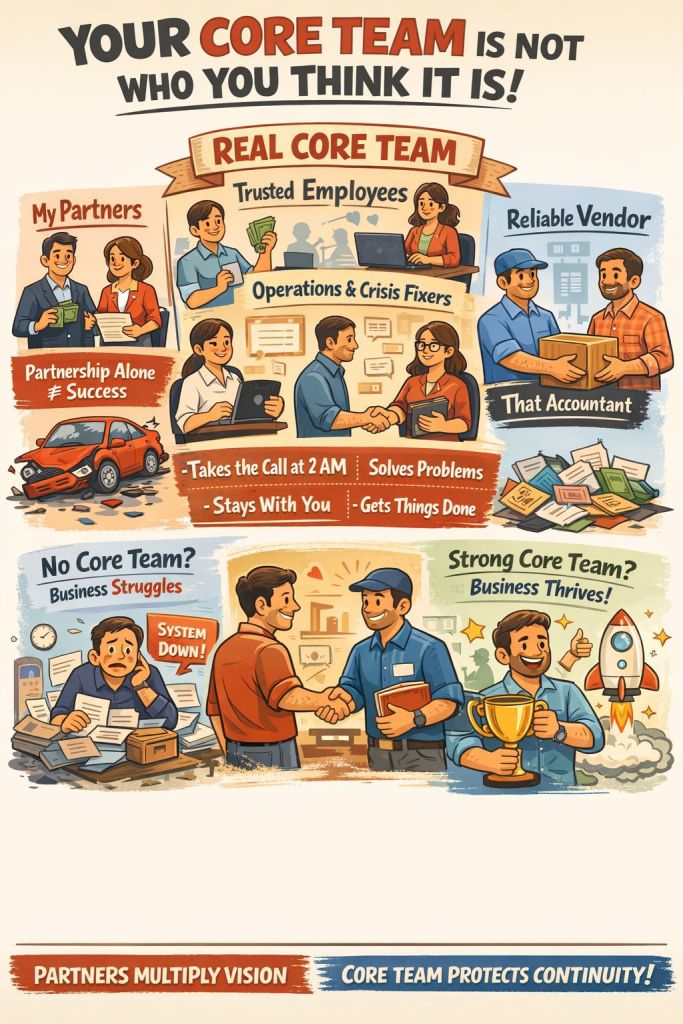
My core team is my partners.”

Fair enough.
Good partners are gold.

But here’s the uncomfortable truth I learned the hard way:

👉 Many businesses die even with partners.
👉 Many businesses survive and grow without partners.

The difference is not partnership.
The difference is the core team.


Let me say this plainly

A core team is not about equity.
It is about who shows up when things go wrong.

The people who:

  • Pick up calls when something breaks
  • Know your business better than your SOPs
  • Fix problems without drama
  • Think, “If this fails, I fail too”

They may be employees.
They may be vendors.
They may not have a fancy title.

But without them, the business slows down or collapses.

That’s the real test.


Why founders misunderstand “core team”

Because startup culture romanticised this idea:

“Find a co-founder. Everything will be solved.”

Reality check:

  • Partners give direction
  • Teams give movement

A car with only a steering wheel won’t move.
You need an engine, wheels, fuel, and a driver who knows the road.

That’s your core team.


What a core team actually does (in real life)

Not theory. Real life.

They:

  • Remember why decisions were taken 3 years ago
  • Handle customers when you are sick, stuck, or burnt out
  • Prevent small issues from becoming public disasters
  • Keep the business breathing during bad phases

Most founders don’t fail suddenly.
They bleed slowly due to weak execution.

A strong core team stops that bleeding.


Some uncomfortable examples

Apple didn’t scale because Steve Jobs had partners.
It scaled because people like Tim Cook ran operations like a machine.

D-Mart didn’t grow because of flashy leadership.
It grew because store managers, buyers, and vendors stayed for decades.

Zoho didn’t win because of funding or hype.
It won because employees stayed long enough to care deeply.

Closer home?

Every successful small business has:

  • That one accountant who “knows everything”
  • That one operations person who holds the chaos together
  • That one vendor who never fails you

They don’t own shares.
But they own responsibility.


Vendors: the most ignored core team

Let’s talk about this honestly.

That vendor who:

  • Delivers even during strikes
  • Adjusts credit when cash flow is tight
  • Saves you from embarrassing customer issues

If they walk away, your business feels it immediately.

They are external employees in spirit.

Treat them like price-only suppliers and you lose them.
Treat them with respect and continuity, they become your shield.


Want to know who your real core team is?

Simple test. No theory.

Ask yourself:

  • If this person leaves tomorrow, will my business struggle?
  • Do they know things I never documented?
  • Do I trust them when money, reputation, or deadlines are at risk?

If the answer is yes — congratulations.
That’s your core team.

Whether HR agrees or not.


The hard truth most founders learn late

A business with partners but no core team is fragile.
A business with a strong core team can survive almost anything.

Partners multiply vision.
Core teams protect continuity.

If you’re building a business, don’t chase only co-founders and equity splits.

Build:

  • Trust
  • Respect
  • Long-term relationships

That’s what quietly builds durable businesses.


The Curious Economics of Gratitude


Helpers live strange lives.

They give without being asked loudly.
They help without calculating returns.
And when life turns, they are expected to disappear quietly.

No applause. No credit. No memory.

How Helping Slowly Becomes Invisibility

There is a social rule nobody teaches you:

Help is respected only when the helper stands above you.

When the helper stands beside you or worse, falls below you help stops being generosity and starts feeling like obligation.

At that point, gratitude quietly exits the room.

The Helper’s Trap

Helpers often give from sacrifice, not surplus.

They help when they shouldn’t.
They stretch when they can’t.
They assume goodwill compounds like interest.

It doesn’t.

What compounds is expectation.

Soon, the helper is no longer thanked they are approached.
Not remembered  but accessed.

And when the helper struggles?

Silence.

The Most Insulting Moment

The hardest part isn’t being refused help.
It’s being asked for help again  by the same people who ignored you when you were drowning.

At that moment, the helper realises something painful:

To some people, help is not a bond. It is a habit.

Why Helpers Are Forgotten

A few repeating patterns explain it:

1. Help Without Power Is Uncomfortable

Acknowledging help from a struggling person forces people to confront an unpleasant truth:

I was lifted by someone who is now below me.

So the mind erases the debt.

2. Helpers Disrupt the Success Narrative

People prefer clean stories:

I did it on my own.

Helpers complicate that story.

3. Familiarity Breeds Entitlement

The more quietly you help, the more invisible you become.

Silence is misread as strength.
Kindness is mistaken for availability.

A Darkly Funny Truth

Helpers are remembered in two moments only:

* When they are needed
* When they finally say no

The second moment is when relationships collapse.

Not because you stopped helping
but because you stopped *absorbing disrespect.

What Helpers Must Learn (The Hard Way)

Helping is noble.
But unprotected helping is self-harm.

Boundaries are not cruelty.
Refusal is not betrayal.
Self-respect is not arrogance.

Closing Line

“Helpers don’t regret helping.
They regret forgetting themselves while doing it.”

If you’re a helper, remember this:
Your value is not measured by how much you give but by how well you protect your dignity.

Breaking the Scarcity Loop: The Invisible Trap That Keeps Entrepreneurs Stuck


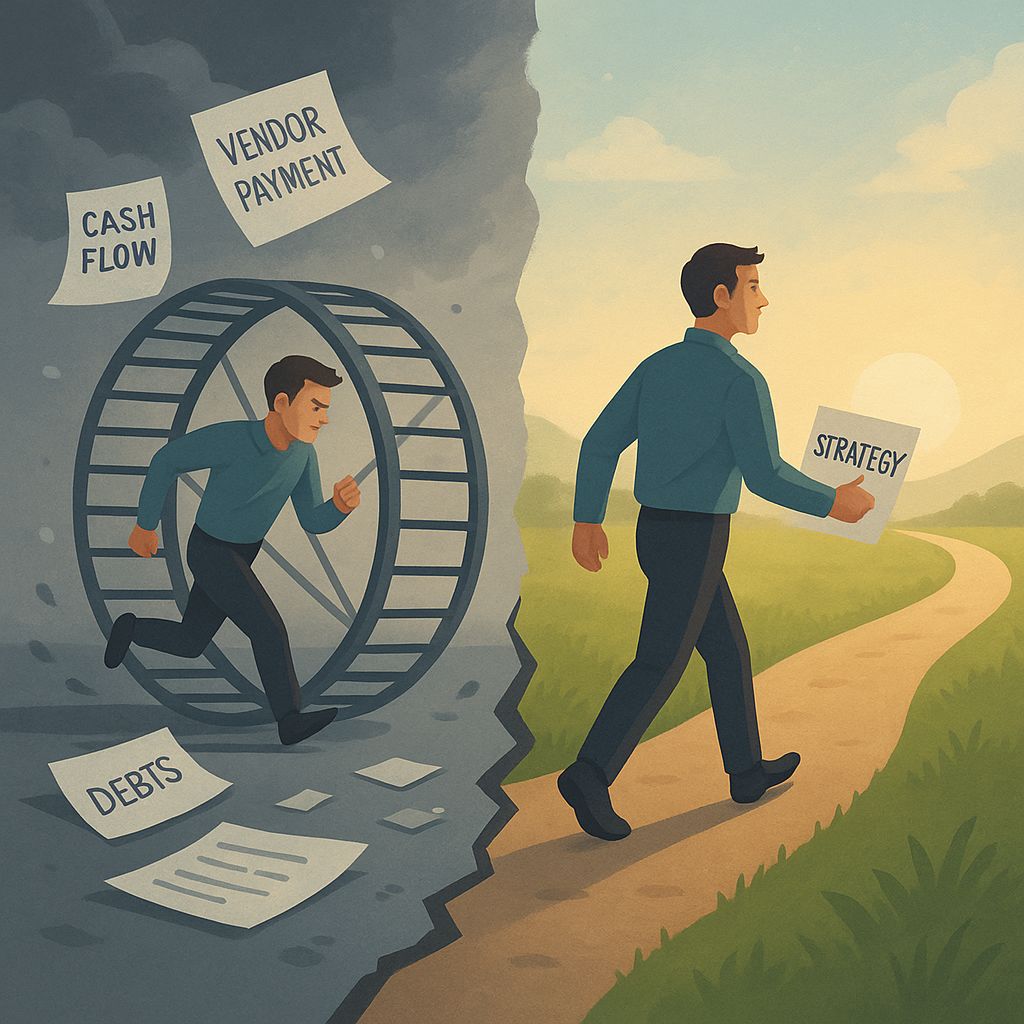
You can’t build tomorrow if you’re forever stuck surviving today.

When you start out as an entrepreneur, people tell you to hustle, to keep moving, to “figure it out somehow.” But nobody warns you about the invisible trap that slowly consumes your mind and robs you of your creativity: the scarcity loop.

What is the scarcity loop?

The scarcity loop is not just about not having enough money. It’s a mental state where your entire bandwidth is consumed by one loud question: “How do I survive today?”

You start solving only for tomorrow’s cash flow, this week’s EMI, or this month’s vendor payment. You forget to look at the big picture because your mental windshield is fogged by immediate fires.

When survival mode hijacks your brain

I remember times when I had to figure out how to pay monthly vendor payments while also preparing the next sales pitch deck to keep future revenue coming in.

  • Instead of thinking about building a long-term brand, I was stuck thinking, “How do I just stay afloat this month?”
  • Instead of selecting ideal customers, I said yes to anyone who could pay, even if it drained our energy and diluted our vision.
  • Instead of working on systems and team processes, I spent nights firefighting because every rupee felt like borrowed oxygen.

I was moving, but not growing. I was hustling, but not building.

The cost of staying in the loop

When you’re trapped in scarcity, you start:

  • Making reactive decisions, not strategic ones.
  • Accepting bad deals because cash today feels more important than sustainability tomorrow.
  • Losing good team members who see chaos and no clear vision.
  • Burning out emotionally and physically — coming home to your family as a shell, not a leader.

In my lowest phases, I realized that the mind, when stuck in scarcity, cannot dream. It cannot imagine a different future because it is busy scanning for immediate threats like a soldier in a battlefield.

Breaking out: From survival to strategy

I learned this the hard way: you can’t build an empire if you’re always patching holes in the roof.

How to step out of this loop?

✅ Build a small cash buffer, even if it means slower growth initially.
✅ Stop chasing clients or projects that only feed today’s cash flow but destroy tomorrow’s vision.
✅ Delegate more and trust systems — the mental relief is worth every penny.
✅ Surround yourself with people who see beyond next month’s revenue sheet.
✅ Shift your question from “How do I survive today?” to “How do I design tomorrow?”

A gentle perspective

If your current profits are going into paying off old mistakes or debts, it’s not failure. It’s healing.

It’s your mind and business paying karmic dues so you can eventually rise lighter and clearer.

A quiet closing thought

“A mind trapped in scarcity can’t build abundance — no matter how good the business plan is.”

Move slow if you must, but move with vision. Survival is necessary, but freedom is where the true magic happens.

From Near-Broke to Trillion-Dollar Titan: The NVIDIA Gamble


20 years of flat growth. One wild bet. $4 trillion later — NVIDIA.

They say overnight success stories often take decades — and if there’s one company that embodies this, it’s NVIDIA.

When Jensen Huang co-founded NVIDIA in 1993, it wasn’t the AI juggernaut we know today. It started as a humble graphics card company with a bold dream: to make visual computing faster and better.

In 1995, NVIDIA nearly went bankrupt. Their first chip, the NV1, flopped badly. Investors lost faith, the market scoffed, and the future looked bleak. But true to its name — derived from the Latin “invidia,” meaning “envy” — the company refused to give up. They pivoted, came back with the RIVA series in 1997, and started making waves in the gaming world.

The real turning point came in 1999 with the launch of GeForce 256, marketed as the world’s first GPU (Graphics Processing Unit). This single move redefined gaming visuals and set NVIDIA on a new path.

Fast forward to 2006 — NVIDIA introduced CUDA, a bold platform that let developers use GPUs for tasks beyond graphics, like scientific computing and simulations. Back then, few outside academia noticed. But Jensen was already looking further ahead.

In 2012–2013, while the world was still fixated on gaming GPUs, Jensen had a wild realization: GPUs could power machine learning. This was no ordinary hunch; it was a bet on the future. At first, the market laughed it off, calling it an expensive gamble. But he stayed the course.

Then came AlexNet. In 2012, this deep learning model trained on NVIDIA GPUs won the ImageNet competition, opening the world’s eyes to what was possible. The AI wave had begun, and NVIDIA was surfing it ahead of everyone else.

The numbers tell the rest of the story:

  • In 2015, NVIDIA’s market cap was around $20 billion.
  • By 2020, it had crossed $300 billion.
  • In 2023, it soared past the $1 trillion mark.
  • And last week in 2024, it touched a jaw-dropping $4 trillion, symbolically putting it on par with India’s entire economy if we think in creative metaphors.

From a near-bankrupt graphics card maker to a global AI powerhouse, it took NVIDIA 20 years of flat growth, patient innovation, and fearless bets before finally catching fire.

Today, NVIDIA’s chips aren’t just inside gaming rigs — they are the backbone of data centers, self-driving cars, healthcare AI, and countless other breakthroughs.

As a fun trivia, while AMD is the closest competitor fighting for the GPU throne, it’s led by Lisa Su, who happens to be Jensen Huang’s distant cousin. The “family GPU feud” only adds another layer of drama to this Silicon Valley epic.

Looking back, Jensen’s story is a masterclass in resilience, vision, and patience. He wasn’t chasing trends; he was creating them. From a struggling startup almost lost to history, NVIDIA today stands as a testament to what happens when you bet on the future — and build it yourself.

Time and Tide Wait for No Man — But They Flow With You


Flow in your rhythm — the tide will find its way to you.

They say time and tide wait for no man. With that belief, I started my rookie entrepreneur run. I had my ups and downs, and today I stand at a point of realization: you will have your time. Put in your efforts, balance your life, and things will happen in their own time.

As a rookie, in just 8 years, I created a business empire that brought the envy of many. I ran ahead of seasoned players who had been around for decades. It felt like I had cracked the code — until I hit the fall.

After that struggle, I started seeing new rookies beating me. People who were once behind me moved ahead. It felt hopeless at times, watching the race from the sidelines. But as I sat back and truly analyzed it, I saw the pattern:

The illusion of permanent success

We often think success is a peak — climb it once, and you’re there forever. But it’s not.

Success is like a series of waves. Today you’re ahead, tomorrow someone else. Then someday you rise again. It’s a continuous, flowing cycle.

Everyone has their reversals

Everyone who sprints ahead will eventually need to slow down. Every empire, every champion, every star performer — they all have their reversals. Some gracefully, some painfully, but all inevitably.

That doesn’t make them failures. It makes them part of life’s natural rhythm.

Effort, balance, and patience

The more I reflect, the more I realize that raw speed isn’t everything. Balance matters more. Effort matters more. Staying patient and showing up consistently matter more.

It’s no longer just about outrunning everyone else; it’s about lasting, evolving, and staying true to yourself.

Your own rhythm

Those rookies overtaking me today? They are in their own prime, their own sprint phase. Some will last, some will fade. Just like I did. Just like everyone does.

There is no permanent “ahead” or “behind.” There’s just your story, your learnings, and your rhythm.

Final thought: Time and tide wait for no man — but they flow with the one who flows with them

So I keep reminding myself: do your part, stay true, keep your balance, and your day will come. Again and again, in different forms.

Entrepreneur Karma: The Invisible Balance Sheet


While you chase numbers, karma quietly balances your true ledger.

You can pivot your business, but you can’t pivot your karma.

An entrepreneur’s life is like sailing in a stormy ocean. You chart your route on glossy pitch decks, you shout “growth” from your deck, and you dream of finding treasure islands called “unicorns.”

But while you’re chasing your horizon, something else silently follows you — karma.

Your silent co-founder

Karma is your silent co-founder.
It doesn’t ask for equity.
It doesn’t sit in boardrooms.
But it audits your soul every night.

Your team, your mirror

If you lead with greed, you’ll breed seeds of speed — people who flee when you bleed.
If you lead with heart, you’ll build an army that won’t fall apart.

Customers — your echo

Treat them like transactions, and they’ll vanish like distractions.
Treat them like humans, and they’ll become your loudest hymn.

Shortcuts cut your soul

You can lie to investors and the world. But when the lights go out, only karma sleeps beside you.
Quick wins often echo as lifelong sins.

Energy never expires

You think that unpaid intern forgot?
You think that co-founder betrayal is buried?
In the ledger of karma, no line item is ever fully written off.

“You can exit your company, but you can’t exit your karma.”
“Your valuation may fade, but your vibration stays.”

So dear entrepreneur, build your karma balance sheet as carefully as your P\&L.
Because at the end, it’s not the shares you hold, but the souls you touch that become your true legacy.

Entrepreneur Dogma: The Silent Killer of Originality


“I started to build my dream. Somewhere along the way, I started building someone else’s playbook.”

In the wild world of startups, we love hero stories. The founder who hustled 24/7, the genius who failed fast and rose again, the team that raised millions overnight.

We turn these stories into gospel. We worship them as dogma — rigid, holy commandments that every founder must obey.

But here’s the dangerous truth:
Dogma is a shortcut to comfort, not success.

The deadliest dogmas every entrepreneur is sold.

1️⃣ Hustle 24/7 or die trying

Work until you collapse. Sleep when you’re dead. Family? Health? Who cares.

Sounds heroic, right?
In reality, this is how burnout is sold as a badge of honor. Sustainable success comes from sharp focus and energy — not self-destruction.

2️⃣ Fail fast, fail often

Yes, learning from failure is crucial. But romanticizing failure without learning is like celebrating a car crash because it “taught you something.”

Failure is a teacher — not a strategy.

3️⃣ Raise money at all costs

Somewhere along the line, we decided VC money was a trophy. The more you raise, the more you “win.”

But money is a tool, not a victory parade.
Your business might thrive better bootstrapped, profitable, and free.

4️⃣ The customer is always right

No. Some customers are wrong, loud, and costly. Your job is to choose your customer — not please everyone.

5️⃣ Growth above everything

We chase hockey-stick graphs, forgetting that vanity metrics are just that — vanity.
Revenue without margins, customers without loyalty, growth without soul — these lead to slow deaths disguised as momentum.

Why do we fall for dogma?

Because it’s easy.
It feels safer to follow a known path than to carve your own.
It feels cooler to repeat Silicon Valley slogans than to think deeply about your own reality.

Dogma gives you a script — but the greatest founders write their own.

The Entrepreneur’s Curse: When the Dream Becomes the Cage


Built to break free, but chained by our own ambition.

“I started to escape the 9-5. But now, I work 24/7 for a boss called ‘my dream’.”

Every entrepreneur starts with a fire in their belly. We tell ourselves, “I’ll be my own boss. I’ll build something meaningful. I’ll find freedom.”

But somewhere along the way, that freedom becomes a mirage. We become prisoners to our own creation — locked inside a cage we proudly built brick by brick.

The never-ending chase

Entrepreneurs are wired to keep moving. The moment we achieve a milestone, we don’t celebrate — we set a new, bigger one.

Your startup gets its first 100 customers? You think, “Why not 1,000?”
You close a big deal? You’re already eyeing the next.

Ambition is our superpower. But it’s also our slow poison.

The idea overdose

Our minds don’t stop. We’re cursed with constant ideation — new products, new pivots, new “next big things.”

We often leave half-built bridges behind, chasing the next shiny island on the horizon. And each unfinished idea weighs on us like a ghost of potential.

The loneliness paradox

Surrounded by a team, admired by peers, loved by family — yet feeling utterly alone.

Why? Because the final decisions, the late-night worries, the quiet fears — they’re all yours.

Success has many fathers, but failure is an orphan — and that orphan usually lives in the entrepreneur’s heart.

The financial and emotional rollercoaster

Some months feel like flying private jets; other months feel like you’re holding on to a falling kite in a storm.

You burn cash, energy, and sometimes your own sanity to keep things alive. Meanwhile, friends in stable jobs post pictures from their vacations, and your blood boils — not from envy, but from the realization that your hustle never really sleeps.

The silent sacrifice

Family dinners become “quick calls.” Gym sessions become “next month.” Sleep? A mythical creature you read about in productivity books.

The worst part? You justify it all in the name of “passion.”

The identity trap

Your business becomes your identity. Wins feel like personal validation; losses feel like public humiliation.

The line between *who you are* and *what you do* blurs until you can’t find yourself outside your pitch deck.

“We wanted freedom, but we got shackles made of ambition.”

The entrepreneur’s curse isn’t just about work stress. It’s about the emotional tax no one talks about. It’s about fighting invisible wars within your mind, every single day.

Yet, we keep going. Why? Because despite the curse, we love the game.

We love building, dreaming, and living on the edge. Because deep down, even our suffering is a story we want to own.