“I started to build my dream. Somewhere along the way, I started building someone else’s playbook.”
In the wild world of startups, we love hero stories. The founder who hustled 24/7, the genius who failed fast and rose again, the team that raised millions overnight.
We turn these stories into gospel. We worship them as dogma — rigid, holy commandments that every founder must obey.
But here’s the dangerous truth: Dogma is a shortcut to comfort, not success.
The deadliest dogmas every entrepreneur is sold.
1️⃣ Hustle 24/7 or die trying
Work until you collapse. Sleep when you’re dead. Family? Health? Who cares.
Sounds heroic, right? In reality, this is how burnout is sold as a badge of honor. Sustainable success comes from sharp focus and energy — not self-destruction.
2️⃣ Fail fast, fail often
Yes, learning from failure is crucial. But romanticizing failure without learning is like celebrating a car crash because it “taught you something.”
Failure is a teacher — not a strategy.
3️⃣ Raise money at all costs
Somewhere along the line, we decided VC money was a trophy. The more you raise, the more you “win.”
But money is a tool, not a victory parade. Your business might thrive better bootstrapped, profitable, and free.
4️⃣ The customer is always right
No. Some customers are wrong, loud, and costly. Your job is to choose your customer — not please everyone.
5️⃣ Growth above everything
We chase hockey-stick graphs, forgetting that vanity metrics are just that — vanity. Revenue without margins, customers without loyalty, growth without soul — these lead to slow deaths disguised as momentum.
Why do we fall for dogma?
Because it’s easy. It feels safer to follow a known path than to carve your own. It feels cooler to repeat Silicon Valley slogans than to think deeply about your own reality.
Dogma gives you a script — but the greatest founders write their own.
Built to break free, but chained by our own ambition.
“I started to escape the 9-5. But now, I work 24/7 for a boss called ‘my dream’.”
Every entrepreneur starts with a fire in their belly. We tell ourselves, “I’ll be my own boss. I’ll build something meaningful. I’ll find freedom.”
But somewhere along the way, that freedom becomes a mirage. We become prisoners to our own creation — locked inside a cage we proudly built brick by brick.
The never-ending chase
Entrepreneurs are wired to keep moving. The moment we achieve a milestone, we don’t celebrate — we set a new, bigger one.
Your startup gets its first 100 customers? You think, “Why not 1,000?” You close a big deal? You’re already eyeing the next.
Ambition is our superpower. But it’s also our slow poison.
The idea overdose
Our minds don’t stop. We’re cursed with constant ideation — new products, new pivots, new “next big things.”
We often leave half-built bridges behind, chasing the next shiny island on the horizon. And each unfinished idea weighs on us like a ghost of potential.
The loneliness paradox
Surrounded by a team, admired by peers, loved by family — yet feeling utterly alone.
Why? Because the final decisions, the late-night worries, the quiet fears — they’re all yours.
Success has many fathers, but failure is an orphan — and that orphan usually lives in the entrepreneur’sheart.
The financial and emotional rollercoaster
Some months feel like flying private jets; other months feel like you’re holding on to a falling kite in a storm.
You burn cash, energy, and sometimes your own sanity to keep things alive. Meanwhile, friends in stable jobs post pictures from their vacations, and your blood boils — not from envy, but from the realization that your hustle never really sleeps.
The silent sacrifice
Family dinners become “quick calls.” Gym sessions become “next month.” Sleep? A mythical creature you read about in productivity books.
The worst part? You justify it all in the name of “passion.”
The identity trap
Your business becomes your identity. Wins feel like personal validation; losses feel like public humiliation.
The line between *who you are* and *what you do* blurs until you can’t find yourself outside your pitch deck.
“We wanted freedom, but we got shackles made of ambition.”
The entrepreneur’s curse isn’t just about work stress. It’s about the emotional tax no one talks about. It’s about fighting invisible wars within your mind, every single day.
Yet, we keep going. Why? Because despite the curse, we love the game.
We love building, dreaming, and living on the edge. Because deep down, even our suffering is a story we want to own.
We didn’t grow up visiting hotels. We grew up visiting hearts.
When I close my eyes and think of my childhood, it’s never about fancy vacations or five-star resorts. It’s the smell of my grandmother’s kitchen, the chaos of sleeping ten to a room on the floor, the shared laughter echoing through my uncle’s village home.
Holidays didn’t mean plane tickets or curated itineraries. Holidays meant piling into crowded buses and trains, hopping from one relative’s house to another. We didn’t book hotels but our homes were each other’s hotels. Our cousins weren’t just “relatives,” they were our first friends, our first rivals, our first lessons in sharing, forgiving, and standing up for each other.
We fought like cats and dogs over a piece of mango, formed secret gangs in the neighborhood, and defended each other in front of elders even if we had fought the previous night. Those silly fights and spontaneous adventures taught us patience, empathy, and resilience. They made us feel rooted, as if no matter how tough the world was outside, there was always a gang waiting with open arms.
But today, as I watch my children grow, I feel a quiet ache in my heart. The world has become smaller and faster, yet our circles have become narrower and colder.
Most of my cousins have moved abroad. We now meet on rare occasions and a rushed dinner, a hurried coffee. When they visit India, they stay in hotels or spend a day at our home before moving on. Our children look at each other like polite strangers, awkwardly sharing a few minutes before retreating to their screens. By the time they warm up, it’s already time to say goodbye.
When I was my daughter’s age, I had at least 15 cousins with whom I had created countless stories. Even today, no matter how far they are, I can pick up the phone and know there’s a friend on the other side who understands me without explanations.
But what about our kids? Who will they call when they’re lonely at midnight? Who will they turn to when they need that quiet moral support that only someone who grew up with you can offer?
We’ve unknowingly cut off a generation from the warmth of cousinhood, from the small fights that build big hearts, from the comfort of shared silences and shared mischief. We’ve traded community for comfort, depth for convenience.
I often wonder, if this new normal progress or a quiet tragedy? Are we giving them wings but forgetting to give them roots?
I don’t have all the answers. But I know this: relationships don’t grow in hotel lobbies or quick meet-ups. They grow in messy kitchens, in crowded living rooms, in late-night talks that spill into dawn.
It’s not too late. We can still invite cousins to stay over, plan longer family visits, encourage our kids to spend a summer vacation at a relative’s home without us hovering around. We can start telling them our stories — about how we played, how we fought, how we learned to love each other through it all.
We owe it to them. We owe it to the silent bonds that made us who we are today.
Let’s not leave them with just photos and polite greetings. Let’s gift them the messy, beautiful, irreplaceable magic of family.
I had been waiting to meet Venky (Venkatachalapathy) again, and the day finally arrived. Here’s how it unfolded — a day of blessings, roads, and memories.
Early Morning Start
* Planned to sleep early since we had to leave home by 6:30 AM, but a stiff neck and headache kept me up until 3:30 AM. * Managed to get just 2 hours of sleep, yet woke up at 5:30 AM and got ready. * Bala arrived right at 6:30 AM in his car. * Bala mentioned he had never driven on a highway before and asked me to take the wheel. * Picked up Ravi, who lives just a street behind my house. * Reached Nithya Amirtham, Tiruvallur, around 8 AM for a hearty breakfast. * Started driving again at 8:30 AM, feeling recharged.
Temple Visits
* First stop: Tiruchanur Padmavathy Thayar Temple. * Took the ₹200 darshan ticket and joined the line. * Blessed to witness a Thiru Kalyanam as we moved through. * Had darshan of Thayar and collected our quota of laddus.
Drive to Tirumala
* Drove to Alipiri Gate and completed the scanning. * The rule: cannot cross the stretch in less than 28 minutes to avoid penalties — drove slowly and reached Tirumala in 35 minutes. * Parked near the entry gate, completed ticket scanning and security checks. * Waited in a hall for 2 hours 15 minutes until the gates opened at 3:30 PM.
Divine Darshan
* Entered the sanctum and finally had the beautiful darshan of Lord Venkateswara — truly a heart-filling moment. * Made an offering in Hindi. * Inside the praharam, it was push and pull with the heavy crowd, but we managed to come out by 4:30 PM. * Collected more laddus from the laddu stall.
On the Way Back
* On the way to the parking lot, witnessed the oonjal seva and received blessings from two elephants. * During the descent, we had to cross Alipiri exit only after 40 minutes. * Even after driving slowly, reached in 38 minutes, so we waited 2 minutes at the gate before crossing without a penalty.
Return Journey
* Started driving back by 5:15 PM. * Reached Nithya Amirtham, Tiruvallur, for dinner at 8:30 PM, and finished by 9:10 PM.
Reflections
* It was my first time driving to Tirumala in 12 years; the last two times were via TTDC packages. * Shocked to see the entire route transformed — endless buildings replacing the peaceful farm lands and empty stretches. * Even Tiruchanur, once a calm village, has grown into a bustling suburb of Tirupati. * Despite all these changes, the journey felt blessed and deeply satisfying. * Loved reconnecting with Bala after so long, and reconnecting with Venky after years felt like coming home.
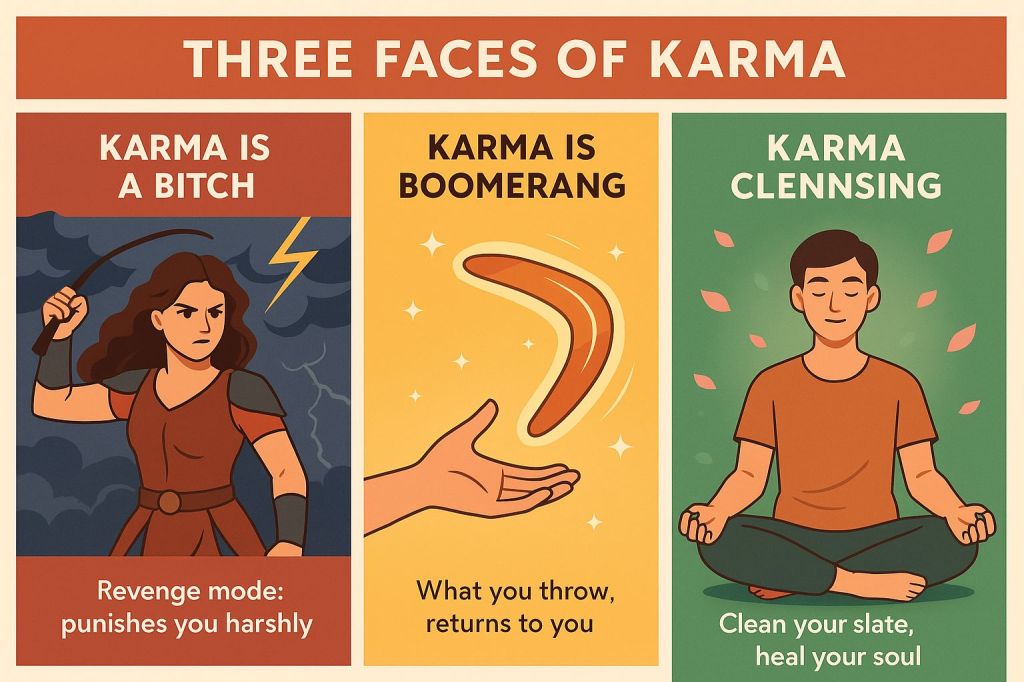
There was a time when I thought karma was just some cosmic revenge system — a way to sleep peacefully after someone wronged me. You know, that comforting phrase we throw around: “Karma is a bitch.”
We say it when someone cheats and loses everything, or when that arrogant boss finally gets fired. It’s a bit of a guilty pleasure, like watching a villain get slapped in a movie. But the truth? This is karma in its most raw, vengeful form — the “bitch” side of karma.
Then there’s the other version we don’t talk about enough: “Karma is a boomerang.” Throw out love, it comes back. Throw out hate, it comes back too. Unlike the bitchy version, this is not about punishment. It’s about balance. The universe simply mirrors what you put out, no drama, no extra seasoning.
And finally, there’s the silent warrior: Karma cleansing. This is for those who decide they’re done with the loop of reaction and revenge. It’s about intentionally cleaning your slate — not by just sitting and waiting for karma to do its thing, but by consciously choosing acts of kindness, forgiveness, meditation, or service. It’s less about “waiting for them to fall” and more about “rising above my own past mess.”
Three perspectives, one principle: What you give is what you get. Whether you want to see karma as a fierce lady with a whip, a simple returning boomerang, or a chance for deep soul detox — the choice is yours.
At the end of the day, karma is not just about punishing others. It’s a mirror, a teacher, and sometimes, the friend who gives us a much-needed slap or a hug at the right time.
“Your karma, your choice. How do you want to play this game?”
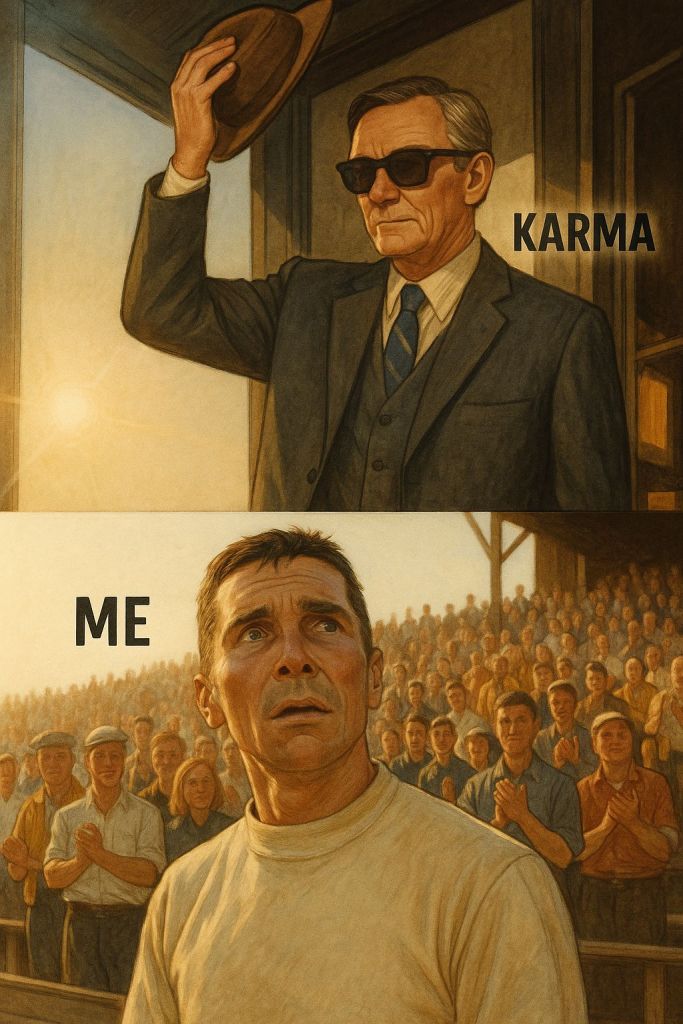
When karma tips its hat, I simply watch — scarred, healed, and finally free.
I grew up hearing the phrase “justice delayed is justice denied.” In my younger days, it sounded so powerful, so sharp — a perfect line to quote when you felt wronged or betrayed.
I believed justice meant someone should pay for hurting me, and they should pay now. I carried this belief with me, holding it close every time I felt cheated or double-crossed.
When I was betrayed, I felt an almost animal-like hunger for revenge. I would replay moments in my head, craft imaginary confrontations, and wish that karma would strike them down while I was still raw and bleeding.
But as time passed, something changed.
Life didn’t stop for my pain. The people who hurt me moved on, sometimes even seeming happier than before. I stayed stuck in a loop of anger, frustration, and helplessness, waiting for karma to arrive like a superhero and save me from my inner chaos.
Years later, karma finally did visit them. Two of the people who had hurt me so deeply faced their consequences — harshly. But by then, something unexpected had happened to me: I had healed.
When I heard about their downfall, it felt like reading an old news headline. There was no thrill, no moment of triumph, no fireworks. Just a quiet nod inside me, as if my soul whispered, “See? Life balances itself.”
In that moment, I realized: karma is not my personal lawyer. It’s not designed to heal my wounds or bring me peace. It’s not even meant to satisfy my sense of timing.
Unlike our legal system, where “justice delayed is justice denied” because victims need relief here and now, karma operates on a different plane altogether. Karma doesn’t arrive on our schedule. It doesn’t rush to fix our pain. Instead, it patiently restores balance in its own mysterious, universal way.
By the time karma acts, the raw wound has already become a scar. And when it does, it often feels like a distant echo rather than the roaring justice I once imagined.
I used to think that if karma didn’t act fast enough, it was as good as denied. But today, I see it differently. Karma is not about me; it is about the larger flow of life, the unseen balance sheet of actions and consequences that spans beyond my small circle of feelings.
Looking back, I understand now that healing was never karma’s job. Healing was mine. Karma didn’t come to save me — I had to save myself, stitch up my own wounds, and learn to walk forward carrying my scars with pride.
Those scars? They’ve taught me more than any revenge ever could. They taught me resilience, boundaries, patience, and — above all — the power of moving on.
So today, when I think about those who wronged me and finally “paid” for it, I feel nothing more than a gentle nod to the universe: Thank you for doing your part. I had already done mine.
What I’ve learned
Don’t wait for karma to heal you.
Don’t put your peace on hold waiting for someone else to fall.
Your healing is your responsibility; karma is just the universe keeping its own books.
In short
“Justice delayed is justice denied” is about human systems. “Karma delayed” is not karma denied — because karma is not about providing you justice, but about cosmic balance.
There was a time when betrayal felt like an open wound. When someone cheated or double-crossed me, I didn’t just feel hurt, I felt an almost animalistic urge for revenge. I wanted blood. I wanted them to feel the pain I was going through.
Other times, I felt like a helpless victim. I moved away quietly, carrying my heartbreak and frustration like a heavy bag I couldn’t put down. And as I carried it, that pain slowly turned into a deep sense of anger, depression, and a silent scream that no one else could hear.
Years passed. The sharpness of those wounds dulled. They turned into scars, they are always there, but no longer bleeding. Life went on, and I learned to walk forward with those scars stitched into my story.
And then, life did something unexpected. Within this year, two of the people who had wronged me, the very people I once wanted revenge against had finally faced the consequences of their actions. Karma, as we like to call it, had arrived.
But here’s the surprising part: it didn’t make me feel victorious. It didn’t bring me the happiness or relief I thought I’d feel a decade ago when those wounds were raw.
Instead, it felt like reading a piece of news. Just information. A passing moment of, Oh, I see. Life has its own way of balancing things out.
I realized something important in that moment: I had outgrown my need for revenge.
Back then, revenge felt like the only closure that could heal me. But healing never really waited for karma. Healing happened inside me, as I moved forward and rebuilt myself piece by piece.
Karma didn’t come to heal me; it simply came to do its job. The person I am today is no longer the same person who once stayed up at night imagining ways to “even the score.” Today, I find peace in knowing that I survived, that I grew stronger, and that my life is no longer defined by those betrayals.
The scars? They remain. But they are no longer a source of pain, they are reminders of how far I’ve come.
If karma had arrived ten years ago, it might have felt like a victory. Today, it feels like a gentle whisper from the universe: “Keep going. You’re already free.”
Don’t wait for karma to heal you. Don’t wait for someone else to hurt for you to move forward.
Your healing is yours — and the most powerful revenge is to build a life so full that you no longer look back waiting for justice.
While we often talk about venture capital, tech units, and risk-taking culture when describing Israel’s startup ecosystem, there’s a silent powerhouse that rarely gets enough credit: the spouses.
When Israel was founded in 1948, it was built in the middle of constant conflict and war. Men often had to volunteer or were called away for military service, leaving farms, family businesses, and shops vulnerable. While there wasn’t a strict law forcing women to officially take over businesses, there was a strong community expectation: the wife must know the business inside out to keep it alive if the husband was away — or never returned.
This wasn’t just about economics; it was survival. Business continuity was seen as a patriotic duty. Women weren’t simply supporters at home — they became equal partners in family businesses, laying the cultural foundation for today’s startup ecosystem where spouses often act as the “hidden co-founders.”
In modern Israeli startup culture, there’s a popular phrase called the “kitchen cabinet.” Originally used to describe Golda Meir’s informal advisory group that gathered in her kitchen, it now refers to the personal circle of trusted advisors founders rely on at home — often their spouses.
Many Israeli founders say their toughest strategic decisions didn’t happen in boardrooms but over late-night coffee with their spouse at the kitchen table. Spouses guide them through funding crises, pivots, layoffs, or those nerve-wracking “should we shut it down?” moments.
They hold the emotional line when things fail and cheer the loudest when things click. In a country where risk isn’t just accepted but celebrated, these spouses are not only emotional backbones but also often step into operational roles when needed — just like they did in the early days of the nation.
In Israel, a startup is never just “his” or “hers.” It’s a family mission, a collective leap, and a living example of shared resilience.
I met my scariest thoughts in silence. Later, I met my truest self there too.
Between 2010 and 2012, most of my close friends got married and slowly started moving to the US. I was still in India, watching my social circle shrink. Slowly, I started feeling a deep loneliness. It wasn’t just the absence of people; it was a heavy, unsettling silence that echoed inside me.
That loneliness didn’t feel like a quiet evening to rest. Instead, it created a voice inside me — a kind of invisible scare. I had sleepless nights and scary nights, but what exactly was I scared of? I couldn’t define it clearly.
Through my own reflection and reading, I understood that these were what psychologists sometimes call phantom threats. When our social support system breaks down, our brain starts scanning for danger, even if there isn’t any real external threat. It’s a leftover survival instinct from when being alone meant being vulnerable to wild animals or enemies. In modern life, this translates to vague fears, restlessness, or a feeling of being unsafe — even in the comfort of our own room.
Then, I got married. Suddenly, I had a partner, someone to share every small joy and every small fear with. That scary loneliness vanished. I didn’t feel that void anymore.
Fast forward to 2019–2025. Life had moved into another gear: kids, family commitments, work deadlines, responsibilities piling up. Ironically, there was no physical loneliness at all — I was constantly surrounded by people.
But deep inside, a new kind of loneliness crept in. This wasn’t the fear of being alone in an empty room; it was the exhaustion of never truly being alone with myself.
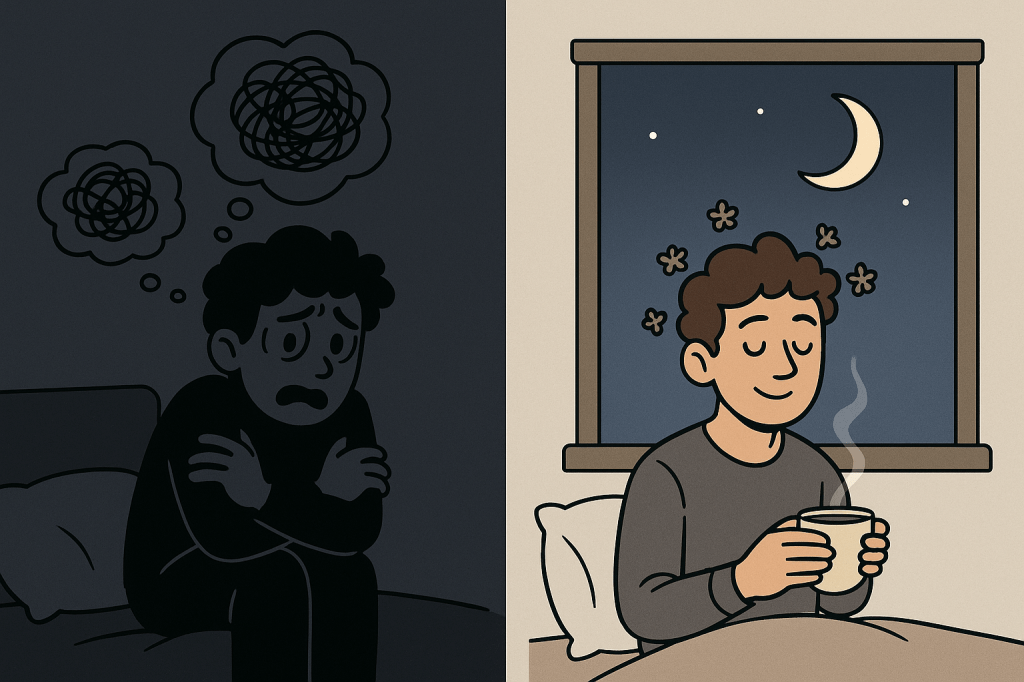
Every day felt like a marathon — waking up to attend to kids, squeezing in work calls, family discussions, endless errands. Even at night, when the world finally went quiet, my mind didn’t. It kept replaying unfinished tasks, small conflicts, worries about the kids, tomorrow’s to-do list.
I would close my eyes but feel half-awake, as if there was a hidden guard inside me who refused to let me fully rest. My dreams were crowded — sometimes about work, sometimes about family, sometimes random worries stitched together in confusing ways.
When I woke up, instead of feeling refreshed, I felt as if I had already lived an entire day in my mind. My body was stiff, my head heavy. It was like my brain never turned off, always on “alert mode,” scanning for the next responsibility.
There was no space for me. No silent cup of coffee alone. No lazy morning staring at the ceiling. No blank mental canvas. Just an endless wave of obligations crashing over me, one after another.
This was a loneliness that no one talks about — the loneliness inside a crowded life. You are surrounded by people, yet your inner self is starved for attention.
In June 2025, I moved to Chennai to focus on work, and for the first time in years, I got a lot of alone time. I was worried that the old fears would return, that those phantom threats would sneak back into my nights. But to my surprise, this loneliness felt completely different.
This time, it wasn’t scary. It was warm, healing. It felt like a solitude that I had long needed.
Now, instead of voices and scares, the silence felt like music. The quiet nights felt like gentle hugs from my own mind. I started enjoying small things again — watching the rain, making my own tea, sitting in silence without having to answer anyone.
I realized that this wasn’t loneliness; it was solitude — a conscious, chosen space to meet myself. It was no longer about being left out but about reconnecting inward.
Looking back, I realize loneliness and solitude are two sides of the same coin. One scares you when you don’t feel safe with yourself; the other heals you when you finally do.
As I write this today, I don’t feel the void I once did. Instead, I feel gratitude — for the noisy years, for the silent nights, and for the rare chance to meet my own mind in peace.
Five started the race. Two rewrote the finish line.
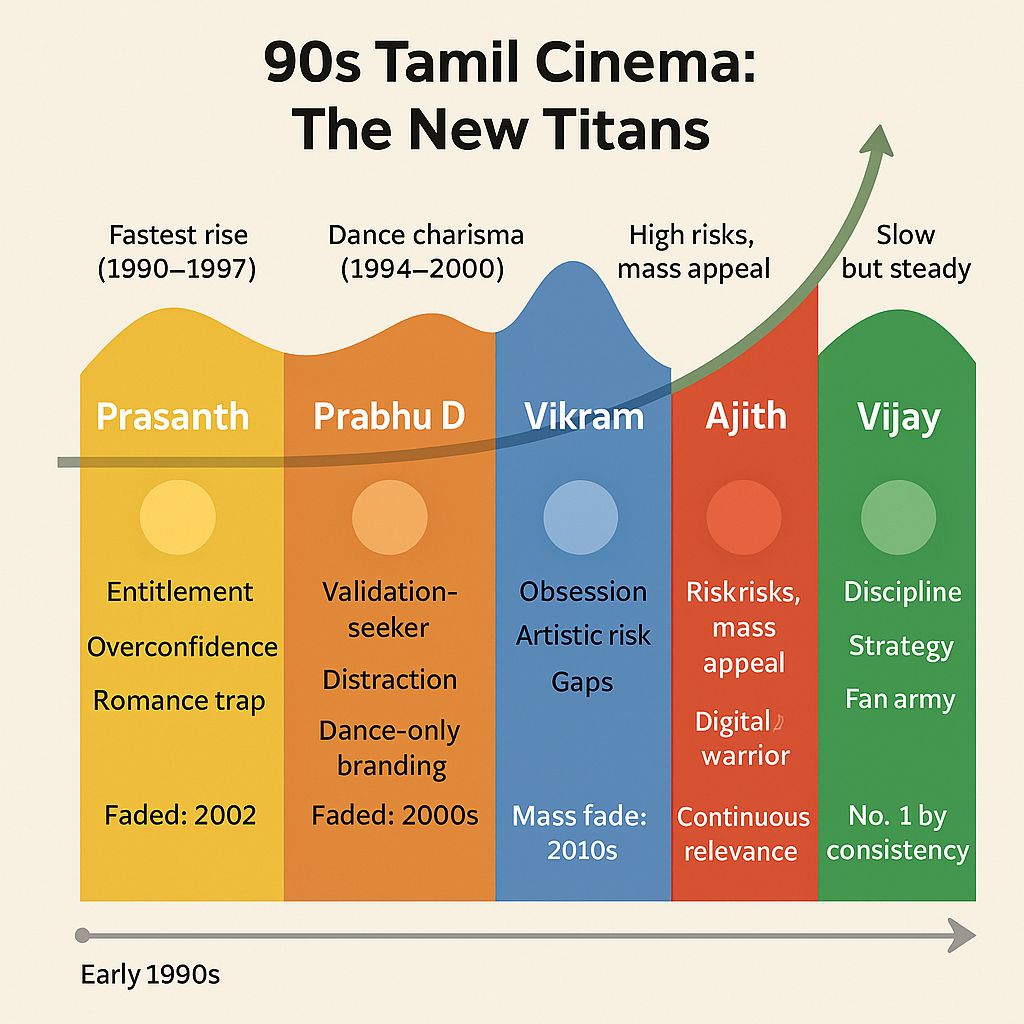
Tamil cinema in the 1990s saw a quiet revolution. Rajinikanth and Kamal Haasan were gracefully moving toward their 50s, creating a vacuum at the top. Into this vacuum stepped five new faces: Ajith, Vijay, Vikram, Prashanth, and Prabhu Deva.
All had the potential to become the next superstar. Yet only two — Ajith and Vijay — emerged and survived as cultural phenomena. Why? Let’s break it down exactly as it is.
Prashanth: The Early Meteor
Prashanth entered the scene like a comet — dream debut, star family, major producers lining up. He had the audience, the youth pulse, the box office. Until 1997, it was Prabhu Deva and Prashanth ruling the charts. Vijay and Ajith were still struggling to establish themselves and nowhere in the race.
But at some point, Prashanth and his father started believing that he alone was the reason for movie success and became too arrogant to be handled. They stopped focusing on stories, assuming Prashanth’s mere presence would guarantee hits. They demanded foreign location songs, controlled heroine selections, and overlooked the importance of strong scripts. Meanwhile, Ajith and Vijay doubled down on stories and started emerging as contenders.
Directors and producers found it difficult to work with them. Director Hari, who debuted through Prashanth, was humiliated by the father-son duo and never worked with him again. Instead of forming a healthy rivalry with Prabhu Deva (which could have expanded fan bases and frozen out Vijay and Ajith), they isolated themselves.
He overstretched the romance genre when he was offered action roles and was late to transform to action just when romance lost market appeal, fading around 2002.
Why he failed:
• Overconfidence and entitlement from early success. • Ignored story strength; thought stardom alone was enough. • Mishandled relationships with key directors and producers. • Refused to shift from romance to action genres on time. • Failed to build or maintain meaningful fan rivalries that could have strategically helped.
Prabhu Deva: The Dancer Who Couldn’t Stay Still
Prabhu Deva started as a dancer and became a star dancer who could carry a film purely for one dance sequence. Backed strongly by directors, he was made a hero around 1994. From 1994 to 2000, he was right in the race with Prashanth, and they were dominating.
But he lacked focus. He, too, thought that movies succeeded only because of his presence and dance appeal. He became difficult to work with and forgot the importance of solid scripts and team harmony. Had he and Prashanth maintained focus and worked collaboratively with producers and directors — creating a rivalry that engaged fans — they could have kept Ajith and Vijay at bay.
However, he let that slip, and Ajith and Vijay emerged as real contenders while he was distracted.
Why he failed:
• Overreliance on charisma and dance appeal. • Lost focus and did not take strategic career planning seriously. • Became difficult to work with, damaging professional relationships. • Didn’t transition into mass-appeal action roles when it was time. • Failed to engage and nurture a large fan base strategically.
Vikram: The Artful Transformer
Vikram debuted in 1990 and struggled for a decade before his breakthrough. From 2000 to 2005, he was unstoppable. During that period, he was on par or even above Vijay and Ajith. He even threatened Ajith’s stardom more than Vijay’s. If he had maintained that streak, he could have easily pushed Ajith aside because he had a strong, organic mass connect.
However, Vikram became obsessed with taking on roles that required extreme physical transformations. This led to large gaps between his films — sometimes several years. Those experiments rarely succeeded commercially. These gaps disconnected him from a whole generation between 2005–2015 who never saw him as a mass hero.
Why he failed:
• Extreme obsession with transformation and experimentation. • Long gaps between films lost a generation of mass audiences. • Focused too much on challenging roles rather than consistent mass appeal. • Failed to balance critical artistic ambition with commercial expectations. • Could not maintain continuous market presence to stay top of mind.
Ajith: The Charismatic Gambler
Ajith debuted in 1993 without any film background. His early films were average grossers, and he was initially known as a chocolate boy, adored by girls. But he took a massive risk — shifting from romantic roles to mass action hero roles at a time when that was not an obvious move. This is precisely where Prashanth lost out.
Ajith never took money if the producer struggled. He even invested his own money to help producers release films. He gave chances to debut or struggling directors, like SJ Suryah, and these gambles paid off big time.
Then came the Ajith-Vijay rivalry, which was fueled further by the rise of the internet. Unlike the physical fan wars of Rajini-Kamal, this was a digital-era rivalry that amplified their reach. Ajith strategically marketed his “self-made” image — someone without any film background, winning purely through grit — and this resonated deeply with fans.
Why he succeeded:
• Early, bold transition from romance to mass action. • Willingness to take risks and gamble on new talent. • Strong self-made narrative that connected emotionally with the public. • Supported producers and maintained goodwill within the industry. • Capitalized on digital fan wars, growing mass presence exponentially. • Luck also favored him, as Vikram was a strong contender for the same “struggler” fan base but faded at the right time, allowing Ajith to consolidate that space completely.
Weakness:
• He lacked consistency and strict discipline, sometimes taking long gaps or unpredictable choices.
Vijay: The Relentless Strategist
Vijay debuted in 1992 and was mocked for his looks and initial performances. Had it been today, he would have been meme material. His interest in acting sparked when he attended Prashanth’s debut success meet and saw the crowd’s reception, which inspired him.
From a filmy background, Vijay’s father was a successful director who supported him wholeheartedly. His father even pledged property to launch Vijay and sustained him during his initial struggles. He directed semi-glamorous, borderline exploitative films purely to attract an audience until Vijay was strong enough to stand on his own.
Unlike Prashanth’s father, Vijay’s father was strategic and sharp: he chose better scripts, built a solid brand, guided fan engagement, and mentored Vijay on handling fame. Vijay’s rise was gradual. His first real success came in 1996, and from there, he never looked back.
He consistently released three to four films a year, stayed professional, and strictly stuck to deadlines. He didn’t go overboard to please directors or producers; he was clear: show up, do the work, move on.
Why he succeeded:
• Strong discipline and professionalism. • Smart, strategic mentorship from his father. • Careful script selection without big gambles early on. • Systematic, strategic fan club creation and engagement. • Regular releases ensured continuous market presence.
Weakness:
• Initially lacked bold experimentation; his rise was slower but extremely stable.
Suriya: The Late Bloomer
Suriya entered later, around 1997, and was first truly recognized in 2002. By this time, Prashanth and Prabhu Deva were fading out, and Vikram was veering into experiments. Ajith and Vijay had already started cementing their strongholds.
Suriya made smart, modern script choices and collaborated with new-wave directors, becoming a respected actor admired for craft rather than mass stardom. He never directly threatened Ajith or Vijay in the mass arena but created his own niche.
Why only Ajith and Vijay stood tall
Ajith
• Embraced early, risky transitions. • Took chances on new talent. • Built an emotionally powerful self-made story. • Supported producers and stayed grounded. • Brilliantly rode the wave of digital fan rivalries.
Vijay
• Maintained laser-sharp discipline and consistency. • Benefited from his father’s mentorship in scripts and public image. • Demonstrated professionalism and on-time delivery. • Built and maintained strong, organized fan clubs. • Evolved steadily without abrupt risks.
Why the others didn’t
Prashanth
• Overconfidence and arrogance. • Ignored script quality. • Damaged industry relationships. • Stuck in outdated genres. • Failed to build smart rivalries.
Prabhu Deva
• Relied too much on dance alone. • Lacked focused strategy. • Developed a difficult reputation among producers. • Did not evolve his genre or brand. • Missed important market shifts.
Vikram
• Over-obsession with transformation. • Long gaps and lost audience connection. • Prioritized artistry over mass appeal. • Failed to balance experiments with commercial films. • Lacked continuous mass presence.
The Final Picture
Ajith was the rebel, the gambler, the people’s king with a self-made badge.
Vijay was the disciplined strategist, the quiet storm who rose without hype.
Prashanth, Prabhu Deva, and Vikram each fell not because of one shared flaw — but because of unique, individual missteps.
Key Takeaway
Success isn’t a formula; it’s an alignment of timing, self-awareness, adaptability, and strategic emotional connect.