Why the Safe Route Looks Easy, But the Wild Route Feels Right


I’ve often sat at my desk late into the night, staring at the ceiling and asking myself the same question: Why do opportunities seem to pass me by? I risked it all. I worked long hours that blurred into days, pawned my wealth, missed family events, and took responsibility when no one else would even step up. Meanwhile, job goers clocked in their neat 10-hour shifts, played safe, saved their salaries, bought flats, and went home to sleep peacefully. Some even quit when things got tough, never bothering to look back. And today, they seem more “settled” than me. It almost feels unfair. But life isn’t a cricket match with a clear scoreboard. It’s more like a marathon with different routes — some smooth, some with hidden potholes.

The curse (and gift) of taking responsibility

When you take responsibility, you don’t just carry tasks; you carry dreams — yours and everyone else’s. You become the cushion when things go wrong, the cheerleader when hope runs out, and the punching bag when blame needs a home. You can’t play safe. You can’t say, “It’s not my problem.” You’re too busy turning fires into candles.

Why the hustler looks inconsistent

I used to think I was inconsistent. But looking back, I realize I wasn’t inconsistent — I was simply overloaded. When you’re fighting battles on ten fronts, you lose focus on the main goal. You build, break, restart, pivot. From the outside, it looks like a lack of discipline. From the inside, it’s a survival dance.

Why job goers win small but steady

Job goers? They stuck to one lane. They focused only on their paycheck, not the company’s future. They didn’t risk sleepless nights thinking about client payments or the next big move. They followed a simple formula: do the job, save, buy a house, take a vacation, repeat. And you know what? There’s nothing wrong with that.

But then, what about us?

We choose the path of impact, not just income. We choose unpredictability over comfort. We play the game knowing that some days, the scoreboard doesn’t even exist. We’re not inconsistent — we’re experimental. We’re not unlucky — we’re learning resilience the hard way. We’re not behind — we’re building stories that will echo beyond bank statements.

Job goers may retire with a pension; you’ll retire with a legacy. Choose your prize.

In the end, life isn’t about collecting steady paychecks or safe medals. It’s about staying in the arena, even when the crowd goes silent.
How to Become an Entrepreneur in 2025: Build Slow, Play Smart


I started my entrepreneurial journey back when internet cafes were still a thing, and valuation was a word only VCs in Silicon Valley threw around. In 2025, the startup game looks fancier, faster, and full of noise — but the fundamentals remain timeless.

Let’s break it down.

Motivation: Why do you really want to do this?

If your motivation is just to quit your boss, show off on LinkedIn, or post those “hustle harder” selfies — stop right here.

Entrepreneurship is about solving a problem you deeply care about, and having the stomach for months (or years) of invisible effort before the first clap.

Bootstrapping: Start with your own shoes

Bootstrapping isn’t just a funding method; it’s a mindset. You learn to be scrappy, resourceful, and ruthless about where every rupee or dollar goes.

Options to bootstrap in 2025:

  • Freelancing or consulting on the side.
  • Using small grants or local government innovation funds.
  • Partnering with customers to prepay (advance orders).
  • Running micro MVPs (minimal products) and using those profits to fuel growth.

Networking: Find ideas, co-founders & allies

Don’t just scroll startup hashtags.

  • Attend local meetups, online communities (like Indie Hackers, Founder Clubs), and industry events.
  • Discuss problems, not pitches — the right co-founder or investor loves problem-solvers, not wannabe unicorn hunters.
  • Build trust slowly, especially if your co-founder isn’t a sibling or lifelong friend.

Sales & branding: Story first, scale next

In 2025, every customer has a 5-second attention span. Your brand is your story.

  • Solve one problem well, not ten problems “sort of.”
  • Build organic brand trust before performance marketing splurges.
  • Don’t just sell products — sell why you exist.

Opportunities: 2025 is gold for niche plays

  • Hyper-local services (think “Swiggy for home-cooked elders’ meals”)
  • AI-powered micro SaaS tools
  • Regional content & commerce
  • Sustainability products (waste management, zero-waste packaging)
  • Health-tech and affordable wellness

Valuation rush vs. slow & steady

People today worship those “raised $50M in Series A” posts. But most don’t realize — those founders are married to investors now.

Conventional way (slow and steady):

  • Build solid foundation.
  • Focus on profits.
  • Cement market trust.

Unconventional way (valuation-focused):

  • Rapid user acquisition.
  • Burn money to dominate quickly.
  • Aim for big exit or IPO.

💬 Which is ideal?

If you’re building with trusted partners (like siblings or lifelong friends) → Conventional. You think long-term, family legacy, steady cash flows.

If you’re building with a convenience-based co-founder (someone you met for skills, not soul) → Unconventional might work. Faster exits, cashing out before personal values clash.

Dos & Don’ts

✅ Do:

  • Focus on one clear customer problem.
  • Keep costs lower than your ego.
  • Build systems before scaling.

❌ Don’t:

  • Build just for investor applause.
  • Ignore mental and physical health.
  • Copy trends blindly.

Benefits of being an entrepreneur

  • You own your time (even if it feels like your startup owns you at first).
  • You create impact beyond your payslip.
  • You choose your tribe — employees, partners, customers.
  • You grow faster as a person than in any corporate boardroom.

In 2025 or 2055, the game is still the same: solve real problems, stay true to your “why,” and play your own game — not someone else’s scoreboard.

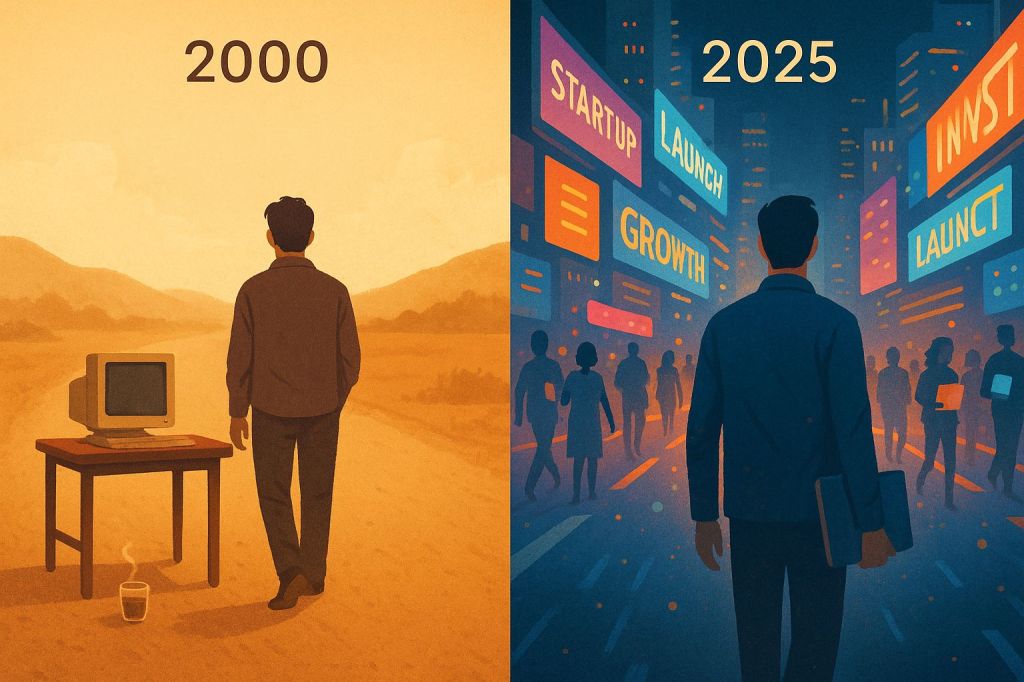
Startups Then & Now: From Empty Streets to Crowded Highways


Two eras, one spirit: the unstoppable heart of an entrepreneur.

I started my entrepreneurial ride back in 2000.

Those days, we didn’t even call it a “startup.” We called it “business,” “consultancy,” or just “trying something on my own.”

There was no Shark Tank. No glossy LinkedIn posts with #hustle. No college workshops on “How to pitch to VCs.”

In 2000, entrepreneurship wasn’t a cool badge. It was something you did if you couldn’t find a job or if you were just stubborn enough to believe you could create something from nothing.

2000: Wild, open roads

  • No references for success. The word “startup” was so rare, only one in a lakh even dared to dream it.
  • Loyalty was real. Your first hire stayed not just for salary but for the dream, even if the office was a one-room setup with plastic chairs and Maaza bottles in the fridge.
  • Markets were raw. Everything was new and waiting. A simple website could make you look like a global player.
  • Corporates & tech were immature. Big companies were still figuring out email, and many had no clue how to use the internet beyond sending scanned copies of invoices.
  • Open source was magic. You could build a product for the price of a few nights of filter coffee.
  • Ecosystem? Nil. No accelerators, no pitch fests, no “startup India” subsidies. Just you, your idea, and sheer guts.
  • Limited resources, big possibilities. Everything felt like a blank canvas.

2025: Crowded highways

  • Startup became a fashion statement. Every Tom, Dick, and Harry wants to “launch something” — sometimes just to add “Founder” to their Instagram bio.
  • Expensive game. Startups today mean burn rates, seed funding rounds, CAC vs LTV debates — even before you have your first paying customer.
  • No loyalty. Employees switch for a ₹2,000 raise or a fancier “Head of Vibe” title.
  • Tech consolidation. The top 5 tech giants dictate tools, languages, and frameworks. Your “freedom to build” has a Terms & Conditions page.
  • Market consolidation. Big sharks have gobbled up fragmented small players. Niches get crushed before you even announce your beta.
  • Ecosystem overload. Events, podcasts, awards, startup conferences. Everyone is “networking,” but very few are really building.
  • Too many eyes, less patience. Today, if your product doesn’t go viral in 2 weeks, you’re labeled a flop.

Then vs Now: What’s the real deal?

In 2000, the road was empty and scary.
In 2025, the road is crowded and noisy.

Then, the challenge was survival in the unknown.
Now, the challenge is standing out in the overcrowded known.

Then, it was about creating a market.
Now, it’s about finding your slot in a saturated market.

Then, you worried about paying your first employee on time.
Now, you worry if your pitch deck slides have enough “impact words.”

But here’s the one thing that hasn’t changed:

The thrill of chasing a vision that only you can see.

Whether you’re hustling on a dusty internet café PC in 2000 or pitching on a Zoom call in 2025 — the soul of entrepreneurship remains the same:
A quiet voice inside that whispers, Let’s try anyway.

“Markets change. Tech evolves. But courage? That stays timeless.”