In Business Breakups, the Winner Writes the Story


There is a kind of loss no one prepares you for.

Not failure.
Not bankruptcy.
Not even a breakup.

This is when a business partnership breaks, the other person walks away with the company, and you walk away with silence, blame, and a long legal shadow.

What makes it brutal is not just losing money or position.
It is losing identity, narrative, and fairness—all at once.

And watching the world applaud the aggressor.


1. Corporate Betrayal Trauma

This is not “a partnership issue.”

This is when:

  • Your life is deeply tied to the company
  • Your work continues—without your name
  • Your seat is occupied by the very person who pushed you out

It feels like divorce + job loss + public humiliation, rolled into one.

The worst part?
People expect you to “move on” while the wound is still open.


2. Asymmetric Power War

This is never a fair fight.

The aggressor has:

  • Company money
  • Legal teams on payroll
  • Employees, agencies, and advisors
  • Time and continuity

The victim has:

  • Personal savings
  • Family pressure
  • Emotional fatigue
  • And a ticking clock

Yet society judges both sides as equals.

They are not.


3. Narrative Hijack (Corrected Reality)

This is the most dangerous phase and the least understood.

The aggressor never speaks alone.

They have:

  • Employees
  • Friends
  • Consultants
  • PR agencies

All speaking on their behalf.

It looks like third-party endorsement, so people believe it.

But when the victim speaks:

  • It looks like self-defense
  • It looks like self-interest
  • It looks like weakness

Silence hurts you.
Speaking hurts you.

This is a communication trap with no clean exit.


4. Success Mask Injustice

Here is the cruel illusion:

The aggressor looks successful:

  • Company runs
  • Team stays
  • Money flows

The victim looks stuck:

  • Legal cases
  • Restarts
  • Explaining life to others

Society quietly assumes:

If he’s successful, he must be right.”

This is how appearance replaces truth.


5. Stakeholder Cross-Examination

You are forced to answer questions you never caused:

  • “Why did this happen to you?”
  • “Couldn’t you have avoided it?”
  • “What did you do wrong?”

Each question chips away at self-worth.

Not because you failed, but because you are the only one explaining.


6. Legal Time Distortion

Legal battles don’t just drain money.

They:

  • Freeze emotional closure
  • Reopen wounds every hearing
  • Delay life itself

Years pass.
Energy leaks.
Life waits unfairly.


7. Moral Injury

This is deeper than stress.

This is when:

  • You played fair
  • Trusted deeply
  • Followed ethics
  • And still lost publicly

It shakes your belief in:
Justice. Karma. Systems. Even faith.


How Do People Actually Survive This?

Not with motivation quotes.
Not with loud comebacks.

1. Stop Fighting on the Old Battlefield

You cannot:

  • Out-spend a company
  • Out-narrate a system
  • Out-perform a machine as an individual

Survival begins when you stop trying to win there.

This is not surrender.
This is strategy.


2. Replace the Narrative, Don’t Defend It

Don’t explain your past.

Build a present so strong that explanations become unnecessary.

People don’t revise beliefs.
They shift attention.


3. Re-Anchor Identity

Betrayal collapses identity.

Survivors consciously anchor themselves to:

  • A new domain
  • A new mission
  • A new value system

Not for money first.
For mental stability.


4. Shrink Your Circles

Keep only:

  • One truth circle
  • One energy-safe circle
  • One work circle

Everyone else gets distance.

Over-exposure is self-harm.


5. Accept Delayed Justice Without Losing Self-Respect

Acceptance is not saying:
They were right.”

Acceptance is saying:
My life will not wait for justice to arrive.

Justice may come or not.

Self-respect cannot wait.


The Quiet Truth

Many successful people carry one silent ruin in their past.
One betrayal they never speak about.
One phase that reshaped them completely.

Some battles are not meant to be won.

They are meant to change the person who survives them.

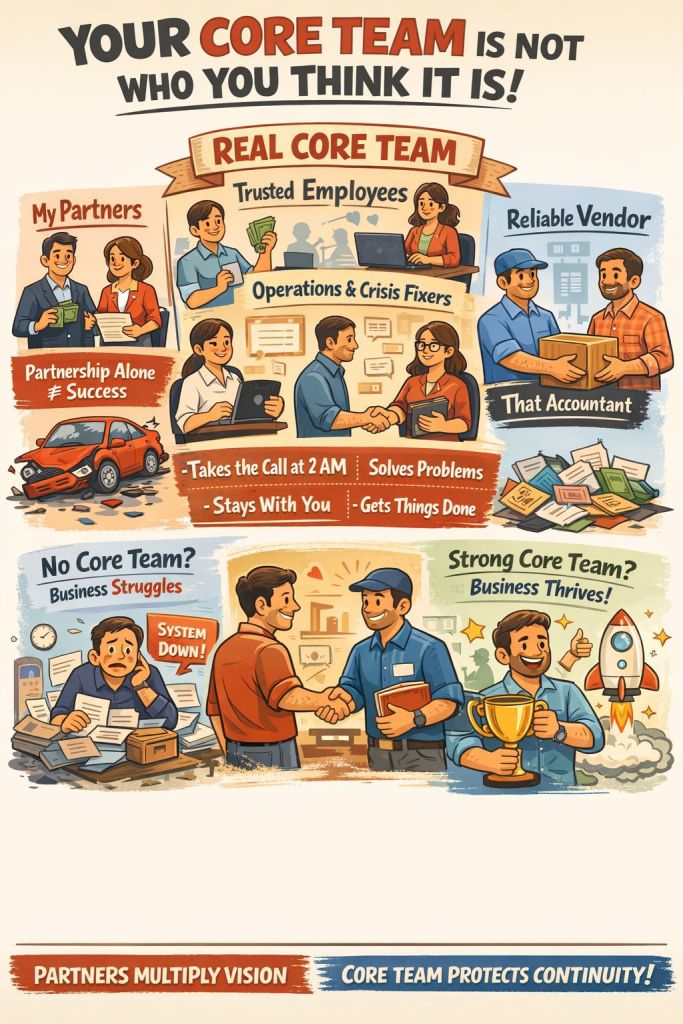
Your Core Team Is Not Who You Think It Is


Most people say this confidently:

My core team is my partners.”

Fair enough.
Good partners are gold.

But here’s the uncomfortable truth I learned the hard way:

👉 Many businesses die even with partners.
👉 Many businesses survive and grow without partners.

The difference is not partnership.
The difference is the core team.


Let me say this plainly

A core team is not about equity.
It is about who shows up when things go wrong.

The people who:

  • Pick up calls when something breaks
  • Know your business better than your SOPs
  • Fix problems without drama
  • Think, “If this fails, I fail too”

They may be employees.
They may be vendors.
They may not have a fancy title.

But without them, the business slows down or collapses.

That’s the real test.


Why founders misunderstand “core team”

Because startup culture romanticised this idea:

“Find a co-founder. Everything will be solved.”

Reality check:

  • Partners give direction
  • Teams give movement

A car with only a steering wheel won’t move.
You need an engine, wheels, fuel, and a driver who knows the road.

That’s your core team.


What a core team actually does (in real life)

Not theory. Real life.

They:

  • Remember why decisions were taken 3 years ago
  • Handle customers when you are sick, stuck, or burnt out
  • Prevent small issues from becoming public disasters
  • Keep the business breathing during bad phases

Most founders don’t fail suddenly.
They bleed slowly due to weak execution.

A strong core team stops that bleeding.


Some uncomfortable examples

Apple didn’t scale because Steve Jobs had partners.
It scaled because people like Tim Cook ran operations like a machine.

D-Mart didn’t grow because of flashy leadership.
It grew because store managers, buyers, and vendors stayed for decades.

Zoho didn’t win because of funding or hype.
It won because employees stayed long enough to care deeply.

Closer home?

Every successful small business has:

  • That one accountant who “knows everything”
  • That one operations person who holds the chaos together
  • That one vendor who never fails you

They don’t own shares.
But they own responsibility.


Vendors: the most ignored core team

Let’s talk about this honestly.

That vendor who:

  • Delivers even during strikes
  • Adjusts credit when cash flow is tight
  • Saves you from embarrassing customer issues

If they walk away, your business feels it immediately.

They are external employees in spirit.

Treat them like price-only suppliers and you lose them.
Treat them with respect and continuity, they become your shield.


Want to know who your real core team is?

Simple test. No theory.

Ask yourself:

  • If this person leaves tomorrow, will my business struggle?
  • Do they know things I never documented?
  • Do I trust them when money, reputation, or deadlines are at risk?

If the answer is yes — congratulations.
That’s your core team.

Whether HR agrees or not.


The hard truth most founders learn late

A business with partners but no core team is fragile.
A business with a strong core team can survive almost anything.

Partners multiply vision.
Core teams protect continuity.

If you’re building a business, don’t chase only co-founders and equity splits.

Build:

  • Trust
  • Respect
  • Long-term relationships

That’s what quietly builds durable businesses.


The Cost of Long Hours: A Lesson for Entrepreneurs


When I started out as an entrepreneur, I wore long hours as a badge of honor.
For me, “long hours” meant 18–21 hour workdays.

I took pride when people said I was available across all time zones. Sales calls at midnight, project delivery in the morning—my calendar never slept, and neither did I. At that time, youth and adrenaline helped my body keep up. No one told me it wasn’t sustainable.

Success came fast, but so did the silent damage. By 2018, sleep was a stranger. It took me 3–4 years of struggle to rebuild the simple habit of night sleep.

For the last three years, I’ve disciplined myself to sleep at nights. But the price I paid is written all over my health—hypertension, cholesterol, muscle stiffness, indigestion, and gut issues.

My advice to young entrepreneurs:
Yes, the path is challenging. Yes, you need to be ahead of the race. But don’t mistake sleeplessness for hustle. Let business happen in the day, let your body rest at night.

Because what’s the point of success if you can’t enjoy it in good health?

The Silent Breakup After Success – Why Founders Part Ways When the Game Is Won


We’ve all heard about startups breaking apart in the early struggle because of cash crunch, no product-market fit, fights over equity. But there’s another kind of breakup that’s quieter, more surprising, and far more common than most people think — the founder split after success.

Yes, after the product clicks, after the funding comes in, after the media starts calling… that’s when some founders walk away from each other. Why?

When the Survival Fire Goes Out

In the early days, the goal is simple — survive. Founders are united by the fear of failure, the hunger to prove themselves. But once the company hits stability, that fire changes shape.

Some want to scale like crazy. Others want to slow down and enjoy the win. One might be thinking IPO, while the other dreams of a small, profitable business they can run for decades. That’s when the cracks show — not in the market, but in the partnership.

The “I’m Doing More Than You” Syndrome

During the hustle, everyone is busy doing everything. But after success, roles become clearer. This is where one founder might feel the other is no longer pulling equal weight. The old “we’re in this together” feeling fades, replaced by silent resentment.

Power, Ego, and the Spotlight

Growth demands structure — titles, decision-making boundaries, and sometimes hierarchy. For people who built a company as equals, suddenly having to accept “final calls” from one person can sting. Add media attention, where one face gets more coverage than the other, and the ego wounds deepen.

Money Changes More Than the Bank Balance

Success brings money, and money changes priorities. Some want to chase new ventures. Some want a quieter life. Others become obsessed with the next big valuation. It’s not greed — it’s just that wealth gives you options, and not all options match.

Why I Think This Is More Common Now

Today’s startups reach “success” faster than before and sometimes within 2–3 years. That’s not enough time to test the partnership beyond the survival phase. Many founders never learn to navigate the post-survival stage together. And so, when the pressure to survive is gone, the glue that held them together also disappears.

The Takeaway

A startup isn’t just a business. It’s a relationship one that needs constant realignment, especially after winning the first big milestone. If founders don’t consciously work on their vision alignment, role clarity, and personal priorities before the win, the split often becomes inevitable.

So if you’re building something today, remember:
Winning the game is hard. Staying together after the win might be harder.

When Dreams Turn Into Daggers


When the hand that built the dream holds the knife that kills it.

In 2008, six of my friends did something most people only dream about.

They walked away from cozy jobs, steady paychecks, and the warm security of “playing safe” to build something bigger. Something worth remembering. They were all in their late 20s, brimming with fire. They took loans, emptied savings, and pledged the prime of their lives to a single dream.

The world of entrepreneurship, however, wasn’t the romantic adventure they imagined. It was brutal, unforgiving, and often lonely. They worked sleepless nights, took no salary for months, and when they finally did, it was far below what they could have earned elsewhere. They traded comfort for survival, and survival for the hope of victory.

And slowly, painfully, they built a brand — a brand that became a name others admired, a story that inspired.

But today… that story has a bitter ending.

One person’s greed — one — has turned all of that sweat, sacrifice, and shared hardship into ashes.
Three of my friends, who bled for this company for 15 long years, have been thrown out. Not because they failed. Not because they lacked value. But because the man they trusted — a friend — decided he wanted it all.

Money. Power. Control.

The irony? That man is my friend too. And watching him walk the same path as my ex‑business partner is like déjà vu wrapped in heartbreak. I’ve lived through betrayal. I’ve woken up to the taste of iron in my mouth, knowing someone I trusted had buried a knife in my back. I know the hollow it leaves inside you.

He needs to understand — really understand — what it means to crush the very people who carried you through the storms.
He needs to know that the applause he hears today will fade… and karma has the longest memory of all.

And to my friends who were wronged —
I want to tell you this:
Believe in yourself. Stay the course. Don’t let the poison of betrayal seep into the veins of your purpose. Karma takes time, yes… but when it moves, it never misses. I have seen it with my own eyes.

Success built on betrayal is a glass palace. It may look beautiful now, but the cracks are already forming.
And one day, when it shatters, the shards will cut deeper than any knife.

The Day I Hired My Destiny


Some choices echo forever.

They say life is nothing but a series of choices — some we make in seconds, some after years of thought. But it’s the unexpected ones, the small decisions on seemingly ordinary days, that end up shaping our destiny the most.

In 2004, I made such a choice.
I hired someone.
That’s it. A routine decision. A resume, a handshake, a promise of a new beginning — it felt like just another Monday on the entrepreneurial calendar.

She was from a small town, working in a call center, holding an MBA in HR but desperate for a break. I saw that raw hunger and decided to offer her a platform — I thought I was enabling a young professional’s dream. Maybe, in some corner of my mind, I even saw a reflection of my own past struggles — that same raw desperation to make it.

I had built my first venture with a dear partner, brick by brick, dream by dream. We didn’t have connections, we didn’t have family money cushioning our falls. All we had was ambition that kept us awake at night and a silent promise to each other that we would make it, no matter what.

But sometimes, we forget — when you open your door wide for someone, they might walk in carrying not gratitude, but greed.
She wasn’t cunning or a mastermind. She was simply short-sighted, hungry for quick luxury, blinded by instant pleasures. While we were busy building a company to stand the test of time, she was busy living in borrowed moments, chasing dinners, perfumes, designer labels — things that glitter only till the lights are on.

In her desperate rush for the high life, she didn’t just stumble — she pulled down everything in her path.
She rattled a ship that was floating on the fragile balance of two young dreamers. She planted doubts, sowed jealousy, whispered false comforts — and before I knew it, the dream I had once guarded like a newborn was thrown out with me.

In 2008, I was pushed out of my own creation. My partner too slowly fell into a pit he couldn’t climb out of. The venture that had so much promise, that spark in our eyes — it all vanished like an unfinished verse in a torn diary.

But the tragedy didn’t spare her either.
The same greed that fueled her steps ultimately consumed her life. She ended up as lost as we were broken — a stark reminder that shortcuts don’t just ruin roads, they erase destinations.

Years later, people still ask me, “What went wrong?”
I don’t blame fate, nor do I hold the world accountable. My only mistake? Hiring the wrong person on that one day in 2004. That single signature on a simple appointment letter shifted the course of twenty-one years of my life.

If I could ask God for just one gift, I wouldn’t ask for money, fame, or even a second chance.
I would simply ask Him to make me dream backwards — just for one night.

A dream where I go back to that fateful day, fix that one decision, and erase that moment when I hired her.
A dream where I see myself and my partner, two young boys with fire in their eyes, running a company that’s recognised, respected, and celebrated by all.
A dream where we are still fighting side by side, laughing over cheap tea, planning crazy ideas that kept us up all night, watching our tiny dream grow into an empire that even we can’t believe we built.

And in that dream, I want to see us standing on a stage, receiving awards, hearing applause, hugging each other with tears in our eyes — whispering, “We did it, against all odds.”
I want to wake up in the morning and still taste that dream, feel its warmth in my veins, carry its fragrance in my mind.

But life doesn’t give us that luxury.
So, I move forward — with scars, with lessons, and with the silent prayer that no one else ever has to learn it the way I did.

From Near-Broke to Trillion-Dollar Titan: The NVIDIA Gamble


20 years of flat growth. One wild bet. $4 trillion later — NVIDIA.

They say overnight success stories often take decades — and if there’s one company that embodies this, it’s NVIDIA.

When Jensen Huang co-founded NVIDIA in 1993, it wasn’t the AI juggernaut we know today. It started as a humble graphics card company with a bold dream: to make visual computing faster and better.

In 1995, NVIDIA nearly went bankrupt. Their first chip, the NV1, flopped badly. Investors lost faith, the market scoffed, and the future looked bleak. But true to its name — derived from the Latin “invidia,” meaning “envy” — the company refused to give up. They pivoted, came back with the RIVA series in 1997, and started making waves in the gaming world.

The real turning point came in 1999 with the launch of GeForce 256, marketed as the world’s first GPU (Graphics Processing Unit). This single move redefined gaming visuals and set NVIDIA on a new path.

Fast forward to 2006 — NVIDIA introduced CUDA, a bold platform that let developers use GPUs for tasks beyond graphics, like scientific computing and simulations. Back then, few outside academia noticed. But Jensen was already looking further ahead.

In 2012–2013, while the world was still fixated on gaming GPUs, Jensen had a wild realization: GPUs could power machine learning. This was no ordinary hunch; it was a bet on the future. At first, the market laughed it off, calling it an expensive gamble. But he stayed the course.

Then came AlexNet. In 2012, this deep learning model trained on NVIDIA GPUs won the ImageNet competition, opening the world’s eyes to what was possible. The AI wave had begun, and NVIDIA was surfing it ahead of everyone else.

The numbers tell the rest of the story:

  • In 2015, NVIDIA’s market cap was around $20 billion.
  • By 2020, it had crossed $300 billion.
  • In 2023, it soared past the $1 trillion mark.
  • And last week in 2024, it touched a jaw-dropping $4 trillion, symbolically putting it on par with India’s entire economy if we think in creative metaphors.

From a near-bankrupt graphics card maker to a global AI powerhouse, it took NVIDIA 20 years of flat growth, patient innovation, and fearless bets before finally catching fire.

Today, NVIDIA’s chips aren’t just inside gaming rigs — they are the backbone of data centers, self-driving cars, healthcare AI, and countless other breakthroughs.

As a fun trivia, while AMD is the closest competitor fighting for the GPU throne, it’s led by Lisa Su, who happens to be Jensen Huang’s distant cousin. The “family GPU feud” only adds another layer of drama to this Silicon Valley epic.

Looking back, Jensen’s story is a masterclass in resilience, vision, and patience. He wasn’t chasing trends; he was creating them. From a struggling startup almost lost to history, NVIDIA today stands as a testament to what happens when you bet on the future — and build it yourself.

Time and Tide Wait for No Man — But They Flow With You


Flow in your rhythm — the tide will find its way to you.

They say time and tide wait for no man. With that belief, I started my rookie entrepreneur run. I had my ups and downs, and today I stand at a point of realization: you will have your time. Put in your efforts, balance your life, and things will happen in their own time.

As a rookie, in just 8 years, I created a business empire that brought the envy of many. I ran ahead of seasoned players who had been around for decades. It felt like I had cracked the code — until I hit the fall.

After that struggle, I started seeing new rookies beating me. People who were once behind me moved ahead. It felt hopeless at times, watching the race from the sidelines. But as I sat back and truly analyzed it, I saw the pattern:

The illusion of permanent success

We often think success is a peak — climb it once, and you’re there forever. But it’s not.

Success is like a series of waves. Today you’re ahead, tomorrow someone else. Then someday you rise again. It’s a continuous, flowing cycle.

Everyone has their reversals

Everyone who sprints ahead will eventually need to slow down. Every empire, every champion, every star performer — they all have their reversals. Some gracefully, some painfully, but all inevitably.

That doesn’t make them failures. It makes them part of life’s natural rhythm.

Effort, balance, and patience

The more I reflect, the more I realize that raw speed isn’t everything. Balance matters more. Effort matters more. Staying patient and showing up consistently matter more.

It’s no longer just about outrunning everyone else; it’s about lasting, evolving, and staying true to yourself.

Your own rhythm

Those rookies overtaking me today? They are in their own prime, their own sprint phase. Some will last, some will fade. Just like I did. Just like everyone does.

There is no permanent “ahead” or “behind.” There’s just your story, your learnings, and your rhythm.

Final thought: Time and tide wait for no man — but they flow with the one who flows with them

So I keep reminding myself: do your part, stay true, keep your balance, and your day will come. Again and again, in different forms.

People Often Judge Outcomes, Not Journeys


Judged by outcomes. Built by journey.

I’ve seen this time and again — in business, in relationships, and especially in entrepreneurship:

People judge outcomes. Not journeys.

Success? You’re celebrated.
Failure? You’re forgotten.
Still trying? You’re questioned.

Why is it this way?

Because outcomes are visible, journeys are not.

Nobody sees the 3 a.m. self-doubt. The loan EMIs. The silent sacrifices.
They only see whether you “made it” — or didn’t.

Society has become obsessed with results.
We’ve built a culture where IPOs trend, but unpaid dues don’t.
Where LinkedIn posts shine, but emotional breakdowns stay hidden.

The cost of this mindset for entrepreneurs?

1.) Emotional burnout

You start believing you’re only as good as your last “win.”
The effort, grit, and growth mean nothing if the scoreboard shows zero.

2.) Judgment from close ones

The toughest hits often come not from strangers, but from family and friends:

“Still chasing your dream?”
“When will you settle down?”
“Why not take up something stable?”

Their concern is real, but their understanding is rare.

3.) Fear of failure

You start making safe bets. You drop ideas too soon.
You avoid risks just to avoid ridicule.

4.) Validation over vision

You chase vanity metrics. You post curated wins.
You start performing entrepreneurship instead of living it.

But here’s the truth no one talks about:

  • The journey builds you, whether or not the startup succeeds.
  • Failure isn’t the opposite of success — it’s a phase of it.
  • Your worth isn’t tied to revenue charts. It’s tied to resilience.

Let’s change the narrative:

Instead of asking:

“What’s your valuation?”
Let’s ask:
“What have you learned?”
“What’s keeping you going?”
“How can I help?”

Because some journeys deserve standing ovations — even without a trophy.

Entrepreneur Karma: The Invisible Balance Sheet


While you chase numbers, karma quietly balances your true ledger.

You can pivot your business, but you can’t pivot your karma.

An entrepreneur’s life is like sailing in a stormy ocean. You chart your route on glossy pitch decks, you shout “growth” from your deck, and you dream of finding treasure islands called “unicorns.”

But while you’re chasing your horizon, something else silently follows you — karma.

Your silent co-founder

Karma is your silent co-founder.
It doesn’t ask for equity.
It doesn’t sit in boardrooms.
But it audits your soul every night.

Your team, your mirror

If you lead with greed, you’ll breed seeds of speed — people who flee when you bleed.
If you lead with heart, you’ll build an army that won’t fall apart.

Customers — your echo

Treat them like transactions, and they’ll vanish like distractions.
Treat them like humans, and they’ll become your loudest hymn.

Shortcuts cut your soul

You can lie to investors and the world. But when the lights go out, only karma sleeps beside you.
Quick wins often echo as lifelong sins.

Energy never expires

You think that unpaid intern forgot?
You think that co-founder betrayal is buried?
In the ledger of karma, no line item is ever fully written off.

“You can exit your company, but you can’t exit your karma.”
“Your valuation may fade, but your vibration stays.”

So dear entrepreneur, build your karma balance sheet as carefully as your P\&L.
Because at the end, it’s not the shares you hold, but the souls you touch that become your true legacy.