
2008 didn’t just take away my company.
It took away people.
A partner I once called my best friend.
A love I believed was real.
Both gone.
Both unreal, as I painfully discovered.
That phase didn’t feel like loss.
It felt like being cut open… slowly… while still alive.
I still remember one day very clearly.
I got ready like any normal day — neatly dressed, wearing my Woodland shoes.
I told myself I’ll go watch a movie at Mayajaal. Maybe that would help.
I reached there.
But I couldn’t walk in.
Something inside me refused.
Instead, I just started walking.
No plan. No destination.
From Mayajaal… all the way to Mahabalipuram.
Tears didn’t stop.
Thoughts didn’t stop.
My mind kept replaying everything —
Was it all fake?
Was I living a dream that never existed?
How did everything collapse so fast?
At times, I don’t even remember parts of that walk.
There were moments of blankness… like my mind was shutting down to protect itself.
I don’t know how I walked that distance.
I don’t know how I came back.
I just did.
Years have passed.
Today, I have accepted what happened.
Life moved forward.
People moved on.
Even karma, in its own way, has done its job.
But acceptance is not the same as understanding.
Some questions never got answers.
Why did it happen?
Why did people change?
Was I blind… or just trusting?
I don’t carry anger anymore.
But I carry those questions.
Silently.
Because sometimes in life…
you don’t get closure.
You just learn to live without it.
Tag: failure
Three Ways to Become ‘Successful’ — Sweat, Setback, or Shaadi?
There are three kinds of “successful” people in this world.

The first kind works hard. Relentlessly. They wake up before sunrise, sleep after midnight, build, rebuild, and keep building. They believe in compounding effort. They trust process.
And they grow.
Not explosively. Not dramatically.
Just steadily.
“They don’t trend. They endure.”
Their life is less fireworks, more sunrise. Not flashy — but dependable. They are the kind who build brick by brick. Slow growth, strong roots.
The second kind works just as hard.
Maybe harder.
They sacrifice sleep, relationships, comfort. They dream big. They bet everything. And sometimes… they lose.
Market shifts. Partners betray. Timing misfires.
And the fall is brutal.
“Hard work guarantees growth of character, not always growth of bank balance.”
These are not failures. They are warriors with scars. They carry depth. They understand gravity. They are the ones who know what it means to fall from the sky and still stand up again.
Empathy belongs here. Respect belongs here.
Because trying and failing builds a different muscle — resilience.
And then… there is the third kind.
The lucky ones.
They marry into wealth.
They inherit position.
They hold property in someone else’s name.
They wake up rich on a Tuesday.
No sweat. No scars. Just destiny saying, “Beta, VIP entry.”
“Some people climb mountains. Some start at the top.”
To be fair, luck is also a skill — mainly in choosing the right wedding venue.
But here’s the humour hidden in truth:
Luck can open doors. It cannot build capability.
And life eventually tests everyone.
In the long run, success is not about how fast you rose.
It is about whether you can stand when the wind changes.
The slow builder? Stable.
The fallen warrior? Stronger than before.
The lucky one? Depends.
Because borrowed power shakes.
Built power roots.
And if you ask me —
I’ll bet on the one who knows how to rebuild.
Time and Tide Wait for No Man — But They Flow With You

They say time and tide wait for no man. With that belief, I started my rookie entrepreneur run. I had my ups and downs, and today I stand at a point of realization: you will have your time. Put in your efforts, balance your life, and things will happen in their own time.
As a rookie, in just 8 years, I created a business empire that brought the envy of many. I ran ahead of seasoned players who had been around for decades. It felt like I had cracked the code — until I hit the fall.
After that struggle, I started seeing new rookies beating me. People who were once behind me moved ahead. It felt hopeless at times, watching the race from the sidelines. But as I sat back and truly analyzed it, I saw the pattern:
The illusion of permanent success
We often think success is a peak — climb it once, and you’re there forever. But it’s not.
Success is like a series of waves. Today you’re ahead, tomorrow someone else. Then someday you rise again. It’s a continuous, flowing cycle.
Everyone has their reversals
Everyone who sprints ahead will eventually need to slow down. Every empire, every champion, every star performer — they all have their reversals. Some gracefully, some painfully, but all inevitably.
That doesn’t make them failures. It makes them part of life’s natural rhythm.
Effort, balance, and patience
The more I reflect, the more I realize that raw speed isn’t everything. Balance matters more. Effort matters more. Staying patient and showing up consistently matter more.
It’s no longer just about outrunning everyone else; it’s about lasting, evolving, and staying true to yourself.
Your own rhythm
Those rookies overtaking me today? They are in their own prime, their own sprint phase. Some will last, some will fade. Just like I did. Just like everyone does.
There is no permanent “ahead” or “behind.” There’s just your story, your learnings, and your rhythm.
Final thought: Time and tide wait for no man — but they flow with the one who flows with them
So I keep reminding myself: do your part, stay true, keep your balance, and your day will come. Again and again, in different forms.
Five Titans, One Throne: Why Only Two Rose in Tamil Cinema’s Great Generation War
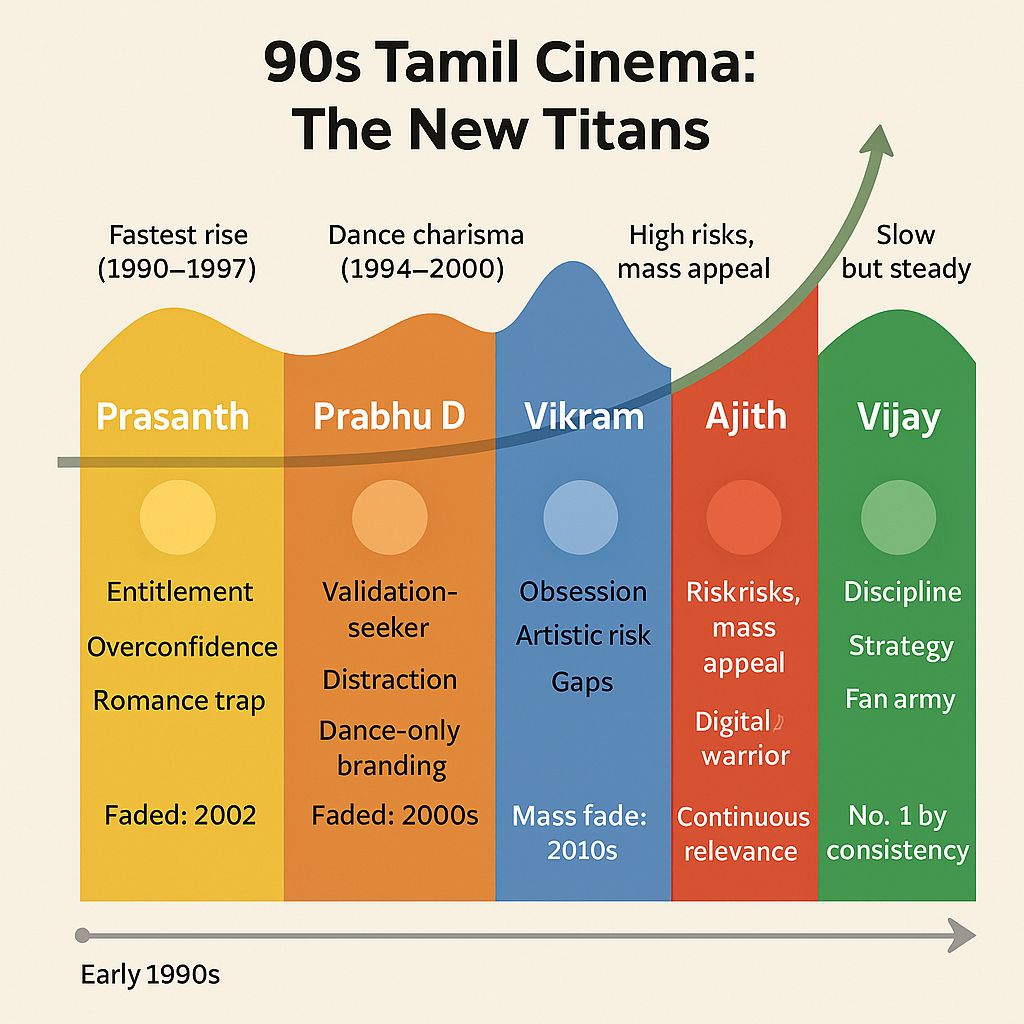
Tamil cinema in the 1990s saw a quiet revolution. Rajinikanth and Kamal Haasan were gracefully moving toward their 50s, creating a vacuum at the top. Into this vacuum stepped five new faces: Ajith, Vijay, Vikram, Prashanth, and Prabhu Deva.
All had the potential to become the next superstar. Yet only two — Ajith and Vijay — emerged and survived as cultural phenomena. Why? Let’s break it down exactly as it is.
Prashanth: The Early Meteor
Prashanth entered the scene like a comet — dream debut, star family, major producers lining up. He had the audience, the youth pulse, the box office. Until 1997, it was Prabhu Deva and Prashanth ruling the charts. Vijay and Ajith were still struggling to establish themselves and nowhere in the race.
But at some point, Prashanth and his father started believing that he alone was the reason for movie success and became too arrogant to be handled. They stopped focusing on stories, assuming Prashanth’s mere presence would guarantee hits. They demanded foreign location songs, controlled heroine selections, and overlooked the importance of strong scripts. Meanwhile, Ajith and Vijay doubled down on stories and started emerging as contenders.
Directors and producers found it difficult to work with them. Director Hari, who debuted through Prashanth, was humiliated by the father-son duo and never worked with him again. Instead of forming a healthy rivalry with Prabhu Deva (which could have expanded fan bases and frozen out Vijay and Ajith), they isolated themselves.
He overstretched the romance genre when he was offered action roles and was late to transform to action just when romance lost market appeal, fading around 2002.
Why he failed:
• Overconfidence and entitlement from early success.
• Ignored story strength; thought stardom alone was enough.
• Mishandled relationships with key directors and producers.
• Refused to shift from romance to action genres on time.
• Failed to build or maintain meaningful fan rivalries that could have strategically helped.
Prabhu Deva: The Dancer Who Couldn’t Stay Still
Prabhu Deva started as a dancer and became a star dancer who could carry a film purely for one dance sequence. Backed strongly by directors, he was made a hero around 1994. From 1994 to 2000, he was right in the race with Prashanth, and they were dominating.
But he lacked focus. He, too, thought that movies succeeded only because of his presence and dance appeal. He became difficult to work with and forgot the importance of solid scripts and team harmony. Had he and Prashanth maintained focus and worked collaboratively with producers and directors — creating a rivalry that engaged fans — they could have kept Ajith and Vijay at bay.
However, he let that slip, and Ajith and Vijay emerged as real contenders while he was distracted.
Why he failed:
• Overreliance on charisma and dance appeal.
• Lost focus and did not take strategic career planning seriously.
• Became difficult to work with, damaging professional relationships.
• Didn’t transition into mass-appeal action roles when it was time.
• Failed to engage and nurture a large fan base strategically.
Vikram: The Artful Transformer
Vikram debuted in 1990 and struggled for a decade before his breakthrough. From 2000 to 2005, he was unstoppable. During that period, he was on par or even above Vijay and Ajith. He even threatened Ajith’s stardom more than Vijay’s. If he had maintained that streak, he could have easily pushed Ajith aside because he had a strong, organic mass connect.
However, Vikram became obsessed with taking on roles that required extreme physical transformations. This led to large gaps between his films — sometimes several years. Those experiments rarely succeeded commercially. These gaps disconnected him from a whole generation between 2005–2015 who never saw him as a mass hero.
Why he failed:
• Extreme obsession with transformation and experimentation.
• Long gaps between films lost a generation of mass audiences.
• Focused too much on challenging roles rather than consistent mass appeal.
• Failed to balance critical artistic ambition with commercial expectations.
• Could not maintain continuous market presence to stay top of mind.
Ajith: The Charismatic Gambler
Ajith debuted in 1993 without any film background. His early films were average grossers, and he was initially known as a chocolate boy, adored by girls. But he took a massive risk — shifting from romantic roles to mass action hero roles at a time when that was not an obvious move. This is precisely where Prashanth lost out.
Ajith never took money if the producer struggled. He even invested his own money to help producers release films. He gave chances to debut or struggling directors, like SJ Suryah, and these gambles paid off big time.
Then came the Ajith-Vijay rivalry, which was fueled further by the rise of the internet. Unlike the physical fan wars of Rajini-Kamal, this was a digital-era rivalry that amplified their reach. Ajith strategically marketed his “self-made” image — someone without any film background, winning purely through grit — and this resonated deeply with fans.
Why he succeeded:
• Early, bold transition from romance to mass action.
• Willingness to take risks and gamble on new talent.
• Strong self-made narrative that connected emotionally with the public.
• Supported producers and maintained goodwill within the industry.
• Capitalized on digital fan wars, growing mass presence exponentially.
• Luck also favored him, as Vikram was a strong contender for the same “struggler” fan base but faded at the right time, allowing Ajith to consolidate that space completely.
Weakness:
• He lacked consistency and strict discipline, sometimes taking long gaps or unpredictable choices.
Vijay: The Relentless Strategist
Vijay debuted in 1992 and was mocked for his looks and initial performances. Had it been today, he would have been meme material. His interest in acting sparked when he attended Prashanth’s debut success meet and saw the crowd’s reception, which inspired him.
From a filmy background, Vijay’s father was a successful director who supported him wholeheartedly. His father even pledged property to launch Vijay and sustained him during his initial struggles. He directed semi-glamorous, borderline exploitative films purely to attract an audience until Vijay was strong enough to stand on his own.
Unlike Prashanth’s father, Vijay’s father was strategic and sharp: he chose better scripts, built a solid brand, guided fan engagement, and mentored Vijay on handling fame. Vijay’s rise was gradual. His first real success came in 1996, and from there, he never looked back.
He consistently released three to four films a year, stayed professional, and strictly stuck to deadlines. He didn’t go overboard to please directors or producers; he was clear: show up, do the work, move on.
Why he succeeded:
• Strong discipline and professionalism.
• Smart, strategic mentorship from his father.
• Careful script selection without big gambles early on.
• Systematic, strategic fan club creation and engagement.
• Regular releases ensured continuous market presence.
Weakness:
• Initially lacked bold experimentation; his rise was slower but extremely stable.
Suriya: The Late Bloomer
Suriya entered later, around 1997, and was first truly recognized in 2002. By this time, Prashanth and Prabhu Deva were fading out, and Vikram was veering into experiments. Ajith and Vijay had already started cementing their strongholds.
Suriya made smart, modern script choices and collaborated with new-wave directors, becoming a respected actor admired for craft rather than mass stardom. He never directly threatened Ajith or Vijay in the mass arena but created his own niche.
Why only Ajith and Vijay stood tall
Ajith
• Embraced early, risky transitions.
• Took chances on new talent.
• Built an emotionally powerful self-made story.
• Supported producers and stayed grounded.
• Brilliantly rode the wave of digital fan rivalries.
Vijay
• Maintained laser-sharp discipline and consistency.
• Benefited from his father’s mentorship in scripts and public image.
• Demonstrated professionalism and on-time delivery.
• Built and maintained strong, organized fan clubs.
• Evolved steadily without abrupt risks.
Why the others didn’t
Prashanth
• Overconfidence and arrogance.
• Ignored script quality.
• Damaged industry relationships.
• Stuck in outdated genres.
• Failed to build smart rivalries.
Prabhu Deva
• Relied too much on dance alone.
• Lacked focused strategy.
• Developed a difficult reputation among producers.
• Did not evolve his genre or brand.
• Missed important market shifts.
Vikram
• Over-obsession with transformation.
• Long gaps and lost audience connection.
• Prioritized artistry over mass appeal.
• Failed to balance experiments with commercial films.
• Lacked continuous mass presence.
The Final Picture
Ajith was the rebel, the gambler, the people’s king with a self-made badge.
Vijay was the disciplined strategist, the quiet storm who rose without hype.
Prashanth, Prabhu Deva, and Vikram each fell not because of one shared flaw — but because of unique, individual missteps.
Key Takeaway
Success isn’t a formula; it’s an alignment of timing, self-awareness, adaptability, and strategic emotional connect.
The Silent War After Failure

I used to think failure was about numbers like losing money, shutting down a company, or missing targets. But real failure? It’s when you lose yourself.
After my own setback, I noticed something strange. It wasn’t just that I didn’t have work. It was that I couldn’t feel like working anymore. The spark that once lit me up like brainstorming at midnight, building teams, scaling products — it didn’t even create a flicker inside me.
I kept asking myself: Why can’t I just pick up something small and start? Why can’t I push through?
The truth hit me like a late-night punch: I had evolved. What excited me before simply didn’t feel meaningful anymore.
When you’ve built something big, your mind builds an invisible yardstick. You unconsciously measure every new idea against your past success. You remember the energy of a big team, the rush of growth charts, the adrenaline of new hires and expansions.
Now, when you try to start something small — a side gig, a consulting call, a tiny digital product — it feels like throwing pebbles after you’ve once launched rockets. You feel silly, almost embarrassed to call it “work.”
But it doesn’t stop there. Your entire identity gets woven into your career. Your “I am” statement was always followed by what you built or led. When that structure crumbles, it cracks you right at the core. You’re not just jobless; you feel nameless.
The worst part? You can’t even explain it to anyone. Friends and family might say, “Do something small! Just start anywhere!” They mean well. But they don’t realize you’re battling an invisible ghost inside — a ghost that constantly whispers, “You’re not enough anymore.”
I lived this. Every single hour felt heavy, every day felt like pushing through fog. I knew I should act, but the energy just wasn’t there.
I’m still figuring it out. I don’t have a grand conclusion yet. Maybe one day I will.
Sometimes the hardest comeback isn’t in the world outside — it’s in the quiet corner of your mind where your old self still lives.
Perceive Without Quitting: Understanding Failure as a Step Before Success
Success is often seen as the ultimate goal, the pinnacle of our achievements. We strive for it, work towards it, and celebrate it when we reach it. But what about failure? We tend to see it as the opposite of success, something to avoid at all costs. But what if I told you that failure is actually a step before success? That it can be a valuable learning experience that propels you forward towards your goals? In this blog post, we’ll explore the idea that failure is not something to fear, but something to embrace and learn from.
Firstly, let’s define failure. Failure is simply not achieving the desired outcome. It’s important to note that failure is not a reflection of your worth as a person. We all fail at some point in our lives, and it’s how we respond to failure that makes all the difference. The fear of failure can be paralyzing, but if we shift our mindset and see failure as an opportunity to learn and grow, we can use it to our advantage.
One of the greatest benefits of failure is that it teaches us resilience. When we fail, we experience disappointment, frustration, and even embarrassment. But if we can pick ourselves up, dust ourselves off, and keep going, we become more resilient. Resilience is the ability to bounce back from setbacks and keep moving forward. It’s an essential quality for success in any area of life, and failure can help us develop it.
Another benefit of failure is that it can lead to creativity and innovation. When we’re faced with a challenge and our first attempt fails, we’re forced to think outside the box and come up with new ideas. This process of trial and error can lead to breakthroughs and new discoveries. Many of the world’s greatest inventors and innovators experienced failure before achieving success.
Lastly, failure can teach us important lessons. When we fail, we have the opportunity to reflect on what went wrong and how we can do better next time. This process of self-reflection and learning is crucial for personal growth and development. It allows us to identify our strengths and weaknesses and work on improving ourselves.
In conclusion, failure is not something to fear or avoid, but something to embrace and learn from. It can teach us resilience, lead to creativity and innovation, and help us learn important lessons. Remember that failure is a step before success, and don’t give up on your goals just because you experience setbacks. Persevere, learn from your failures, and keep moving forward. With this mindset, you’ll be well on your way to achieving success
The Power of Persistence: How Embracing Failure Can Lead to Success

If you want to be rich, never give up. These words may sound cliché, but they hold a lot of truth. Many people start on the path to wealth with a lot of enthusiasm, only to give up when the going gets tough. However, if you have persistence, you will come out ahead of most people. More importantly, you will learn.
It is important to understand that failure is not a sign of weakness or incompetence. It is simply an indication that you have not learned enough. When you do something and fail, it is not the end of the world. You can use that experience to learn and grow, and do it differently the next time around.
The most successful people in the world have failed countless times before achieving their goals. It is through failure that they have learned valuable lessons that have helped them succeed. So, if you want to be rich, don’t be afraid to fail. Failure is your friend.
Persistence is key when it comes to achieving success. You need to have the courage to keep going even when things seem impossible. This requires a lot of mental and emotional strength. But, if you are determined and persistent, you will eventually achieve your goals.
It is important to note that success does not come overnight. It takes time and effort to achieve success. So, be patient and keep working hard. It may take years, but if you keep at it, you will eventually achieve your goals.
In conclusion, if you want to be rich, never give up. Be persistent, learn from your failures, and keep working hard. Remember, failure is not a sign of weakness, but an opportunity to learn and grow. With persistence and hard work, you will eventually achieve your goals and become successful
The Stigma of Failure: Society’s Treatment of Those Who Have Fallen Short
Failure is not inherently a dogma, but it can often be perceived as such in certain societies or cultural contexts. This is because success is often highly valued and celebrated, while failure is seen as a negative outcome. As a result, people who fail to achieve their goals or experience setbacks may be stigmatized or treated poorly by others.
However, it’s important to recognize that failure is a natural part of life and can actually be a valuable learning experience. Many successful individuals have experienced multiple failures before ultimately achieving their goals. Therefore, it’s important to not view failure as a defining characteristic of a person, but rather as a temporary setback that can be overcome.
The way that failed people are treated by society can vary depending on the culture and context. In some cases, they may be looked down upon or criticized, while in other cases, they may be supported and encouraged to try again. It’s important to create a culture that celebrates effort, growth, and resilience, rather than one that stigmatizes failure. This can create a more supportive and inclusive environment where individuals feel safe to take risks and learn from their mistakes.
A book I can read again and again without getting bored…..

It is after reading this book my life got transformed… It was during 2004 I got this book and finished reading it at one go…
My Situation: My company was in near disaster when 35 out of 40 of my staff resigned in less than 2 weeks..
That was the first time I came across an attrition and I was almost collapsed… I got convinced that my four year entrepreneur journey has come to an end..
It was after reading this book that I got the confidence to fight back… The book taught me how to approach failure… My entire perception about failure changed and I stared looking for opportunity and lessons from every failure…
The book talks about ways of turning setbacks to success and it is conveyed with 27 real life cases..
I keep reading this book when ever I feel demotivated… Till now I would have read this book more than 50 times and I keep gifting this book to entrepreneur friends…
A small snippet about Failure from the book;
Old Definition:A negative, fatal, and final result indicating:
- An inability to perform and a lack of success
- A falling short because of ineptness, deficiency, or negligence
- A bad, bad thing that should be avoided, mourned, and punished.
New Definition: A short-term unexpected result that reflects a challenge in progress and that provides:
- A stepping-stone to success
- An opportunity for learning and development
- An opportunity for creative change and innovation.
Finally I’ve to thank the author Charles Manz for giving us such a wonderful book.. Your book had huge impact on me SIR!!!
Thank You Once Again SIR!!!
Criticising an entrepreneur yields empty reaction!!! Babeeee!!!!!!
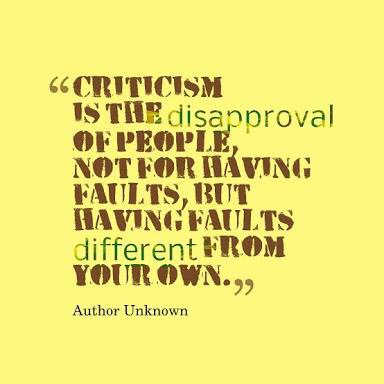
Today I’ve been criticised for a lot of my decisions and for the not soo favourable results!!!
Criticism One
I purchased our car from a different dealer instead of the dealer you have recommended!!!
The result is the car stopped abruptly while driving!!! It took 5 breakdowns & a year to fix the issue, of which couple of breakdowns have been charged by the dealer!!
Criticism Two
I didn’t do a proper due diligance while applying for a home loan!!! This inspite of you telling not to go with a particular bank!!!
Criticism Three
I ventured into Cinema Production against your wish and against your warning!!! Eventually the movie flopped and it was a bomb in the box office!!!
Criticism Four
I’m working on the Coffee Shop project again in spite of your concerns for availibility of time to manage it!!!
Though I’ve my own reasons and explanation for all the criticism, I don’t want to make it a normal affair by justifying my decisions!!!
Let me confess that;
- I’ve taken wrong decisions, but I progressed in some direction instead of doing nothing!!!
- I failed, but I learned my lessons!!!
- I risked, after all life without risk is a dream!!!
- I over-stretched, if not how can I push myself to excellence!!!
Also I’d like to remind you a point… Never criticise an entrepreneur… It will only make his resolve and perceivarance more stronger!!!
Please do understand that “Ship is safe on the shores, but it is not built for that”!!
Likewise an entrepreneur is safe doing nothing, but their genes are not tuned for that!!!
But I’d like to thank you for kindling my resolve to succeed against the odds!!!
Let me close it with my favourite number from Akon!!!
As life goes on I’m starting to learn more and more about responsibility
And I realize everything I do is affecting the people around me
So I want to take this time out to apologize for things that I’ve done
And things that haven’t occurred yet
And the things they don’t want to take responsibility forYou can put the blame on me
Said you can put the blame on me
You can put the blame on me
 AnandNataraj