The Entrepreneur’s Curse: When the Dream Becomes the Cage


Built to break free, but chained by our own ambition.

“I started to escape the 9-5. But now, I work 24/7 for a boss called ‘my dream’.”

Every entrepreneur starts with a fire in their belly. We tell ourselves, “I’ll be my own boss. I’ll build something meaningful. I’ll find freedom.”

But somewhere along the way, that freedom becomes a mirage. We become prisoners to our own creation — locked inside a cage we proudly built brick by brick.

The never-ending chase

Entrepreneurs are wired to keep moving. The moment we achieve a milestone, we don’t celebrate — we set a new, bigger one.

Your startup gets its first 100 customers? You think, “Why not 1,000?”
You close a big deal? You’re already eyeing the next.

Ambition is our superpower. But it’s also our slow poison.

The idea overdose

Our minds don’t stop. We’re cursed with constant ideation — new products, new pivots, new “next big things.”

We often leave half-built bridges behind, chasing the next shiny island on the horizon. And each unfinished idea weighs on us like a ghost of potential.

The loneliness paradox

Surrounded by a team, admired by peers, loved by family — yet feeling utterly alone.

Why? Because the final decisions, the late-night worries, the quiet fears — they’re all yours.

Success has many fathers, but failure is an orphan — and that orphan usually lives in the entrepreneur’s heart.

The financial and emotional rollercoaster

Some months feel like flying private jets; other months feel like you’re holding on to a falling kite in a storm.

You burn cash, energy, and sometimes your own sanity to keep things alive. Meanwhile, friends in stable jobs post pictures from their vacations, and your blood boils — not from envy, but from the realization that your hustle never really sleeps.

The silent sacrifice

Family dinners become “quick calls.” Gym sessions become “next month.” Sleep? A mythical creature you read about in productivity books.

The worst part? You justify it all in the name of “passion.”

The identity trap

Your business becomes your identity. Wins feel like personal validation; losses feel like public humiliation.

The line between *who you are* and *what you do* blurs until you can’t find yourself outside your pitch deck.

“We wanted freedom, but we got shackles made of ambition.”

The entrepreneur’s curse isn’t just about work stress. It’s about the emotional tax no one talks about. It’s about fighting invisible wars within your mind, every single day.

Yet, we keep going. Why? Because despite the curse, we love the game.

We love building, dreaming, and living on the edge. Because deep down, even our suffering is a story we want to own.
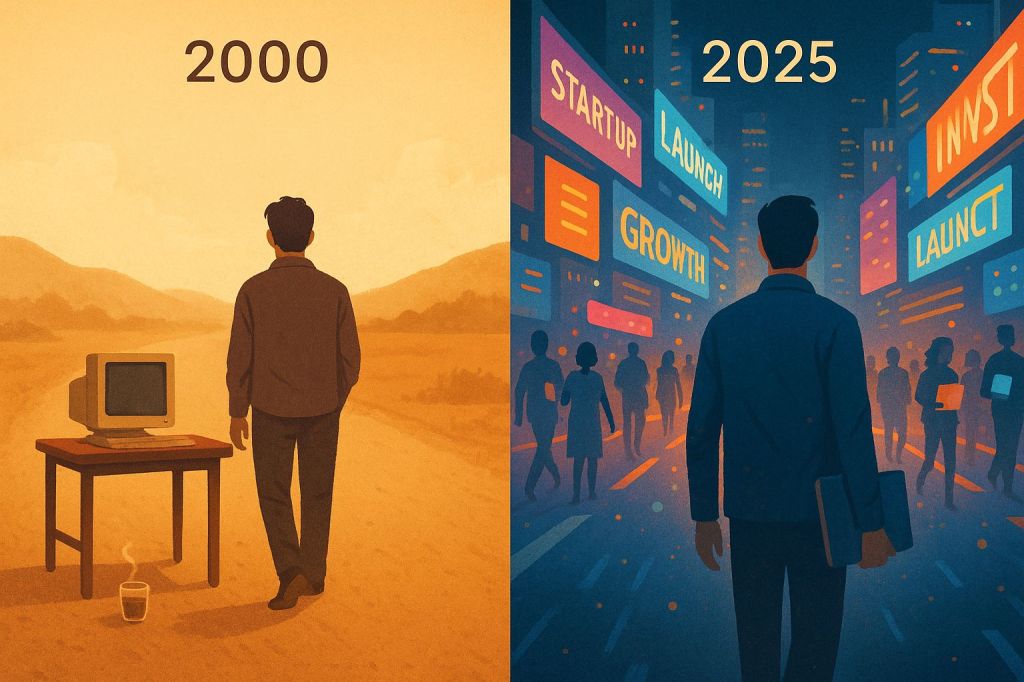
Startups Then & Now: From Empty Streets to Crowded Highways


Two eras, one spirit: the unstoppable heart of an entrepreneur.

I started my entrepreneurial ride back in 2000.

Those days, we didn’t even call it a “startup.” We called it “business,” “consultancy,” or just “trying something on my own.”

There was no Shark Tank. No glossy LinkedIn posts with #hustle. No college workshops on “How to pitch to VCs.”

In 2000, entrepreneurship wasn’t a cool badge. It was something you did if you couldn’t find a job or if you were just stubborn enough to believe you could create something from nothing.

2000: Wild, open roads

  • No references for success. The word “startup” was so rare, only one in a lakh even dared to dream it.
  • Loyalty was real. Your first hire stayed not just for salary but for the dream, even if the office was a one-room setup with plastic chairs and Maaza bottles in the fridge.
  • Markets were raw. Everything was new and waiting. A simple website could make you look like a global player.
  • Corporates & tech were immature. Big companies were still figuring out email, and many had no clue how to use the internet beyond sending scanned copies of invoices.
  • Open source was magic. You could build a product for the price of a few nights of filter coffee.
  • Ecosystem? Nil. No accelerators, no pitch fests, no “startup India” subsidies. Just you, your idea, and sheer guts.
  • Limited resources, big possibilities. Everything felt like a blank canvas.

2025: Crowded highways

  • Startup became a fashion statement. Every Tom, Dick, and Harry wants to “launch something” — sometimes just to add “Founder” to their Instagram bio.
  • Expensive game. Startups today mean burn rates, seed funding rounds, CAC vs LTV debates — even before you have your first paying customer.
  • No loyalty. Employees switch for a ₹2,000 raise or a fancier “Head of Vibe” title.
  • Tech consolidation. The top 5 tech giants dictate tools, languages, and frameworks. Your “freedom to build” has a Terms & Conditions page.
  • Market consolidation. Big sharks have gobbled up fragmented small players. Niches get crushed before you even announce your beta.
  • Ecosystem overload. Events, podcasts, awards, startup conferences. Everyone is “networking,” but very few are really building.
  • Too many eyes, less patience. Today, if your product doesn’t go viral in 2 weeks, you’re labeled a flop.

Then vs Now: What’s the real deal?

In 2000, the road was empty and scary.
In 2025, the road is crowded and noisy.

Then, the challenge was survival in the unknown.
Now, the challenge is standing out in the overcrowded known.

Then, it was about creating a market.
Now, it’s about finding your slot in a saturated market.

Then, you worried about paying your first employee on time.
Now, you worry if your pitch deck slides have enough “impact words.”

But here’s the one thing that hasn’t changed:

The thrill of chasing a vision that only you can see.

Whether you’re hustling on a dusty internet café PC in 2000 or pitching on a Zoom call in 2025 — the soul of entrepreneurship remains the same:
A quiet voice inside that whispers, Let’s try anyway.

“Markets change. Tech evolves. But courage? That stays timeless.”