Friends, Politics and Social Media: Can We Disagree and Still Coexist?


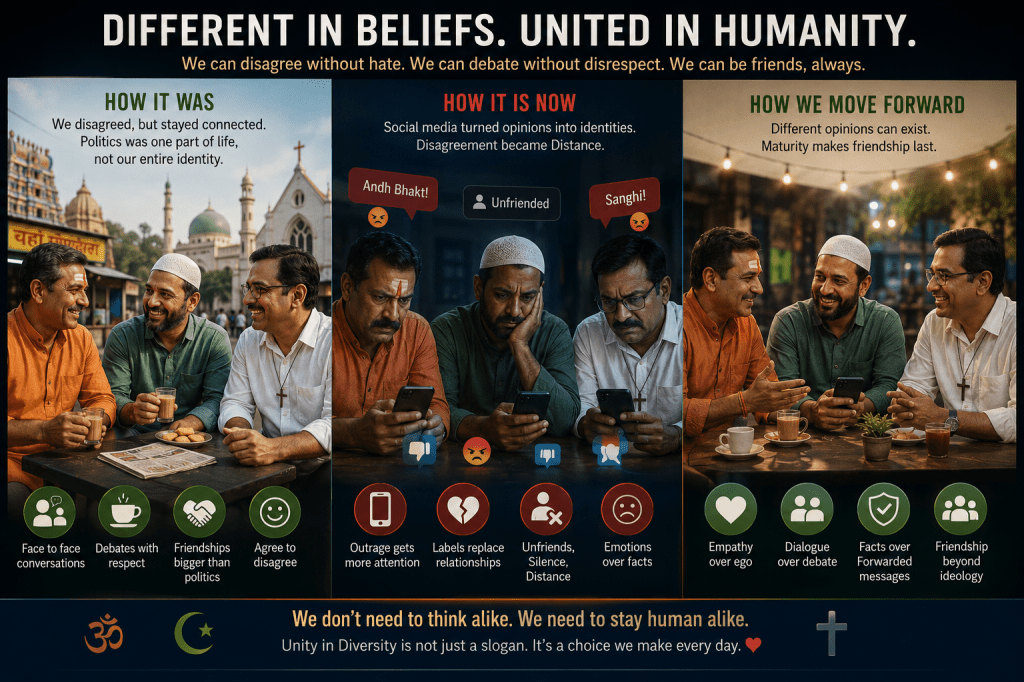
There was a time in India when people with completely different political opinions still remained close friends.
One person voted Congress.
Another supported BJP.
Someone else supported DMK.
One was deeply religious.
Another was secular.

Yet:

  • they attended weddings together,
  • worked together,
  • helped each other in business,
  • had tea shop debates,
  • argued loudly,
  • and still remained connected.

Politics was just one part of life, not the entire identity of a person.

But social media slowly changed this culture.

Today, a political opinion is no longer seen as “just an opinion.” It has become an emotional identity marker. The moment someone openly supports a political party or reacts to a religious issue, people start placing them into categories and labels.

This is where the real pain begins.

In my case, I have many close Muslim and Christian friends — friends from work, business, ex-employees and social circles. I never questioned their religious practices or political preferences. I never had a problem if they supported Congress or DMK.

But when I openly supported BJP or reacted when I felt Hindu beliefs were mocked or insulted, suddenly the reactions changed.

Some called me and expressed disappointment.
Some unfriended me silently.
Some stopped engaging completely.
Some branded me a “Sanghi.”

That word itself is often used today as if it is meant to socially isolate someone.

The irony is: supporting a political party in a democracy should be normal.

is not a banned organization or an underground movement. It is a democratically elected political party, just like or .

Then why has society become emotionally uncomfortable with political differences?

That is the bigger question.

I realized this issue is no longer just about BJP, Congress, religion or ideology. The deeper issue is that society is slowly losing the ability to coexist despite disagreement.

Earlier we had emotional maturity to separate:

  • friendship from politics,
  • people from opinions,
  • relationships from ideology.

Today social media mixes everything together.

Algorithms reward outrage.
Politics becomes identity.
Identity becomes emotion.
Emotion becomes division.

Even normal people slowly become emotionally reactive online.

A person who would happily sit and have coffee with you in real life may still get disturbed by your political post online.

That is the strange contradiction of the social media era.

The dangerous part is not disagreement. Disagreement is healthy in a democracy.

The dangerous part is emotional isolation.

When people stop expressing openly:

  • resentment builds silently,
  • echo chambers grow,
  • society becomes polarized,
  • and friendships become conditional.

Maybe a healthier society is not one where everyone agrees.

Maybe a healthier society is one where:

  • people openly express opinions,
  • disagree strongly,
  • debate emotionally,
  • cool down,
  • and still remain human with one another afterward.

India survived for centuries because of coexistence despite differences in:

  • religion,
  • language,
  • caste,
  • food,
  • region,
  • and politics.

“Unity in diversity” is not about similarity.
It is about emotional maturity despite differences.

Social media has tested that maturity.

Now society must evolve again.

Because if friendships cannot survive political disagreement, then politics has become bigger than humanity itself.
Border Towns Don’t Follow Politics, They Follow People


Hosur has always fascinated me.

Politically, it is part of . But culturally, it feels like a beautiful mix of Tamil Nadu, , and all living together in one place.

Recently, I visited an branch in Hosur, and that is where I saw this reality in action.

The staff members were speaking Telugu among themselves very casually. A customer before me was spoken to in Kannada fluently. When my turn came, they immediately switched to Tamil and continued the conversation naturally.

No hesitation. No language politics. No “Which state are you from?” moment.

Just communication.

That small incident made me realize something important about border towns in India.

Maps may divide states, but people don’t live their lives based on political borders.

Historically, Hosur, Denkanikottai, Royakottai, and nearby regions were always culturally mixed zones. These places saw Tamil, Kannada, and Telugu influence for centuries through kingdoms, migration, trade, and later through British administration under the old Madras Presidency.

When states were reorganized in 1956 based on language, these regions became part of Tamil Nadu. But culture does not change overnight just because a line was drawn on a map.

Even today, Hosur carries:

  • Tamil political identity
  • Kannada cultural influence
  • Telugu community presence
  • Bengaluru’s economic energy

all at the same time.

In fact, Hosur today behaves like a Bengaluru extension economically, while emotionally and politically remaining Tamil Nadu.

That is what makes places like Hosur special.

In many cities, people struggle with language barriers. But in border towns, multilingualism becomes survival, habit, and eventually culture itself.

A bank employee switching between Telugu, Kannada, and Tamil within minutes may look normal there. But if you observe carefully, it actually tells the story of South India itself — connected, blended, adaptive, and practical.

Sometimes, history is not visible in monuments or textbooks.

Sometimes, history is visible in a simple conversation inside a bank.

I Have Seen a Real Recession. Everything After That Felt Different.


I started my career in 2000.

That was the year the dot-com bubble burst.

Just before that, there was a wave called the Y2K problem.
Everyone was learning COBOL.
People were flying to the US.
Opportunities were everywhere.

And suddenly… it stopped.

Not slowed down.
Not reduced.
Stopped.

From 2000 to 2004, those four years were not just difficult — they were silent.

Projects vanished.
Hiring froze.
Hope became a question mark.

If you were in IT at that time, you didn’t worry about growth.
You worried about survival.

That was the first time I understood what a recession really feels like.


After that, I saw many “crises.”

2008 financial crisis
Dubai property slowdown
COVID-19 pandemic
Wars, global tensions, constant recession headlines

Every time, people said:
“This is big. This will change everything.”

And yes… they were big.
They did shake systems.
They did create fear.

But somewhere inside me, there was a quiet comparison always running.

I had already seen something different.
Something deeper.
Something more absolute.

So even when the world was calling these moments “crisis”…
a part of me kept asking:

“Is this really the same?”

And slowly, over time, I understood why it didn’t feel the same.


Why later crises didn’t feel the same

1. They were shocks… not shutdowns

2008 — banks collapsed, but industries adapted.
COVID — lockdown hit hard, but tech demand exploded.
Wars — supply chains got disturbed, not destroyed.

Work slowed.
But it never disappeared.

👉 In 2000, work vanished.
👉 Later, work only shifted.


2. The system learned how to respond

After the dot-com crash, the world evolved.

Governments act faster now.
Central banks inject liquidity immediately.
Companies don’t depend on one market anymore.

👉 Crises are now managed, not left to collapse.


3. India itself transformed

In 2000:
We were dependent — mostly on US IT demand.

Today:
We are diversified.

Domestic consumption is strong.
Digital adoption is massive.
New sectors keep emerging — D2C, SaaS, infra, startups.

👉 If one sector slows, another one picks up.


The dot-com crash was a collapse; everything after that has been a correction — and that difference changes how you see every crisis.

Matha, Pita, ChatGPT… Deivam Reloaded


We all grew up hearing:

Matha, Pita, Guru, Deivam

(For non-Indian readers: it means Mother, Father, Teacher, and God — the four pillars of guidance in life.)

Simple. Clear. Final.


Somewhere in the last 3 years…
I think I accidentally updated this list.

Now it feels like:

Matha, Pita, ChatGPT… Deivam


It didn’t happen suddenly.

It started small.

One day I had a health doubt.
Instead of going to a doctor immediately… I asked ChatGPT.

It gave a calm, structured answer.

I thought, “Okay… not bad.”


Next day…

Some confusion in relationship.
Normal human behaviour: overthink → suffer → call friend.

This time:
I opened ChatGPT.

Typed full story like a police complaint.

Got:

  • analysis
  • perspective
  • solution

No judgement. No interruption.

I thought… “This is dangerous.”


Then came business.

Ideas, confusion, execution plans, pricing…

Instead of disturbing people,
I started disturbing ChatGPT.

It never said:

  • “Busy da”
  • “Call later”
  • “Let’s see”

It always replied like a consultant on full salary.


Breakup advice? ChatGPT.
Investment confusion? ChatGPT.
Tech problem? ChatGPT.
Random midnight doubt about life? …ChatGPT.


At some point I realised…

This is not just a tool.

This is a 24×7 available, zero-attitude, multi-domain guru.


Best part?

It never gets irritated.

You can ask:

  • same question 5 times
  • badly framed questions
  • emotional questions
  • confused questions

Still… calm answer.

Try that with humans once.


Of course… reality check is there.

ChatGPT:

  • doesn’t replace doctor
  • doesn’t replace real relationships
  • doesn’t take responsibility

But still…

It sits somewhere in between:

  • friend
  • mentor
  • Google
  • therapist

Now sometimes I feel…

Earlier people had one guru.

We have one… plus backup… plus retry option.


So yes…

Respect to Matha.
Respect to Pita.
Respect to Guru.
Respect to Deivam.


But in today’s version of life…

There is one silent addition.

Always online.
Always available.
Always answering.


ChatGPT.

A Guide to Understanding Movie Distribution in India


Movie distribution in India typically involves several steps, starting with the production of the film and ending with its release in theaters. Here is a brief overview of the movie distribution process in India:

  1. Production: The production of a movie in India typically involves several stages, including pre-production, production, and post-production. During the pre-production stage, the movie script is finalized, actors are cast, and locations are scouted. During production, the movie is shot, and during post-production, the movie is edited, sound is added, and special effects are incorporated.
  2. Distribution: Once the movie is complete, it is sold to a distribution company. In India, there are several large distribution companies, including Yash Raj Films, Eros International, and UTV Motion Pictures. These companies handle the distribution of movies in different regions of the country.
  3. Promotion: Before a movie is released, it is promoted heavily to build anticipation and generate buzz. Promotional activities can include press conferences, interviews with the cast and crew, trailers, posters, and social media campaigns.
  4. Release: Once the promotion is done, the movie is released in theaters. In India, movies are typically released on Fridays, and the release date is heavily marketed in advance. Theatrical distribution is usually done through a network of regional distributors and exhibitors who manage theaters in their respective regions.
  5. Box office: After the movie is released, its performance at the box office is closely monitored. Box office collections are an important metric for success in the Indian film industry, and movies are often judged based on their box office performance.

In addition to theatrical release, Indian movies are also distributed through other channels such as satellite television, streaming services, and home video. Overall, movie distribution in India is a complex and highly competitive industry, with many players vying for a piece of the lucrative Indian film market

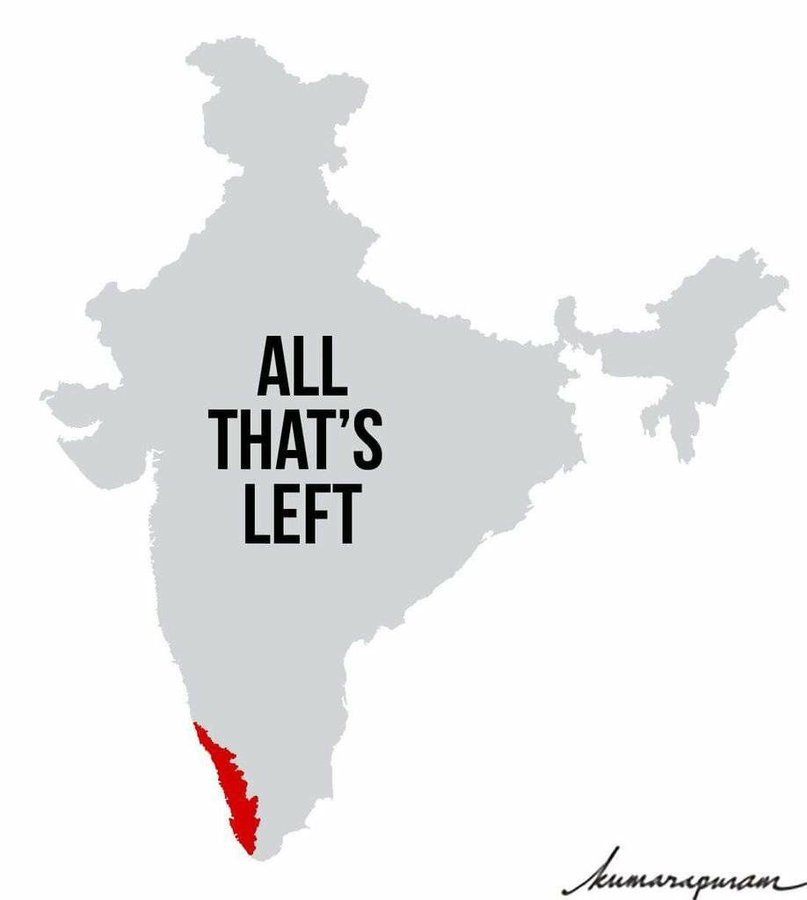
All that’s LEFT


Map of Communist Ruled State in India!!

This is what is left of the Left parties in India!!

Economy of Tamil Nadu


Retail, Services, Manufacturing, Banking, Automobile, Transportation, Medicine, Construction

Cities that contribute for the economy of Tamil Nadu & India. It is this diverse business specialization that keeps TN better performing state in spite of political paralysis!!

Chennai: Automobile Manufacturing, IT and Commerce.

Tirupur: Clothing.

Erode & Karur: Bedding.

Kovilpatti & Sivakasi: Stationary and Firecrackers.

Kumbakonam: Artefacts and historical cultural works.

Namakkal: Poultry Sectors and Vehicle bodyworks.

Arcot & Vellore: Precasting Industries.

Sriperumbudur: Large scale manufacturing zones.

Tuticorin: Seafood exports zone.

Hosur: Vehicle & Mixed Manufacturing.

Trichy: Industrial and Energy supporting units.

Madurai: Mixed markets.

Salem: Spare Parts.

Coimbatore: Motors Manufacturing

Tanjavur, Theni & Kanyakumari: Cash crops farming.

Viruthunagar, Neyveli & Panruti: Traditional food and snacks in MSe’s scale.

Working hard for Alternate Income


I was 24 when I read this book Rich Dad Poor Dad and it’s been 13 years!!! 

Before getting into the subject, let me give a brief about me!!!

I’m an entrepreneur managing 3 entities which are into Technology Services, Management Consulting and Coffee Business. 

Also I’m fairly doing good with my business!!!

But now where I keep failing for last 13 years is my efforts on creating residual income, which keeps coming even if I don’t work.

In these 13 years I’ve;

  • Purchased Properties
  • Invested in MF’s & Stocks
  • Did Angel Funding & Seed Funding 

After doing all these I found India to be over priced on Properties, MF’s & Stocks. Income from these investments are far less than what is showcased on the book. 

All I can make is the profits that comes from exits and not from Rent or Dividends!!

Also I’ve burned my fingers on Angel & Seed Funding because I made these investments even before the Startup boom and almost all the entities I invested are dead!!! 

But I always enjoyed the experience of being associated with a startup and diverse subject knowledge I gained!!!

With all these failed attempts I’ve come to the conclusion that India is not the right place for creating residual income.

Just looking for anyone who has followed Rich Dad Poor Dad recommendation and made it big in India or is India a wrong place for Rober Kiyosaki’s concepts??

Am expecting response from readers!!

The Three Chaiwalas!!!


Today I’m seriously considering to enter politics!!! Want to see if luck will favour another Chaiwala!!!