Failure tastes different when we find success. Struggles taste sweeter when we achieve. Humiliation tastes lighter when we’re recognized. Insomnia tastes worth it when we accomplish our mission. Criticism tastes meaningful when we become leaders. I tasted them all when I became an entrepreneur.
There’s a thief that roams around my mind often. It doesn’t steal money, time, or opportunities. It steals my now.
It’s called nostalgia – the most charming liar of all time.
I’ve realized something lately (after deep self-reflection… and one too many walks down memory lane): We humans have a weird habit of loving what we had, and completely ignoring what we have.
Think about it…
We miss school when we’re in college.
We miss college once we start working.
We miss the rookie hustle when we finally settle into comfort.
We miss our first love when we marry a beautiful, nag-proof spouse.
And just when we start enjoying couplehood, kids arrive — and we start missing our couple time.
And it doesn’t stop there.
This disease spreads to professional life too:
We carry the baggage of past roles, old bosses, and “those glory days.”
We talk about how things used to be better — instead of figuring out how to make this better.
We keep looking over our shoulder, wishing life had a reverse gear. But here’s the joke — we’re so busy missing the past that we forget to make the present miss-worthy.
So today, I’ve decided to stop romanticizing what was and start appreciating what is. No more looking back unless it’s to laugh, learn, or let go.
Because one day, we might miss this moment too — so let’s live it like it’s worth remembering.
I went to Trichy for the wedding reception of Advocate Prashanth. He’s not just any groom — I’ve known him since the day he was born. His father is a close family friend who never missed any of our family functions and always stood by us during tough times.
Prashanth was the youngest in our circle — always around in our get-togethers as a little boy. I’ve seen him grow, step by step, and today he’s a smart lawyer who even handles some of my cases. Seeing him as a groom made me feel both proud and emotional. It was a big fat Trichy wedding — full of people, lights, and good vibes.
Apart from the reception, it turned into a mini family get-together.
I made sure to take my kids along — I’ve started doing this more consciously. I want them to stay connected with cousins, feel the warmth of extended family, and create their own memories. They had a great time.
Even I got to catch up with my cousins, uncles, and aunties. It felt nice. These small moments matter.
We drove from Madurai to Trichy, visited my uncle and cousins, attended the wedding, and drove back. Long day, but worth every bit.
Some Saturdays are for work. Some for rest. This one — was for memories.
The world wore it as fashion. We wove it as identity — Madras checks, born of breeze, dyed in soul.
If you grew up in Madras — the real Madras, not the renamed Chennai — you probably know the scent of Marina’s sea breeze, the rhythm of Ilaiyaraaja in the evening air, and the comforting chaos of Ranganathan Street on a festival weekend.
But here’s something fewer people know:
One of **India’s most iconic contributions to global fashion** quietly originated from this very soil — the **Madras checked shirt**.
What Is a Madras Check?
Madras check is a lightweight, breathable cotton fabric with colorful, often uneven plaid patterns. Its signature trait? The dyes were natural and deliberately unstable, designed to bleed and fade over time — giving every shirt a unique, lived-in character.
These weren’t mass-manufactured patterns. They were woven with soul.
From Madras Mills to Ivy League Halls
During the 1960s, this fabric made its way to the United States through export channels. American retailers like Brooks Brothers picked it up, sold it as a summer luxury fabric, and branded it boldly:
Guaranteed to bleed.
What started as local, humble workwear became the go-to summer style for American college students, yacht owners, and golf lovers.
Imagine that — something woven in Chengalpattu or Salem ended up on the runways and prep schools of New York.
And the Weavers?
Many of these legendary fabrics came from handloom clusters in Tamil Nadu — especially around Chengalpattu, Salem, and Madurai.
Today, due to industrial shifts, some weavers have moved to other professions, while a few still continue the tradition for heritage boutiques and niche export markets.
What was once an everyday wear in our land is now a prized vintage item overseas.
Why This Matters
We often celebrate global trends without realizing they were born in our own backyard. Madras check isn’t just a design — it’s a reminder that local hands can shape global taste.
It’s a tribute to a time when fabric had character, shirts had stories, and style came with soul.
Madras isn’t just a city. It’s a signature. Sometimes… it bleeds. Sometimes… it checks you with pride. Always, it stays timeless.
As entrepreneurs, we are wired to chase growth, break limits, and build legacies. We dream of freedom — financial, creative, emotional. But there’s a tug-of-war inside us that nobody talks about enough: Karma vs Dharma.
Let me break it down the way life taught me — not from a textbook or a spiritual discourse, but from those raw, sleepless nights when I sat alone questioning every move I ever made.
Karma: The Baggage You Carry
Karma isn’t just some cosmic scoreboard of good and bad deeds. For an entrepreneur, karma shows up as the invisible baggage we drag along:
Past business mistakes
Betrayals from partners or friends
Poor financial decisions made under pressure
Emotional debts with family and loved ones
It quietly shapes how we trust people, how we take risks, and how much we dare to dream again. We don’t always realize it, but karma sits in the boardroom with us, listens to investor pitches with us, and whispers into our ears when we think we’re making a “bold move.”
Dharma: The Duty That Grounds You
While karma pulls you into your past, dharma anchors you to your responsibility today.
For me, my dharma was clear: protect my family, provide a safety net, and keep them away from financial storms.
Every decision I made — be it launching a new venture, holding on to an old business despite losses, or taking on unexpected debts — was driven by this deep-rooted sense of duty. I wasn’t gambling for fame; I was fighting for my family’s dignity.
People on the outside see failed ventures or debts. But in my mind, those moves were never reckless bets — they were desperate attempts to shield the people I love.
The Clash: When Karma Tests Your Dharma
Sometimes, your karma and dharma go to war.
You act out of dharma, but karma turns it into a mess. You try to build a protective revenue stream for your family, but karma brings delays, unexpected losses, and betrayals that collapse your plans.
Then come the harsh judgments: “Why didn’t you pause?”, “Why didn’t you consult someone first?”, “Why did you jump into it?”
But nobody sees that, at that moment, you were acting from the purest intention possible — to protect, to uplift, to fulfill your dharma.
What I Learned (The Hard Way)
Your karma might twist your outcomes, but your dharma defines your character.
If your current business profits are going into paying off past mistakes or settling old loans, it’s not a failure. It’s karmic cleansing. It’s a debt paid not just in money, but in the form of maturity, resilience, and a stronger foundation for the future.
When the dust settles, the world may only remember balance sheets and success stories. But you — and your soul — will remember why you took each step.
A Quiet Conclusion
Karma tests you, dharma defines you.
If you’re an entrepreneur feeling weighed down by invisible debts — emotional or financial — don’t judge yourself only by the outcomes. Look at your intentions.
Maybe you didn’t build an empire (yet). But if you fought for your people, you didn’t really lose.
Still here. Still trying. And that, I believe, is the purest dharma.
You can’t build tomorrow if you’re forever stuck surviving today.
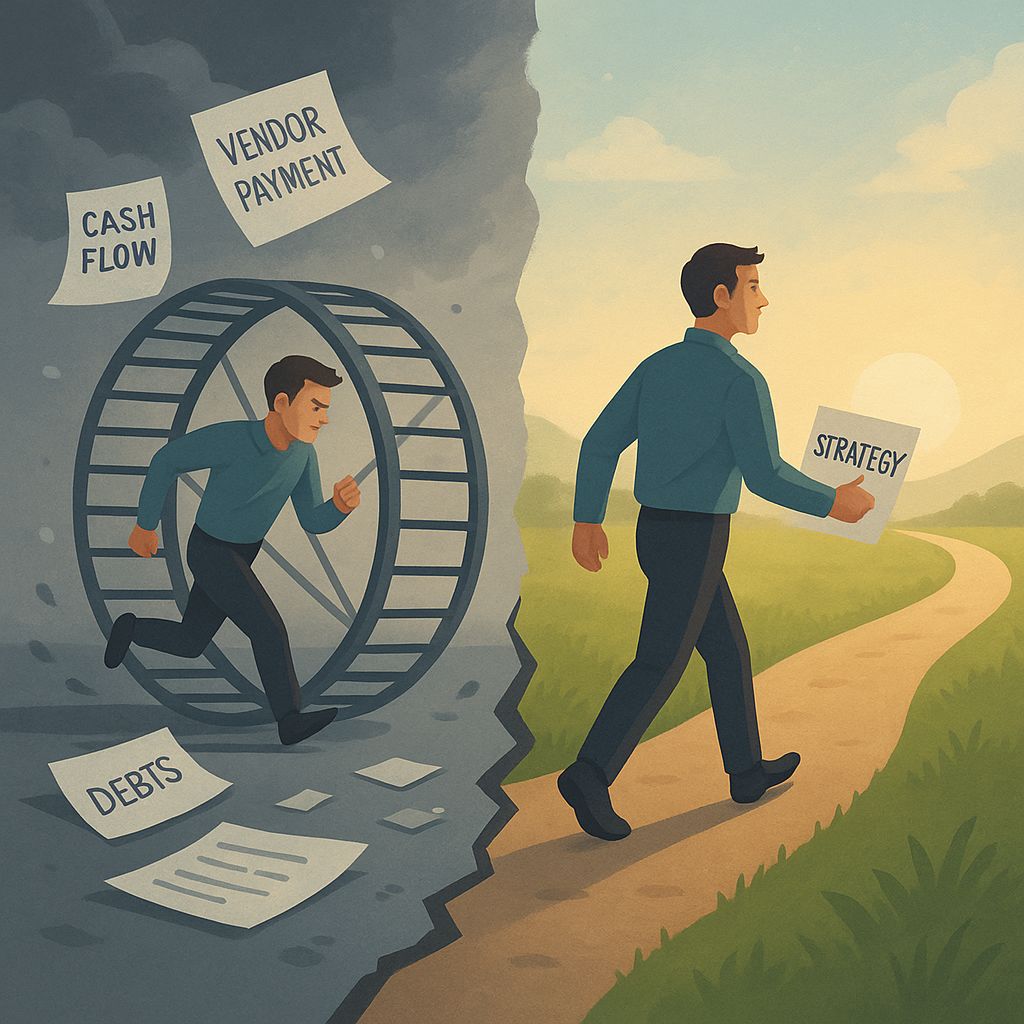
When you start out as an entrepreneur, people tell you to hustle, to keep moving, to “figure it out somehow.” But nobody warns you about the invisible trap that slowly consumes your mind and robs you of your creativity: the scarcity loop.
What is the scarcity loop?
The scarcity loop is not just about not having enough money. It’s a mental state where your entire bandwidth is consumed by one loud question: “How do I survive today?”
You start solving only for tomorrow’s cash flow, this week’s EMI, or this month’s vendor payment. You forget to look at the big picture because your mental windshield is fogged by immediate fires.
When survival mode hijacks your brain
I remember times when I had to figure out how to pay monthly vendor payments while also preparing the next sales pitch deck to keep future revenue coming in.
Instead of thinking about building a long-term brand, I was stuck thinking, “How do I just stay afloat this month?”
Instead of selecting ideal customers, I said yes to anyone who could pay, even if it drained our energy and diluted our vision.
Instead of working on systems and team processes, I spent nights firefighting because every rupee felt like borrowed oxygen.
I was moving, but not growing. I was hustling, but not building.
The cost of staying in the loop
When you’re trapped in scarcity, you start:
Making reactive decisions, not strategic ones.
Accepting bad deals because cash today feels more important than sustainability tomorrow.
Losing good team members who see chaos and no clear vision.
Burning out emotionally and physically — coming home to your family as a shell, not a leader.
In my lowest phases, I realized that the mind, when stuck in scarcity, cannot dream. It cannot imagine a different future because it is busy scanning for immediate threats like a soldier in a battlefield.
Breaking out: From survival to strategy
I learned this the hard way: you can’t build an empire if you’re always patching holes in the roof.
How to step out of this loop?
✅ Build a small cash buffer, even if it means slower growth initially. ✅ Stop chasing clients or projects that only feed today’s cash flow but destroy tomorrow’s vision. ✅ Delegate more and trust systems — the mental relief is worth every penny. ✅ Surround yourself with people who see beyond next month’s revenue sheet. ✅ Shift your question from “How do I survive today?” to “How do I design tomorrow?”
A gentle perspective
If your current profits are going into paying off old mistakes or debts, it’s not failure. It’s healing.
It’s your mind and business paying karmic dues so you can eventually rise lighter and clearer.
A quiet closing thought
“A mind trapped in scarcity can’t build abundance — no matter how good the business plan is.”
Move slow if you must, but move with vision. Survival is necessary, but freedom is where the true magic happens.
They say family is your anchor — the people who catch you when you fall, the voices that remind you who you are when the world forgets. But what happens when the storms of life are so strong that even your anchor feels shaky?
In 2018, my life entered what I now call the perfect storm phase. My tech cofounder left, a trusted employee faced a personal crisis, my property got stuck in litigation, and an old partner filed a false legal case against me. If that wasn’t enough, a fire took down the one cash-generating coffee shop I had left.
I made a bold decision then — to create Advaith’s Nest, a rental asset meant to bring residual income. The plan was simple: build a stable foundation so I could focus on my main business, free from daily financial turbulence.
But life, as always, had its own script.
When a shield becomes a battlefield
I envisioned Advaith’s Nest as a protective wall for my family. In reality, it became a battleground for debts.
Originally, it was planned as a quick, smart move — deliver the building in 8 months, start earning rental income, and finally build a life where I was shielded from daily financial turbulence.
But then came a series of punches I couldn’t block.
The builder delayed far beyond what I could question or control. COVID lockdowns slammed the brakes on construction, freezing everything in place.
Instead of 8 months, it took 41 months to finally see it completed. Those extra 33 months weren’t just a delay on paper — they were a slow bleed on every plan I had carefully charted out.
By the time the project was ready, my financial shield had become a battlefield of debt repayments and emotional damage. Every rupee of rental income went into plugging holes from the past instead of protecting my future.
I built Advaith’s Nest for my wife — so she could live stress-free, focusing on her dreams and passions. But instead, she had to step into a job, facing the very financial storms I promised to keep away.
What was meant to be a fortress became a front line. A safe haven turned into another battleground. And watching that transformation unfold in slow motion — unable to stop it, unable to fight it — is a pain I still carry in every breath.
The slow poison of lost trust
When you lose money, you feel pain. When you lose trust, you lose the very fuel that keeps you moving.
Family trust isn’t just about financial support — it’s about feeling seen and understood. Without it, every business pitch feels heavier, every new idea seems riskier, and every sunrise feels a little less bright.
I didn’t want my wife to work because I believed I could be her shield. Now, watching her step into the battlefield with me stings in ways words can’t capture.
Rebuilding: brick by brick, breath by breath
Many say, “Start again! Rebuild!” But what they don’t tell you is that rebuilding after a major collapse is not just a logistical task — it’s an emotional surgery.
You carry every past betrayal, every criticism, every silent stare at dinner. You build not just a new business, but a new identity. You move with double caution, second-guess every decision, and question whether your “big comeback” is even possible.
The toughest part isn’t raising money or building products. It’s rebuilding trust — in yourself, in your vision, and most painfully, in the eyes of those you love the most.
A quiet promise to myself and my family
I know I cannot fix the past. No apology or explanation can fully heal the wounds that unexpected financial struggles have caused. But I can honor the pain by transforming it.
I still believe in the core reason I started: to build something meaningful, not just for the market but for my family’s dignity and future.
To my family: I see the weight you carried. I see your sacrifices. I see your silent prayers at night. And I see the disappointment too.
I don’t seek blind forgiveness or instant validation. I seek your presence as I try again. Not as a flawless savior, but as a man who refuses to stop fighting for his family — even when he bleeds internally.
I may not be the man who always wins, but I am the man who never stops coming back home.
They say friendships are the family we choose. But sometimes, life gives us friends we never knew we needed — and takes them away just as unexpectedly.
Between 2008 and 2012, I had a circle that was nothing short of electric. We weren’t just building businesses; we were building each other.
It was a phase of wild nights and wilder dreams. Knowledge collaboration in the day, partying hard at night, getting stoned over the weekends — we did things that today sound crazy and almost unbelievable. But that madness was our glue. It detoxed us from daily business stress, kept us alive, and taught us more than any MBA ever could.
But life, as always, had its own plans.
End of 2012, I got married. My father’s sudden hospitalization soon after shattered that rhythm. One by one, the circle started breaking — some had fallouts among themselves, some quit entrepreneurship, some got into serious personal crises, others moved abroad, and a few simply withdrew into their own worlds.
Then came COVID. Financial struggles and the survival grind tightened the last few threads. I got so entangled in rebuilding my life that those friendships, once my lifeline, drifted into oblivion.
Today, I look back and wonder: What were those friendships? Why did they feel so irreplaceable? Why do they hurt to remember?
What were they really?
Those were what I now understand as situational friendships — connections born out of a specific context, a shared madness, and a common dream. We didn’t become friends because of shared childhoods or family ties, but because we shared the same burning fire in that phase of life.
We were all entrepreneurs — each of us a little broken, a little foolish, yet unshakably hopeful. We learned from each other, fought with each other, and celebrated every tiny win like it was the end of the world.
Why do they fade?
Because life is not a constant. Priorities change. Marriage, kids, health crises, business failures, relocations — all these start pulling us in different directions. Some find new tribes, some retreat into personal solitude, and some get consumed by survival.
There’s no big betrayal or dramatic end — just a quiet drifting apart. A slow fade into silence.
Do I miss them?
Every day.
I miss the impulsive midnight drives, the heated debates that went from business models to philosophical rabbit holes, the sense of belonging to a gang that truly “got it.”
But I also know that those friendships, like beautiful old songs, belong to a time and place that can’t be recreated. They were chapters meant to end, lessons meant to be carried forward, not lived on repeat.
Some friendships are like rivers — they flow into your life, shape your shores, then find their way to the sea. You can’t hold them back, but you can always feel the shape they left on your soul.
A final whisper to that gang
Wherever you all are — running a new venture, teaching your kids to ride a bicycle in Canada, or quietly reflecting on those reckless days — I hope you feel the same warmth when you think of our nights in Adambakkam.
Some friendships are meant to be wild tides — crashing, roaring, unforgettable — before they dissolve into the larger sea of life.
They say life is nothing but a series of choices — some we make in seconds, some after years of thought. But it’s the unexpected ones, the small decisions on seemingly ordinary days, that end up shaping our destiny the most.
In 2004, I made such a choice. I hired someone. That’s it. A routine decision. A resume, a handshake, a promise of a new beginning — it felt like just another Monday on the entrepreneurial calendar.
She was from a small town, working in a call center, holding an MBA in HR but desperate for a break. I saw that raw hunger and decided to offer her a platform — I thought I was enabling a young professional’s dream. Maybe, in some corner of my mind, I even saw a reflection of my own past struggles — that same raw desperation to make it.
I had built my first venture with a dear partner, brick by brick, dream by dream. We didn’t have connections, we didn’t have family money cushioning our falls. All we had was ambition that kept us awake at night and a silent promise to each other that we would make it, no matter what.
But sometimes, we forget — when you open your door wide for someone, they might walk in carrying not gratitude, but greed. She wasn’t cunning or a mastermind. She was simply short-sighted, hungry for quick luxury, blinded by instant pleasures. While we were busy building a company to stand the test of time, she was busy living in borrowed moments, chasing dinners, perfumes, designer labels — things that glitter only till the lights are on.
In her desperate rush for the high life, she didn’t just stumble — she pulled down everything in her path. She rattled a ship that was floating on the fragile balance of two young dreamers. She planted doubts, sowed jealousy, whispered false comforts — and before I knew it, the dream I had once guarded like a newborn was thrown out with me.
In 2008, I was pushed out of my own creation. My partner too slowly fell into a pit he couldn’t climb out of. The venture that had so much promise, that spark in our eyes — it all vanished like an unfinished verse in a torn diary.
But the tragedy didn’t spare her either. The same greed that fueled her steps ultimately consumed her life. She ended up as lost as we were broken — a stark reminder that shortcuts don’t just ruin roads, they erase destinations.
Years later, people still ask me, “What went wrong?” I don’t blame fate, nor do I hold the world accountable. My only mistake? Hiring the wrong person on that one day in 2004. That single signature on a simple appointment letter shifted the course of twenty-one years of my life.
If I could ask God for just one gift, I wouldn’t ask for money, fame, or even a second chance. I would simply ask Him to make me dream backwards — just for one night.
A dream where I go back to that fateful day, fix that one decision, and erase that moment when I hired her. A dream where I see myself and my partner, two young boys with fire in their eyes, running a company that’s recognised, respected, and celebrated by all. A dream where we are still fighting side by side, laughing over cheap tea, planning crazy ideas that kept us up all night, watching our tiny dream grow into an empire that even we can’t believe we built.
And in that dream, I want to see us standing on a stage, receiving awards, hearing applause, hugging each other with tears in our eyes — whispering, “We did it, against all odds.” I want to wake up in the morning and still taste that dream, feel its warmth in my veins, carry its fragrance in my mind.
But life doesn’t give us that luxury. So, I move forward — with scars, with lessons, and with the silent prayer that no one else ever has to learn it the way I did.
20 years of flat growth. One wild bet. $4 trillion later — NVIDIA.
They say overnight success stories often take decades — and if there’s one company that embodies this, it’s NVIDIA.
When Jensen Huang co-founded NVIDIA in 1993, it wasn’t the AI juggernaut we know today. It started as a humble graphics card company with a bold dream: to make visual computing faster and better.
In 1995, NVIDIA nearly went bankrupt. Their first chip, the NV1, flopped badly. Investors lost faith, the market scoffed, and the future looked bleak. But true to its name — derived from the Latin “invidia,” meaning “envy” — the company refused to give up. They pivoted, came back with the RIVA series in 1997, and started making waves in the gaming world.
The real turning point came in 1999 with the launch of GeForce 256, marketed as the world’s first GPU (Graphics Processing Unit). This single move redefined gaming visuals and set NVIDIA on a new path.
Fast forward to 2006 — NVIDIA introduced CUDA, a bold platform that let developers use GPUs for tasks beyond graphics, like scientific computing and simulations. Back then, few outside academia noticed. But Jensen was already looking further ahead.
In 2012–2013, while the world was still fixated on gaming GPUs, Jensen had a wild realization: GPUs could power machine learning. This was no ordinary hunch; it was a bet on the future. At first, the market laughed it off, calling it an expensive gamble. But he stayed the course.
Then came AlexNet. In 2012, this deep learning model trained on NVIDIA GPUs won the ImageNet competition, opening the world’s eyes to what was possible. The AI wave had begun, and NVIDIA was surfing it ahead of everyone else.
The numbers tell the rest of the story:
In 2015, NVIDIA’s market cap was around $20 billion.
By 2020, it had crossed $300 billion.
In 2023, it soared past the $1 trillion mark.
And last week in 2024, it touched a jaw-dropping $4 trillion, symbolically putting it on par with India’s entire economy if we think in creative metaphors.
From a near-bankrupt graphics card maker to a global AI powerhouse, it took NVIDIA 20 years of flat growth, patient innovation, and fearless bets before finally catching fire.
Today, NVIDIA’s chips aren’t just inside gaming rigs — they are the backbone of data centers, self-driving cars, healthcare AI, and countless other breakthroughs.
As a fun trivia, while AMD is the closest competitor fighting for the GPU throne, it’s led by Lisa Su, who happens to be Jensen Huang’s distant cousin. The “family GPU feud” only adds another layer of drama to this Silicon Valley epic.
Looking back, Jensen’s story is a masterclass in resilience, vision, and patience. He wasn’t chasing trends; he was creating them. From a struggling startup almost lost to history, NVIDIA today stands as a testament to what happens when you bet on the future — and build it yourself.




 AnandNataraj