Time and Tide Wait for No Man — But They Flow With You


Flow in your rhythm — the tide will find its way to you.

They say time and tide wait for no man. With that belief, I started my rookie entrepreneur run. I had my ups and downs, and today I stand at a point of realization: you will have your time. Put in your efforts, balance your life, and things will happen in their own time.

As a rookie, in just 8 years, I created a business empire that brought the envy of many. I ran ahead of seasoned players who had been around for decades. It felt like I had cracked the code — until I hit the fall.

After that struggle, I started seeing new rookies beating me. People who were once behind me moved ahead. It felt hopeless at times, watching the race from the sidelines. But as I sat back and truly analyzed it, I saw the pattern:

The illusion of permanent success

We often think success is a peak — climb it once, and you’re there forever. But it’s not.

Success is like a series of waves. Today you’re ahead, tomorrow someone else. Then someday you rise again. It’s a continuous, flowing cycle.

Everyone has their reversals

Everyone who sprints ahead will eventually need to slow down. Every empire, every champion, every star performer — they all have their reversals. Some gracefully, some painfully, but all inevitably.

That doesn’t make them failures. It makes them part of life’s natural rhythm.

Effort, balance, and patience

The more I reflect, the more I realize that raw speed isn’t everything. Balance matters more. Effort matters more. Staying patient and showing up consistently matter more.

It’s no longer just about outrunning everyone else; it’s about lasting, evolving, and staying true to yourself.

Your own rhythm

Those rookies overtaking me today? They are in their own prime, their own sprint phase. Some will last, some will fade. Just like I did. Just like everyone does.

There is no permanent “ahead” or “behind.” There’s just your story, your learnings, and your rhythm.

Final thought: Time and tide wait for no man — but they flow with the one who flows with them

So I keep reminding myself: do your part, stay true, keep your balance, and your day will come. Again and again, in different forms.

People Often Judge Outcomes, Not Journeys


Judged by outcomes. Built by journey.

I’ve seen this time and again — in business, in relationships, and especially in entrepreneurship:

People judge outcomes. Not journeys.

Success? You’re celebrated.
Failure? You’re forgotten.
Still trying? You’re questioned.

Why is it this way?

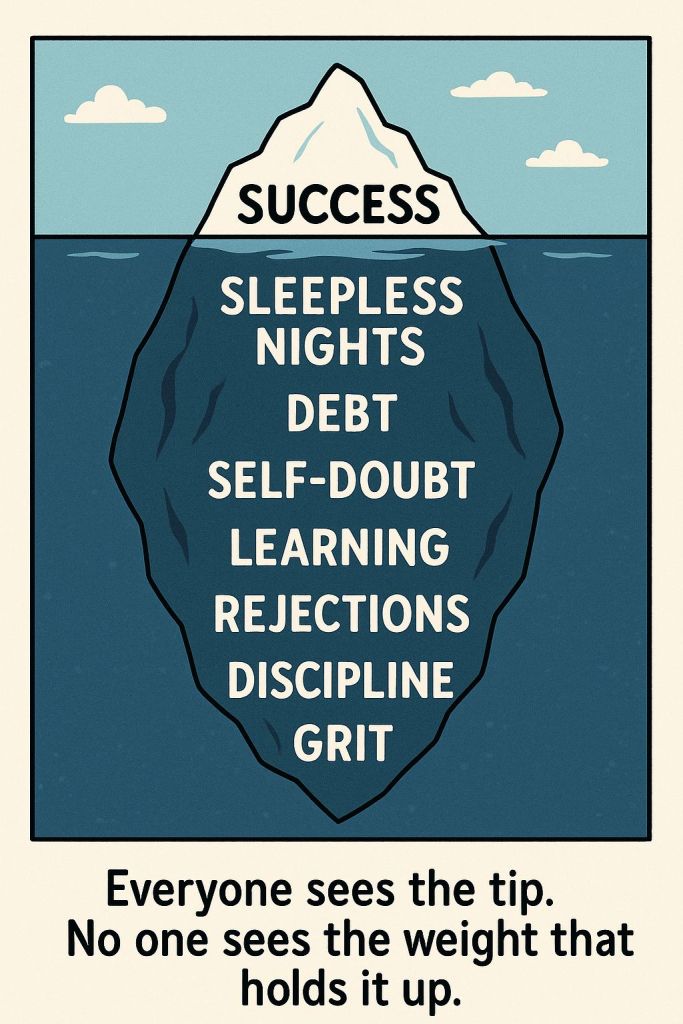
Because outcomes are visible, journeys are not.

Nobody sees the 3 a.m. self-doubt. The loan EMIs. The silent sacrifices.
They only see whether you “made it” — or didn’t.

Society has become obsessed with results.
We’ve built a culture where IPOs trend, but unpaid dues don’t.
Where LinkedIn posts shine, but emotional breakdowns stay hidden.

The cost of this mindset for entrepreneurs?

1.) Emotional burnout

You start believing you’re only as good as your last “win.”
The effort, grit, and growth mean nothing if the scoreboard shows zero.

2.) Judgment from close ones

The toughest hits often come not from strangers, but from family and friends:

“Still chasing your dream?”
“When will you settle down?”
“Why not take up something stable?”

Their concern is real, but their understanding is rare.

3.) Fear of failure

You start making safe bets. You drop ideas too soon.
You avoid risks just to avoid ridicule.

4.) Validation over vision

You chase vanity metrics. You post curated wins.
You start performing entrepreneurship instead of living it.

But here’s the truth no one talks about:

  • The journey builds you, whether or not the startup succeeds.
  • Failure isn’t the opposite of success — it’s a phase of it.
  • Your worth isn’t tied to revenue charts. It’s tied to resilience.

Let’s change the narrative:

Instead of asking:

“What’s your valuation?”
Let’s ask:
“What have you learned?”
“What’s keeping you going?”
“How can I help?”

Because some journeys deserve standing ovations — even without a trophy.

Entrepreneur Karma: The Invisible Balance Sheet


While you chase numbers, karma quietly balances your true ledger.

You can pivot your business, but you can’t pivot your karma.

An entrepreneur’s life is like sailing in a stormy ocean. You chart your route on glossy pitch decks, you shout “growth” from your deck, and you dream of finding treasure islands called “unicorns.”

But while you’re chasing your horizon, something else silently follows you — karma.

Your silent co-founder

Karma is your silent co-founder.
It doesn’t ask for equity.
It doesn’t sit in boardrooms.
But it audits your soul every night.

Your team, your mirror

If you lead with greed, you’ll breed seeds of speed — people who flee when you bleed.
If you lead with heart, you’ll build an army that won’t fall apart.

Customers — your echo

Treat them like transactions, and they’ll vanish like distractions.
Treat them like humans, and they’ll become your loudest hymn.

Shortcuts cut your soul

You can lie to investors and the world. But when the lights go out, only karma sleeps beside you.
Quick wins often echo as lifelong sins.

Energy never expires

You think that unpaid intern forgot?
You think that co-founder betrayal is buried?
In the ledger of karma, no line item is ever fully written off.

“You can exit your company, but you can’t exit your karma.”
“Your valuation may fade, but your vibration stays.”

So dear entrepreneur, build your karma balance sheet as carefully as your P\&L.
Because at the end, it’s not the shares you hold, but the souls you touch that become your true legacy.

Entrepreneur Dogma: The Silent Killer of Originality


“I started to build my dream. Somewhere along the way, I started building someone else’s playbook.”

In the wild world of startups, we love hero stories. The founder who hustled 24/7, the genius who failed fast and rose again, the team that raised millions overnight.

We turn these stories into gospel. We worship them as dogma — rigid, holy commandments that every founder must obey.

But here’s the dangerous truth:
Dogma is a shortcut to comfort, not success.

The deadliest dogmas every entrepreneur is sold.

1️⃣ Hustle 24/7 or die trying

Work until you collapse. Sleep when you’re dead. Family? Health? Who cares.

Sounds heroic, right?
In reality, this is how burnout is sold as a badge of honor. Sustainable success comes from sharp focus and energy — not self-destruction.

2️⃣ Fail fast, fail often

Yes, learning from failure is crucial. But romanticizing failure without learning is like celebrating a car crash because it “taught you something.”

Failure is a teacher — not a strategy.

3️⃣ Raise money at all costs

Somewhere along the line, we decided VC money was a trophy. The more you raise, the more you “win.”

But money is a tool, not a victory parade.
Your business might thrive better bootstrapped, profitable, and free.

4️⃣ The customer is always right

No. Some customers are wrong, loud, and costly. Your job is to choose your customer — not please everyone.

5️⃣ Growth above everything

We chase hockey-stick graphs, forgetting that vanity metrics are just that — vanity.
Revenue without margins, customers without loyalty, growth without soul — these lead to slow deaths disguised as momentum.

Why do we fall for dogma?

Because it’s easy.
It feels safer to follow a known path than to carve your own.
It feels cooler to repeat Silicon Valley slogans than to think deeply about your own reality.

Dogma gives you a script — but the greatest founders write their own.

The Entrepreneur’s Curse: When the Dream Becomes the Cage


Built to break free, but chained by our own ambition.

“I started to escape the 9-5. But now, I work 24/7 for a boss called ‘my dream’.”

Every entrepreneur starts with a fire in their belly. We tell ourselves, “I’ll be my own boss. I’ll build something meaningful. I’ll find freedom.”

But somewhere along the way, that freedom becomes a mirage. We become prisoners to our own creation — locked inside a cage we proudly built brick by brick.

The never-ending chase

Entrepreneurs are wired to keep moving. The moment we achieve a milestone, we don’t celebrate — we set a new, bigger one.

Your startup gets its first 100 customers? You think, “Why not 1,000?”
You close a big deal? You’re already eyeing the next.

Ambition is our superpower. But it’s also our slow poison.

The idea overdose

Our minds don’t stop. We’re cursed with constant ideation — new products, new pivots, new “next big things.”

We often leave half-built bridges behind, chasing the next shiny island on the horizon. And each unfinished idea weighs on us like a ghost of potential.

The loneliness paradox

Surrounded by a team, admired by peers, loved by family — yet feeling utterly alone.

Why? Because the final decisions, the late-night worries, the quiet fears — they’re all yours.

Success has many fathers, but failure is an orphan — and that orphan usually lives in the entrepreneur’s heart.

The financial and emotional rollercoaster

Some months feel like flying private jets; other months feel like you’re holding on to a falling kite in a storm.

You burn cash, energy, and sometimes your own sanity to keep things alive. Meanwhile, friends in stable jobs post pictures from their vacations, and your blood boils — not from envy, but from the realization that your hustle never really sleeps.

The silent sacrifice

Family dinners become “quick calls.” Gym sessions become “next month.” Sleep? A mythical creature you read about in productivity books.

The worst part? You justify it all in the name of “passion.”

The identity trap

Your business becomes your identity. Wins feel like personal validation; losses feel like public humiliation.

The line between *who you are* and *what you do* blurs until you can’t find yourself outside your pitch deck.

“We wanted freedom, but we got shackles made of ambition.”

The entrepreneur’s curse isn’t just about work stress. It’s about the emotional tax no one talks about. It’s about fighting invisible wars within your mind, every single day.

Yet, we keep going. Why? Because despite the curse, we love the game.

We love building, dreaming, and living on the edge. Because deep down, even our suffering is a story we want to own.

The Bohra Community: A Masterclass in Business Ecosystem Building


When we talk about thriving business communities, we often think of Silicon Valley or startup hubs like Tel Aviv and Bengaluru. But long before these flashy tech ecosystems rose, there existed quiet, tightly-knit business networks that mastered community-based growth. One shining example is the Bohra community — a fascinating case study for any entrepreneur or community builder today.

Who are the Bohras?

The Bohra community, primarily known today as Dawoodi Bohras, originated in Gujarat, India. Historically, they trace their roots to traders and merchants who were excellent at building trust-based relationships. While the community has religious origins, what really sets them apart is their social and economic ecosystem that has flourished across centuries.

Why was such a community system needed?

Imagine you’re a small trader in medieval India. There are no banks to loan you money easily. No formal insurance if your ship sinks or your goods get stolen. No “startup pitch nights” or VC funds waiting to take a bet on your idea.

You were on your own — unless you belonged to a community that pooled resources, guaranteed credit, and vouched for your reputation.

The Bohra community filled this exact gap. They created a tightly bonded network that offered:

* Financial support (credit lines, shared funds)
* Crisis assistance (help during business losses or personal emergencies)
* Mentorship and skill sharing (how to trade, manage risks, expand to new territories)
* Trust-based business references (the original “LinkedIn recommendations” if you will!)

How did the Bohra business ecosystem work?

The Bohra system was surprisingly sophisticated and modern, even by today’s standards. Here’s a simplified breakdown:

Shared Identity & Ethical Code

Every community member followed a strong ethical code. Reputation wasn’t just personal; it reflected on your family and the entire community. Trustworthiness was non-negotiable.

Interconnected Support System

Members didn’t just help each other for charity — they saw it as mutual growth. If one merchant grew, the whole network gained access to more opportunities. This meant:

      Zero-interest or low-interest loans within the community.
      Collective bargaining for better trade deals.
      Emergency support funds to bounce back from failures.

Knowledge Transfer & Mentoring

New entrepreneurs didn’t have to figure things out alone. Older, more experienced traders mentored the younger ones, often within family lines or through arranged apprenticeships.

How the system works: from small pods to larger councils

The Bohra community is beautifully structured, almost like a layered support network. At the foundation level, members often operate in small, tightly-knit local groups known as jamaats. Think of these as 7-member “pods” — small circles where individuals share resources, discuss problems, and support each other directly.

Above these pods, there is a central jamaat at the town or regional level, which acts like a larger council. This bigger body manages larger pooled funds, organizes business mentorship sessions, resolves disputes, and offers bigger loans or collective trade guarantees.

Finally, there’s the highest central leadership, which sets ethical standards, provides strategic guidance, and connects the entire global network. This tier acts as a unified brand, ensuring trust and credibility wherever a Bohra merchant goes in the world.

This pod-to-council model means a struggling entrepreneur can first lean on their 7-member pod for immediate help; if needed, they escalate to the town jamaat for bigger resources; and for major crises or opportunities (like international expansion), they can count on support from the central leadership.

Global Network Before Globalization

The Bohras were pioneers in creating cross-border trade networks long before “globalization” became a buzzword. From East Africa to the Middle East and Southeast Asia, they established trusted nodes of commerce and created a seamless supply chain.

The Bohra Community Template for Modern Builders

Today’s founders and startup enthusiasts can learn a lot from this framework:

1️⃣ Build on trust, not just transactions.
2️⃣ Create pooled resources (funds, discounts, services) for mutual growth.
3️⃣ Focus on reputation and collective brand value.
4️⃣ Encourage mentorship as a core practice, not an optional add-on.
5️⃣ Celebrate shared wins and support failures without judgment.

Why this matters today

In a hyper-competitive world where many entrepreneurs feel isolated, the Bohra community model reminds us of the power of belonging. It shows us that a strong, values-driven group can become a safety net, a growth engine, and an inspiration hub — all rolled into one.

If you’re building an entrepreneur community today, take a page from their playbook: build trust, share resources, and treat every member’s success as your own.

The Hidden Co-Founders: Israeli Spouses & The Kitchen Cabinet


While we often talk about venture capital, tech units, and risk-taking culture when describing Israel’s startup ecosystem, there’s a silent powerhouse that rarely gets enough credit: the spouses.

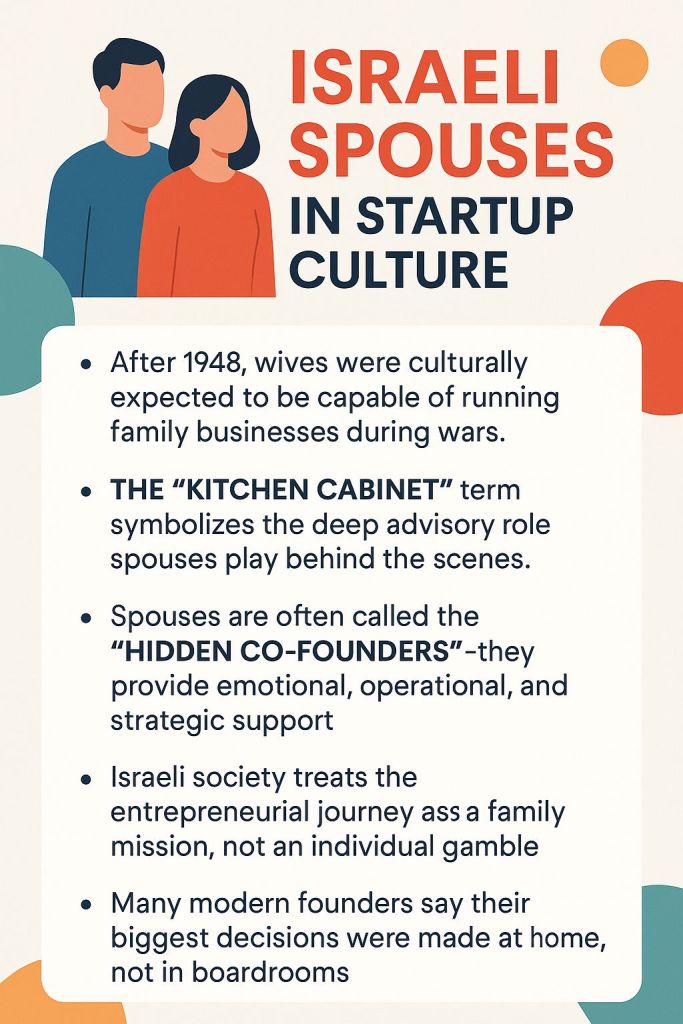
When Israel was founded in 1948, it was built in the middle of constant conflict and war. Men often had to volunteer or were called away for military service, leaving farms, family businesses, and shops vulnerable. While there wasn’t a strict law forcing women to officially take over businesses, there was a strong community expectation: the wife must know the business inside out to keep it alive if the husband was away — or never returned.

This wasn’t just about economics; it was survival. Business continuity was seen as a patriotic duty. Women weren’t simply supporters at home — they became equal partners in family businesses, laying the cultural foundation for today’s startup ecosystem where spouses often act as the “hidden co-founders.”

In modern Israeli startup culture, there’s a popular phrase called the “kitchen cabinet.” Originally used to describe Golda Meir’s informal advisory group that gathered in her kitchen, it now refers to the personal circle of trusted advisors founders rely on at home — often their spouses.

Many Israeli founders say their toughest strategic decisions didn’t happen in boardrooms but over late-night coffee with their spouse at the kitchen table. Spouses guide them through funding crises, pivots, layoffs, or those nerve-wracking “should we shut it down?” moments.

They hold the emotional line when things fail and cheer the loudest when things click. In a country where risk isn’t just accepted but celebrated, these spouses are not only emotional backbones but also often step into operational roles when needed — just like they did in the early days of the nation.

In Israel, a startup is never just “his” or “hers.” It’s a family mission, a collective leap, and a living example of shared resilience.

Why Israel Doesn’t Fear Startup Failure — And What We Can Learn


In Israel, failure isn’t feared — it’s your startup badge of courage.

When we think of failure in India, it usually comes with a long line of unsolicited advice from relatives, worried glances from parents, and that unspoken label — “loser.” But if you zoom out to Israel, famously known as the Startup Nation, you’ll see something very different.

I’ve been diving into articles, founder interviews, and global startup reports — and one thing is crystal clear: failure isn’t just accepted in Israel, it’s almost celebrated.

In Israel, if your startup fails, people don’t write you off. They ask, “So, what’s next?” Investors don’t shy away from you; they lean in closer. It’s as if failure is your badge of honor, proof that you had the guts to play in the arena instead of watching from the sidelines.

Why? Because in Israel, they believe that if you haven’t failed, you probably haven’t aimed big enough. You didn’t push hard enough. You didn’t swing for the fences.

A huge part of this mindset comes from their military culture. Israeli youth go through mandatory army service, where experimentation, rapid problem-solving, and facing unexpected challenges are everyday routines. Mistakes aren’t punished — they’re analyzed and turned into future strategies.

Add to that a society built on survival and constant innovation. When you’re turning deserts into green farms and defending your borders every day, you learn fast that trial and error isn’t optional — it’s how you stay alive.

What really blew my mind is that many Israeli VCs actually prefer founders who have tasted failure. They believe these founders have “paid their tuition fees” and know what not to do. Imagine pitching to an investor in India after a failed venture — chances are you’ll get a lecture on “safe government jobs” instead of funding.

Israel’s startup ecosystem treats failure like a pivot, not a funeral. It’s a milestone, not a tombstone. And that’s exactly why they keep producing unicorns and game-changing technologies, even with a population smaller than some Indian cities.

As founders and dreamers, maybe it’s time we bring this “fail forward” attitude home. Because the real failure isn’t falling — it’s refusing to get back up.

Israel doesn’t bury failed startups; it recycles them into stronger founders.

When Passion Meets Practicality: A Silent Test of Marriage


In Indian arranged marriages, your first meeting with your future wife often happens in a temple, surrounded by her relatives and yours, all watching closely. When I first met my wife like this, I didn’t make any big promises. I just told her honestly that entrepreneurship was my passion and that I would need her extra support to succeed.

She agreed. We got married. And for the first six years, it felt like life had blessed us. The business was thriving, money was flowing, and the house was filled with laughter. In those days, support was easy because success made everything look shiny.

But the real test of any relationship isn’t when you’re flying high — it’s when you crash.

When business challenges started piling up, everything changed. Debts, setbacks, betrayals — my dream began to crumble, and with it, so did the sense of security in our home.

Yet, she stood by me. She didn’t pack her bags or run away. In fact, after an eight-year career gap spent raising our kids, she took up a job to support the family. That move alone deserves more respect than any applause I’ve ever received in my entrepreneurial journey.

But support has layers. While she stood strong on the outside, inside there were storms. She wanted me to take up a job, to drop the dream, to “be practical” for the sake of the family. There were fights, emotional distance, and moments when we felt like strangers living under the same roof.

From her side, it made sense. She saw stability as love, and she believed protecting the kids from uncertainty was her duty. From her view, why should anyone hold on to a passion so stubbornly when it meant risking everything?

From my side, quitting wasn’t an option. Entrepreneurship wasn’t a hobby — it was who I am. If I gave up on it, I wouldn’t just lose a business; I would lose myself. I believed true happiness can exist even in simplicity or poverty, as long as you’re true to your soul’s calling.

I often asked myself: *Who is cruel here? Who is right?*

The truth is, neither of us was wrong. We were just two people trying to survive in our own ways. She fought for emotional and financial security; I fought for identity and purpose.

Marriage is often painted as a journey of compromise. But sometimes, it’s a silent negotiation between two very different worlds: passion and practicality.

She may never fully understand why I chose to stay on this rocky path. And I may never fully understand her fear of instability. But in those differences, there’s a story of two people who didn’t give up on each other — even when they didn’t fully agree.

The “Common Enemy Effect” in Founder Relationships


The common enemy effect is a powerful social phenomenon: people unite strongly when they share a common threat. We often see it in military units, sports teams, and political movements — and it’s equally true for founders and startup teams.


Phase 1: The early struggle

When founders start out, they face huge external threats:

  • Market rejection
  • Cash burn
  • Pressure to prove themselves
  • Family or societal doubt

Their common enemy is failure itself. This shared threat aligns them deeply. There’s no time for ego; decisions are fast and collective. Emotional support is strong. They feel like warriors in the same trench.


Phase 2: Early wins and success

Then comes funding, product traction, revenue, or media buzz. Suddenly, the “enemy” that held them together begins to fade.

Without that shared fight, founders start:

  • Claiming credit individually
  • Listening to “proxy teams” or external voices that inflate egos
  • Pushing personal agendas

The urgent need to survive is gone, so the cracks appear.


Phase 3: Gaps widen

When the common threat disappears:

  • Misaligned visions surface
  • Egos grow
  • Trust erodes
  • Silent power struggles begin

The same founders who once pulled all-nighters together may now fight over direction, credit, or influence.


Lessons from research

✅ Ben Horowitz (The Hard Thing About Hard Things): In crises, teams unite; in safety, they splinter.
✅ Patrick Lencioni (The Five Dysfunctions of a Team): Without a shared mission, conflict thrives.
✅ Harvard Business Review: “Shared existential threats unify.” New shared missions are critical as you grow.
✅ Social Identity Theory (Tajfel & Turner): Strong group identity often needs an external “enemy” to stay focused.


What can founders do?

  • Constantly define new “enemies” or big missions (new markets, innovations, tougher impact goals).
  • Regularly revisit and realign personal and collective visions.
  • Watch out for external influences that inflate individual egos.
  • Build a culture where mission > individuals, always.

In short

What unites founders at first? A common enemy (failure, survival).
What causes splits later? The enemy fades, egos rise.
What’s the fix? Keep creating new shared battles to stay united.