Friends, Politics and Social Media: Can We Disagree and Still Coexist?


There was a time in India when people with completely different political opinions still remained close friends.
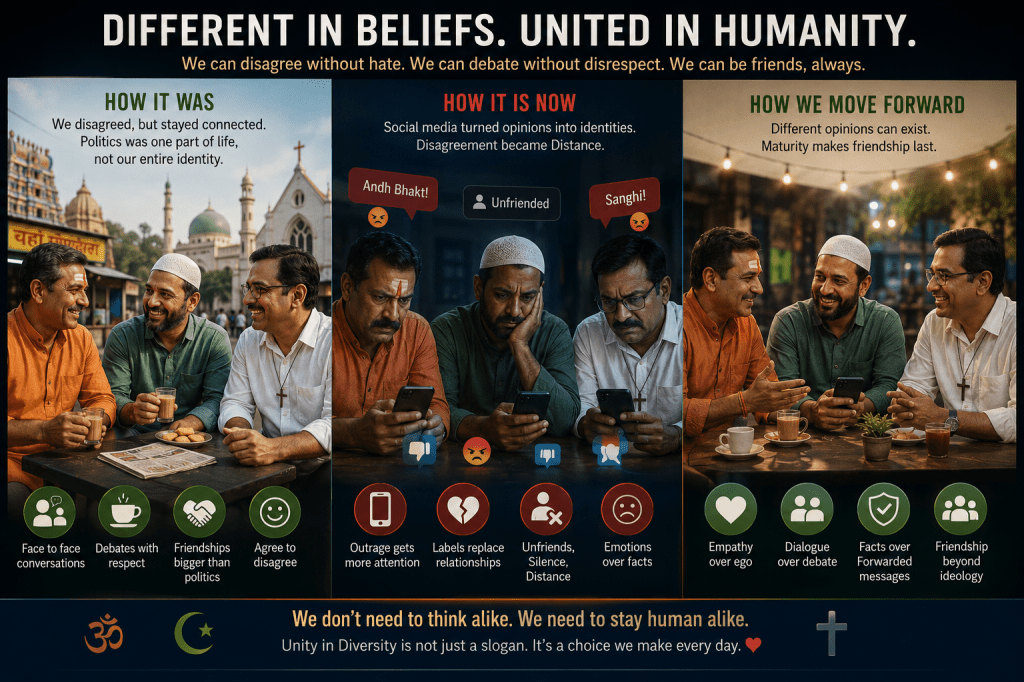
One person voted Congress.
Another supported BJP.
Someone else supported DMK.
One was deeply religious.
Another was secular.

Yet:

  • they attended weddings together,
  • worked together,
  • helped each other in business,
  • had tea shop debates,
  • argued loudly,
  • and still remained connected.

Politics was just one part of life, not the entire identity of a person.

But social media slowly changed this culture.

Today, a political opinion is no longer seen as “just an opinion.” It has become an emotional identity marker. The moment someone openly supports a political party or reacts to a religious issue, people start placing them into categories and labels.

This is where the real pain begins.

In my case, I have many close Muslim and Christian friends — friends from work, business, ex-employees and social circles. I never questioned their religious practices or political preferences. I never had a problem if they supported Congress or DMK.

But when I openly supported BJP or reacted when I felt Hindu beliefs were mocked or insulted, suddenly the reactions changed.

Some called me and expressed disappointment.
Some unfriended me silently.
Some stopped engaging completely.
Some branded me a “Sanghi.”

That word itself is often used today as if it is meant to socially isolate someone.

The irony is: supporting a political party in a democracy should be normal.

is not a banned organization or an underground movement. It is a democratically elected political party, just like or .

Then why has society become emotionally uncomfortable with political differences?

That is the bigger question.

I realized this issue is no longer just about BJP, Congress, religion or ideology. The deeper issue is that society is slowly losing the ability to coexist despite disagreement.

Earlier we had emotional maturity to separate:

  • friendship from politics,
  • people from opinions,
  • relationships from ideology.

Today social media mixes everything together.

Algorithms reward outrage.
Politics becomes identity.
Identity becomes emotion.
Emotion becomes division.

Even normal people slowly become emotionally reactive online.

A person who would happily sit and have coffee with you in real life may still get disturbed by your political post online.

That is the strange contradiction of the social media era.

The dangerous part is not disagreement. Disagreement is healthy in a democracy.

The dangerous part is emotional isolation.

When people stop expressing openly:

  • resentment builds silently,
  • echo chambers grow,
  • society becomes polarized,
  • and friendships become conditional.

Maybe a healthier society is not one where everyone agrees.

Maybe a healthier society is one where:

  • people openly express opinions,
  • disagree strongly,
  • debate emotionally,
  • cool down,
  • and still remain human with one another afterward.

India survived for centuries because of coexistence despite differences in:

  • religion,
  • language,
  • caste,
  • food,
  • region,
  • and politics.

“Unity in diversity” is not about similarity.
It is about emotional maturity despite differences.

Social media has tested that maturity.

Now society must evolve again.

Because if friendships cannot survive political disagreement, then politics has become bigger than humanity itself.
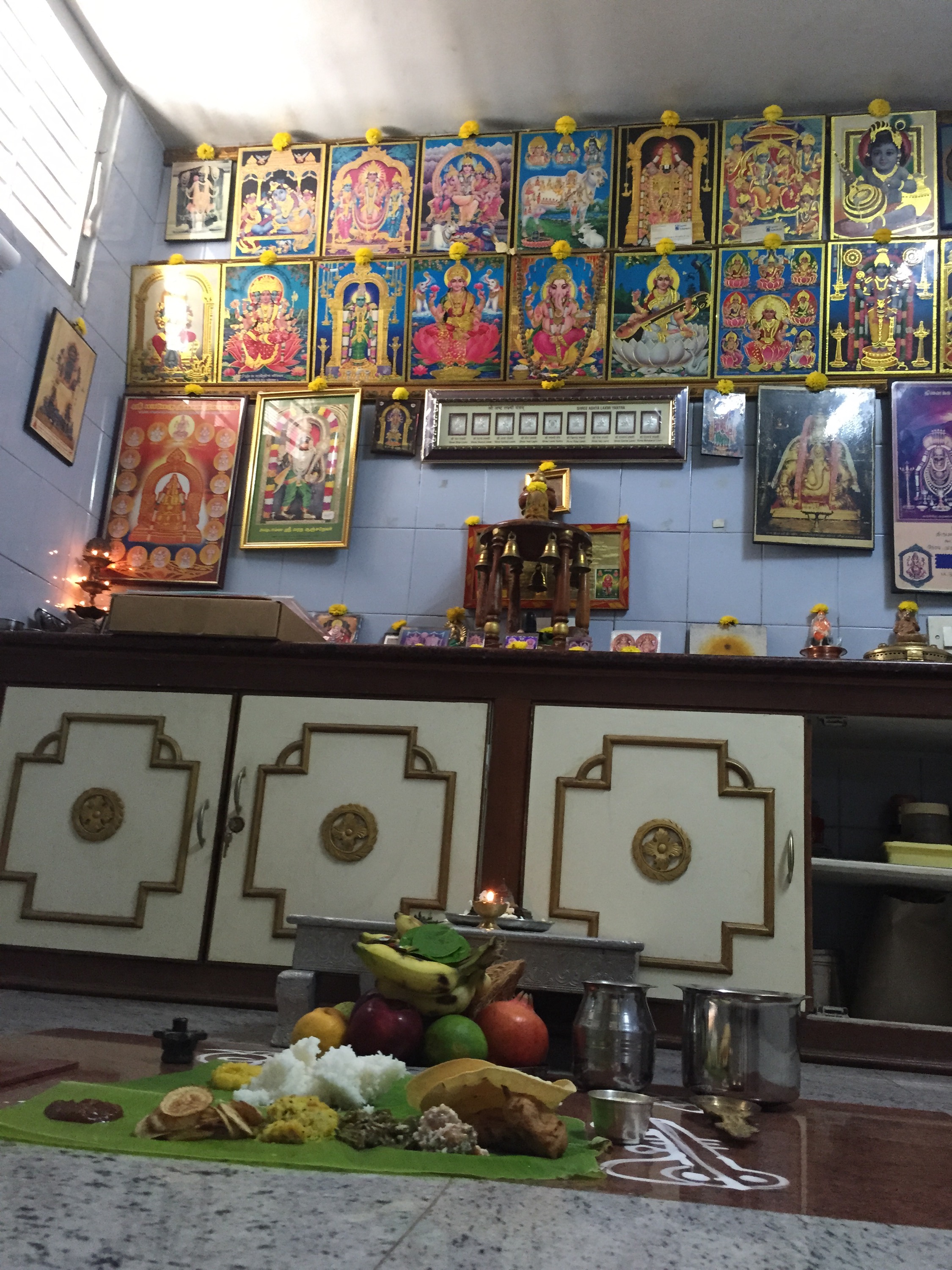
A festival celebrated after 3 years!!


I remember Ganesh Chadurthi 2012 was the last festival celebrated happily with dad.

Subsequent festivals couldn’t be celebrated happely because of my dads hospitalisation!!!

Then dad passed away last year back and as per HINDU customs we were not supposed to celebrate any festival for a year!!

It’s been a year since my dad left us and this Tamil New Year 2015 is a festival celebrated after 3 years!! 


Let this new year begin a new chapter in our life with blessings from Dad!!

And தமிழ் புத்தாண்டு வாழ்த்துக்கள்(Happy Tamil New Year) to everybody!!! 

From

K.Sivanesan & Family!!!

The Science Behind Temple BELLS!!


20140507-161907.jpg

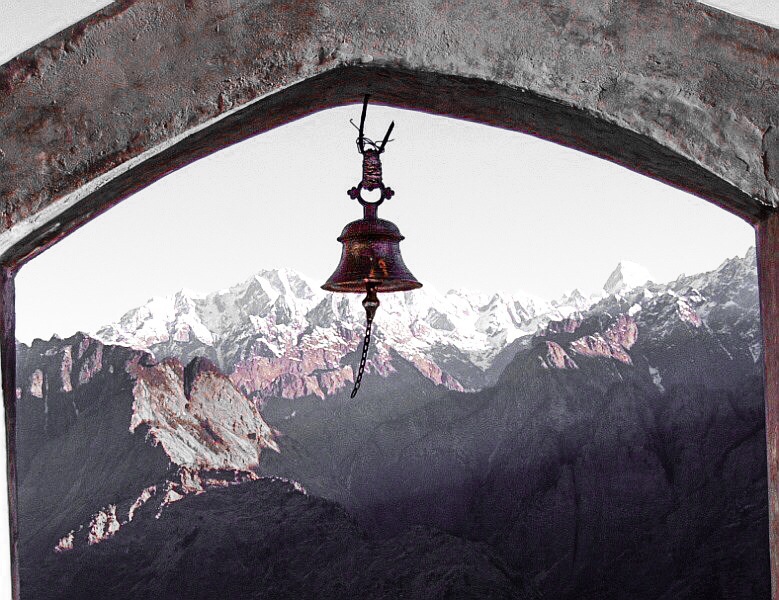
Most of the old temples have large bell at the entrance of the temple and you need to ring it before you enter temple.

A Temple bell have a scientific phenomena; it is not just your ordinary metal. It is made of various metals including cadmium, lead, copper, zinc, nickel, chromium and manganese.

The proportion at which each one of them mixed is real science behind a bell. Each of these bells is made to produce such a distinct sound that it can create unity of your left andright brain.

The moment you ring that bell, bell produces sharp but lastingsound which lasts for minimum of seven seconds in echo mode good enough totouch your seven healing centres or chakras in your body.

The moment bell sound happens your brain is emptied of all thoughts. Invariably you will enter state of Tran’s state where you are very receptive. This Trans state is the one with awareness.

You are so occupied in mind that only way to awaken you is with a Shock! Bell works as Anti-dote to your mind. Before you enter temple – to awake you and prepare you for taste of awareness is the real reason behind temple bell.

Why do we have a prayer room?


20140430-173239.jpg

Most Indian homes have a prayer room or altar. A lamp is lit and the Lord worshipped each day. Other spiritual practices like japa – repetition of the Lord’s name, meditation, paaraayana – reading of the scriptures, prayers, and devotional singing etc are also done here.

Special worship is done on auspicious occasions like birthdays, anniversaries, festivals and the like. Each member of the family – young or old – communes with and worships the Divine here.The Lord is the entire creation. He is therefore the true owner of the house we live in too.

The prayer room is the Master room of the house.We are the earthly occupants of His property. This notion rids us of false pride and possessiveness. Also the Lord is all pervading. To remind us that He resides in our homes with us, we have prayer rooms.

Without the grace of the Lord, no task can be successfully or easily accomplished. We invoke His grace by communing with Him in the prayer room each day and on special occasions.

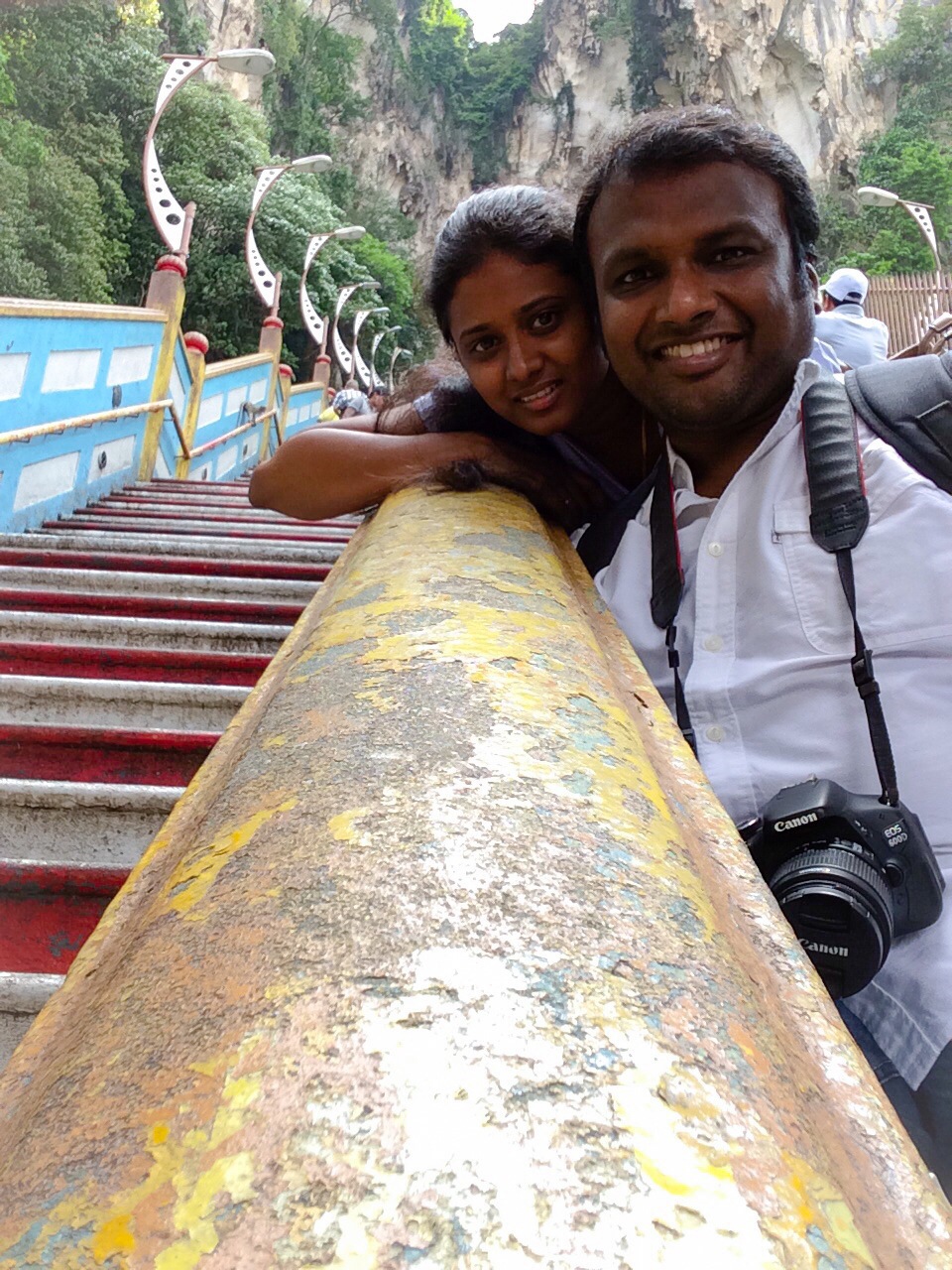
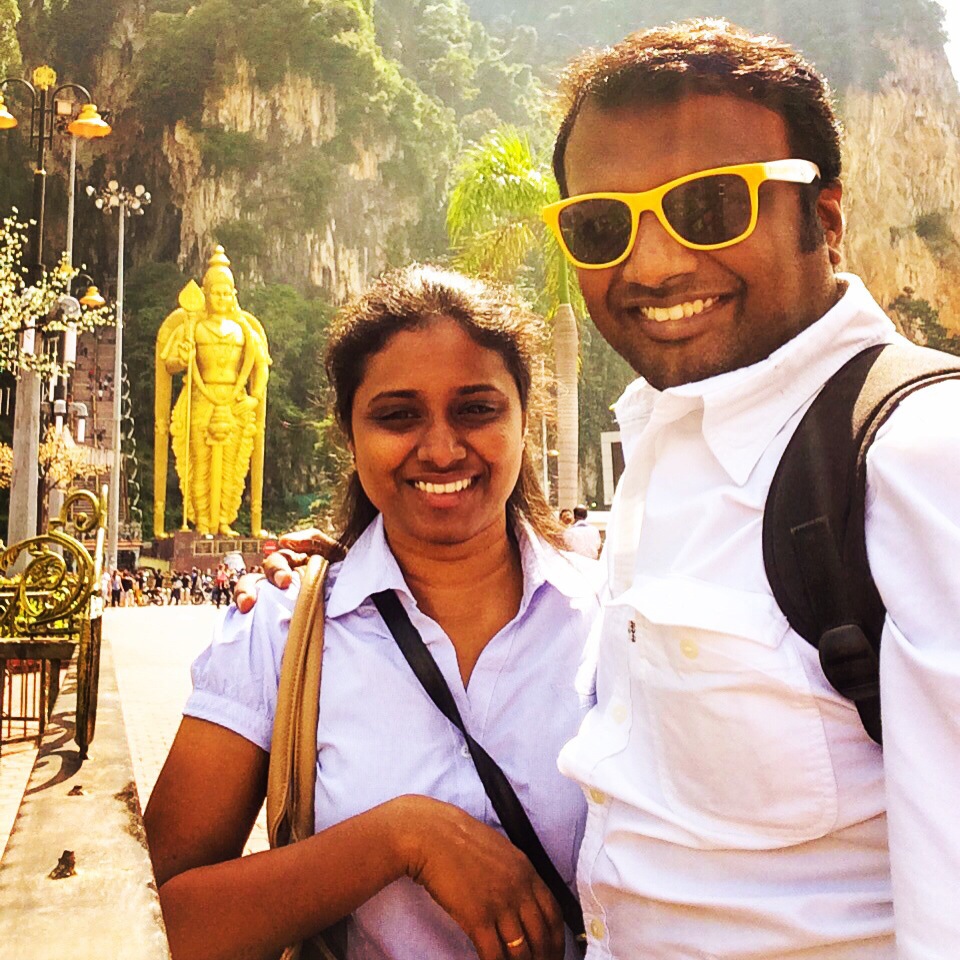
Got blessings From Lord Murugan From Batu Caves


I’ve seen Batu Caves Lord Murugan temple only on Tamil Movies… When I was a kid I wanted to visit this place and it took soo long for the wish to come true :)…

Finally arrived, saw, prayed & got blessed by him…

20140419-213441.jpg

20140419-213547.jpg

20140419-214055.jpg

20140419-214046.jpg

20140419-214117.jpg

Hindu is a geographical identity!!! Not a religion


image

Hindu is a geographical identity, or at the most a cultural one – not a religion. There is no set of beliefs that everyone has to adhere to. Sadhguru

So, what is “HINDUISM” , is it really an organised religion ?

  • people think that Hinduism is a religion that worships idols, animals etc but in reality hinduism is not a relegion, hindu is a geographical identity
  • hindu is a term given by the persians to the people who were followers of the oldest civilization of sanatana dharma
  • there is no founder of hinduism and its not only about beliefs its about seeking
  • in hinduism you dont have to believe in specific god or even god , hinduism accept even atheists
  • in vedas a sacred scripture it is written that truth is one but paths are different
  • there are many paths to realise the truth – bhakti(devotion), jyana(knowledge by scriptures, meditation)
  • in sanskrit we say it adhyatma , it says to find the god within you by self realisation yoga , tantra, advaita , sankhya, etc are the parts of hinduism
  • many great people like buddha, vivekananda, ramkrishna paramhansa, ramana maharshi , gorakshanath, adi shankracharya etc were followers of sanatana dharma
  • today millions of people in the world are doing yoga which is an orthodox school of hinduism
  • hinduism itself is a spritual science , vedas , upanishads are the oldest holy scriptures which are not only for any particular relegion but for the whole mankind
  • hinduism is a philosphy , a way of life and its not a relegion , other name of hinduism is sanatan dharma from which buddhism, jainism, sikkhism originated , sanatan means eternal and it is for the whole mankind not for any community or religion…

Birbal’s Explanation on Power of Chanting Rama Nama


20140408-145001.jpg

Birbal was a minister in the court of Akbar, the great Mogul Emperor. Birbal, apart from his sharp intellect, was also a devotee of Sri Rama. Akbar had a special regard for Birbal. Akbar used to openly ask Birbal to clarify his impulsive – and very often strange doubts. Birbal never failed to give an immediate and a fitting reply to such questions. Wherever Akbar went, he used to take Birbal along with him.

During one such instance, when they traveled for some official purpose, they had to take a route through a dense forest. In the course of the journey, both were totally exhausted and famished. So they decided to rest under the shade of a tree for a while before continuing their journey. Since Akbar was very hungry, he wanted to look around the place to see if he could find a house to get some food. He induced Birbal to follow suit.

But Birbal, who was in the midst of Rama Naam Jap (repetition of Rama’s name), turned down Akbar’s request.

Akbar looked at Birbal and said, ‘Mere chanting of the name of the Lord would not fetch you food. You have to put in your efforts…. You cannot achieve anything without self effort…’

Akbar left Birbal in the pursuit of pacifying his belly. In a little while, he spotted a house. The inmates of the house were overjoyed to see their King coming to their very doorstep for food. They treated him to the best of their capacity. Akbar finished his meal and took a little food for Birbal too, and left the house to meet Birbal. He met Birbal and gave him the food.

‘See Birbal, I told you… I took some efforts for the food and I got it. You were just sitting and chanting Rama Naam, and you did not get any food.’

Birbal ignored his scoffing, and partook the food given by Akbar. After he finished the meal, he looked up at Akbar and said,

‘I have just now experienced the power of Rama Naam, like never before. You are the ruler of the land. But today, even the King had to beg for food. But you look at me. I was just chanting Rama Naam here, and the Rama Naam made the king himself get me food, that too by begging. So I got the food, just by sitting here and chanting Rama Naam without any other special efforts. Such is the power of Rama Naam!!

Ashtamsa Sri Varada Anjaneya Temple History


Two decades ago, Rajamani Bhattar, a temple priest of Tirunelveli, brought up in Vaikanasa Agama tradition and an upasaka of the Anjaneya, was blessed by Guruji Haridos Giri Swami and he was presented with the idols of Sri Rama, Sita, Lakshmana, Anjaneya and a Shadchakra Saligrama at Thennangur.

The Swami had made an apocalyptic statement that the votary would build a shrine for Anjaneya.

In the year 2004, a divine call directed him to devote his entire time and resources to construct a shrine for Anjaneya at the spot indicated in his dream, at Peelamedu in Coimbatore.

Located on a spacious plot of ground tucked a few meters away from and on theCoimbatore-Avinashi road, opposite ESSO bus stop (near Suguna Kalyanamandapam) the Ashtamsa Sri Varada Anjaneya is endued with eight special features.

Hence its uniqueness in standing apart from other temples dedicated to the Anjaniputhra.

Normally Hanuman is portrayed with His folded hands praying to Sri Ramachandra.

But, the gomukhi-structured idol of the deity here, in Peelamedu facing west and measuring eight feet is of a different kind.

And many more unique featrues of the lord Hanuman can be found in this temple.

20140206-184046.jpg
Source: Coimbatorian

WHY WE SHOULD VISIT TEMPLES?


20130416-135619.jpg

There are thousands of temples all over India in different size, shape and locations but not all of them are considered to be built the Vedic way. Generally, a temple should be located at a place where earth’s magnetic wave path passes through densely. It can be in the outskirts of a town/village or city, or in middle of the dwelling place, or on a hilltop. The essence of visiting a temple is discussed here.

Now, these temples are located strategically at a place where the positive energy is abundantly available from the magnetic and electric wave distributions of north/south pole thrust. The main idol is placed in the core center of the temple, known as “*Garbhagriha*” or *Moolasthanam*. In fact, the temple structure is built after the idol has been placed. This *Moolasthanam* is where earth’s magnetic waves are found to be maximum. We know that there are some copper plates, inscribed with Vedic scripts, buried beneath the Main Idol. What are they really? No, they are not God’s / priests’ flash cards when they forget the *shlokas*. The copper plate absorbs earth’s magnetic waves and radiates it to the surroundings. Thus a person regularly visiting a temple and walking clockwise around the Main Idol receives the beamed magnetic waves and his body absorbs it. This is a very slow process and a regular visit will let him absorb more of this positive energy. Scientifically, it is the positive energy that we all require to have a healthy life.

Further, the Sanctum is closed on three sides. This increases the effect of all energies. The lamp that is lit radiates heat energy and also provides light inside the sanctum to the priests or *poojaris* performing the pooja. The ringing of the bells and the chanting of prayers takes a worshipper into trance, thus not letting his mind waver. When done in groups, this helps people forget personal problems for a while and relieve their stress. The fragrance from the flowers, the burning of camphor give out the chemical energy further aiding in a different good aura. The effect of all these energies is supplemented by the positive energy from the idol, the copper plates and utensils in the *Moolasthan*am / *Garbagraham*. *Theertham*, the “holy” water used during the pooja to wash the idol is not
plain water cleaning the dust off an idol. It is a concoction of Cardamom,*Karpura* (Benzoin), zaffron / saffron, *Tulsi* (Holy Basil), Clove, etc…Washing the idol is to charge the water with the magnetic radiations thus increasing its medicinal values. Three spoons of this holy water is distributed to devotees. Again, this water is mainly a source of magneto-therapy. Besides, the clove essence protects one from tooth decay, the saffron & *Tulsi* leafs protects one from common cold and cough, cardamom and *Pachha Karpuram* (benzoin), act as mouth fresheners. It is proved that *Theertham* is a very good blood purifier, as it is highly energized. Hence it is given as *prasadam* to the devotees. This way, one can claim to remain healthy by regularly visiting the Temples. This is why our elders used to suggest us to offer prayers at the temple so that you will be cured of many ailments. They were not always superstitious. Yes, in a few cases they did go overboard when due to ignorance they hoped many serious diseases could be cured at temples by deities. When people go to a temple for the *Deepaaraadhana*, and when the doors open up, the positive energy gushes out onto the persons who are there. The water that is sprinkled onto the assemblages passes on the energy to all. This also explains why men are not allowed to wear shirts at a few temples and women are requested to wear more ornaments during temple visits. It is through these jewels (metal) that positive energy is absorbed by the women. Also, it is a practice to leave newly purchased jewels at an idol’s feet and then wear them with the idol’s blessings. This act is now justified after reading this article. This act of “seeking divine blessings” before using any new article, like books or pens or automobiles may have stemmed from this through mere observation.

Energy lost in a day’s work is regained through a temple visit and one is refreshed slightly. The positive energy that is spread out in the entire temple and especially around where the main idol is placed, are simply absorbed by one’s body and mind. Did you know, every Vaishnava(Vishnu devotees), “must” visit a Vishnu temple twice every day in their location. Our practices are NOT some hard and fast rules framed by 1 man and his followers or God’s words in somebody’s dreams. All the rituals, all the practices are, in reality, well researched, studied and scientifically backed thesis which form the ways of nature to lead a good healthy life.

The scientific and research part of the practices are well camouflaged as “elder’s instructions” or “granny’s teaching’s” which should be obeyed as a mark of respect so as to once again, avoid stress to the mediocre brains…

British distorted Hindu Aryavrata-Bharata History of India


The flawed Aryan invasion theory (AIT) was actually part of the British policy of divide and rule, French historian Michel Danino, an expert on ancient Indian history, said on Thursday on the sidelines of the Kolkata Literary Meet. Danino, who authored books such as The Lost River: On The Trail of Saraswati and Indian Culture and India’s Future, blames the British for distorting Indian history and challenged the Arayan invasion theory, while maintaining that there was no actual Aryan-Dravidian divide.

“No ancient or medieval Indian text would support the Aryan invasion theory. It is genetically proven that Aryans and Dravidians belong to the same race, ”said Danino, who settle in India in 1977 and has since acquired Indian citizenship.

Danino said that early Tamil literature displayed a cultural fusion with north Indian literature. Even the name of the city Maduri was influence from the ancient north Indian heritage city, Mathura, Danino claimed.

“Indians are basically a mixed breed and the mixing started as early as the Stone Age. After the Saraswati river dried up, leading to the collapse of the Indus Valley civilization, people started settling on the banks of the Ganges. This phenomenon that occurred around 2000 BC led to massive mixing up of the populace as a while has to shift its base,” Danino explained.

“The Mahabharata defined ethnic groups as jatis, whereas the British brought in the term tribes to describe the same thing, thus denigrating the homogenous culture of India. Jatis were defined on ecological terms. There is a popular perception that casteism started in India since the Vedas but that is not true. There was no casteism even during the Mahabharata period,” he said.

Danino also rued the fact that Indians are apathetic towards the preservation of their rich culture and heritage. “1170 sites of the ancient Harappan civilization have been identified during its mature phase. But till date only around 100 sites have been excavated. There is a fear that 90% of the sites might disappear due to expansion of urban areas or agricultural land being converted to residential high rises,” Danino said.

He went on to give an example of how the archaeological Survey of India (ASI) could recover only eight kilos of Harappan gold when about 80 kilos of the same was unearthed at Mandi in Uttar Pradesh. Villagers pilfered the rest, depriving India of a useful insight into its rich heritage.

“ASI admitted to a Parliament query that 42 protected sites vanished from Delhi alone. No one noticed as land sharks went to grab the sites and construct high-rises on them,” Danino said.

Historian Sanjeev Sanyal, speaking on the continuity of Indian history claimed that east European and north Indian people share genetic similarities.
————————–
Source : Hindustan Times

Link : http://www.hindustantimes.com/India-news/Kolkata/Indian-history-was-distorted-by-the-British/Article1-1004972.aspx