Startups Then & Now: From Empty Streets to Crowded Highways


Two eras, one spirit: the unstoppable heart of an entrepreneur.

I started my entrepreneurial ride back in 2000.

Those days, we didn’t even call it a “startup.” We called it “business,” “consultancy,” or just “trying something on my own.”

There was no Shark Tank. No glossy LinkedIn posts with #hustle. No college workshops on “How to pitch to VCs.”

In 2000, entrepreneurship wasn’t a cool badge. It was something you did if you couldn’t find a job or if you were just stubborn enough to believe you could create something from nothing.

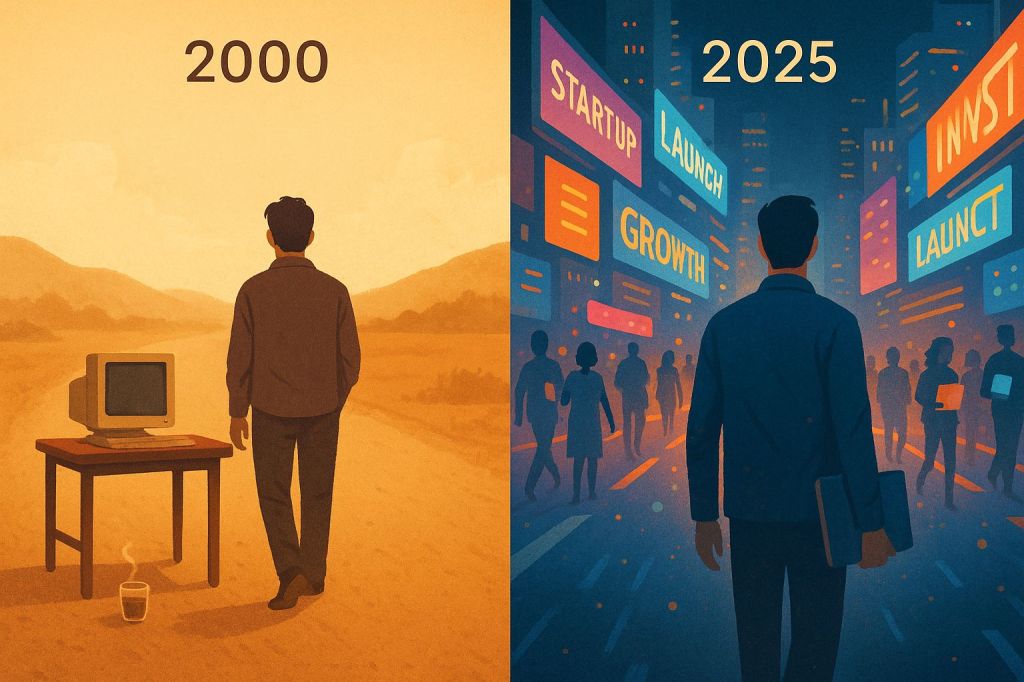
2000: Wild, open roads

  • No references for success. The word “startup” was so rare, only one in a lakh even dared to dream it.
  • Loyalty was real. Your first hire stayed not just for salary but for the dream, even if the office was a one-room setup with plastic chairs and Maaza bottles in the fridge.
  • Markets were raw. Everything was new and waiting. A simple website could make you look like a global player.
  • Corporates & tech were immature. Big companies were still figuring out email, and many had no clue how to use the internet beyond sending scanned copies of invoices.
  • Open source was magic. You could build a product for the price of a few nights of filter coffee.
  • Ecosystem? Nil. No accelerators, no pitch fests, no “startup India” subsidies. Just you, your idea, and sheer guts.
  • Limited resources, big possibilities. Everything felt like a blank canvas.

2025: Crowded highways

  • Startup became a fashion statement. Every Tom, Dick, and Harry wants to “launch something” — sometimes just to add “Founder” to their Instagram bio.
  • Expensive game. Startups today mean burn rates, seed funding rounds, CAC vs LTV debates — even before you have your first paying customer.
  • No loyalty. Employees switch for a ₹2,000 raise or a fancier “Head of Vibe” title.
  • Tech consolidation. The top 5 tech giants dictate tools, languages, and frameworks. Your “freedom to build” has a Terms & Conditions page.
  • Market consolidation. Big sharks have gobbled up fragmented small players. Niches get crushed before you even announce your beta.
  • Ecosystem overload. Events, podcasts, awards, startup conferences. Everyone is “networking,” but very few are really building.
  • Too many eyes, less patience. Today, if your product doesn’t go viral in 2 weeks, you’re labeled a flop.

Then vs Now: What’s the real deal?

In 2000, the road was empty and scary.
In 2025, the road is crowded and noisy.

Then, the challenge was survival in the unknown.
Now, the challenge is standing out in the overcrowded known.

Then, it was about creating a market.
Now, it’s about finding your slot in a saturated market.

Then, you worried about paying your first employee on time.
Now, you worry if your pitch deck slides have enough “impact words.”

But here’s the one thing that hasn’t changed:

The thrill of chasing a vision that only you can see.

Whether you’re hustling on a dusty internet café PC in 2000 or pitching on a Zoom call in 2025 — the soul of entrepreneurship remains the same:
A quiet voice inside that whispers, Let’s try anyway.

“Markets change. Tech evolves. But courage? That stays timeless.”

The Garage Dream by the Sea: Two Years That Built a Legacy


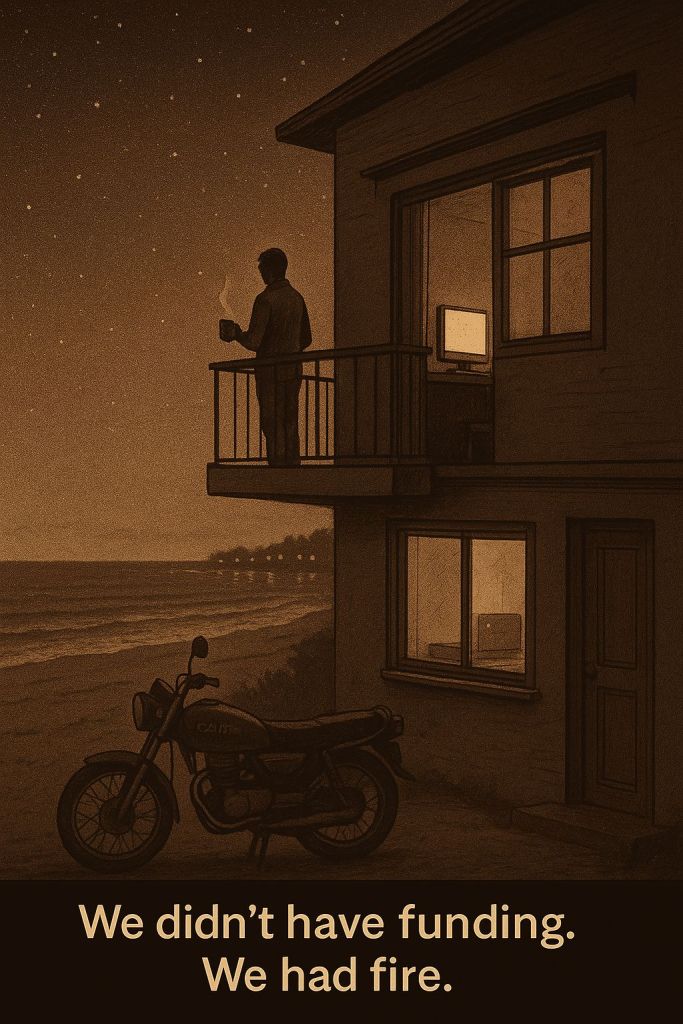
Between September 2002 and September 2004, we built something unforgettable. Our office wasn’t in a fancy building or a posh tech park. It was tucked inside a TNHB quarters apartment in Valmiki Nagar, Kottivakkam. But for us, it felt like Silicon Valley.

Renting that space with self-earned money brought a satisfaction that can’t be fully put into words—it was something only a hustler’s heart could feel.

We began as a humble team of 8, packed with energy, grit, and ideas. Within two years, we had grown into a 40-member unit that breathed ambition. We set up everything ourselves—our very own Samba server, our desks, our dreams. Vel Sir stood by us, offering assembled computers on credit when funds were tight. We didn’t have an air conditioner when we started; the heat from the Chennai sun and CRT monitors turned the place into a furnace. But we endured.

We hustled in sweat, but not in despair.

Slowly, we upgraded—one A/C at a time. We set up a tiny kitchen for tea and coffee. We insisted that everyone must volunteer to prepare coffee or tea in that kitchen. Many resisted in the beginning. But soon, everyone took their turn—each cup brewed with pride, with patience. That pantry transformed into our bonding zone, our ritual, our daily pause between lines of code.

Every milestone—big or small—was celebrated with team lunches. From every corner restaurant in Besant Nagar to the iconic joints in Adyar, we made those places our own.

I practically lived in that office. My routine? Wake up at 5 AM, dash home to shower, and be back by 7:30. The location was a dream in itself—sea-facing, serene, and soul-fueling. The Sindoor Sea Club next door lit up weekends, Diwalis, and New Year’s Eves. I walked the beach to stay fit. I walked it again at midnight to clear my mind.

There were nights I rode solo on my Calibre bike from Valmiki Nagar to Mahabalipuram. Back then, ECR after 8 PM was a ghost road—no streetlights, no traffic, no cops, not even open tea stalls. But I needed that silence. That solitude was therapy.

Night shows at Prarthana or Mayajaal were my release. The rest of the time, we were a silent storm—working with focus, building in stealth. No one believed in us yet, but we did. We learned to smile through the struggle, to lead without applause, to hustle without hashtags.

There were times when the weight of challenges felt unbearable. But that location, that ocean breeze, those midnight drives—they helped me breathe, helped me bounce back.

Those two years weren’t just about building a company. They were about building character.

Entrepreneurial rollercoaster: Navigating relationships, emotions, failures, and demotivation on the path to success


Entrepreneurship can be a challenging and rewarding journey. While building a business, entrepreneurs face numerous challenges that can affect their relationships, emotions, and motivation. In this blog, we will explore some of the common challenges faced by entrepreneurs and how they can overcome them.

  1. Relationships:

Entrepreneurship can put a strain on relationships, whether it’s with a spouse, family, or friends. Entrepreneurs often work long hours and put all their energy into their business, leaving little time for other areas of their life. This can lead to feelings of guilt and resentment from their loved ones.

To overcome this, entrepreneurs should communicate their goals and schedule with their loved ones. Setting boundaries and being transparent about their workload can help to manage expectations and reduce stress. Additionally, making time for self-care and spending quality time with loved ones can help to maintain healthy relationships.

  1. Emotions:

Entrepreneurship can be an emotional rollercoaster. The highs of success and the lows of failure can be challenging to manage. Entrepreneurs may also face anxiety and stress due to the uncertainty of their business.

To overcome this, entrepreneurs should practice mindfulness and self-care. Taking breaks, practicing meditation, and exercising can help to reduce stress and anxiety. Seeking support from a mentor or a therapist can also help to manage emotions and maintain a positive mindset.

  1. Failures:

Failures are inevitable in entrepreneurship. Entrepreneurs may experience setbacks, such as failed product launches, unsuccessful marketing campaigns, or financial challenges. These failures can be demotivating and make entrepreneurs question their abilities.

To overcome this, entrepreneurs should embrace failure as a learning opportunity. They should analyze their failures and use the lessons learned to improve their business. Additionally, seeking support from a mentor or a business coach can provide a fresh perspective and help entrepreneurs to stay motivated.

  1. Demotivation:

Entrepreneurship can be a lonely journey, and entrepreneurs may feel demotivated at times. It can be challenging to stay motivated when facing constant challenges and setbacks.

To overcome this, entrepreneurs should set realistic goals and celebrate small wins. Breaking down big goals into smaller achievable tasks can make them feel less overwhelming. Additionally, seeking support from a community of like-minded entrepreneurs can provide motivation and accountability.

In conclusion, entrepreneurship is a challenging but rewarding journey. Entrepreneurs may face challenges in their relationships, emotions, failures, and motivation. However, by practicing mindfulness, seeking support, and embracing failure, entrepreneurs can overcome these challenges and achieve success in their business

The Entrepreneurial Spirit: Once Ignited, Forever Alive


Entrepreneurship is a way of life, not just a profession. It is a mindset that enables individuals to identify and pursue opportunities, create value, and take calculated risks. While some people may choose to start their own businesses only once, for others, entrepreneurship becomes a lifelong pursuit. The phrase “Once an entrepreneur always an entrepreneur” reflects this reality, and in this blog post, we will explore why this is the case.

  1. Entrepreneurship is a mindset

Entrepreneurship is not just about starting a business; it’s about the mindset that drives individuals to pursue their goals and create value. Entrepreneurs are inherently curious and creative. They are always on the lookout for new opportunities and ways to improve existing systems. This mindset doesn’t just disappear once an entrepreneur has sold their business or retired from the startup world.

  1. Entrepreneurs thrive on challenge

Entrepreneurs are often attracted to the challenge of starting a business. They relish the opportunity to create something new and solve problems that others have overlooked. This drive doesn’t disappear once a business is up and running. Many entrepreneurs continue to seek out new challenges, whether that means starting a new business or pursuing other endeavors that require creativity and problem-solving skills.

  1. Entrepreneurs are passionate

Entrepreneurs are often driven by a deep passion for what they do. Whether they are creating a new product or service, solving a problem, or serving a specific market, entrepreneurs are committed to their vision. This passion doesn’t simply disappear once a business is sold or retired from. Many entrepreneurs continue to be passionate about the same issues that drove them to start their business in the first place, and they may pursue other avenues for expressing that passion.

  1. Entrepreneurs are resilient

Starting a business is not easy, and entrepreneurs often face setbacks, failures, and unexpected challenges along the way. However, successful entrepreneurs learn from their experiences and use them to build resilience. This resilience doesn’t disappear once a business is sold or retired from. Many entrepreneurs continue to be resilient in other areas of their lives and pursue new challenges with the same level of determination.

  1. Entrepreneurship is a community

Entrepreneurship is not just about the individual; it’s about the community of like-minded individuals who support each other and share a common vision. Once an entrepreneur has entered this community, they are unlikely to leave it entirely. Many entrepreneurs continue to be involved in the startup world, even if they are no longer running their own business. They may mentor new entrepreneurs, invest in startups, or simply attend events and stay connected with others in the community.


In conclusion, the phrase “Once an entrepreneur always an entrepreneur” reflects the reality that entrepreneurship is a way of life, not just a profession. The mindset, drive, passion, resilience, and community that define entrepreneurship are unlikely to disappear once a business is sold or retired from. For many entrepreneurs, entrepreneurship becomes a lifelong pursuit, and they continue to seek out new challenges and opportunities to create value long after they have left the startup world

Rebuilding a Business from Scratch at 43: Overcoming Adversity


I’m sorry to hear that you’ve experienced such a setback in your business. However, it’s important to remember that failure is a part of the entrepreneurial journey, and many successful entrepreneurs have faced similar challenges and gone on to build even stronger businesses.

Here are some steps you can take to rebuild your business from scratch:

  1. Take some time to reflect and learn from your experience: Reflect on what went wrong with your previous business and what you could have done differently. This will help you avoid making the same mistakes in the future.
  2. Identify your strengths and weaknesses: Understanding your strengths and weaknesses will help you identify the areas where you need to improve or seek help. You may want to consider working with a business coach or mentor to help you with this.
  3. Develop a new business plan: Create a new business plan based on what you have learned from your previous experience. This should include a clear mission statement, a target market, a marketing strategy, and financial projections.
  4. Secure funding: Determine how much funding you need to get your business off the ground and explore funding options such as loans, grants, or investors. You may also want to consider crowdfunding or launching a presale campaign to generate early revenue.
  5. Build a new team: Start building a new team by hiring employees or contractors who have the skills and experience you need. Be sure to vet potential candidates thoroughly and consider their fit with your company culture.
  6. Launch your business: Once you have everything in place, launch your new business. Be sure to promote it through marketing channels that reach your target audience, such as social media, email marketing, and advertising.

Remember that rebuilding a business from scratch is not an easy task, but with determination, hard work, and a solid plan, it is possible to achieve success. Good luck!

Transit at London Heathrow!!


Landed at London Heathrow airport for transit!!! Next is another 12 hour flight to SFO!!!

Got a new address


Starting up is always fun!!! You are always left with limited resources and you keep coming up with ways to counter limitations!!!

One such situation is setting up a corporate office for Temple Town Coffee!!! Though we are fortunate enough to have the support group companies (Cogzidel Technologies Pvt & Cogzidel Consultancy Services) to bootstrap us with required resources and infrastructure, we didn’t want to bother them too much with our request.

Also we didn’t want to disturb the professional culture of those entities with would unruly startup work culture!!

Also we spend most of the time on driving in search of locations and meeting people. So, we found it unnecessary on investing for a office and was working out ways!!!

That is when my co-founder Balki, came with the recommendation of setting up a SOCO(Small Office Car Office). 

Our SOCO includes;

  • Swift Dzire car!!
  • Reliance 4G WIPOD!!
  • 2 Laptops!!
  • One official mobile!!
  • Power Bank!!
  • Portable Power Inverter Adapter!!

A look at our powerful gadgets;

That’s my Laptop!!!
Small Office Car Office Phone
SOCO Phone
Balki’s Laptop

So, mostly we use Truck Bay Lane’s as our office.

This is our new Madurai office address;

Truck Bay Lane
NH7, Nilakottai.

Small Office Car Office
Balki working at T2C’s Small Office Car Office at NH7, Nilakottai.
 

Since we are not a Technology company, Balki and me decided not to invest on Gadgets. So, we got contentented with gadgets which are not being used by our friends.

I got this broken Laptop of my wife, which is damaged but with small tweaks, uninstalling unnecessary applications and downgraded version of Linux, I’m able to get a good performing system.
This is our customer support phone which was given to Balki by his aunt. 

Also this is Balki’s old Laptop which he uses to work and do some weight lifting exercise ;)!!

I’m fortunate enough to get back to startup life and by comfort zone of breaking and fixing this!!

For now heading to my kitchen to explore the recipe of Karupatti Kaapi!!!

World Entrepreneurship Day


My Festivuswould be World Entrepreneurship Day and I want to celebrate it 24tn February of every year… Yes that happens to be the birth date of Legendary Steve Jobs who taught the world how to dream and how to make dreams come true!!!

How all the day can be celebrated??

  • One entrepreneur all over the world can be awarded World Entrepreneur Award, something on the lines of Nobel or Oscar!!
  • There can be Startup Battlefield and Pitches, conducted for funding!!!
  • Entrepreneur Clubs can be formed, make entrepreneurs as members and raise donations from successful entrepreneur… Those funds can be used for Entrepreneurship Development, something like Rotary Club for social Service!!!
  • Day can be developed like Black Friday & Cyber Monday!!! It should be crazy deals all over the world!!

Why it has to be celebrated??

  • Entrepreneurs help build a nations economy!!
  • Entrepreneurs help in Job Creation!!!
  • Entrepreneurs bring best products and services to the end users!!
  • Entrepreneurs successful or failed add value to society!!! Successful ones become role-models and failed ones becomes mentors!!!

Thanks to WordPress “The Daily Post” for this wonderful topic!!! It made me think of such a day!!! I wish someday 24th February would be celebrated as a grand festival!!! 

Let me try to start it with a small group from this year!!

Business Meeting at The Brew Room


Had a wonderful business meeting with buddies Bala & Mishra!!

20140701-002642-1602199.jpg

20140701-002642-1602675.jpg

20140701-002643-1603421.jpg

20140701-002643-1603960.jpg

20140701-002643-1603092.jpg

Looking to Invest & Partner in a Manpower Services Staryup


Looking to partner with a ManPower Consultancy as an investor / mentor / working partner.

These are the specifications for the type of company I’m looking at;

1.) Core competency should be on recruitment services. Preferably a Training and placement company.

2.) Must be a less than a year old startup.

3.) Preferably a sole proprietor company. However, not more than 2 partners.

4.) Must be headquartered in Chennai.

If you are one such startup or you have any reference kindly send an email to anand@cogzidel.com