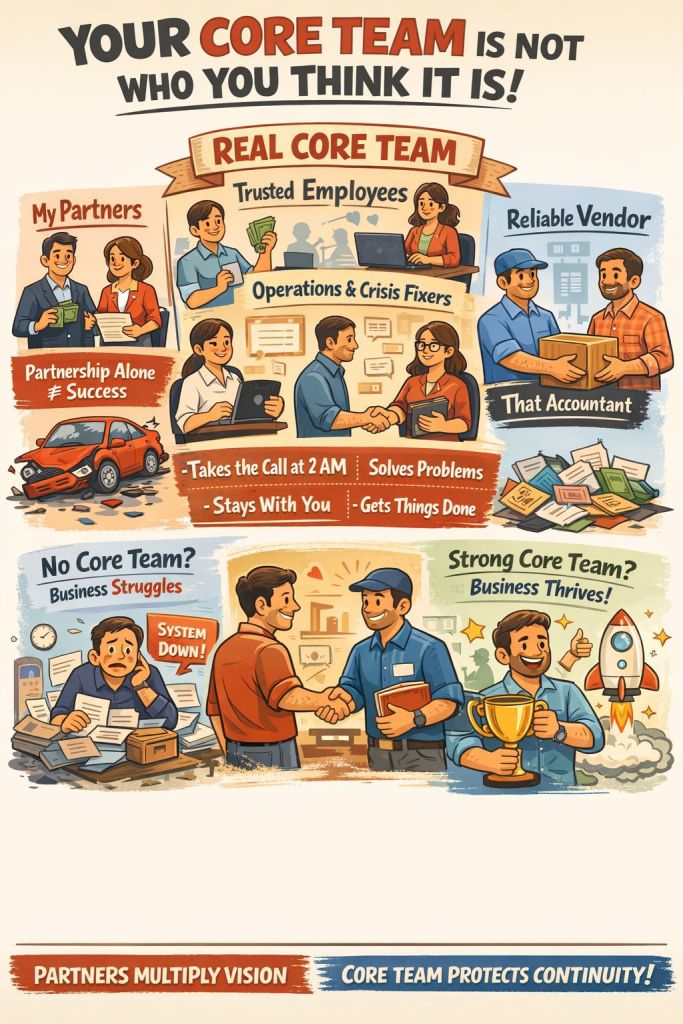
Your Core Team Is Not Who You Think It Is


Most people say this confidently:

My core team is my partners.”

Fair enough.
Good partners are gold.

But here’s the uncomfortable truth I learned the hard way:

👉 Many businesses die even with partners.
👉 Many businesses survive and grow without partners.

The difference is not partnership.
The difference is the core team.


Let me say this plainly

A core team is not about equity.
It is about who shows up when things go wrong.

The people who:

  • Pick up calls when something breaks
  • Know your business better than your SOPs
  • Fix problems without drama
  • Think, “If this fails, I fail too”

They may be employees.
They may be vendors.
They may not have a fancy title.

But without them, the business slows down or collapses.

That’s the real test.


Why founders misunderstand “core team”

Because startup culture romanticised this idea:

“Find a co-founder. Everything will be solved.”

Reality check:

  • Partners give direction
  • Teams give movement

A car with only a steering wheel won’t move.
You need an engine, wheels, fuel, and a driver who knows the road.

That’s your core team.


What a core team actually does (in real life)

Not theory. Real life.

They:

  • Remember why decisions were taken 3 years ago
  • Handle customers when you are sick, stuck, or burnt out
  • Prevent small issues from becoming public disasters
  • Keep the business breathing during bad phases

Most founders don’t fail suddenly.
They bleed slowly due to weak execution.

A strong core team stops that bleeding.


Some uncomfortable examples

Apple didn’t scale because Steve Jobs had partners.
It scaled because people like Tim Cook ran operations like a machine.

D-Mart didn’t grow because of flashy leadership.
It grew because store managers, buyers, and vendors stayed for decades.

Zoho didn’t win because of funding or hype.
It won because employees stayed long enough to care deeply.

Closer home?

Every successful small business has:

  • That one accountant who “knows everything”
  • That one operations person who holds the chaos together
  • That one vendor who never fails you

They don’t own shares.
But they own responsibility.


Vendors: the most ignored core team

Let’s talk about this honestly.

That vendor who:

  • Delivers even during strikes
  • Adjusts credit when cash flow is tight
  • Saves you from embarrassing customer issues

If they walk away, your business feels it immediately.

They are external employees in spirit.

Treat them like price-only suppliers and you lose them.
Treat them with respect and continuity, they become your shield.


Want to know who your real core team is?

Simple test. No theory.

Ask yourself:

  • If this person leaves tomorrow, will my business struggle?
  • Do they know things I never documented?
  • Do I trust them when money, reputation, or deadlines are at risk?

If the answer is yes — congratulations.
That’s your core team.

Whether HR agrees or not.


The hard truth most founders learn late

A business with partners but no core team is fragile.
A business with a strong core team can survive almost anything.

Partners multiply vision.
Core teams protect continuity.

If you’re building a business, don’t chase only co-founders and equity splits.

Build:

  • Trust
  • Respect
  • Long-term relationships

That’s what quietly builds durable businesses.


When Dreams Turn Into Daggers


When the hand that built the dream holds the knife that kills it.

In 2008, six of my friends did something most people only dream about.

They walked away from cozy jobs, steady paychecks, and the warm security of “playing safe” to build something bigger. Something worth remembering. They were all in their late 20s, brimming with fire. They took loans, emptied savings, and pledged the prime of their lives to a single dream.

The world of entrepreneurship, however, wasn’t the romantic adventure they imagined. It was brutal, unforgiving, and often lonely. They worked sleepless nights, took no salary for months, and when they finally did, it was far below what they could have earned elsewhere. They traded comfort for survival, and survival for the hope of victory.

And slowly, painfully, they built a brand — a brand that became a name others admired, a story that inspired.

But today… that story has a bitter ending.

One person’s greed — one — has turned all of that sweat, sacrifice, and shared hardship into ashes.
Three of my friends, who bled for this company for 15 long years, have been thrown out. Not because they failed. Not because they lacked value. But because the man they trusted — a friend — decided he wanted it all.

Money. Power. Control.

The irony? That man is my friend too. And watching him walk the same path as my ex‑business partner is like déjà vu wrapped in heartbreak. I’ve lived through betrayal. I’ve woken up to the taste of iron in my mouth, knowing someone I trusted had buried a knife in my back. I know the hollow it leaves inside you.

He needs to understand — really understand — what it means to crush the very people who carried you through the storms.
He needs to know that the applause he hears today will fade… and karma has the longest memory of all.

And to my friends who were wronged —
I want to tell you this:
Believe in yourself. Stay the course. Don’t let the poison of betrayal seep into the veins of your purpose. Karma takes time, yes… but when it moves, it never misses. I have seen it with my own eyes.

Success built on betrayal is a glass palace. It may look beautiful now, but the cracks are already forming.
And one day, when it shatters, the shards will cut deeper than any knife.

Founder Wellness Framework: The Asset We Forget to Protect


The founder’s true hustle: balancing the dream and the self.

When we talk about entrepreneurship, we love to throw around big words — hustle, grind, passion, risk. We romanticize late nights, skipped meals, endless meetings, and that elusive “big win.”

But here’s the bitter truth I learned the hard way: the biggest asset in your startup isn’t your product, your team, or even your funding — it’s you.

As founders, we become our startup’s first sacrifice. We skip meals, work until we doze off at our desk or in the car, ditch workouts, and pile up stress like it’s a badge of honor. We tell ourselves, “Once I close this round… Once we hit this milestone… Then I’ll fix my health.” But that day rarely comes.

I’ve been there — poor eating habits, no fixed sleeping schedule, mind always racing at 200 km/h, pulling my family into a life of constant uncertainty. I realized one thing: building a business shouldn’t mean breaking myself down.

So, I decided to flip the narrative. Here’s my simple Founder Wellness Framework — a survival kit for anyone crazy enough to chase a dream and bold enough to protect themselves in the process.

Treat your health like an investor meeting

If you wouldn’t miss a call with your top investor, don’t skip your health appointments or workouts.
Block time in your calendar for walks, workouts, or at least a few stretches. Move like your runway depends on it — because it does.

Eat to fuel, not just to fill

No one expects gourmet meals or fancy diets, but choose real food over packet snacks.
Keep fruits, nuts, or home-cooked options at arm’s reach instead of biscuits and chips.
Remember: a well-fed founder thinks better, decides better, lives better.

Protect your sleep like your IP

Your mind is your most valuable intellectual property. Sleep is the best free maintenance service for it.
No “just one more mail.” No working till you doze off at your desk or in your car. Shut it down. Recharge. Next day, show up like a human, not a zombie.

Build your emotional safety net

Talk to friends, mentors, or even a professional if needed.
Don’t carry every failure and every setback like a private burden. Share it, release it. You’ll be surprised how many others are silently going through the same.

Protect your close ones from your chaos

Entrepreneurship is your chosen roller coaster, not theirs. Be mindful not to drag them into every loop and drop.
Check in with your family. Show up at dinners. Put the phone down and listen — truly listen. You’ll build more than a company; you’ll build a legacy they’ll want to be part of.

The real hustle

The real hustle isn’t just about 100-hour weeks or raising millions. The real hustle is building something without losing yourself in the process.
We can’t pour from an empty cup. Our dreams are big, but they deserve a founder who’s strong enough to see them through.

So to every founder out there: build your product, scale your team, delight your customers — but above all, build and protect yourself.

That’s the only way the story you’re writing today becomes the legend you’ll tell tomorrow.

“The founder is the first investor, the first employee, and the last line of defense. Protect that asset at all costs.”

Entrepreneur Dogma: The Silent Killer of Originality


“I started to build my dream. Somewhere along the way, I started building someone else’s playbook.”

In the wild world of startups, we love hero stories. The founder who hustled 24/7, the genius who failed fast and rose again, the team that raised millions overnight.

We turn these stories into gospel. We worship them as dogma — rigid, holy commandments that every founder must obey.

But here’s the dangerous truth:
Dogma is a shortcut to comfort, not success.

The deadliest dogmas every entrepreneur is sold.

1️⃣ Hustle 24/7 or die trying

Work until you collapse. Sleep when you’re dead. Family? Health? Who cares.

Sounds heroic, right?
In reality, this is how burnout is sold as a badge of honor. Sustainable success comes from sharp focus and energy — not self-destruction.

2️⃣ Fail fast, fail often

Yes, learning from failure is crucial. But romanticizing failure without learning is like celebrating a car crash because it “taught you something.”

Failure is a teacher — not a strategy.

3️⃣ Raise money at all costs

Somewhere along the line, we decided VC money was a trophy. The more you raise, the more you “win.”

But money is a tool, not a victory parade.
Your business might thrive better bootstrapped, profitable, and free.

4️⃣ The customer is always right

No. Some customers are wrong, loud, and costly. Your job is to choose your customer — not please everyone.

5️⃣ Growth above everything

We chase hockey-stick graphs, forgetting that vanity metrics are just that — vanity.
Revenue without margins, customers without loyalty, growth without soul — these lead to slow deaths disguised as momentum.

Why do we fall for dogma?

Because it’s easy.
It feels safer to follow a known path than to carve your own.
It feels cooler to repeat Silicon Valley slogans than to think deeply about your own reality.

Dogma gives you a script — but the greatest founders write their own.

The “Common Enemy Effect” in Founder Relationships


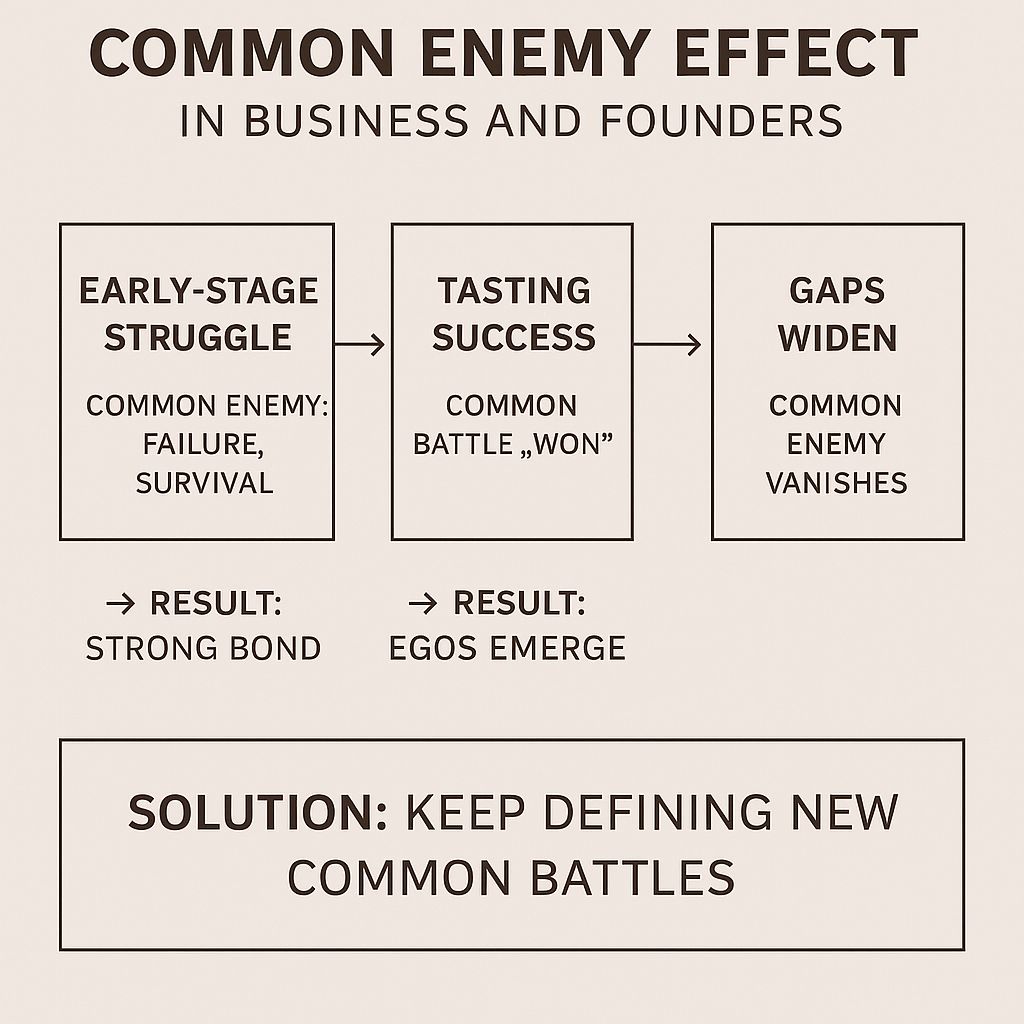
The common enemy effect is a powerful social phenomenon: people unite strongly when they share a common threat. We often see it in military units, sports teams, and political movements — and it’s equally true for founders and startup teams.


Phase 1: The early struggle

When founders start out, they face huge external threats:

  • Market rejection
  • Cash burn
  • Pressure to prove themselves
  • Family or societal doubt

Their common enemy is failure itself. This shared threat aligns them deeply. There’s no time for ego; decisions are fast and collective. Emotional support is strong. They feel like warriors in the same trench.


Phase 2: Early wins and success

Then comes funding, product traction, revenue, or media buzz. Suddenly, the “enemy” that held them together begins to fade.

Without that shared fight, founders start:

  • Claiming credit individually
  • Listening to “proxy teams” or external voices that inflate egos
  • Pushing personal agendas

The urgent need to survive is gone, so the cracks appear.


Phase 3: Gaps widen

When the common threat disappears:

  • Misaligned visions surface
  • Egos grow
  • Trust erodes
  • Silent power struggles begin

The same founders who once pulled all-nighters together may now fight over direction, credit, or influence.


Lessons from research

✅ Ben Horowitz (The Hard Thing About Hard Things): In crises, teams unite; in safety, they splinter.
✅ Patrick Lencioni (The Five Dysfunctions of a Team): Without a shared mission, conflict thrives.
✅ Harvard Business Review: “Shared existential threats unify.” New shared missions are critical as you grow.
✅ Social Identity Theory (Tajfel & Turner): Strong group identity often needs an external “enemy” to stay focused.


What can founders do?

  • Constantly define new “enemies” or big missions (new markets, innovations, tougher impact goals).
  • Regularly revisit and realign personal and collective visions.
  • Watch out for external influences that inflate individual egos.
  • Build a culture where mission > individuals, always.

In short

What unites founders at first? A common enemy (failure, survival).
What causes splits later? The enemy fades, egos rise.
What’s the fix? Keep creating new shared battles to stay united.

This might be a little long but an interesting story!


Qualities of a Leader


“Becoming the Person Others Will Want to Follow” – John C. Maxwell

“If you can become the leader you ought to be on the inside, you will be able to become the person you want on the outside. People will want to follow you. And when that happens, you’ll be able to tackle anything in this world.”

1. Character: Be a Piece of the Rock

“Leadership is the capacity and will to rally men and women to a common purpose and the character which inspires confidence.” – British Field Marshal

What must everyone know about character?

Actions are the Real Indicator of Character Talent is a Gift, but Character is a Choice Character Brings Lasting Success with People Strong Character is the Foundation on which to Build Success

2. Charisma : The First Impression Can Seal the Deal

“How can you have charisma? Be more concerned about making others feel good about themselves than you are making them feel good about you.” – Vice President of Leadership Development, INJOY

“When it comes to charisma, the bottom line is other mindedness. Leaders who think about others and their concerns before thinking of themselves exhibit charisma.” – John C. Maxwell

3. Commitment: It separates Doers from Dreamers

To the boxer, it’s getting off the mat one more time than you’ve been knocked down. To the marathoner, it’s running another ten miles when your strength is gone. To the solider, it’s going over the hill, not knowing what’s waiting on the other side. To the leader, it’s all that and more because everyone you lead it depending on you

Improve your Commitment

Look at how you spend your time, are you really committed or do you just say you are?

Know what’s worth dying for. Practice the Edison method. Make your plans public, then you might be morecommitted to follow through.

4. Communication: Without It You Travel Alone

Simplify your Message- It’s not what you say, but also how you say it.

Really Care about your Audience

Show the Truth- Believe what you say, Live what you say

Seek a Response- the goal of all communication is action

Developing excellent communication skills is absolutely essential to effective leadership. The leader must be able to share knowledge and ideas to transmit a sense of urgency and enthusiasm to others. If a leader can’t get a message across clearly to motivate others to act on it, then having a message doesn’t even matter.” – Gilbert Amelio

5. Competence: If you build it, they will come

“Competence goes beyond words. It’s the leader’s ability to say it, plan it, and do it in such a way that others know that you know how- and know that they want to follow you.”

Keys to Cultivate High Competence

Show up Every Day & Come Ready to Work Keep Learning, Growing, and Improving Follow Through with Excellence Accomplish More than Expected Inspire and Motivate Others.

6. Courage: One Person with Courage is a Majority

“Courage is fear that has said its prayers.” – Swiss Theologian

Courage is doing what you’re afraid to do. There can be no courage unless you’re scared.”

“You gain strength, courage, and confidence by every experience in which you really stop to look fear in the face. You are able to say to yourself, ‘I lived through this horror. I can take the next thing that comes along.’ You must do the thing you cannot do.”

7. Discernment: Put an End to Unsolved Mysteries

“Smart leaders believe only half of what they hear. Discerning leaders know which have to believe.”

Effective leaders need discernment, although even good leaders don’t display it all the time.

Examples of Famous last words:

“I think there is a world market for about five computers.” – Thomas J. Watson, chairman of IBM.(1943)

“I don’t need bodyguards.” – Jimmy Hoffa, one month before disappearance (1975)

8. Focus: The Sharper It Is; The Sharper You Are

The Keys are

Priorities and Concentration

A leader who knows what his priorities are but lacks concentration knows what to do but never gets it done. If he has concentration but no priorities, he has excellence without progress. But when he harnesses both, he has potential to achieve great things.

How should you focus your time and energy?

Focus 70 Percent on Strengths Develop them to their fullest potential

Focus 25 Percent on New Things Growth = Change

Focus 5 Percent on Areas of Weakness Minimize weaknesses as much as possible, delegate

9. Generosity: Your Candle Loses Nothing When It Lights Another

“No person was ever honored for what he received. Honor has been the reward for what he gave.” C, American President

“All that is not given is lost.” R, Indian Poet

Cultivate the Quality of Generosity in Your Life

Be Grateful For What You Have Put People First Don’t Allow the Desire for Possessions to Control You Regard Money as a Resource Develop the Habit of Giving.

10. Initiative: You Won’t Leave Home Without It

“Success seems to be connected with action. Successful people keep moving. They make mistakes, but they don’t quit.” – C, Hotel Executive

Qualities Leaders Posses To Make Things Happen

They Know What They Want ; They Push Themselves to Act;  They Take More Risks; They Make More Mistakes.

11. Listening: To Connect With Their Hearts, Use Your Ears

You have to be silent to listen. Both words are formed from the same letters.

S-i-l-e-n-t

L-i-s-t-e-n

“The ear of the leader must ring with the voices of the people.”

“A good leader encourages followers to tell him what he needs to know, not what he wants to hear.” – John C. Maxwell

12. Passion: Take This Life and Love It

“Concentrate on what you do well, and do it better than anybody else.”

What makes it possible for people who might seem ordinary to achieve great things?

Fact: More than 50% of all CEOs of Fortune 500 companies had C or C- averages in college

Fact: Nearly 75% of all U.S. Presidents were in the bottom half of their school classes

Fact: More than 50% of all millionaires entrepreneurs never finished college

They All Had Passion, It Makes A Difference!

13. Positive Attitude: If You Believe You Can, You Can

Your Attitude Is a Choice

Your Attitude Determines Your Actions

Your People Are a Mirror of Your Attitude

Maintaining a Good Attitude Is Easier Than Regaining One

Words of Wisdom Thomas Edison

“Genius is 99% perspiration and 1% inspiration.”

“If we did all the things we were capable of doing, we would literally astound ourselves.”

“Many of life’s failures are people who did not realize how close they were to success when the gave up.”

14. Problem Solving: You Can’t Let Your Problems Be A Problem

“You can measure a leader by the problems he tackles. He always looks for ones his own size.”

Leaders With Good Problems Solving Abilities Demonstrate Five Qualities

They Anticipate Problems

They Accept the Truth

They See the Big Picture

They Handle One Thing At a Time

They Don’t Give Up On a Major Goal

When They’re Down

15. Relationships:

If You Get Along, They’ll Get Along

“The most important single ingredient in the formula of success is knowing how to get along with people.” – Theodore Roosevelt, American President

All people have some things in common

They like to feel special, so sincerely compliment them.

They want a better tomorrow, so show them hope.

They desire direction, so navigate for them.

They are selfish, so speak to their needs first.

They get low emotionally, so encourage them.

They want success, so help them win.

16. Responsibility: If You Won’t Carry the Ball, You Can’t Lead the Team

“ Success on any major scale requires you to accept responsibility. . . In the final analysis, the one quality that all successful people have is the ability to take on responsibility.”

Are You On Target When It Comes To Responsibility?

“When an archer misses the mark he turns and looks for fault within himself. Failure to hit the bull’s-eye is never the fault of the

target. To improve your aim, improve yourself.” – G, Gilbert Arland

17. Security:

Competence Never Compensates For Insecurity

“No man will make a great leader who wants to do it all himself or get all the credit for doing it.”

Margaret Thatcher, world leader

“You don’t follow the crowd, you make up your own mind.”

“Words of encouragement from own mind.”

Words of encouragement from her father She stood for conviction in leadership. The “Iron Lady” was elected three consecutive terms as prime minister. The ONLY British leader of modern era to achieve that great honor.

18. Self-Discipline: The First Person You Lead Is You

“A man without a decision of character can never be said to belong to himself. . . He belongs to whatever can make captive of him.”

“Don’t quit, because once you in that mode of quitting, then you feel like it’s okay.” J, Best Ever Wide Receiver

19. Servanthood: To Get Ahead, Put Others First

“I don’t know what your destiny will be, but one thing I know: The ones among you who will be really happy are those who have sought and found how to serve.”

“The true leader serves. Serves people. Serves their best interests, and in so doing will not always be popular, may not always impress. But because true leaders are motivated by loving concern rather than a desire for personal glory, they are willing to pay the price.”

20. Teachability: To Keep Leading, Keep Learning

“It’s what you learn after you know it all that counts.”

Why Should You Keep Growing?

Your growth determines who you are.

Who you are determines who you attract.

Who you attract determines the success of your organization.

If you want your organization to grow, you have to remain teachable.

21. Vision: You Can Seize Only What You Can See

“A great leader’s courage to fulfill his vision comes from passion, not position.”

Vision is everything for a leader.

It leads the leader.

It paints the target.

It sparks and fuels the fire within, and draws him forward.

It is also the fire lighter for others who follow that leader.

23. Remember

“If you can dream it, you can do it.”

Forsee a need for leaders in Cogzidel


A lot of our initiatives are slowly yielding dividends and with my gut intuition if everything’s well we might need to expand our team drastically…

For now we are well placed in filling slots with freshers but with experienced we really slog it out… If things catch up we might have to triple our operations team size…

But such a drastic growth will create a huge imbalance until we start working on our people’s leadership skills… We must even work hard with our existing leaders to enhance their skills…

So, what is it that is expected out of a LEADER???

  • Must be a risk taker….
  • Must be a decision maker and take hard decisions during tough situations…
  • Must be communicative with his team, managers, client and support departments…
  • Love failure and must quickly take lessons and fix them or take control over situation…
  • Good in team building…
  • Speed in executing new things, in learning…
  • Ability to take control over situations…
  • Must be a good Learner…

It is time to look for talents who has the zeal to become a leader… From then have a herculian task in the training process and am expecting the support of my HR to make things a success…

Is leadership Skill or Trait?


Last two week I’ve been working with my Project Managers to understand;


Why there are slippages in delivery?

What they are unable to keep up to the commitments?


After throwing those two questions… They immediately wanted to defend them and came with many explanations and at last they explained their working process and their challenges… What I got from them took me by surprise and these are issues with them;

  •  They assume things and they create their own version about things…
  • They get contented on their own performance as well as their sub-ordinates… They never challenge themselves…
  • Then they said they have fear of Karma by being strict…

The third point took me by surprise and shock… But I forgot to understand the cultural values… In Hinduism Karma means getting back the bad deeds we do and mostly it is believed that we will get it back or our children will be affected…


I’m sure by conducting workshops I can help them to over first two blocks; but I’m not sure how I can make them understand / realize that cultural values are different from professional values…


Then I remembered a scene from Tony Jhaa’s movie where his mentor will tell him that “Killing and being merciless is the last trait of a leader”… Likewise I had to explain them that knowingly or unknowingly there is a culture created in IT and we have to be demanding and strict to be competitive…


I don’t know how far I can succeed in making them understand the difference between Cultural Values & Professional Values… If any of you have come across such challenge and if you have any solution please share it here…


So, I’m preparing a presentation for my leaders with example for them to overcome the challenges / blocks they have in the pursuit of becoming a leader… And my presenting will be mostly covering;


  • Communication which is very much important for their first challenge…
  • How excellent leaders challenged themselves and their peers to gain excellence…
  • Collecting clips from leaders to show them why they are successful as leader… Also explaining them about what Democratic, Autocratic & Laissez Faire leadership traits are…


And let me see how they understand it and transform…

Meet Capt. Gopinath


Meet Capt. Gopinath this Friday; listen to his views on Entrepreneurship, Leadership and Politics.

Capt. Gopinath has revolutionized the Aviation sector in India, how did he go about it, and what values, beliefs and methods did he use to do this and can he do the same with Politics?

The talk and interactive discussion will be moderated by Balaji Pasumarthy of Businessgyan Business Digest.


Venue

Hotel Nahar Heritage
St. Marks Rd.

Opposite Bishop Cotton’s Girls School, Bangalore.
Phone:- 22278731-736


Date

Friday the 17th April 2009


Time

3:45PM Registration


4:00PM to 5:30PM Talk and Interaction


Registration:  Rs.150/-

Do send your confirmation to:- balajiram@businessgyan.com, +91.9901357254