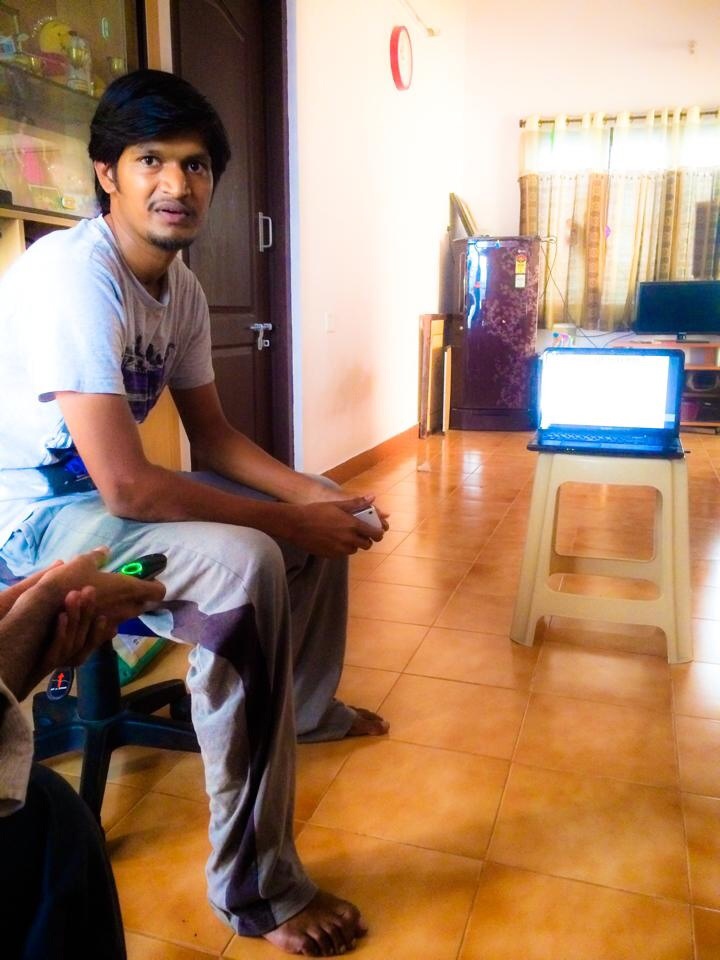
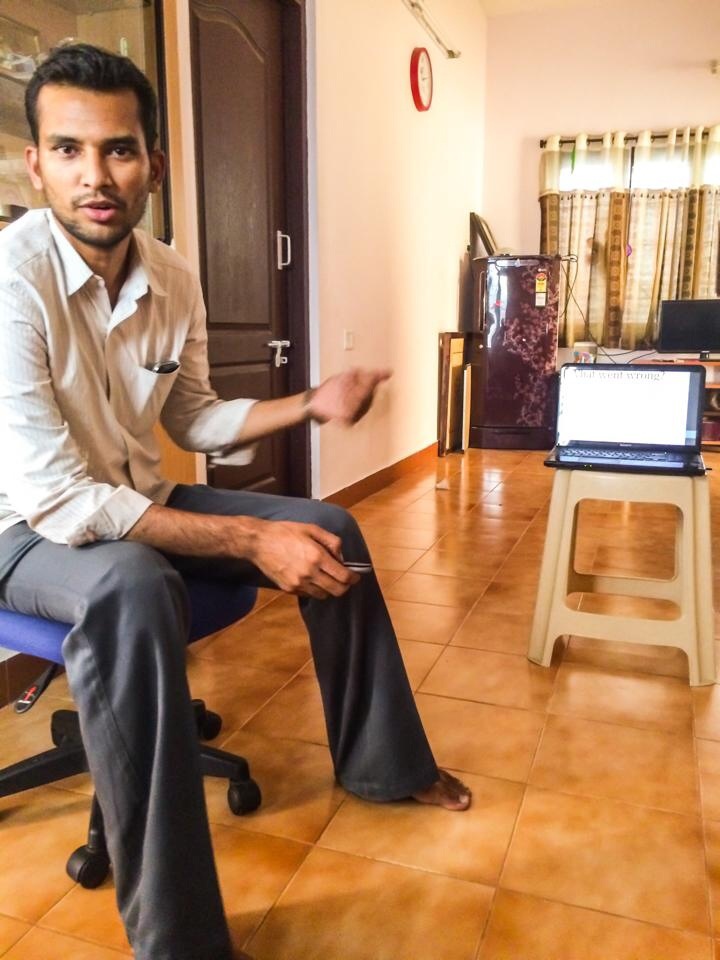
Meeting Keerthana at Llyods Tea House


Was waiting to meet my architect cousin Keerthana at Llyods Tea House at Gopalpuram… This is what one will do if he is left waiting…

imageTea brewing timer…

imageTrying my Photography skills with natural lighting…

imageLemongrass Tea

Remember ‘Small Wonder’? and this is hot those kids look now!!


image

For a generation which grew up watching Small Wonder.,.

Thanks to Swami for referring CamMe APP


Thanks to my friend Swami for referring me to this app called CamMe which makes it easy to make a Selfie click….

No wonder the APP won the most innovative APP at the mobile congress. Once again Jews & Israel has won over me :)…

Get Ready Indigo Marina


Six years back I met with an accident with this car… The car was badly damaged and it saved me unhurt… From then I developed an emotional connect with this car… Even when people advised me to sell the car… I gently ignored their suggestions…

But I couldn’t use this car inside a city owning to its size and the mileage… I mostly use this car for long drives… Since I couldn’t travel a lot for last 20 months, this car was lying unused… Now I’m driving this car to Madurai…

After opening the cover;

  • Car deserved a cleaning and asked my maid to do that immediately…
  • Battery had to be changed and did that immediately
  • A/C pressure was less than 80… Filled gas and the A/C is working fine…
  • To my surprise tyres had enough Air… But checked it anyway…
  • There was some bad petrol smell… Went for a drive and things were normal

Now am super excited to drive to Madurai tomorrow…

History behind Hyderabad streets and locality names


20130323-003955.jpg
Nampally:
Raza Ali Khan, was the Dewan of Nizam’s State in 1670 AD. His Title was ‘Nekh Nam Khan’ A jagir was granted to him, which came to be called nekh-Nampally. This became ‘Nampally’.

Begumpet:
Basheerunnissa Begum, daughter of Nizam II was married to a Paigah noble. She received lands in dowry. The village came to be known as Begumpet.

Khairatabad:
The jagir granted to Khairunnisa Begum daughrer of Ibrahim Qutub Shah, came to be known as Khairatabad.

Begum Bazar:
Land gifted by Humda Begum ( the wife of Nizam Ali Khan Nizamul Mulk) to the merchants of Hyderabad for trade and commerce, finally developed as Begum Bazar.

Sultan Bazar:
After 1933, the Residency bazar was renamed Sultan Bazar, when these areas were returned to the Nizam, by the British (Residency).

Afzal Gunj:
The V Niza
m (Afzalud Dawlah) gifted land to the grain merchants for trade and commerce. The place was named Afzal Gunj.

Secunderabad:
Named after Sikander jha (1806) (III Nizam). The Village where British troops were stationed.

Ma Saheba Ka Talab:
Hayat Bakshi Begum, wife of Quli Qutub Shah VI – was called Ma Saheba. The tank constructed by her to irrigate lands of Mallepally village, was called Masaheba ka Talab. Finally it was called Masab Tank.

Kadve Saheb Ki Galli (lane):
After a person, who was always angry-faced and talked ill of others. This lane is in the old city.

Himayat Nagar:
New locality named
after Himayat Ali Khan – Azam Jha – eldest son of VII Nizam – Osman Ali Khan ( in 1933). His name was Himayat Ali Khan.

Hyderguda:
New locality named after Hyder Ali, who was 1st Talukhdar (District Collector) and owned lands in the village formerly the Jagir of Vaheed Unnisa Begum, wife of Nizam. The locality is called after him, as Hyderguda.

Basheer Bagh:
The garden of Sir Asman Jha, Basirud-dulah – a Paigah Noble, who had a palace at the Garden.

Somajiguda:
A revenue department employee, named Sonaji, who owned lands and resided in this village. Sonaji became Somaji and the hamlet came to be called ‘Somajiguda’ . (Guda is from Godem a hamlet).

Malakpet:
Named after Malik Yakoob, a servant of Abdulah Qutub Shah Golconda King where he resided had a market, hence the name Malakpet.

Saidabad:
A Jagir village of Sayed Meer Momin, Dewan of Golconda (1591).

Abid Shop:
A Valet and steward of Nizam (VI) Mahboob Ali Khan. This man had his first shop here.

Saroornagar:
Named after Sarwari Afzal Bai, mistress of Arasthu Jha. Dewan of Hyderabad, who granted a Jagir,and constructed a palace and Garden for her.

Debirpura:
The village named after Abdul Samad with the titles; Dabir-ul Mulk, a noble man.

Noor Khan Bazar:
A market developed by Noor Khan, who came from Lucknow, during the time of the II Nizam.

A.C.Guards:
A locality to the West of Lakdi-ka-pul. The barracks of Abyssinian Cavalry Guards of Raja of Wanaparthy – (1910) (Abyssinia is the old name of Ethiopia, an East African country).

Walk in Interview @ Cogzidel Technologies Madurai!!


A Great Opportunity for fresher and Experienced PHP developers!!

Walk in dates : 23/03/2013 – 24/03/2013

20130317-114258.jpg

Environment Screws Life Screws


Just realized how technology has been embedded on me…. Am restless for a reason which I couldn’t believe me… Still feeling like am missing something…

So here are the reasons;

Evernote sync issue: Did a lot of content writing on Evernote… Now I couldn’t sync and share the content…

FaceBook on Android doesn’t Load: For last two days I couldn’t get into Facebook on my Android… I could post, share, like or comment… Feeling like someone has chopped my two hands :-(…

WordPress Post Doesn’t Upload: Couldn’t post blow through mobile… Reason should be slow internet? Or is it an app issue??? Should figure it out…

Overall whatever the reason would be am feeling totally motivated and let down :-(…

British distorted Hindu Aryavrata-Bharata History of India


The flawed Aryan invasion theory (AIT) was actually part of the British policy of divide and rule, French historian Michel Danino, an expert on ancient Indian history, said on Thursday on the sidelines of the Kolkata Literary Meet. Danino, who authored books such as The Lost River: On The Trail of Saraswati and Indian Culture and India’s Future, blames the British for distorting Indian history and challenged the Arayan invasion theory, while maintaining that there was no actual Aryan-Dravidian divide.

“No ancient or medieval Indian text would support the Aryan invasion theory. It is genetically proven that Aryans and Dravidians belong to the same race, ”said Danino, who settle in India in 1977 and has since acquired Indian citizenship.

Danino said that early Tamil literature displayed a cultural fusion with north Indian literature. Even the name of the city Maduri was influence from the ancient north Indian heritage city, Mathura, Danino claimed.

“Indians are basically a mixed breed and the mixing started as early as the Stone Age. After the Saraswati river dried up, leading to the collapse of the Indus Valley civilization, people started settling on the banks of the Ganges. This phenomenon that occurred around 2000 BC led to massive mixing up of the populace as a while has to shift its base,” Danino explained.

“The Mahabharata defined ethnic groups as jatis, whereas the British brought in the term tribes to describe the same thing, thus denigrating the homogenous culture of India. Jatis were defined on ecological terms. There is a popular perception that casteism started in India since the Vedas but that is not true. There was no casteism even during the Mahabharata period,” he said.

Danino also rued the fact that Indians are apathetic towards the preservation of their rich culture and heritage. “1170 sites of the ancient Harappan civilization have been identified during its mature phase. But till date only around 100 sites have been excavated. There is a fear that 90% of the sites might disappear due to expansion of urban areas or agricultural land being converted to residential high rises,” Danino said.

He went on to give an example of how the archaeological Survey of India (ASI) could recover only eight kilos of Harappan gold when about 80 kilos of the same was unearthed at Mandi in Uttar Pradesh. Villagers pilfered the rest, depriving India of a useful insight into its rich heritage.

“ASI admitted to a Parliament query that 42 protected sites vanished from Delhi alone. No one noticed as land sharks went to grab the sites and construct high-rises on them,” Danino said.

Historian Sanjeev Sanyal, speaking on the continuity of Indian history claimed that east European and north Indian people share genetic similarities.
————————–
Source : Hindustan Times

Link : http://www.hindustantimes.com/India-news/Kolkata/Indian-history-was-distorted-by-the-British/Article1-1004972.aspx

The Cockroach Theory for Self-development


At a restaurant, a cockroach suddenly flew from somewhere and sat on a lady.She started screaming out of fear. With a panic stricken face and trembling voice, she started jumping, with both her hands desperately trying to get rid of the cockroach.Her reaction was contagious, as everyone in her group also got panicky. The lady finally managed to push the cockroach away…

But it landed on another lady in the group.Now, it was the turn of the other lady in the group to continue the drama.The waiter rushed forward to their rescue.

In the relay of throwing, the cockroach next fell upon the waiter.The waiter stood firm, composed himself and observed the behavior of the cockroach on his shirt. When he was confident enough, he grabbed it with his fingers and threw it out of the restaurant.

Was the cockroach responsible for their histrionic behavior?
If so, then why was the waiter not disturbed?

He handled it near to perfection, without any chaos.It is not the cockroach, but the inability of the ladies to handle the disturbance caused by the cockroach that disturbed the ladies.

We have to realize that it is not the shouting of your father or your boss or your wife that disturbs you, but it’s your inability to handle the disturbances caused by their shouting that disturbs you.

It’s not the traffic jams on the road that disturbs you, but your inability to handle the disturbance caused by the traffic jam that disturbs you.

More than the problem, it’s your reaction to the problem that creates chaos in your life.

Lessons learnt from the story:

  • I understood, I should not react in life.
  • I should always respond.
  • The women reacted, whereas the waiter responded.

Reactions are always instinctive whereas responses are always well thought of, just and right to save a situation from going out of hand, to avoid cracks in relationship, to avoid taking decisions in anger, anxiety, stress or hurry.

Let’s all Practice this – Let’s RESPOND, NOT REACT !!!

Some facts about Indian Flag


The national flag of India is a horizontal rectangular tricolour of deep saffron, white and India green; with the Ashoka Chakra, a 24-spoke wheel, in navy blue at its centre.

It was adopted in its present form during a meeting of the Constituent Assembly held on 22 July 1947, when it became the official flag of the Dominion of India.

The flag, by law, is to be made of khadi, a special type of hand-spun cloth of cotton or silk made popular by Mahatma Gandhi.

The manufacturing process and specifications for the flag are laid out by the Bureau of Indian Standards (BIS).

The right to manufacture the flag is held by the Khadi Development and Village Industries Commission, who allocate it to the regional groups.

As of 2009, the Karnataka Khadi Gramodyoga Samyukta Sangha was the sole manufacturer of the flag.

Usage of the flag is governed by the Flag Code of India and other laws relating to the national emblems.

The original code prohibited use of the flag by private citizens except on national days such as the Independence day and the Republic Day. In 2002, on hearing an appeal from a private citizen, Naveen Jindal, the Supreme Court of India directed the Government of India to amend the code to allow flag usage by private citizens. Subsequently, the Union Cabinet of India amended the code to allow limited usage.

The code was amended once more in 2005 to allow some additional use including adaptations on certain forms of clothing.

The flag code also governs the protocol of flying the flag and its use in conjunction with other national and non-national flags.