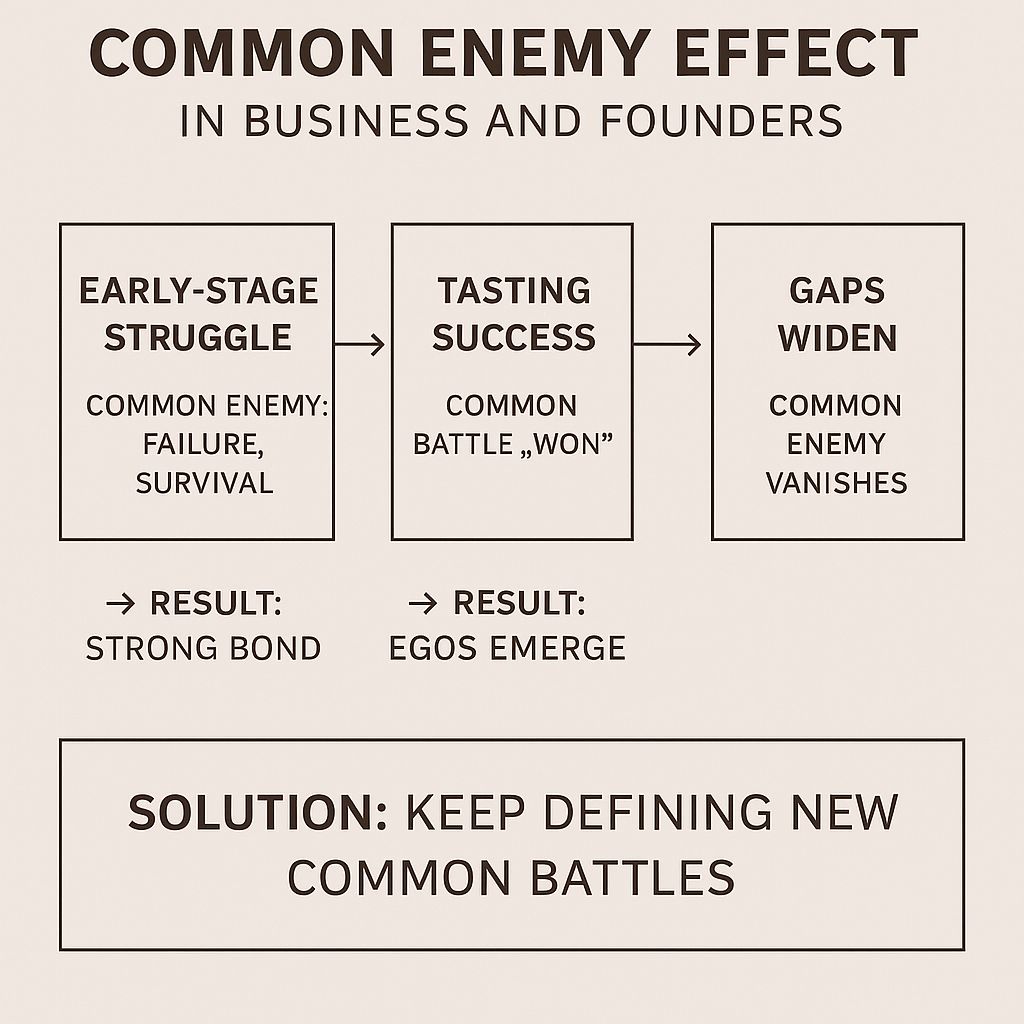
The “Common Enemy Effect” in Founder Relationships


The common enemy effect is a powerful social phenomenon: people unite strongly when they share a common threat. We often see it in military units, sports teams, and political movements — and it’s equally true for founders and startup teams.


Phase 1: The early struggle

When founders start out, they face huge external threats:

  • Market rejection
  • Cash burn
  • Pressure to prove themselves
  • Family or societal doubt

Their common enemy is failure itself. This shared threat aligns them deeply. There’s no time for ego; decisions are fast and collective. Emotional support is strong. They feel like warriors in the same trench.


Phase 2: Early wins and success

Then comes funding, product traction, revenue, or media buzz. Suddenly, the “enemy” that held them together begins to fade.

Without that shared fight, founders start:

  • Claiming credit individually
  • Listening to “proxy teams” or external voices that inflate egos
  • Pushing personal agendas

The urgent need to survive is gone, so the cracks appear.


Phase 3: Gaps widen

When the common threat disappears:

  • Misaligned visions surface
  • Egos grow
  • Trust erodes
  • Silent power struggles begin

The same founders who once pulled all-nighters together may now fight over direction, credit, or influence.


Lessons from research

✅ Ben Horowitz (The Hard Thing About Hard Things): In crises, teams unite; in safety, they splinter.
✅ Patrick Lencioni (The Five Dysfunctions of a Team): Without a shared mission, conflict thrives.
✅ Harvard Business Review: “Shared existential threats unify.” New shared missions are critical as you grow.
✅ Social Identity Theory (Tajfel & Turner): Strong group identity often needs an external “enemy” to stay focused.


What can founders do?

  • Constantly define new “enemies” or big missions (new markets, innovations, tougher impact goals).
  • Regularly revisit and realign personal and collective visions.
  • Watch out for external influences that inflate individual egos.
  • Build a culture where mission > individuals, always.

In short

What unites founders at first? A common enemy (failure, survival).
What causes splits later? The enemy fades, egos rise.
What’s the fix? Keep creating new shared battles to stay united.
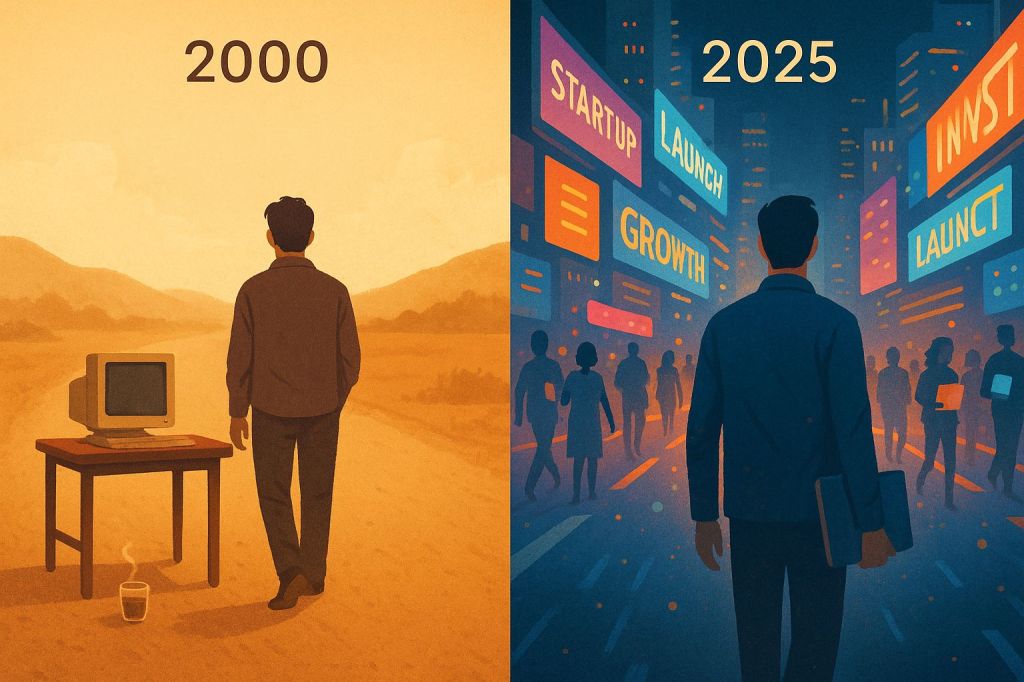
Startups Then & Now: From Empty Streets to Crowded Highways


Two eras, one spirit: the unstoppable heart of an entrepreneur.

I started my entrepreneurial ride back in 2000.

Those days, we didn’t even call it a “startup.” We called it “business,” “consultancy,” or just “trying something on my own.”

There was no Shark Tank. No glossy LinkedIn posts with #hustle. No college workshops on “How to pitch to VCs.”

In 2000, entrepreneurship wasn’t a cool badge. It was something you did if you couldn’t find a job or if you were just stubborn enough to believe you could create something from nothing.

2000: Wild, open roads

  • No references for success. The word “startup” was so rare, only one in a lakh even dared to dream it.
  • Loyalty was real. Your first hire stayed not just for salary but for the dream, even if the office was a one-room setup with plastic chairs and Maaza bottles in the fridge.
  • Markets were raw. Everything was new and waiting. A simple website could make you look like a global player.
  • Corporates & tech were immature. Big companies were still figuring out email, and many had no clue how to use the internet beyond sending scanned copies of invoices.
  • Open source was magic. You could build a product for the price of a few nights of filter coffee.
  • Ecosystem? Nil. No accelerators, no pitch fests, no “startup India” subsidies. Just you, your idea, and sheer guts.
  • Limited resources, big possibilities. Everything felt like a blank canvas.

2025: Crowded highways

  • Startup became a fashion statement. Every Tom, Dick, and Harry wants to “launch something” — sometimes just to add “Founder” to their Instagram bio.
  • Expensive game. Startups today mean burn rates, seed funding rounds, CAC vs LTV debates — even before you have your first paying customer.
  • No loyalty. Employees switch for a ₹2,000 raise or a fancier “Head of Vibe” title.
  • Tech consolidation. The top 5 tech giants dictate tools, languages, and frameworks. Your “freedom to build” has a Terms & Conditions page.
  • Market consolidation. Big sharks have gobbled up fragmented small players. Niches get crushed before you even announce your beta.
  • Ecosystem overload. Events, podcasts, awards, startup conferences. Everyone is “networking,” but very few are really building.
  • Too many eyes, less patience. Today, if your product doesn’t go viral in 2 weeks, you’re labeled a flop.

Then vs Now: What’s the real deal?

In 2000, the road was empty and scary.
In 2025, the road is crowded and noisy.

Then, the challenge was survival in the unknown.
Now, the challenge is standing out in the overcrowded known.

Then, it was about creating a market.
Now, it’s about finding your slot in a saturated market.

Then, you worried about paying your first employee on time.
Now, you worry if your pitch deck slides have enough “impact words.”

But here’s the one thing that hasn’t changed:

The thrill of chasing a vision that only you can see.

Whether you’re hustling on a dusty internet café PC in 2000 or pitching on a Zoom call in 2025 — the soul of entrepreneurship remains the same:
A quiet voice inside that whispers, Let’s try anyway.

“Markets change. Tech evolves. But courage? That stays timeless.”

Startup Economics & Valuation Well Explained


Mary is the proprietor of a bar in Dublin . She realizes that virtually all of her customers are unemployed alcoholics and, as such, can no longer afford to patronise her bar. 

To solve this problem, she comes up with a new marketing plan that allows her customers to drink now, but pay later. She keeps track of the drinks consumed on a ledger (thereby granting the customers loans). 

Word gets around about Mary’s “drink now, pay later” marketing strategy and, as a result, increasing numbers of customers flood into Mary’s bar. Soon she has the largest sales volume for any bar in Dublin.

By providing her customers’ freedom from immediate payment demands, Mary gets no resistance when, at regular intervals, she substantially increases her prices for wine and beer, the most consumed beverages. Consequently, Mary’s gross sales volume increases massively. 

A young and dynamic vice-president at the local bank recognises that these customer debts constitute valuable future assets and increases Mary’s borrowing limit. He sees no reason for any undue concern, since he has the debts of the unemployed alcoholics as collateral 

At the bank’s corporate headquarters, expert traders figure a way to make huge commissions, and transform these customer loans into DRINKBONDS, ALKIBONDS and PUKEBONDS. These securities are then bundled and traded on international security markets. Naive investors don’t really understand that the securities being sold to them as AAA secured bonds are really the debts of unemployed alcoholics. Nevertheless, the bond prices continuously climb, and the securities soon become the hottest-selling items for some of the nation’s leading brokerage houses. 

One day, even though the bond prices are still climbing, a risk manager at the original local bank decides that the time has come to demand payment on the debts incurred by the drinkers at Mary’s bar. He so informs Mary.

Mary then demands payment from her alcoholic patrons, but being unemployed alcoholics they cannot pay back their drinking debts.Since, Mary cannot fulfil her loan obligations she is forced into bankruptcy. The bar closes and the eleven employees lose their jobs. Overnight, DRINKBONDS, ALKIBONDS and PUKEBONDS drop in price by 90%. The collapsed bond asset value destroys the banks liquidity and prevents it from issuing new loans, thus freezing credit and economic activity in the community. 

The suppliers of Mary’s bar had granted her generous payment extensions and had invested their firms’ pension funds in the various BOND securities. They find they are now faced with having to write off her bad debt and with losing over 90% of the presumed value of the bonds. 

Her wine supplier also claims bankruptcy, closing the doors on a family business that had endured for three generations, her beer supplier is taken over by a competitor, who immediately closes the local plant and lays off 150 workers. 

Fortunately though, the bank, the brokerage houses and their respective executives are saved and bailed out by a multi-billion euro no-strings attached cash infusion from their cronies in Government. The funds required for this bailout are obtained by new taxes levied on employed, middle-class, non-drinkers who have never been in Mary’s bar. 

Now, do you understand economics in 2015?

Event on startup challenges


Event focusing on operational challenges for running a startup. The upcoming event (August 22, 2009) deals with hiring challenges in startups.

Here are the details

Hiring in a startup is a challenge – right from finding the right match, figuring out salary structure to keeping the employees motivated (especially in tight situation). While there aren’t any ‘right ways’ to do so, the best way out is to share experiences.

pluGGd.in is conducting a ‘Hiring strategy for startups’ event (half-day) where we are inviting entrepreneurs to share their experiences; and a HR consulting firm to show the ‘other’ side of the world.

Topic: How to combat Hiring Blues in Startups

Date: August 22nd, 2009, Saturday [10AM – 1 PM]

Agenda

  • How do I structure employee salary? ESOP vs. Salary Distribution?
  • Employee Agreement – what are the points one need
  • I am not a funded startup and don’t have a lot of money to give away. How do I recruit smart people?
  • How do I judge the commitment of candidates when they are applying? [Share/learn from experiences…]

And related topics on hiring @ startups visit http://www.pluggd.in/unpluggd/august.html

Great resource for entrepreneurs


Wanted to share this wonderful resource site shared by Mr.Harendhiraprasad M N which covers all information a startup needs. A must read resource for all entrepreneurs.

For more visit http://www.gabrielweinberg.com/startupswiki/Ask_YC_Archive

Bad times big opportunity for startups!!


I started my entrepreneurship ride during the year 2000 in the month of September. It was the starting days of so called dotcom bubble. The buzz, happenings and the glamour have all come to a halt. It was one of the worst times to even think of starting a company and that too offering Web based services. We were criticized left right and center for becoming an entrepreneur. My parents asked me to take up higher studies and my friends asked me to take up a job till things revert back.


In spite of all those obstacles I started my company with the help of my mentor and well wisher Mr.Shunmugavel Yogan, founder TheITDepot.com. Initial struggles were enormous… When ever I failed there was more criticism than getting moral support… We had no mentors and also the startup ecosystem was not mature… Everything was starting to take shape unlike today;


  • Opensource and frameworks were starting to emerge and were not usable. So, we had to develop everything from the scratch.
  • There were not many market places like elance or scriptlance. We had to depend on forums and on top listing on search engines (SEO).
  • Startup ecosystem like proto.in, barcamps, open coffee clubs etc were not there.
  • Also the concept of bootstrapping was new. There was an illusion that to start a business one needs huge capital.


In spite of all those odds we were able to strike it big and I personally feel we can see persons best only when his character is put on a test. Why I keep repeating these kind of post is because I see many enthusiastic people who want to become entrepreneurs keep telling me reasons like it is recession, market is inflated, family commitments, emotional commitments etc.


Unless we have control on us we can’t strike the gold. So instead of getting inspired by successful people try to know their path to success which can teach you lots of lessons.

Flaunge – Small in size Big in investment


Last Sunday I’ve been to Bangalore to attend B’lore OCC and then went to 13th floor to honor my promise to host Hrish Thota for a treat… Only then I came to know Hrish was a documentary film maker and it kindled my eagerness to know more about film-making…


Hrish said that he is going to his office to finish some editing work and I asked him if I can accompany him to have a look at his office…


The name of their company is Flaunge and it is a home-cum-office housed in his friend’s house… By entering his office I was thrilled to see this small fish tank… This really pulled my attention… Positioning of tank was well done where in visitors don’t feel the pinch of waiting…


dsc006681


Then I went into their office and I was really amazed to see such a small office… It must be a 10 * 6 Sq.Ft. office… But the equipment used is expensive… You can also have a peep into their office…


dsc006724This is the size of Sweet little Flaunge & you can see all the equipments fitted within that room…This is Hrish working in his MAC… 

dsc006712


Then Hrish showed me their sample work and I really liked Tour De Nilgiris… Here is the video…

Tour Of Nilgiris – Experience Nature from Tour Of Nilgiris on Vimeo.


In the mean time if you have any requirement for short film-making or ad film-making you can contact Flaunge


Google Ventures Launched


Much expected Google Ventures is out at last… Google coming from rags and knowing the pains of a startup they must have done this before… But it is better late than never… These are some insights about the venture…

  •  
    • Launched on 31st March 2009
    • Managed by Bill Maris & Rich Miner (Can check their BIO’s)
    • Will invest in any kind of startups
    • Investment ranges from Seed funding to tens of millions of dollar
    • Should be contacted only thru email ventures@google.com


As usual the site is very simple with just four pages and up to the point… Their FAQ is also very little covering most of the questions…


In their FAQ they claim that that they are an independent company and they never push to use Google products or force for an acquisition…


Let us see how the company transforms startups in days to come…


At this point we wish Google Ventures Best Luck…